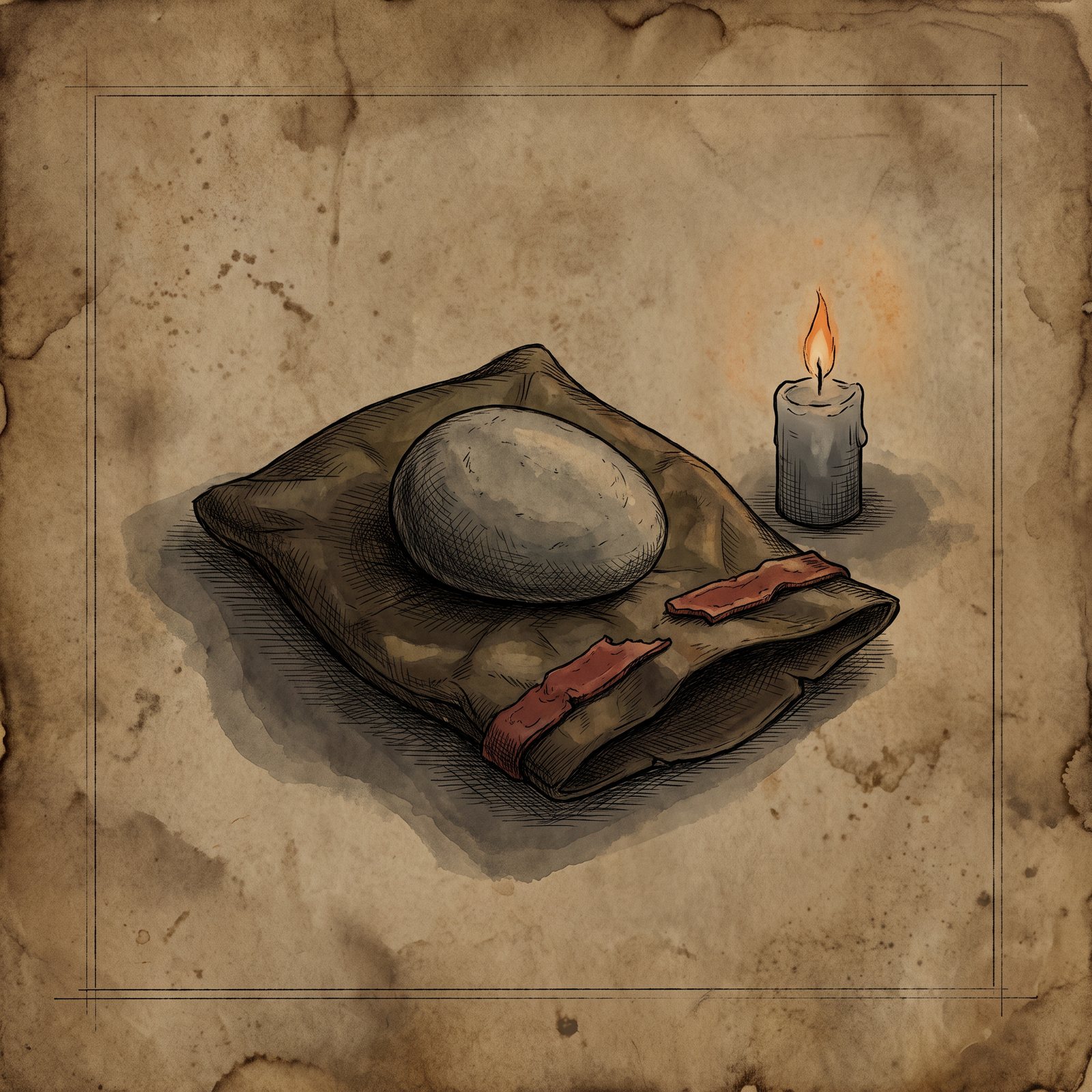
A stone that carries sworn words to people who weren’t there to hear them. It belongs wherever someone’s word has to travel farther than they can: courts, councils, feuds, the bedside of a dying witness. It doesn’t tell truth from lies. It lets a listener hear the speaker closely enough to judge them, and leaves the judging to the listener.
Wondrous Item, Uncommon
This smooth, palm-sized stone holds one record: up to 1 minute of speech by one speaker.
Take Testimony. As a Magic action, a creature holding the stone can open it to one speaker within 5 feet of it. The speaker can be a creature, or a corpse given speech by magic such as Speak with Dead. The speaker must be willing, and must begin by declaring, in any words and any language, that what follows is true. A speaker that can only answer questions put to it (as a corpse under Speak with Dead does) is instead asked by the stone’s holder whether it swears that what follows is true; if the speaker answers only another creature’s questions (as a corpse answers only the caster of Speak with Dead), that creature asks it for the holder. A “yes” is both its consent and its declaration, and that question counts against any limit on the questions it can be asked. The stone records everything the speaker says, beginning with its declaration, for up to 1 minute, or until the holder closes it, which costs no action, Bonus Action or Reaction. While the speaker is answering questions, the record also holds each question put to it, so the record of a speaker that only answers begins with the oath question and its “yes”. A new record replaces the old one.
Give Testimony. As a Magic action, a creature holding the stone can make it repeat its record word for word, in the speaker’s own voice, audibly within 30 feet or as a whisper heard only by the holder (the holder’s choice).
A creature that hears all of the playback has Advantage on the Wisdom (Insight) check it makes to judge whether the speaker believed what it said. A creature can make this check only once for a given record. The stone compels nothing and reveals nothing by itself: the speaker was free to lie, and a listener is simply better placed to notice. If the speaker said anything it disbelieved, the DM makes one Charisma (Deception) check for it when the record is taken; each listener’s Insight check has a DC equal to that total, and a listener who succeeds notices that the speaker said something it didn’t believe, but not which statement it was. If the speaker believed everything it said, there is no total to beat, and a listener’s check turns up nothing amiss, whatever it rolls. If the speaker was under an effect that makes magic report it as truthful (such as Glibness) when it spoke, listeners don’t gain this Advantage.
The stone can play its record any number of times, but each listener judges a given record only once. Its holder can erase the record as a Magic action.
In Different Worlds
Ashwinter (After the fall · Mythic culture)
- Who made it. The old Crown chancery’s registrars, who cut them from the same grey stone as the waystones and swore their witnesses before the Witness’s Crown face, Rettmal, the Even Measure. The Candle Compact’s courts still use them.
- What it is called. A witness-stone, which echoes the Witness on purpose; the fjords call it a saga-stone, and the old chancery’s word is a measure-stone. Taking testimony is giving your word to the stone.
- How it looks and sounds. Waystone-grey, palm-smooth from four centuries of hands, with a registrar’s mark cut small on its underside; it travels in oilcloth with a strip of sealing wax across the bag. It plays back in the speaker’s own voice, cold and a little too close, as if the speaker stood just behind the listener’s shoulder. On the fjords a saga-stone is passed round the hall before it is played, so that everyone can say they held it.
- Where one is found. In a registrar’s satchel on the Westway, and, the circle-folk say, on the table of testimony at the Court beneath Blackwood.
- Story hook. The only witness to the Blackwood Burn is a half-burned dead man who will speak once, and only into a stone. The party has one stone, and three factions want to be holding it when the testimony is played.
- Rules caveat. None. Speak with Dead always finds someone here, because the dead stay by their remains, so dead testimony is common. The Court beneath Blackwood, the circle-folk say, hears a witness-stone as it would hear the witness (story; the Antlered Judge‘s own rules decide its worth).
A city of courts and great houses (Urban intrigue)
- Who made it. Court artificers, under a charter that makes tampering with one a hanging offence.
- What it is called. A deposition stone; testimony given into one is “stoned”, and lawyers’ clerks say a witness “stoned well” or “stoned badly”. Hearing one out with a trained ear is “listening for the catch”.
- How it looks and sounds. A black slate disc in a lawyer’s velvet-lined case. It plays back thin and close, like a voice through a keyhole, every swallow and hesitation intact.
- Where one is found. In the evidence rooms of the High Court, and in the pockets of the blackmailers who steal from them.
- Story hook. A dead magistrate’s deposition stone holds his account of a confession everyone now says was forced. Every clerk who has heard it comes away sure the old man believed what he said, except one, who swears his voice caught on a single name.
- Rules caveat. None.
A city of foundries and licensed trades (Arcane-industrial)
- Who made it. The Telegraph and Phonograph Company, which sells the stones to insurers, newspapers and the police.
- What it is called. A sworn cylinder; the trained listener the company hires out to courts and insurers is “the ear”, and what the ear listens for is “the waver”.
- How it looks and sounds. A cylinder of polished grey stone set on a brass spindle, played through a horn. The voice comes out crackling, with every breath and pause the speaker made.
- Where one is found. In a newspaper’s archive room, labelled and shelved by date.
- Story hook. A factory owner’s sworn cylinder about the night of the fire sounds honest to everyone who hears it. So does the foreman’s, and the two accounts can’t both be true. The insurer’s best ear has played them both a dozen times and still can’t say which one wavered.
- Rules caveat. None.
Origins and Inspiration
Stones as witnesses are old. In the Hebrew Bible Joshua sets up a great stone and says, “this stone shall be a witness unto us; for it hath heard all the words” (Joshua 24:27, King James Version), and Jacob and Laban raise a heap of stones as a witness between them (Genesis 31). Medieval Germanic law relied on sworn testimony and compurgation, in which oath-helpers swore to a party’s good faith rather than to the facts: the belief-not-truth idea the stone keeps. The dead as witnesses, and a court that hears them, come from the “door-court” held at Fróðá against the household’s revenants in the Icelandic Eyrbyggja saga (chapter 55).