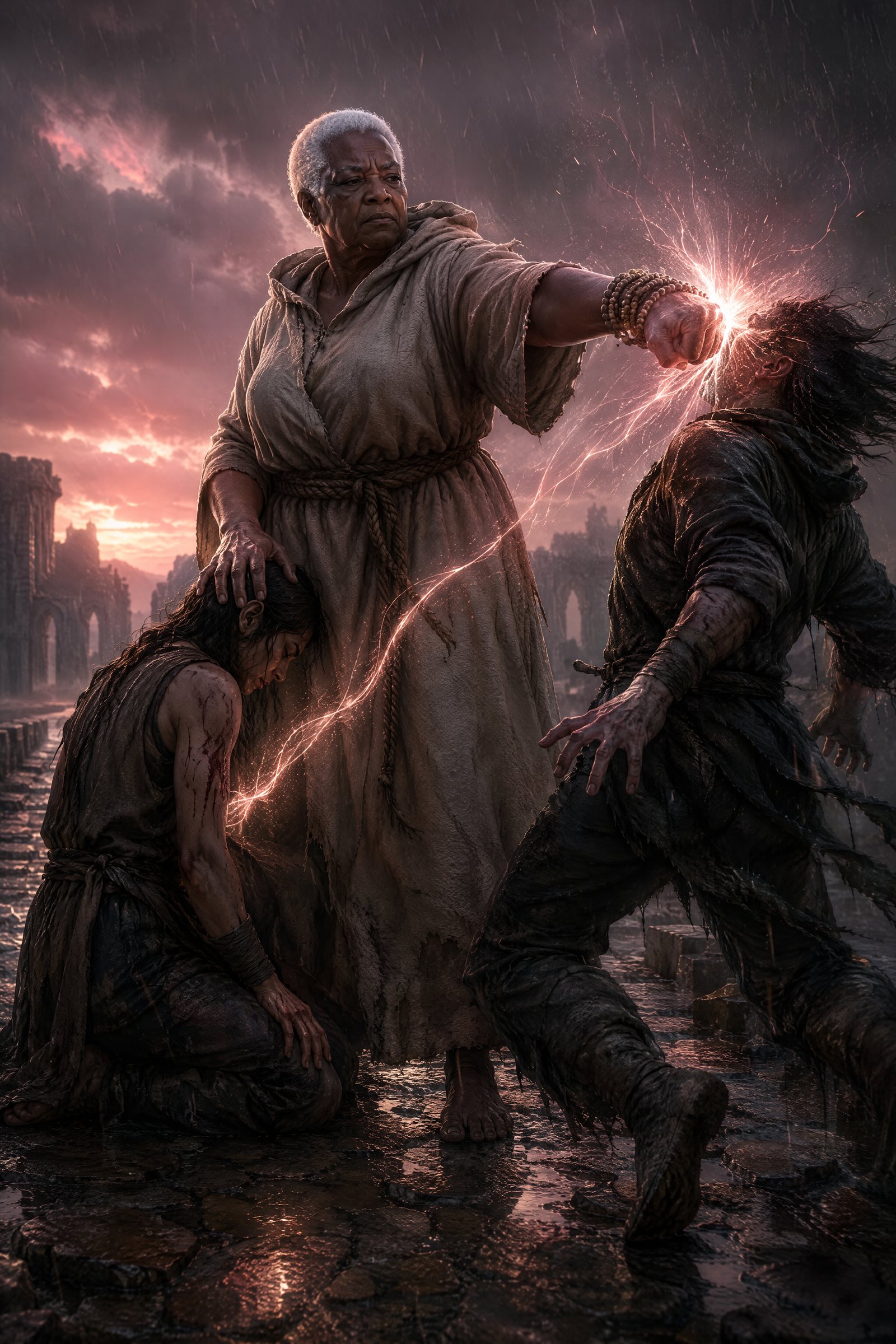
Identity
An ascetic who keeps a handful of public promises, and whose grace runs exactly as far as a hand can reach.
Others kneel, and speak, and hold a symbol up between themselves and the dark. You keep none of the three, because you understood one morning that the grace was never in the symbol; it was in the hand, and in the keeping. You need nothing to answer you: a life kept narrow enough becomes its own channel, so you starve the noise out of yourself, walk the ward into being with your own feet, and lay the healing on with a fist still warm from the blow that earned it. In a story you are the one whose promises everyone at the fire can recite — the keeper a village sends for, the conscience a party argues with, and the person an enemy studies to learn which promise to lean on.
The Anchorite is an ascetic warrior-mystic whose divine magic runs entirely through a disciplined body — never a spoken prayer flung across a room, always a hand laid on, a ward paced out, a wound closed by the same knuckles that opened another. Wisdom is the depth of your keeping. Your baseline weapon is the Hallowed Strike, radiant grace poured down your arm into a target on contact; your identity is the Vow — the living promises you have sworn, each one a conduit that carries a persistent blessing so long as you keep it, and goes dark the moment you break it, until you have done penance and made it whole again. Everyone in your party knows your vows. That is the point. The drama of the Anchorite is not casting the spell. It is keeping the promise while the world does everything it can to make you break it. Blessing travels the length of your arm and no farther; if you want to bless a thing, you will have to be close enough to touch it.
Campaign rules apply. Thirteen spells are banned, two are modified, and every spellcaster uses spell points instead of spell slots in this campaign — see Campaign Rules. This document already conforms: banned spells have been removed and replaced at the same level, modified spells are annotated where they appear, and spell slots have been converted to spell points.
This class belongs to the monk-caster family and is built to SPEC. Its power is devotional: it comes from keeping vows, and from nothing else. No god, spirit, saint or other creature grants it, withholds it or revokes it, and no feature needs one to exist — the vow itself is the conduit. (Contrast the family’s other axes: the Furnace Adept generates its power and the Tithed Fist conducts it.)
Class Overview
| Primary Abilities | Dexterity and Wisdom |
| Hit Point Die | d8 per Anchorite level |
| Saving Throws | Wisdom and Charisma |
| Skills | Choose 2: Athletics, Insight, Medicine, Perception, Religion, or Survival |
| Weapons | Simple weapons |
| Armor | None |
| Starting Equipment | A rough undyed robe and a knotted cord belt, a begging bowl, a mat you sleep and meditate on, a string of counting-beads worn smooth (a focus with no mechanical effect of its own), a waterskin, 10 days of plain rations, and 5 GP — or as little of it as your first vow permits |
Spellcasting summary. You cast spells from the Anchorite spell list, a closed list drawn mostly from the Divine spells of healing, warding, blessing, and radiant magic, with a few named class additions, using Wisdom as your spellcasting ability. You are a half-caster who prepares spells, casting from the half-caster spell point pool, recovered on a Long Rest. Every spell you cast has its range changed to Self or Touch — you deliver grace by contact and by walking wards into being, never by ranged prayer (your Mystic Arcanum spells, from level 13, are the single exception). No damage cantrips, but you learn utility cantrips — your Unarmed Strikes and the blessings they carry are your at-will harm, and a small handful of blessing-cantrips (see Utility Cantrips) is your at-will grace. Spell save DC = 8 + your Wisdom modifier + your Proficiency Bonus; spell attack modifier = your Wisdom modifier + your Proficiency Bonus.
Class Table
| Level | Proficiency Bonus | Martial Arts Die | Hallowed Strike | Qi | Vows | Prepared | Spell Points | Max Spell Level | Features |
|---|---|---|---|---|---|---|---|---|---|
| 1 | +2 | 1d6 | 1 die | 1 | 1 | — | — | — | Martial Arts, Unarmored Defense, Devotion, Hallowed Strike, Vows |
| 2 | +2 | 1d6 | 1 die | 2 | 1 | 2 | 4 | 1st | Spellcasting, Consecrated Touch, Utility Cantrips, Unarmored Movement |
| 3 | +2 | 1d6 | 1 die | 3 | 1 | 3 | 6 | 1st | Vigil |
| 4 | +2 | 1d6 | 1 die | 4 | 1 | 4 | 6 | 1st | Ability Score Improvement |
| 5 | +3 | 1d8 | 1 die | 5 | 2 | 5 | 14 | 2nd | Extra Attack, The Mended Hand |
| 6 | +3 | 1d8 | 1 die | 6 | 2 | 5 | 14 | 2nd | Vigil feature, Unarmored Movement (+15 ft) |
| 7 | +3 | 1d8 | 1 die | 7 | 2 | 6 | 17 | 2nd | Penance in the Field |
| 8 | +3 | 1d8 | 1 die | 8 | 2 | 6 | 17 | 2nd | Ability Score Improvement |
| 9 | +4 | 1d8 | 1 die | 9 | 2 | 7 | 27 | 3rd | Consecrated Body |
| 10 | +4 | 1d8 | 1 die | 10 | 2 | 7 | 27 | 3rd | Aura of the Kept Vow, Unarmored Movement (+20 ft) |
| 11 | +4 | 1d10 | 3 dice | 11 | 3 | 8 | 32 | 3rd | Vigil feature |
| 12 | +4 | 1d10 | 3 dice | 12 | 3 | 8 | 32 | 3rd | Ability Score Improvement |
| 13 | +5 | 1d10 | 3 dice | 13 | 3 | 9 | 38 | 4th | Boundless Touch, Mystic Arcanum (6th) |
| 14 | +5 | 1d10 | 3 dice | 14 | 3 | 9 | 38 | 4th | Unshakable Faith, Unarmored Movement (+25 ft) |
| 15 | +5 | 1d10 | 3 dice | 15 | 3 | 10 | 44 | 4th | Overflowing Grace |
| 16 | +5 | 1d10 | 3 dice | 16 | 3 | 10 | 44 | 4th | Ability Score Improvement, Mystic Arcanum (7th) |
| 17 | +6 | 1d12 | 5 dice | 17 | 4 | 11 | 57 | 5th | Vigil feature |
| 18 | +6 | 1d12 | 5 dice | 18 | 4 | 11 | 57 | 5th | The Standing Vow, Unarmored Movement (+30 ft) |
| 19 | +6 | 1d12 | 5 dice | 19 | 4 | 12 | 64 | 5th | Epic Boon, Mystic Arcanum (8th) |
| 20 | +6 | 1d12 | 5 dice | 20 | 4 | 12 | 64 | 5th | The Whole Devotion |
Cantrips Known: 1 at level 2, 2 at level 7, 3 at level 13 — utility only.
Unarmored Movement: +10 ft at level 2, +15 ft at level 6, +20 ft at level 10, +25 ft at level 14, +30 ft at level 18; vertical surfaces and liquids from level 9.
Mystic Arcanum: one 6th-level spell at 13, one 7th-level at 16, one 8th-level at 19 — each cast once per Long Rest, outside the spell point pool and outside the touch-only rule.
Class Features
Level 1: Martial Arts
Your body is the only holy symbol you kept. While you are unarmed or wielding a simple weapon and you aren’t wearing armor or wielding a Shield, you gain the following benefits.
- Martial Arts die. You can roll your Martial Arts die (see the class table) in place of the normal damage of your Unarmed Strikes and simple weapons.
- Ascetic strikes. You can use Dexterity instead of Strength for the attack and damage rolls of your Unarmed Strikes and simple weapons.
- Second blow. When you take the Attack action with an Unarmed Strike or a simple weapon on your turn, you can make one Unarmed Strike as a Bonus Action.
Level 1: Unarmored Defense
While you aren’t wearing armor or wielding a Shield, your base Armor Class equals 10 + your Dexterity modifier + your Wisdom modifier. Half of it is a life spent learning where a blow was always going to fall; the other half is a stillness that a weapon has trouble finding.
Level 1: Devotion
Your keeping is a resource you carry as a pool of Qi points equal to your Anchorite level — what the disciplines call Qi; in you it is devotion made substance. You regain all expended Qi when you finish a Short or Long Rest — a few minutes of quiet keeping is enough to fill the well. Qi fuels your Hallowed Strike, extends your blessings past the reach of one hand, and powers many of your Vigil features; every feature that costs Qi says so.
Qi is not stamina and it is not mood. It is the width of the channel your grace runs through, and the channel is kept open by the vows you hold. A vow you have broken and not yet atoned for narrows it: while any of your vows are breached, your Anchorite Qi maximum is reduced by 1 for each such vow. (If you also have Qi from another class, this reduces only your Anchorite share of the pool; see Multiclassing.) Keep your promises and the whole river is yours. Break them and nothing withholds grace out of anger; nothing stands behind the vow to do the withholding. The pipe is simply pinched, because you pinched it.
Level 1: Hallowed Strike
Grace does not need a prayer. It needs contact. Once on each of your turns, immediately after you hit a creature with an Unarmed Strike or a simple weapon, you can spend Qi — 1 at levels 1–10, 2 at levels 11–16, and 3 at levels 17–20 — to pour blessing down your arm into the target as a free rider; the deeper the grace runs, the more of your keeping it draws. This costs no action, Bonus Action, or Reaction, and doesn’t replace any other part of your turn.
Roll a number of dice of your Martial Arts die size and add your Wisdom modifier; the target takes that much extra radiant damage (or, if you prefer, the strike’s own damage type). The number of dice is 1 at levels 1–10, 3 at levels 11–16, and 5 at levels 17–20, as shown in the Hallowed Strike column.
Because the Hallowed Strike is limited to once per turn, throwing more strikes only gives you more chances to land it — it never fires twice on the same turn (the one exception is The Bridge Held Alone, in the Vigil of the Sworn Wall), and no vow, Vigil feature, or spell adds Hallowed Strike dice onto the same strike. This is the intentional ceiling on your single-turn burst; your reach comes from what you keep standing around you, not from stacking one blow.
Hallowed Overflow. The blow’s holy overflow does not stop at the enemy it lands on. When you use the Hallowed Strike, one ally within 30 feet — or you — gains Temporary Hit Points equal to your Wisdom modifier. These Temporary Hit Points don’t stack with themselves.
Level 1: Vows
Your power is a set of promises, sworn aloud and kept in the body. Each vow is a live conduit: while it is kept, it grants a persistent benefit — a blessing, an aura, a hardening of the self. While it is breached, that benefit goes dark and your Anchorite Qi maximum drops by 1 (see Devotion) until you have done penance and made the vow whole. Choose your vows from The Menu of Vows, later in this document.
- How many. You keep the number of vows shown in the Vows column of the class table: one at 1st level, two at 5th, three at 11th, and four at 17th. When you finish a Long Rest, you can renounce a vow you hold and swear a different one in its place — but a vow renounced in comfort is not the same as a vow kept under fire, and your DM may rule that a repeatedly abandoned vow no longer answers.
- Keeping. A kept vow’s benefit is always on; it costs no action and no Qi. Your vows are public. Your party knows them, your enemies can learn them, and both will use that knowledge. This is not a drawback to be minimized — it is the whole drama of the class.
- Breaching. Each vow lists the act that breaks it. The instant you commit that act, the vow is breached: its benefit ends immediately, and your Anchorite Qi maximum falls by 1 (if your current Qi is now above your Qi maximum, you lose the excess at once). A breach is a choice you are always free to make. Sometimes it is the right one.
- Penance. A breached vow is restored when you finish a Long Rest spent in its penance — the specific act of contrition named in the vow, or, if none fits, a night of keeping vigil over what you broke. Until then it stays dark. (At 7th level, Penance in the Field lets you mend a vow without waiting for the dawn.)
Level 2: Spellcasting
You have kept yourself narrow enough that the grace comes through on its own. See the end of this document for the full Spellcasting rules, your spell point progression, and the Anchorite spell list. In brief:
- You are a half-caster using Wisdom. Your spell save DC = 8 + your Wisdom modifier + your Proficiency Bonus; your spell attack modifier = your Wisdom modifier + your Proficiency Bonus.
- You prepare spells from the Anchorite spell list, choosing a number equal to the Prepared column each time you finish a Long Rest.
- Your spell points follow the half-caster progression on the class table and are regained on a Long Rest.
- Everything is by touch. Every spell you cast has its range changed to Self or Touch. You never cast at range; grace runs the length of your arm and no farther.
- No damage cantrips, but you learn utility cantrips. Your at-will harm is your Martial Arts and the blessing your strikes carry; grace does not spend a whole prayer to wound. But grace will bless small things gladly — you learn a few utility cantrips (see Utility Cantrips), delivered by touch and presence like the rest of your magic.
Level 2: Consecrated Touch
The hand that fights is the hand that blesses, and it does not put down one duty to take up the other. When you cast an Anchorite spell that targets a creature by touch, you can deliver it in either of two ways:
- A blow. You deliver a harmful touch spell through an Unarmed Strike. If the spell’s casting time is an action, you can take the Attack action and, in place of one of your attacks, make one Unarmed Strike; on a hit, the spell takes effect on that creature (in addition to the strike’s damage). If the spell’s casting time is a Bonus Action, you can deliver it through your Bonus Action Unarmed Strike.
- A laying-on. You deliver a beneficial touch spell to a willing creature with an open hand — a light tap that needs no attack roll — including as part of moving past an ally in the same action, provided you can reach them.
In addition, once per turn when you extend a spell into an aura (see Boundless Touch and the Spellcasting rules), the movement of walking the ward into being provokes no Opportunity Attacks.
Level 2: Utility Cantrips
Your devotion does not spend itself on small harm, but it can bless small things. You learn 1 cantrip at level 2, a 2nd at level 7, and a 3rd at level 13, from the list below — utility cantrips only (no attack roll, no damage, no save-for-damage). They use Wisdom, and like all your divine magic they are delivered by touch or presence rather than at range. You can swap one when you gain a level. Choose from: Guidance, Light, Mending, Spare the Dying, Resistance, Thaumaturgy, Message, Druidcraft. Message and Druidcraft are class additions from outside the Divine list.
Level 2: Unarmored Movement
Unarmored Movement — what you call the Errand. You do not leave the cell for yourself. But a promise made in one place is sometimes kept in another — a deathbed three valleys over, a bridge that will not hold without a body on it, one person who asked — and when the vow sends you out, the going is not a break in the keeping. It is the keeping, walked. While you aren’t wearing armor or wielding a Shield, your Speed increases by 10 feet. This bonus increases to +15 feet at level 6, +20 feet at level 10, +25 feet at level 14, and +30 feet at level 18.
Starting at level 9, the errand stops negotiating with the ground: on your turn you can move along vertical surfaces and across liquids without falling during that movement. A wall is only a floor stood on end, a river only a road that moves, and neither was ever the thing that was going to keep you from arriving.
Nothing here asks you to be restless. An Anchorite standing still is an Anchorite at work, and half your art is refusing to be moved. But grace that lives in the hand has to get the hand there, and when the errand is holy the road gives way in front of you.
Level 3: Vigil
The keeping is one thing; the ways of keeping are many. Choose a Vigil — the tradition your discipline descends from: the Glad Servant, the Sworn Wall, the Pillar, the Wrathful Guard, the Mendicant, or the Reckoning, each described later in this document. You gain its level 3 features, and additional features at levels 6, 11, and 17.
Level 4, 8, 12, 16: Ability Score Improvement
You gain the Ability Score Improvement feat or another feat of your choice for which you qualify.
Level 5: Extra Attack
You can attack twice, instead of once, whenever you take the Attack action on your turn.
Level 5: The Mended Hand
The wound you give pays for the wound you mend. Once on each of your turns, when you deal Hallowed Strike damage to a creature, you can send an equal measure of that grace the other way as healing — no action required. A creature of your choice that you can reach (yourself, or an ally within your reach) regains Hit Points equal to one roll of your Martial Arts die + your Wisdom modifier. This takes nothing from the blow; you struck for full and mended for free, because the grace runs both directions at once.
Level 7: Penance in the Field
You no longer have to wait for the dawn to make a broken promise whole. As a Magic action, you can perform a brief penance and spend Qi equal to the breached vow’s tier (1 Qi for a lesser vow, or 3 for a vow you have deepened; if unsure, count it as 1) to restore one breached vow immediately, as though you had completed its penance. You can use this feature only if you have not, this turn, committed the act that breaks the vow you are mending. Once you restore a vow this way, you can’t restore that same vow again with this feature until you finish a Short or Long Rest.
In addition, you gain proficiency in Constitution saving throws — a body kept this long does not flinch easily.
Level 9: Consecrated Body
The years of keeping have burned the ordinary frailties out of you. You no longer need to eat, drink, or breathe, and you don’t suffer the effects of a Long Rest’s worth of sleeplessness; a few hours of meditation serve you as a full night. You are immune to disease and have Resistance to poison damage, and you have Advantage on saving throws against the Poisoned condition. You also stop aging visibly and can’t be aged magically.
Level 10: Aura of the Kept Vow
A promise kept long enough stops being private. Choose one vow you keep; its benefit now extends as an aura to your allies. Each ally within 10 feet of you gains that vow’s kept benefit as it applies to them (using your Martial Arts die and your Wisdom modifier where the benefit calls for them). An ally doesn’t keep the vow and can’t breach it; only your breach darkens the aura. The hours the vow binds (such as Vow of Silence’s dusk to dawn) are yours. A condition on what the bearer wears, carries, or does is checked against the ally instead: Vow of Poverty’s bonus doesn’t function for an ally who wears a magic item, is attuned to one, or carries wealth, and Vow of the Kept Post’s bonus builds only while that ally stays in place. A benefit that needs a feature the ally lacks, such as the Hallowed Strike, does nothing for them. If that vow becomes breached, the aura goes dark with it. You can change which vow projects when you finish a Long Rest.
Level 13: Boundless Touch
Your reach still ends at your hand — but your hand has learned to make a wider blessing. The aura you create when you extend a spell (see Spellcasting) grows to a 10-foot Emanation, and your Aura of the Kept Vow grows to 15 feet. In addition, once on each of your turns when you would deliver a beneficial touch spell to an ally, you can instead deliver it to two willing creatures you can both reach.
Level 13: Mystic Arcanum
Mystic Arcanum — what you call the Great Vow. Most of your promises are small enough to keep every hour of every day; that is what makes them promises and not gestures. This one is not. It is a thing sworn so large that keeping it spends a whole day’s devotion at a stroke, and once you have made it good you cannot make it good again until you have slept and started the keeping over.
You learn one 6th-level spell from the Divine spell list. You can cast it once without spending spell points or Qi, and you regain the ability to do so when you finish a Long Rest. At level 16 you learn a 7th-level spell, and at level 19 an 8th-level spell, each cast once per Long Rest in the same way. Whenever you gain a level in this class, you can replace one of these spells with another of the same level from the Divine list. These spells use Wisdom. See the Spellcasting section for the 6th-, 7th-, and 8th-level options, which are Arcanum-only — you can never prepare or cast them with spell points.
Three vows, three keepings. Each Arcanum spell has its own once-per-Long-Rest use; they are not a shared pool. Casting the 6th-level spell does not spend the 7th or the 8th.
The Great Vow reaches. Alone among everything you cast, an Arcanum spell is cast as written, at its normal range and in its normal area. Your touch-only rule does not apply to it, and you don’t spend Qi to extend it as an Emanation — you simply cast it, the way the rest of the world casts. This exception is deliberate, so that no table has to rule on it: Heal across the room, Holy Aura over allies you could not possibly reach in one turn, Resurrection spoken over a body you have not yet been able to make yourself touch. A promise this large is the one time in your life your reach exceeds your arm. Everything else still ends at your hand, exactly as before.
Level 14: Unshakable Faith
Nothing writes itself over a will this narrow. You have Advantage on saving throws against being Charmed or Frightened, you can’t be moved against your will while you have at least 1 Qi, and while you are conscious, being surprised doesn’t give you Disadvantage on your Initiative roll. You also gain proficiency in Wisdom saving throws; if you already have that proficiency (as you do if you took your first level in this class), you gain proficiency in Dexterity saving throws instead.
Level 15: Overflowing Grace
A well kept full spills back into itself. When a creature drops to 0 Hit Points within 15 feet of you, when you score a Critical Hit with an Unarmed Strike, or when you restore a breached vow, you regain 1 Qi. In addition, when you finish a Short Rest, you can renounce one vow you hold and swear a different one in its place — a few minutes of true keeping is enough to change what you are promised to.
Level 18: The Standing Vow
Your promises no longer bend to the world; the world bends to your promises. A vow you keep can’t be forced into breach by any effect that would compel the breaking act against your will — a magically forced word does not break your Vow of Silence, a dominate that marches you off consecrated ground does not break your Vow of the Kept Post. Only a breach you choose is a breach.
In addition, once per Long Rest, you can cast one Anchorite spell you have prepared without spending spell points.
Level 19: Epic Boon
You gain an Epic Boon feat or another feat of your choice for which you qualify. The Boon of Fate and the Boon of Truesight both suit an Anchorite, but any Boon your DM allows fits a life kept this far past the last door.
Level 20: The Whole Devotion
For one clean stretch you are nothing but grace running through a kept body. As a Bonus Action, for 1 minute:
- Your Hallowed Strike costs no Qi.
- The save DC of your Anchorite spells and Vigil features increases by 2.
- All of your vows count as kept, no matter their state, and their benefits are all active at once — even ones you had breached moments ago.
- Once on each of your turns, when you deliver a beneficial spell as an aura, you can affect every ally within it regardless of the spell’s normal target limit.
When the minute ends, you gain 1 Exhaustion level; a body opened that wide takes a while to close. Once you use this feature, you can’t use it again until you finish a Long Rest.
The Menu of Vows
You choose your vows from the list below (you keep the number your class table allows). Each vow gives the exact act that breaks it and the penance that mends it; the drama of the Anchorite lives in that gap. A benefit that scales says so. Unless a vow states otherwise, its benefit is a passive effect that costs no action and no Qi.
Some vows can be deepened — sworn in a stricter form for a stronger benefit and a harsher breach. A deepened vow counts as a tier-3 vow for Penance in the Field. Once you have at least 3 Anchorite levels, you can deepen a vow you already hold when you finish a Long Rest.
Vow of Poverty
You swear to own nothing you cannot give away, to hold no coin overnight, and to carry no more than a beggar’s kit.
- Kept. Your body is unweighted by wanting. You gain a +1 bonus to Armor Class and to Dexterity and Wisdom saving throws. This bonus doesn’t function while you wear a magic item or are attuned to one, or while you carry wealth or trade goods worth more than a few silver.
- Breach. You finish a Long Rest while owning coin or valuables you have not given away or spent, or while attuned to a magic item, or while carrying goods beyond your ascetic kit.
- Penance. Give away everything you have accumulated to those who need it more, keeping nothing.
- Deepened: the bonus rises to +2, and you can never willingly touch coin at all.
Vow of Silence
You swear to speak no word aloud from dusk to dawn (deepened: at all times).
- Kept. Your stillness sharpens every other sense. While the vow binds you, you have Advantage on Wisdom (Perception) checks and on Wisdom saving throws, and you can’t be Charmed.
- Breach. You speak aloud while the vow binds — even to warn a friend, even to save a life. (You may still fight, gesture, and deliver blessings by touch; only words are forbidden.)
- Penance. Keep an unbroken silent vigil until the next dusk.
- Deepened: the vow binds day and night; while kept, you also gain Advantage on Initiative rolls and can’t be detected by magic that relies on sound.
Vow of the Patient Hand
You swear never to begin violence — never to strike the first blow of a fight.
- Kept. The hand that waits strikes truest. On each of your turns, once an enemy has made an attack or dealt damage in the current combat, your first Unarmed Strike has Advantage. In addition, the first Hallowed Strike you land in a combat after an enemy has attacked costs no Qi.
- Breach. You deal the first damage of an encounter, or make the first attack roll against a creature that has not yet acted with hostility. (Readying, warning, defending, and moving are all fine. Throwing the first punch is not.)
- Penance. Accept a blow without answering it, or sit a watch over the harm your haste caused.
- Deepened: while kept, enemies that have not yet attacked you have Disadvantage on their first attack roll against you — the patient are hard to open on.
Vow of Truth
You swear to speak no knowing lie.
- Kept. You are a clear vessel, and clarity looks both ways. You have Advantage on Insight checks and on saving throws against Illusions and against being Charmed, and once per Short or Long Rest you can touch a creature and know with certainty whether the last thing it said to you was a knowing lie.
- Breach. You knowingly speak a falsehood. (Silence, refusal, and the careful truth are all permitted; the lie is not.)
- Penance. Confess the lie to someone it wronged, and set right what you can.
- Deepened: while kept, creatures within 10 feet of you have Disadvantage on Deception checks, and you always know when one of them lies aloud.
Vow of Pilgrimage
You swear to always press toward a holy destination — never to sleep two nights in the same place, never to turn back in fear.
- Kept. The road blesses the feet that keep it. Your Speed increases by 10 feet, you ignore Difficult Terrain, and your Speed can’t be reduced below its normal value.
- Breach. You take two Long Rests in the same place, or you turn back from your pilgrimage’s course out of fear rather than duty.
- Penance. Resume the road and walk a hard mile of it in deliberate penance before you rest again.
- Deepened: while kept, you can also move across liquids and up vertical surfaces without falling, and you can’t be Restrained or have the Grappled condition against your will.
Vow of Fasting
You swear to take only the barest food, drink, and comfort, and to refuse luxury and excess of every kind.
- Kept. The hollowed body is hard to reach. You have Resistance to poison damage and to necrotic damage, Advantage on saving throws against disease and the Poisoned condition, and Advantage on Constitution saving throws made to resist gaining a level of Exhaustion.
- Breach. You indulge — a feast, drink taken for pleasure, a soft bed sought for comfort rather than survival.
- Penance. Fast fully from the next dawn to the dawn after.
- Deepened: while kept, you also don’t age and you have Advantage on death saving throws — a body kept this empty has very little the grave can take.
Vow of the Shield
You swear never to leave an ally or an innocent to fall within your reach, and never to flee a battle while one you guard still stands.
- Kept. Those you guard are warded by your keeping. When an ally within 5 feet of you (or within your Aura of the Kept Vow, if it projects this vow) is hit by an attack, you can take a Reaction to reduce that damage by one roll of your Martial Arts die + your Wisdom modifier. In addition, you have Advantage on attack rolls against any creature that has damaged an ally within 5 feet of you since your last turn.
- Breach. You knowingly abandon a downed ally or leave an innocent to die whom you could have saved, or you flee a fight while one you guard still fights.
- Penance. Keep a rite over the one you failed, or place yourself in equal danger to draw a like harm away from another.
- Deepened: the Reaction ward can also be used on yourself, and when you ward an ally this way, they can immediately move 5 feet without provoking Opportunity Attacks.
Vow of the Kept Post
You swear that when you claim a ground to hold, you will not willingly leave it until the duty is done.
- Kept. A thing rooted is hard to move. At the start of each of your turns, if you have not willingly moved from your space since the start of your last turn, you gain a stacking +1 bonus to AC (to a maximum of + your Proficiency Bonus) until you willingly move, and the first creature that hits you with a melee attack each turn takes radiant damage equal to your Wisdom modifier.
- Breach. You willingly leave a space you have sworn to hold before the duty that fixed you there is finished. (Being moved against your will does not break the vow — only choosing to go does.)
- Penance. Return to hold a post to its end, whatever the cost, or keep an unmoving vigil through a full night.
- Deepened: the AC bonus caps at + your Proficiency Bonus + 2, and while you hold your ground you have Resistance to the damage of the first attack that hits you each turn.
Vigils (Subclasses)
Six Vigils describe the tradition your discipline descends from. Each grants features at 3rd, 6th, 11th, and 17th level. The real-world traditions each Vigil draws on are credited under Origins and Inspiration, and In Different Worlds gives each Vigil’s local names in several worlds, so you can frame the same mechanics in whichever lineage speaks to you. None of the Vigils asks you to be stern. Discipline in the Anchorite is a shape love takes when it decides to last.
Vigil of the Glad Servant
Joy is not the reward for the service. Joy is the service. Where other keepers are gaunt and quiet, you are quick and glad — a running errand of a person, tumbling between allies, carrying the wounded on your back and laughing at the size of the mountain you have decided to move. Your devotion is motion, and your grace is given fastest to whoever needs it most. Your strength was never for yourself, and you have never once wanted it to be.
Level 3: The Glad Errand. As a Bonus Action, you can take the Dash or Disengage action, and your long and high jumps triple until the end of your turn. When you move to within reach of an ally and deliver a beneficial spell or The Mended Hand to them, that creature also gains Temporary Hit Points equal to your Wisdom modifier. The warmth is not a metaphor; describe it.
Level 6: Carry the Mountain. Your body serves far past its size. You count as one size larger for carrying capacity and for grappling, you have Advantage on saving throws against being moved or knocked Prone, and when you take the Dash action you can carry one willing creature of your size or smaller with you at no cost to your movement. When you enter a space adjacent to a Prone, Grappled, or Restrained ally, you can free them of one such condition as part of the same move.
Level 11: The Leaping Blessing. While you have at least 1 Qi, you gain a flying speed equal to your Speed and can hover, and you can’t be knocked Prone. Once on each of your turns, if you moved at least 20 feet toward a creature before hitting it, your Hallowed Strike against it deals an extra 1d8 radiant damage and you can push it up to 10 feet.
Level 17: The Faithful Servant. No friend is ever out of your reach. As a Reaction when an ally you can see within 60 feet takes damage or drops to 0 Hit Points, you can teleport to an unoccupied space within 5 feet of them; you can take the triggering damage in their place, or deliver a prepared beneficial spell or The Mended Hand to them as part of the same Reaction. You can use this a number of times equal to your Wisdom modifier per Long Rest, and additional times for 2 Qi each.
Playing a Glad Servant Anchorite: you are the party’s gladness and its ambulance both. The interesting play is that your power is only ever pointed at other people, and you would not have it any other way.
Vigil of the Sworn Wall
Whatever is behind me does not fall today. That is the whole of my creed. You are a gate-guardian, a bridge-holder, a body sworn to a doorway. Where the Glad Servant runs, you plant. Your grace is not for reaching the wounded — it is for standing where the wound was going to be, and being there when it arrives. The stories told about your kind tend to end the same way: one body still on its feet in the doorway, and nothing past it.
Level 3: Warden’s Post. When a creature within 5 feet of you attacks a target other than you, you can take a Reaction to make one Unarmed Strike against that creature; if you hit, its attack has Disadvantage. In addition, while you aren’t Incapacitated, allies within 5 feet of you have Half Cover from your body’s bulk (a +2 bonus to AC and Dexterity saving throws).
Level 6: Immovable Bulwark. As a Bonus Action, you can set yourself for 1 minute: you can’t be moved against your will, you gain Temporary Hit Points equal to twice your Anchorite level, and while you have any of those Temporary Hit Points, the first time each turn an ally within 5 feet of you would take damage, you can take that damage instead. You can use this feature twice per Short or Long Rest.
Level 11: The Bridge Held Alone. You extend your guard to a 10-foot reach for Warden’s Post and for shielding allies, and when the strike you make with Warden’s Post hits, you can add your Hallowed Strike to it, paying its usual Qi cost. This is an exception to the Hallowed Strike’s once-on-each-of-your-turns limit: it works on any creature’s turn, once per round. If you are reduced to 0 Hit Points but not killed outright, you can choose to remain standing with 1 Hit Point instead of falling Unconscious; you fight on until the end of your next turn, when you drop as normal unless healed. Once you stand like this, you can’t again until you finish a Long Rest.
Level 17: The Unbreakable Wall. Once per round, when an ally within 10 feet of you would be reduced to 0 Hit Points by damage that doesn’t kill them outright, they drop to 1 Hit Point instead, provided you have at least 1 Qi and aren’t Incapacitated. This costs no action, Bonus Action, or Reaction, and it works on any creature’s turn — the blow lands, and then it stops, because you are between it and them. When this saves an ally, you take radiant-scattered feedback: you lose 1 Qi, and if you have none left, the wall rests until you regain some.
Playing a Sworn Wall Anchorite: you are the reason the fragile people behind you get to keep being fragile. Stand in the doorway. Make them come through you.
Vigil of the Pillar
I have decided to be here. The world may negotiate with the ground. You are a pillar-dweller — a keeper who took a stand, literally, and made endurance itself the prayer. You do not chase and you do not flee. You root, you shine, and everything that strikes the pillar learns why pilgrims come to stand beneath it. Keep still long enough and your stillness becomes a landmark; people give directions by you.
Level 3: The Long Standing. At the end of each of your turns in which you did not willingly move, you gain a Vigil charge (to a maximum equal to your Wisdom modifier, minimum 1). While you have at least one charge, you shed dim radiant light in a 10-foot radius, and when a creature hits you with a melee attack, it takes radiant damage equal to your number of Vigil charges. You lose all charges the first time you willingly move on a turn.
Level 6: Sun on the Pillar. As a Magic action, you can spend 2 Qi to blaze for 1 minute: your radiant light becomes a 20-foot radius of bright light, undead and fiends that start their turn in it take radiant damage equal to your Wisdom modifier, and the retribution from The Long Standing rises to your Vigil charges + your Wisdom modifier. While blazing, you can’t be Blinded and have Advantage on saves against being Frightened.
Level 11: Weathered to Stone. Your stillness has made you nearly geological. While you have at least one Vigil charge, you have Resistance to bludgeoning, piercing, and slashing damage, you don’t gain levels of Exhaustion, and at the start of each of your turns you regain Hit Points equal to your number of Vigil charges. You can hold up to your Wisdom modifier + your Proficiency Bonus charges.
Level 17: Pillar of Fire and Judgment. As a Magic action, you become a beacon of standing judgment for 1 minute (no Concentration): you shed bright light in a 30-foot radius, and each enemy that starts its turn within it makes a Wisdom saving throw, taking radiant damage equal to three rolls of your Martial Arts die + your Wisdom modifier on a failure, or half on a success, and undead and fiends have Disadvantage. While it burns, all retribution and healing from your Pillar features doubles. Once you use this feature, you can’t again until you finish a Long Rest.
Playing a Pillar Anchorite: you are the fixed point the fight has to organize itself around. Pick your ground before the first blow and dare the world to make you leave it.
Vigil of the Wrathful Guard
My gentleness is a door, and I am also the thing behind the door. Do not mistake the first for the absence of the second. You are a fierce protector — a keeper whose love, when its charge is threatened, wears a terrible face. Your wrath is not rage; it is ritual, controlled and aimed, sworn not to a person but to a teaching, a place, or a threshold you will not see profaned. When the vow is safe you are calm. When it is not, you are the storm the calm was always holding back — wrath in the service of what you keep, never of the self.
Level 3: Wrathful Countenance. Name a charge — a person, place, teaching, or object you are sworn to guard. As a Bonus Action, if your charge has been threatened or harmed since your last turn, you can enter a controlled wrath for 1 minute (or until your charge is no longer in danger and a round passes). While in wrath: your Hallowed Strike deals its damage even against creatures that would resist radiant, enemies within 10 feet of you that can see you have Disadvantage on attack rolls against your charge, and the first time each turn you hit a creature that has harmed your charge, it makes a Wisdom saving throw or is Frightened of you until the end of its next turn. You can enter wrath a number of times equal to your Wisdom modifier per Long Rest, or for 2 Qi.
Level 6: The Guardian’s Roar. As a Magic action while in wrath, you can loose a terrible cry: each enemy of your choice within 30 feet makes a Wisdom saving throw. On a failure, it is Frightened of you for 1 minute (repeating the save at the end of each of its turns) and takes radiant damage equal to two rolls of your Martial Arts die + your Wisdom modifier; on a success, half damage and not Frightened. Allies within 30 feet gain Temporary Hit Points equal to your Anchorite level.
Level 11: The Many-Armed Guard. The guardian has more than two hands. While in wrath, when a Frightened enemy within your reach attacks or moves toward your charge, you can make one Unarmed Strike against it. This doesn’t use your Reaction and costs no action or Bonus Action. You can do this twice each round, and no more than once on each creature’s turn. These strikes come on other creatures’ turns, so they can’t carry your Hallowed Strike. Your wrath no longer ends while any enemy remains Frightened of you.
Level 17: Dance of the Terrible Face. Once per Long Rest, when you enter wrath, you can make it a Great Wrath for its duration: your reach with Unarmed Strikes increases by 5 feet, you have Resistance to all damage from creatures that are Frightened of you, at the start of each of your turns every enemy within 15 feet must repeat the save against being Frightened of you, and each of your Hallowed Strikes against a Frightened creature deals maximum dice instead of rolling. The face you are wearing is not for you, and everyone in the room understands that now.
Playing a Wrathful Guard Anchorite: you are calm until you are not, and the table should feel the difference land. The oath is to the teaching, never to your own anger — the moment the charge is safe, the storm is supposed to stop, and holding to that is the whole discipline.
Vigil of the Mendicant
Everything I set down is one more thing that cannot be taken from me. I intend to be impossible to rob. You are a wandering holy beggar, and your power runs backward from everyone else’s: it grows as your possessions shrink. You own nothing, you carry nothing, you fear nothing, and the blessing you cannot buy you give away by the fistful to whoever fills your bowl. Your emptiness is understood, by those who have watched you long enough, to be a fullness of another kind.
Level 3: Empty-Handed Grace. Your grace pools in the space where your belongings aren’t. You gain a bonus to your spell save DC and to the damage of your Hallowed Strike (radiant only) based on how little you hold: +1 if you carry no more than a beggar’s kit and hold no wealth, and this becomes +2 if you also wield no weapon and hold no magic item at all. In addition, when a creature gives you something freely — coin, food, aid, a true kindness — you can, as a Reaction, bless the giver: they gain Temporary Hit Points equal to your Anchorite level or the benefit of your Bless for one turn.
Level 6: The Wandering Blessing. As a Bonus Action, you can spend 1 Qi to lay a traveling blessing on a willing creature you touch that lasts 1 hour or until you place it elsewhere: while blessed, they add your Martial Arts die to one attack roll, ability check, or saving throw of their choice once per turn. You can maintain this blessing on a number of creatures equal to your Wisdom modifier at once. You never keep it on yourself; the beggar’s gift is always outward.
Level 11: Nothing to Take. You have made yourself untouchable by making yourself worthless to touch. You can’t be robbed by any nonmagical means, effects that would take or destroy your possessions fail, and once on each of your turns you can spend 1 Qi to step through a beggar’s-luck fold and teleport up to 30 feet to an unoccupied space you can see. While you carry no wealth, magic item, or weapon, attacks against you have Disadvantage while any ally is within 30 feet of you — the holy beggar is always somehow behind someone.
Level 17: The Bare Foot on the Road. Your emptiness has become a wellspring the whole party drinks from. As a Magic action, spend 4 Qi to open your begging bowl to the sky: for 1 minute, each ally within 30 feet of you gains the benefit of Empty-Handed Grace’s bonus and your Wandering Blessing at once, regains Hit Points equal to your Wisdom modifier at the start of each of their turns, and can’t be Charmed or Frightened. You own nothing, and so you can give away everything. Once you use this feature, you can’t again until you finish a Long Rest.
Playing a Mendicant Anchorite: you are the party’s paradox — the poorest at the table and the source of half its blessings. Give things away on purpose. Watch your numbers climb as your pack empties.
Vigil of the Reckoning
Every life is reckoned. My mercy is that I will let you set down what you can, before the count is read. You are the keeper who sits with the dying — a reckoner of lives, a giver of the last kindness, the one who kneels where a life is ending and decides, with terrible gentleness, whether it ends here and when. You show the dying mercy and the undead none, because the undead have refused their ending, and that is the one debt the reckoning cannot forgive.
Level 3: Reckon the Life. As a Bonus Action, you can reckon a creature you can see within 30 feet, learning its current and maximum Hit Points and whether it is an Undead, a Fiend, or a Construct. Until your next turn, your Hallowed Strike against that creature deals its extra dice as radiant that ignores Resistance, and if the creature is Undead or a Fiend, you roll the Hallowed Strike dice twice and use the higher total. When you reduce a reckoned creature to 0 Hit Points, you choose whether it falls Unconscious and stable or dies — the mercy of the reckoning is that you may always choose to spare.
Level 6: Rest for the Restless. As a Magic action, you can spend 2 Qi to speak the last kindness over a 30-foot Emanation. Each Undead and Fiend of your choice in it makes a Wisdom saving throw or is Frightened and can’t approach within 10 feet of you for 1 minute (repeating the save at the end of each turn); an Undead that fails by 5 or more and whose Challenge Rating is no higher than half your Anchorite level is instead destroyed, given the rest it was denied. At the same time, each dying or wounded ally in the Emanation is stabilized and regains Hit Points equal to your Wisdom modifier.
Level 11: The Account Settled. Your judgment falls where it is owed. Once on each of your turns when you hit a reckoned creature that is Undead or a Fiend, or any creature that is below half its Hit Points, your Hallowed Strike deals an extra 1d10 radiant damage. In addition, once per Long Rest you can perform the deeper rite: touch a creature that died within the last minute and return it to life with Hit Points equal to your Anchorite level, the reckoning read in its favor.
Level 17: Not Their Time. You kneel at every ending in the room now, and the dead answer your hand. As a Magic action, spend 5 Qi for a 1-minute vigil (no Concentration): each Undead and Fiend that starts its turn within 30 feet of you makes a Wisdom saving throw, taking radiant damage equal to three rolls of your Martial Arts die + your Wisdom modifier on a failure (half on a success) and being unable to regain Hit Points until your next turn; and the first time each round an ally within 30 feet would drop to 0 Hit Points, they instead drop to 1 — you are holding the door, and it is not their time. Once you use this feature, you can’t again until you finish a Long Rest.
Playing a Reckoning Anchorite: you are the party’s quiet authority over endings — the one who decides who is spared, who is put to rest, and who is dragged back. Play the mercy as seriously as the wrath; both are the reckoning.
Spellcasting
You have kept yourself narrow enough that grace comes through without asking. Your Anchorite spellcasting is governed by the rules below.
Casting ability. Wisdom. Spell save DC = 8 + your Wisdom modifier + your Proficiency Bonus. Spell attack modifier = your Wisdom modifier + your Proficiency Bonus.
Preparing spells. Whenever you finish a Long Rest, you prepare a list of spells from the Anchorite spell list below, choosing a number equal to the Prepared column of the class table (the spells must be of a level no higher than your Max Spell Level). You cast prepared spells by spending spell points. You can change your prepared list only when you finish a Long Rest, in the quiet of your keeping.
Spell Points (half-caster, long-rest). This campaign uses spell points in place of spell slots (see Campaign Rules). Your pool is shown in the Spell Points column of the class table, and the Max Spell Level column shows the highest level of spell you can cast from it (1st at level 2, 2nd at 5, 3rd at 9, 4th at 13, 5th at 17). To cast a spell of 1st level or higher, spend spell points equal to its cost — 1st 2, 2nd 3, 3rd 5, 4th 6, 5th 7. You can cast a spell at any higher level up to your Max Spell Level by paying that level’s cost, and it takes effect as a higher-level version, exactly as the spell describes. You regain all spent spell points when you finish a Long Rest. Your spell points and your Qi points are separate pools: neither can pay for the other, and they recover on their own schedules. You can never spend spell points on a spell of 6th level or higher — those come only from Mystic Arcanum. If you also have long-rest spell points from another class, combine them as described under Multiclassing.
Spell list source. Every spell you prepare of 1st through 5th level comes from the Anchorite spell list below, and from nowhere else. It is drawn from the Divine spell list to the Anchorite’s four graces — healing, warding, blessing, and radiant magic — with a few class additions named there, and every spell on it is delivered by touch or worn as an aura.
Everything is by touch. This is the heart of your art. Every Anchorite spell you cast has its range changed to Self or Touch, and you deliver it through the body:
- A spell that targets one or more creatures at range instead targets creatures you touch — a laid-on hand for a blessing, an Unarmed Strike for a harm (see Consecrated Touch).
- A spell with an area that originates at a distant point instead originates on you, as an Emanation or aura — you walk the ward into being and stand at its center.
- A spell that wards a fixed object or place (such as Alarm, Arcane Lock, Glyph of Warding, Hallow or Mordenkainen’s Private Sanctum) is cast by touching that object, or a point within the area. The ward stays where you set it; it doesn’t move with you.
- A spell that would otherwise target one or more allies at range can instead, if you spend 1 Qi, take the form of a 5-foot Emanation (10 feet at 13th level, via Boundless Touch) that affects each willing creature of your choice within it, up to the spell’s normal number of targets.
You never cast at range. This is a real limit — your offensive spells require you to close and touch the enemy, and your blessings require you to reach your friends — and it is the price of a grace that lives in the hand rather than the voice.
The one exception: Mystic Arcanum. From level 13, the spells you gain through Mystic Arcanum are cast as written, at their normal range and area, and are not converted to Self or Touch. You also don’t need the 1-Qi aura extension to shape them. Nothing else in your spellcasting works this way, and the Arcanum spells can’t be prepared or cast with spell points — each is a single Great Vow, kept once between Long Rests.
No damage cantrips, but you learn utility cantrips. Your at-will harm is your Martial Arts, your Hallowed Strike, and the blessings your hands carry — grace does not spend a spell on wounding something too small to be worth a whole prayer. But grace will bless small things, so you also learn a few utility cantrips (see Utility Cantrips at level 2): no attack roll, no damage, no save-for-damage, and delivered by touch or presence like everything else you cast.
Anchorite Spell List
This is a closed list: every spell you prepare of 1st through 5th level comes from it, and the DM does not add others. It holds 75 spells (17 / 22 / 16 / 10 / 10 at 1st–5th level, about three-quarters of the 2024 Player’s Handbook Sorcerer list at each level), sorted alphabetically within each level, each delivered by touch or worn as an aura per the rules above. Most are Divine (Cleric and Paladin) spells from the 2024 Player’s Handbook. Ceremony, Life Transference and Holy Weapon are from Xanathar’s Guide to Everything, where they are Cleric or Paladin spells. Five 2024 Player’s Handbook spells from outside the Divine list are this class’s own additions: Alarm, Arcane Lock, Arcane Vigor and Mordenkainen’s Private Sanctum (Arcane) and Barkskin (Primal). The list carries no smite spells: the once-per-turn Hallowed Strike is your only rider on a hit. The 6th-, 7th-, and 8th-level entries are Mystic Arcanum options only.
1st level (17; available at 2).
- Alarm — a ward set on the cell door, that tells the keeper who comes
- Bane — a curse delivered through an Unarmed Strike
- Bless — a blessing laid on with the hand, extended as an aura to those you can reach
- Ceremony — the proper rites: a vow witnessed, a passage blessed, a water hallowed
- Compelled Duel — a challenge sealed with a touch, drawing a foe’s eyes away from those you guard
- Cure Wounds — grace poured into a wound by touch, its native form
- Detect Evil and Good — the keeping-sense, always close to hand
- Detect Magic — the quiet attention that notices a working before it notices you
- Detect Poison and Disease — the healer’s sense for the sickness under the skin
- Divine Favor — your weapon hallowed for a minute, its blows bright with radiance
- Guiding Bolt — radiance driven down your arm into a struck enemy
- Healing Word — a mending given with a tap rather than a shout
- Heroism — courage pressed into an ally with a steadying hand
- Protection from Evil and Good — a warding drawn on the skin
- Purify Food and Drink — the blessing over the bowl
- Sanctuary — a hush laid on a creature you touch
- Shield of Faith — a ward walked onto an ally you touch
2nd level (22; available at 5).
- Aid — a shared blessing walked out to your allies as an aura
- Arcane Lock — the cell door sealed by a hand laid flat on it
- Arcane Vigor — the keeper’s own body mended from its reserves
- Augury — the near road asked about, in stillness
- Barkskin — a skin made hard as the ward around it, by touch
- Blindness/Deafness — a flash of radiance or a hush, pressed into a foe on contact
- Calm Emotions — a stilling laid over the reach of your presence
- Continual Flame — a light kept burning, given from the hand
- Enhance Ability — a strength lent to an ally you touch
- Find Steed — a celestial companion for the pilgrim’s road
- Find Traps — the keeping-sense turned on the path ahead
- Gentle Repose — the last kindness, given by touch
- Hold Person — a paralysis pressed into an enemy on contact
- Lesser Restoration — a hand laid on the sick or bound, unmaking the affliction
- Locate Object — the lost thing found by quiet attention
- Magic Weapon — a simple weapon hallowed in your grip
- Prayer of Healing — the long touch-rite over those gathered close
- Protection from Poison — the poison drawn out and warded against, by touch
- Silence — a hush worn as an Emanation, walked where you go
- Spiritual Weapon — a radiant hand of force that orbits you, an aura made to strike
- Warding Bond — a sigil shared between you and one you guard
- Zone of Truth — the truth-vow made an aura around you. Campaign modification: it compels nothing; you and those you designate gain Advantage on Insight checks against creatures in the area
3rd level (16; available at 9).
- Aura of Vitality — a well of healing you carry and pour
- Beacon of Hope — hope worn as an aura over your allies
- Crusader’s Mantle — radiance worn as an aura, lending its light to your allies’ weapons
- Daylight — the standing light, shed from your own keeping
- Dispel Magic — a false working unmade by touch
- Glyph of Warding — a ward written by hand on a door, a stone or a page
- Life Transference — your own grace spent into another’s wound
- Magic Circle — the cell’s boundary drawn around you, that the profane cannot cross
- Mass Healing Word — a mending given to all you can reach
- Meld into Stone — the anchorite’s cell, entered by stepping into the rock
- Protection from Energy — an elemental ward walked onto an ally
- Remove Curse — a curse lifted with a laid-on hand
- Revivify — the door held open a moment longer, by hand
- Spirit Guardians — the keeping made a storm of radiance around you, its native form
- Tongues — the gift of every speech, laid on with a touch to the lips
- Water Walk — a blessing that lets your companions cross where the road gives out
4th level (10; available at 13).
- Aura of Life — life-keeping worn as an Emanation
- Aura of Purity — a cleansing field walked into being around you
- Banishment — a thing sent out of the room by contact
- Death Ward — the last-door ward pressed onto one you guard
- Divination — the deeper page, questioned in stillness
- Freedom of Movement — an ally unbound by your touch
- Guardian of Faith — a standing radiant sentinel set at your side
- Locate Creature — the lost one found by the keeping-sense
- Mordenkainen’s Private Sanctum — a room made into a cell, warded by hand at every wall
- Stone Shape — the anchorite’s cell or ward shaped from rock by hand
5th level (10; available at 17).
- Circle of Power — a warding field against magic, worn as an Emanation
- Commune — three questions asked in the deepest stillness you keep
- Dispel Evil and Good — the keeping made a shield against the profane, around you
- Flame Strike — a pillar of radiance called down where you stand or on a foe you touch
- Greater Restoration — the deep mending, given by hand
- Hallow — a ground consecrated by walking its bounds, the keeping made into a place
- Holy Weapon — your own Unarmed Strikes sanctified to shining, delivered on yourself
- Mass Cure Wounds — grace poured to all within your reach as an aura
- Raise Dead — the door reopened, the reckoning read again, by touch
- Summon Celestial — a fellow keeper called to your side by rite
6th Level (Mystic Arcanum at 13 — Arcanum only, never cast with spell points).
- Heal — the Great Vow of mending: a wound closed whole, at range, the one time your arm is not the limit
- Planar Ally — a fellow keeper from elsewhere, answering a vow rather than a summons
- Forbiddance — the cell’s own wall, sworn over a whole building; the anchorite’s art at its largest scale
- True Seeing — the clear vessel made clear all the way through; nothing lies to a look this kept
7th Level (Mystic Arcanum at 16 — Arcanum only, never cast with spell points).
- Resurrection — the deepest vow a keeper can swear: the reckoning read again, and the door held open
- Divine Word — the one time you speak, and the profane cannot stay in the room to hear it
- Regenerate — a body rebuilt by a promise that will not accept the shape harm left behind
- Fire Storm — judgment given the shape of a fire that burns only what you name
8th Level (Mystic Arcanum at 19 — Arcanum only, never cast with spell points).
- Holy Aura — the keeping itself, finally big enough for everyone standing in it; the Anchorite’s truest Great Vow
- Antimagic Field — a cell of pure refusal walked out around you, where nothing false can work
- Earthquake — the ground made to answer, for a duty large enough to be worth the asking
- Control Weather — the long, patient blessing of a place: the drought broken, the siege-storm called
Multiclassing
To take your first level of Anchorite while multiclassing, you need Dexterity 13 and Wisdom 13. When you enter the class you gain proficiency with simple weapons; if you don’t already have them, you gain Martial Arts and Unarmored Defense (10 + Dex + Wis). You gain Devotion (Qi points), the Hallowed Strike, and Vows (one to start; you can deepen a vow only once you have at least 3 Anchorite levels), but this class’s Qi entry, your Martial Arts die and your Hallowed Strike dice are sized to your Anchorite levels only — they follow your Anchorite level on this class’s table, never your total character level. Your spell points are those of a half-caster: they combine with the long-rest spell points of other spellcasting classes under the standard multiclass spellcaster rules and the multiclass spell point table in Campaign Rules (count your Anchorite levels as half, rounded down, when adding up your combined caster level), and you always prepare spells from the Anchorite spell list using Wisdom, delivered by touch. You reach features like Extra Attack based on Anchorite level, and Extra Attack doesn’t stack with the same feature from another class.
Qi from more than one class. If another class in this library also gives you Qi points, or the Monk class gives you Focus Points, you have a single pool of Qi points; your Monk features spend it as Focus Points. Its maximum is the total of each class’s Qi or Focus entry for your level in that class (including any feature that raises a class’s maximum). A feature from any of those classes can spend from it. Each class’s share recovers by that class’s own rule, and a feature that reduces one class’s maximum reduces only that class’s share. Each feature keeps its own limits (once per turn, Surge dice, and so on). While your pool combines more than one class, you can use each class’s Surge no more times between one rest and the next than your level in that class. A feature that restores all of a class’s Qi or Focus Points restores no more than that class’s entry.
In Different Worlds
Setting layer. Everything above this heading works unchanged in each of these worlds; only names, looks and stories differ. Names here are setting names, each mapped to the neutral name the rules use.
Heroic high fantasy — the house setting (the class’s origin)
Who has it. In the house setting, great temples teach kneeling, liturgy and the holy symbol held up against the dark. Anchorites are the ones who walked out, to a walled cell or to the open road. The temples call them heretics or saints, depending on the decade. Anchorites still say “the god” out of habit. In this world, though, no god grants their grace or can revoke it, and their quiet heresy is having noticed that the grace came anyway.
What they call it. The class is the Anchorite. The Hallowed Strike, the Vows, the Errand and the Great Vow keep their names. The Vigils are the Open Hand, the Sworn Wall, the Pillar, the Wrathful Guard, the Mendicant and the Ledger.
How it looks and sounds. The Hallowed Strike flashes gold-white at the knuckles, with the sound of a bell struck close by. Each kept vow is a knot in the cord belt; a breached one hangs untied until the penance is done.
Story hook. The temple that once tried an anchorite for heresy sends for a Ledger anchorite to sit with its dying high priest. He has one question: was the grace ever the god’s?
Rules caveat. None. Two house names collide with names outside this document. Vigil of the Open Hand matches the official Monk’s Warrior of the Open Hand, and The Weighing matches a Thresholder feature. A table that uses either of those keeps the neutral names.
| Neutral name (rules) | House-setting name |
|---|---|
| Vigil of the Glad Servant · Vigil of the Reckoning | Vigil of the Open Hand · Vigil of the Ledger |
| Vigil of the Sworn Wall · Pillar · Wrathful Guard · Mendicant | unchanged |
| Penance in the Field | Rite of Penance |
| Dance of the Terrible Face | Dance of the Dharmapala |
| Reckon the Life (“reckoned creature”) · Rest for the Restless · The Account Settled · Not Their Time | The Weighing (“weighed creature”) · Final Rites · The Ledger Balanced · Psychopomp |
| a string of counting-beads | a set of prayer-beads |
| gate-guardian · pillar-dweller · holy beggar · reckoner of lives · “the last kindness” (Rest for the Restless) | temple-guardian · stylite · beggar-saint · psychopomp’s hand, weigher of souls · “the last office” |
| grace; the vow; the keeping | “the god”, “the god’s grace”, “the divine” (house speech, not a patron) |
Gritty low magic
Who has it. In the hill country the temples burned a generation ago. A keeper is someone who has sworn aloud before a whole village, and the village holds them to it. People bring keepers bread, their sick and their quarrels.
What they call it. The class is a keeper, or the Sworn. The Hallowed Strike is the warm hand. Vows are words: “she carries three words”. A breach is dropping a word, and Penance in the Field is picking it back up. The Vigils go by village nicknames:
| Vigil | Nickname |
|---|---|
| Glad Servant · Sworn Wall · Pillar | the Runner · the Ford-Holder · the Post |
| Wrathful Guard · Mendicant · Reckoning | the Dog · the Bowl · the Last Visitor |
How it looks and sounds. The warm hand leaves a reddened print, like a palm held too near a stove, and it is plainly seen. A Post’s light is the dull orange of banked coals.
Story hook. A Ford-Holder sworn to the Kept Post has held a river crossing for eleven years. The baron needs the ford by spring, and the man he sends to ask nicely is the keeper’s own son.
Rules caveat. Worlds like this often have no gods, and the class needs none. Two spells on its list, however, assume something will answer:
- Divination, which in the 2024 rules contacts a god or a god’s servants;
- Planar Ally, which beseeches a known otherworldly being.
If nothing answers in this world, swap each for another spell of the same level from the list. Summon Celestial assumes celestials: reskin the spirit as a fellow keeper’s echo, or swap it. In a world with no other planes, the DM decides where Banishment and Divine Word send a creature “home”; the rest of each spell works as written. Without Fiends, the Fiend clauses of the Pillar and the Reckoning rarely apply. The warm hand stays radiant and visible.
Wilds and courts of the fey
Who has it. The courts of the fey sit just behind the hedgerow, and a kept promise is the one coin the Fair Folk cannot counterfeit. Mortals who swear before a court’s witnesses and keep the vow for a year and a day are the Unforsworn. The courts find them fascinating, which is not the same as safe.
What they call it. The class is the Unforsworn. The Hallowed Strike is the honest blow. Vows are bonds; a breach is being forsworn; Penance in the Field is making amends; Mystic Arcanum is the Great Bond. The Vigils take the hedge’s oldest names:
| Vigil | Hedge name |
|---|---|
| Glad Servant · Sworn Wall · Pillar | the Hob’s Errand · the Hedge · the Oak |
| Wrathful Guard · Mendicant · Reckoning | the Holly · the Gleaner · the Wake |
How it looks and sounds. The honest blow smells of cut hay and lands like sun through leaves. Each kept bond is a ribbon at the wrist, and it frays when the bond is broken.
Story hook. A summer-court lord has wagered that an Unforsworn’s deepened Vow of Silence will break before midsummer. He has arranged for a child who can only be saved by a shouted warning. The party learns of the wager; the Unforsworn does not.
Rules caveat. None. The courts witness bonds; they neither grant nor enforce them. A breach costs exactly what Vows says, and the fey add nothing to it. Vow of Silence’s protection against being Charmed works against fey as written, which is half the fascination.
Arcane-industrial
Who has it. In the foundry cities, the Pledged are the mutual-aid keepers of the works districts: part medic, part picket and part conscience. They swear their pledges at the works gate, and the pledges are posted on the shift-board so the whole shift can hold them to it. No church licenses them. The Board of Works has tried, twice.
What they call it. The class is a Pledgeholder. The Hallowed Strike is the clean hand. Vows are pledges; the Kept Post is the picket; Penance in the Field is making good; Mystic Arcanum is the Great Pledge. The Vigils are crews:
| Vigil | Crew |
|---|---|
| Glad Servant · Sworn Wall · Pillar | the Stretcher Crew · the Gate Watch · the Picket Line |
| Wrathful Guard · Mendicant · Reckoning | the Marshals · the Open Kitchen · the Deadhouse Watch |
How it looks and sounds. The clean hand flashes white like a magnesium flare and smells of carbolic soap. A Picket Line keeper’s light is the steady white of a safety lamp. Nothing hums and nothing sparks, because the pledge is not wired into anything.
Story hook. A foundry master offers a Picket Line Pledgeholder enough money to rebuild the burned tenements if she steps off the line for one hour. The money breaks nothing, so long as she gives it all away before she sleeps. The step breaks her Kept Post. The tenants are her neighbours.
Rules caveat. None. The shift-board is fiction, and no feature needs a registry. The power is devotional; it is not drawn from the works.
Origins and Inspiration
Inspiration, not setting. Nothing here is a rule, and nothing here is assumed by one.
The anchorite. The word comes from Greek anachōrētḗs, “one who withdraws”. In medieval Western Christianity an anchorite or anchoress was a recluse enclosed for life, with the bishop’s blessing, in a cell called an anchorhold. The cell was built against a church wall and usually had one window onto the altar and one onto the world, through which the recluse gave counsel. The best known is Julian of Norwich (c. 1343 – after 1416), whose Revelations of Divine Love is usually counted as the earliest surviving book in English known to be by a woman. The early thirteenth-century Ancrene Wisse is a rule of life written for anchoresses. Behind them stand the Desert Fathers and Mothers of fourth-century Egypt, Anthony the Great first among them. The class keeps the narrowing and the counsel at the window, and lets its keepers walk out.
Power from keeping. The idea that austerity itself is power comes most clearly from South Asia.
- Tapas. In Vedic and epic Sanskrit literature, tapas (literally “heat”) is the force an ascetic builds through discipline. In the epic and Purāṇic stories it grows strong enough that the gods grow uneasy and send temptations to break it.
- The public vow. Jain practice gives the public, specific vow its shape: the five mahāvratas (great vows) of the renunciant are non-violence (ahiṃsā), truthfulness (satya), not stealing, chastity and non-possession (aparigraha). Silence as a discipline (mauna in Hindu and Jain usage; the “noble silence” of Buddhist practice) runs through all three traditions.
- The broken vow. The cost of breaking a vow comes from Irish saga. Cú Chulainn’s geasa forbade him both to eat dog-flesh and to refuse food offered at a hearth. In The Death of Cú Chulainn, three crones roasting a dog offer him a share. He has to break one geis or the other, and the hand and thigh that took the meat lose their strength before his last fight.
The Vows and their touchstones
| Vow | Touchstones |
|---|---|
| Poverty | Franciscan holy poverty; Jain aparigraha |
| Silence | mauna; the night silence of Benedictine and Cistercian houses. Trappists keep silence by rule rather than by a formal vow of silence, despite the popular phrase. |
| the Patient Hand | karate ni sente nashi (“there is no first strike in karate”), one of Funakoshi Gichin’s twenty precepts; ahiṃsā as its stricter cousin |
| Truth | satya; Harishchandra, the king of Hindu legend who gave up his kingdom, his family and his freedom rather than break his word |
| Pilgrimage | the wandering Hindu renunciant (parivrājaka), whom classical rules discourage from staying long in one village outside the rainy season; the long walking pilgrimages, from Shikoku’s eighty-eight temples to the road to Santiago |
| Fasting | the fasts of Lent, Ramadan and Yom Kippur; Jain fasting as discipline |
| the Shield | the Germanic retinue’s duty, as Tacitus describes it (Germania 14), never to leave the field alive once the chief had fallen |
| the Kept Post | Felicia Hemans’s “Casabianca” (1826): the boy who stood on the burning deck at the Battle of the Nile (1798) because his father had not released him |
The Vigils and their touchstones
| Vigil (neutral) | House name | Touchstones | Archetype |
|---|---|---|---|
| Glad Servant | Open Hand | Hanuman; Avalokiteśvara | The Glad Servant |
| Sworn Wall | Sworn Wall | Benkei; the sōhei of Mount Hiei; Horatius; the Golem of Prague | The Threshold-Keeper |
| Pillar | Pillar | Simeon Stylites; Bahubali; zhan zhuang | The Standing Saint |
| Wrathful Guard | Wrathful Guard | the dharmapālas; Fudō Myō-ō; the Niō | The Fierce Protector |
| Mendicant | Mendicant | Francis of Assisi; the bhikkhu; the dervish; the sādhu | The Beggar-Saint |
| Reckoning | Ledger | the weighing of the heart; Yama and Chitragupta; the passing bell | The Weigher |
- Glad Servant.
- Hanuman, devotee of Rāma in the Rāmāyaṇa. He leaps the sea to Laṅkā, and when sent for one healing herb to save Lakṣmaṇa he carries back the whole mountain rather than risk the wrong plant. His strength is never for himself.
- Avalokiteśvara (Guanyin in China), the bodhisattva whose name is glossed as “the one who hears the cries of the world”.
- The popular image of the Shaolin monk as acrobat-healer, which owes more to film than to chronicle.
- Reskin: the glad servant, whose devotion is speed and gladness and whose grace is always pointed at someone else.
- Sworn Wall.
- Musashibō Benkei, the warrior-monk retainer of Minamoto no Yoshitsune. In the Gikeiki and the legends that grew from it, he dies on his feet at Koromogawa (1189), riddled with arrows, guarding his lord’s door. Many retellings put him on a bridge.
- The sōhei, the armed temple monks of Enryaku-ji on Mount Hiei.
- Horatius Cocles holding the Sublician Bridge (Livy 2.10).
- The Golem of Prague, the clay guardian that the legend attaches to Rabbi Judah Loew (the Maharal), raised to protect the city’s Jewish quarter.
- Reskin: the threshold-keeper, a body sworn to a doorway.
- Pillar.
- Simeon Stylites the Elder (c. 390–459), who lived some thirty-seven years atop a pillar near Aleppo, and the stylites who followed him.
- Bahubali (Gommateshwara) of Jain tradition, who stood in meditation until vines climbed his legs. The colossal statue at Shravanabelagola shows them.
- The standing-post practice (zhan zhuang) of Chinese martial arts.
- Reskin: the standing saint.
- Wrathful Guard.
- The dharmapālas (“protectors of the dharma”) of Tibetan Buddhism, Mahākāla and Palden Lhamo among them: fearsome in form, compassionate in purpose.
- Fudō Myō-ō (Acala), the flame-wreathed Wisdom King of Japanese esoteric Buddhism. Fudō is not a gate figure; the guardians who flank Japanese temple gates are the Niō, a wrathful pair.
- The masked cham dances of Tibetan monasteries, in which dancers embody wrathful protectors. They sit behind the level-17 Dance.
- Many-armed wrathful forms such as the six-armed Mahākāla, behind The Many-Armed Guard.
- Reskin: the fierce protector.
- Mendicant.
- Francis of Assisi and the mendicant orders of thirteenth-century Europe (Franciscans, Dominicans and others).
- The Buddhist bhikkhu, whose title means roughly “beggar” or “one who lives on alms”, on the morning alms-round with the bowl.
- The wandering Sufi dervishes, some of whose orders lived on alms.
- The Hindu sādhu.
- Reskin: the beggar-saint.
- Reckoning.
- The weighing of the heart against the feather of Maat in the Egyptian Book of the Dead (spell 125), with Anubis at the balance and Thoth recording the result.
- Yama, judge of the dead in Hindu and Buddhist traditions. In Hindu tradition his scribe Chitragupta keeps the account of every life, and East Asian Buddhist depictions of Yama’s court (Yanluo, Enma) give him scribes and records of his own. The image of a life kept as an account is closer to the scribe’s ledger than to a scale, which is why the house name for this Vigil is the Ledger.
- The passing bell, rung in English parishes for the dying.
- The Christian last rites.
- Reskin: the weigher. The library’s Thresholder draws on the same Egyptian image for its Rite of the Scales.
How the material was adapted
The Anchorite borrows the temple’s discipline without its god: no patron stands behind the grace, and the power is devotion to the vow itself. Each source lends one thing:
- tapas: power built by austerity;
- the Jain great vows: the public, specific vow;
- the anchorhold: the narrowing and the counsel at the window;
- the geis: the price of breaking a vow.
The six Vigils borrow shapes, not faiths: the servant who carries the mountain, the retainer dead on his feet in the doorway, the keeper on the pillar, the wrathful protector, the beggar with the bowl, the reckoner at the deathbed. No god, place or people appears in the rules. The house names live in the house-setting example above, beside other worlds’ names for the same things, and the touchstones stay here as credit for where the shapes came from.
Playing an Anchorite
The core of the character is the vow — the visible, load-bearing promise that everyone at the table can name, and that the world spends every session trying to make you break. This is the whole drama of the class, and it is not really a mechanical one. Your vows are cheap in raw numbers on purpose; what they cost you is choice. The bandit has your friend and will let them go only if you speak, and you have sworn silence. The dying village needs the gold you swore never to hold. The only path forward retraces the road your pilgrimage forbids. A lesser class would never notice. You will notice every time, because you built your power out of the noticing. The interesting question is never “can I win the fight?” — it is “what am I willing to become, and unbecome, to keep the promise, and is keeping it still love or has it curdled into pride?” Breaking a vow is always allowed. Sometimes it is the holy thing to do. The class never tells you which; that is yours.
A physical relationship with power. A cleric prays and a paladin swears an oath in the abstract; you keep yours in the tendons. Give your Qi a somatic reality — a full pool as an unhurried steadiness, low Qi as a channel gone thin, a breached vow as a specific cold place, a pinched pipe you can feel every time you reach for grace. And keep your magic close. You do not cast across the room. You cross the room. You lay the blessing on with a hand, you pace the ward out with your feet, you drive the radiance down your arm into a body you are close enough to smell. When you heal, you are touching. When you harm, you are touching. Describe the contact every time, because contact is the entire theology.
Where did the keeping come from? Answer this in session zero; it sets what your vows are for. A cloister you left (you were taught to kneel and pray, and you walked out the morning you understood the grace was in the hand, not the symbol — and someone back there thinks you a heretic); a debt of survival (something spared you, or someone died so you’d live, and the vows are the price you set on the second chance); a place you guard (a shrine, a grave, a teaching, a threshold, and every vow is a wall around it); or a penance that became a life (you took the vows to atone for a specific wrong, and kept keeping them long after the wrong was paid, because you had become the kind of person who keeps them).
Quirks (d6). 1: You touch things to bless them without thinking — doorframes, the sick, the crockery, sleeping children. 2: You give away food, coin, or comfort compulsively and are cheerful about the resulting inconvenience. 3: You keep a running, gentle tally of your own small failures and murmur them at day’s end. 4: You are physically incapable of taking the soft chair, the good bed, or the last portion. 5: You narrate your promises to strangers within an hour of meeting them, unprompted, as if introducing family. 6: You go very still and very warm before violence, and people find it more alarming than shouting.
Bonds and hooks (d6). 1: A vow you broke once, years ago and for good reason, has never fully healed, and you have never told anyone what it was. 2: The cloister you left wants you back — or wants you silenced — and has sent someone who knew you when you knelt. 3: You are sworn to guard a place or person you have not seen in years, and you can feel, somehow, that the vow is being tested right now, far away. 4: A dying enemy begged you to sit with them at the end, and you did; their people now consider you kin, and their enemies consider you marked. 5: Someone in the party has, without knowing it, put you in a standing choice between two of your vows, and you have not decided which you will break when it finally comes due. 6: You are teaching your vows to a student who keeps them more strictly than you do, and their purity is starting to frighten you.
The arc by tier. Levels 1–4: one vow, kept close and felt sharply — you learn its edges the first time the world leans on it, and you learn that your power really does dim when you let it go. Levels 5–10: the keeping deepens; you hold two vows and a healing that flows through your fists, and the temptation of the tier is the ascetic’s oldest one — mistaking the difficulty of your keeping for its holiness, and starting to look down on people who live easier. Levels 11–16: your discipline overflows its banks — your kept vows become auras the whole party stands inside, your penances mend in the field, and the question becomes whether your promises still serve love or have started to serve only themselves. Levels 17–20: four vows held at once, and for one incandescent minute the ability to keep them all no matter what the world does — the capstone question being what a person who has made themselves this unbreakable owes the breakable people they built the unbreaking to protect.
In the party. You are a support-striker and a frontline anchor — a durable, mobile body who fights in melee and pays for the privilege in blessings. Your damage spine (the Hallowed Strike) is single-target and steady; your real value is the field you carry with you: healing given through the same strikes that deal damage, wards paced out over your allies, and vow-auras that harden everyone standing near you. You are the party’s conscience made mechanical — the one who literally cannot lie, or cannot leave the fallen, or cannot flee — and a canny group learns to route its hardest moral moments through you on purpose, because your promises turn abstract questions into real ones. You pair beautifully with a controller who herds enemies into your reach (all your offense is melee), a face who can talk when your Vow of Silence can’t, and any fragile ally glad to spend the fight standing inside your keeping.