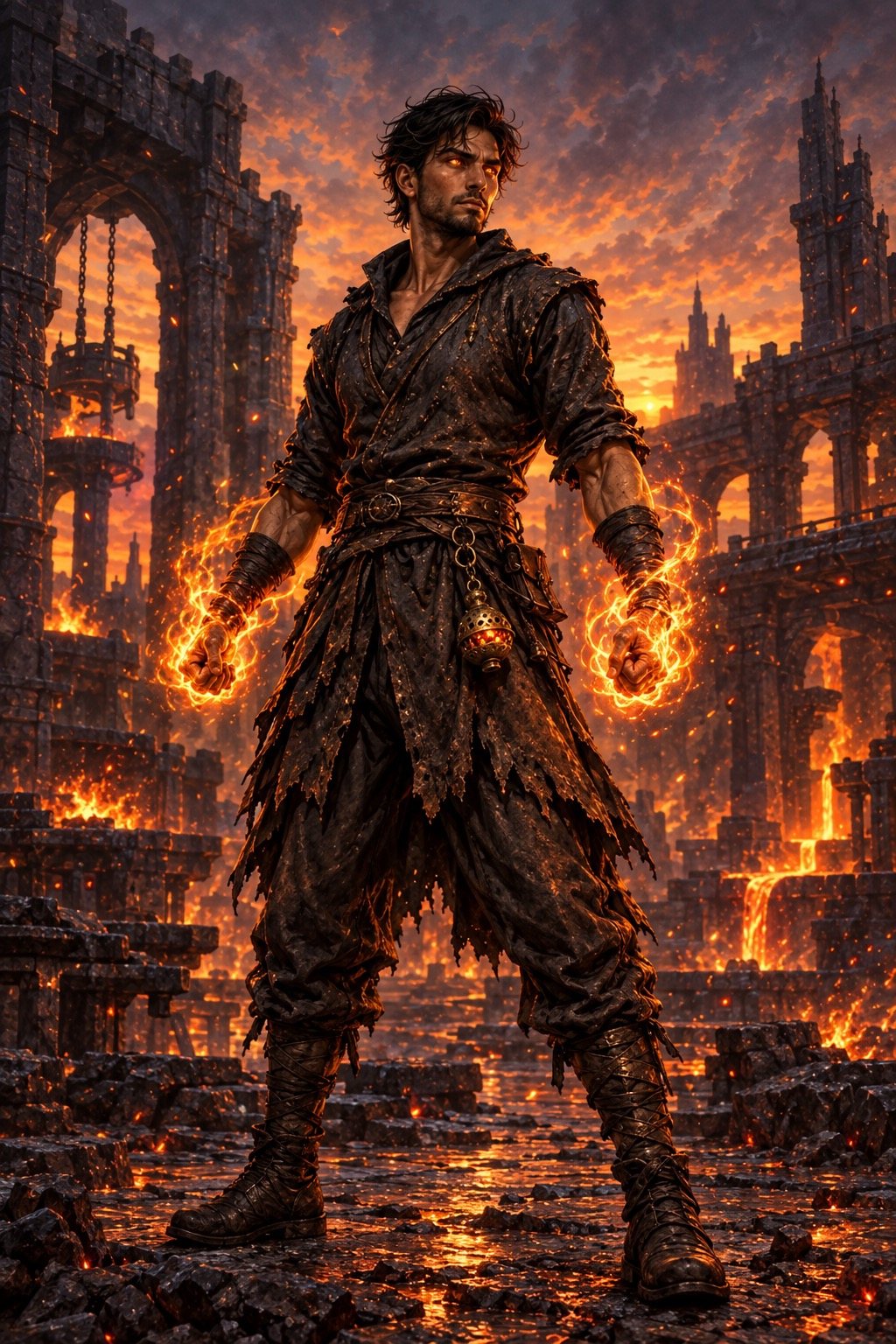
Campaign rules apply. Thirteen spells are banned, two are modified, and every spellcaster uses spell points instead of spell slots in this campaign — see Campaign Rules. This document already conforms: banned spells have been removed and replaced at the same level, modified spells are annotated where they appear, and spell slots have been converted to spell points.
Identity
A body that makes its own fire, and a lifetime’s discipline spent keeping it from burning down the room.
You do not cast spells; you sweat them. Somewhere in your blood or your training a fire was lit that never went out, and every discipline you have learned since is a way of keeping it from burning through you. Other mages reach outward for power — a patron, a current, a library; you breathe, bank the coals, and decide every single day not to burn down the room. In a story you are the warm, dangerous one, the guest everyone is glad of on a cold night and nobody seats near the thatch, and the question people ask about you is never whether you could, only what would make you stop holding it in.
The Furnace Adept is an ascetic whose magic is a metabolism — heat generated by the body, contained by discipline, and released through the fists or vented as raw eruption. Your baseline weapon is a strike that carries a lick of your own furnace (the Cinder Surge); your artistry is Metamagic — the shaping techniques your discipline calls Tempering — and your safety valve is a small short-rest pool of spell points, which you call Vents, that let you throw the fire outright. Where a sorcerer’s magic is a gift and a wizard’s is a library, yours is an organ, and Constitution is the size of it.
Class Overview
| Primary Abilities | Dexterity and Constitution |
| Hit Point Die | d8 per Furnace Adept level |
| Saving Throws | Dexterity and Charisma |
| Skills | Choose 2: Acrobatics, Athletics, Arcana, Insight, Intimidation, or Survival |
| Weapons | Simple weapons |
| Armor | None |
| Starting Equipment | A traveler’s outfit of heat-scarred cloth, 5 javelins, an ember kept alive in a brass censer (spellcasting focus, no mechanical effect of its own), and 11 GP |
Spellcasting summary. You cast spells from the Furnace Adept spell list (Evocation, Transmutation, and Abjuration only; see Spellcasting), using Constitution as your spellcasting ability. You know spells (no preparation) and cast them with short-rest spell points — this campaign’s conversion of Pact Magic — which you call Vents: a small pool, recovered on a Short or Long Rest. Utility cantrips only — you learn a few utility cantrips (see the Utility Cantrips feature), but your Unarmed Strikes and Cinder Surge are your at-will damage. Spell save DC = 8 + your Constitution modifier + your Proficiency Bonus; spell attack modifier = your Constitution modifier + your Proficiency Bonus.
Class Table
| Level | Proficiency Bonus | Martial Arts Die | Cinder Surge | Qi | Spell Points | Max Spell Level | Spells Known | Features |
|---|---|---|---|---|---|---|---|---|
| 1 | +2 | 1d6 | 1 die | 1 | — | — | — | Martial Arts, Unarmored Defense, Inner Furnace, Cinder Surge |
| 2 | +2 | 1d6 | 1 die | 2 | 2 | 1st | 2 | Furnace Techniques, Metamagic (2 options), Spellcasting (Vents), Unarmored Movement |
| 3 | +2 | 1d6 | 1 die | 3 | 2 | 1st | 3 | Temper (subclass) |
| 4 | +2 | 1d6 | 1 die | 4 | 2 | 1st | 3 | Ability Score Improvement |
| 5 | +3 | 1d8 | 1 die | 5 | 3 | 2nd | 4 | Extra Attack, Uncanny Metabolism |
| 6 | +3 | 1d8 | 1 die | 6 | 6 | 2nd | 4 | Temper feature, Unarmored Movement (+15 ft) |
| 7 | +3 | 1d8 | 1 die | 7 | 6 | 2nd | 5 | Evasion, Metamagic (+1) |
| 8 | +3 | 1d8 | 1 die | 8 | 6 | 2nd | 5 | Ability Score Improvement |
| 9 | +4 | 1d8 | 1 die | 9 | 10 | 3rd | 6 | Fireproof Soul, Unarmored Movement (vertical surfaces and liquids) |
| 10 | +4 | 1d8 | 1 die | 10 | 10 | 3rd | 6 | Self-Restoration, Timeless Body, Metamagic (+1), Unarmored Movement (+20 ft) |
| 11 | +4 | 1d10 | 3 dice | 11 | 10 | 3rd | 7 | Temper feature |
| 12 | +4 | 1d10 | 3 dice | 12 | 10 | 3rd | 7 | Ability Score Improvement |
| 13 | +5 | 1d10 | 3 dice | 13 | 18 | 4th | 8 | Metamagic (+1), Mystic Arcanum (6th) |
| 14 | +5 | 1d10 | 3 dice | 14 | 18 | 4th | 8 | Shared Heat, Unarmored Movement (+25 ft) |
| 15 | +5 | 1d10 | 3 dice | 15 | 18 | 4th | 9 | Never Cold |
| 16 | +5 | 1d10 | 3 dice | 16 | 18 | 4th | 9 | Ability Score Improvement, Mystic Arcanum (7th) |
| 17 | +6 | 1d12 | 4 dice | 17 | 21 | 5th | 10 | Temper feature, Metamagic (+1) |
| 18 | +6 | 1d12 | 4 dice | 18 | 28 | 5th | 10 | White Heat, Unarmored Movement (+30 ft) |
| 19 | +6 | 1d12 | 4 dice | 19 | 28 | 5th | 11 | Epic Boon, Mystic Arcanum (8th) |
| 20 | +6 | 1d12 | 4 dice | 20 | 28 | 5th | 11 | Total Combustion |
Cantrips Known: 1 at level 2, 2 at level 7, 3 at level 13 — utility only. Spell Points is your short-rest pool (your Vents); Max Spell Level is the highest level you can cast from it (your Vent Level).
Unarmored Movement: +10 ft at level 2, +15 ft at level 6, +20 ft at level 10, +25 ft at level 14, +30 ft at level 18; vertical surfaces and liquids from level 9.
Mystic Arcanum: one 6th-level spell at 13, one 7th-level at 16, one 8th-level at 19 — each cast once per Long Rest, outside the Vent table.
Class Features
Furnace Adept powers at a glance
Every Furnace Adept power that costs a resource, takes an action, or produces a discrete effect, with what it costs, what it takes, how far it reaches, how long it lasts, what the target rolls, what it deals, and what anyone watching sees. A field reads “—” where it does not apply. Chassis features shared with the 2024 Monk — Martial Arts, Unarmored Defense, Extra Attack, Evasion, Unarmored Movement — and this class’s own versions of Self-Restoration, Uncanny Metabolism and Mystic Arcanum (written out below) are not repeated here.
Display and Counterspell. This class is the library’s least subtle by some distance, and the Display column says so honestly: a Furnace Adept’s power is heat, and heat is visible, audible and felt. No Furnace Adept feature claims immunity to Counterspell or dispel magic, and none needs a subtlety clause — there is no version of this class that goes unnoticed. Spells are published spells (2024 Player’s Handbook, or Xanathar’s Guide to Everything where the spell list says so) and are answered exactly as printed.
Class features.
| Power | Cost | Action | Range | Duration | Save and damage | Display |
|---|---|---|---|---|---|---|
| Inner Furnace (minor heat) | — | Magic action | Touch | Instantaneous | — | tactile and visual (obvious) — the air over your hands shimmers |
| Cinder Surge | 1 Qi at 1–10, 2 at 11–16, 3 at 17–20 | No action, once on each of your turns, after a hit (not on a Quickened Spell turn) | The creature you hit | Instantaneous | — · 1 / 3 / 4 Martial Arts dice + Constitution modifier, fire | visual (obvious) — fire goes down the arm and into the blow |
| — Form: Backdraft | as the Surge | part of the Surge | 5 feet of the target | Instantaneous | — · one Martial Arts die, fire, to each creature of your choice near the target | visual (obvious) — the fire jumps sideways off the hit |
| Flurry of Blows (Cinder Flurry) | 1 Qi | Bonus Action, after the Attack action | Self | Instantaneous | — · +1 fire per strike | visual (obvious) — each knuckle trails flame |
| Step of the Wind (Vent Step) | 1 Qi | Bonus Action | Self | To the start of your next turn | — | visual (obvious) — a wash of shimmering air where you were |
| Hungry Flame | 2 Qi | No action; one of the three strike techniques on each of your turns, shaping one strike | The creature you hit | Instantaneous | — · rerolls up to Constitution modifier of the strike’s dice | visual (obvious) — the flame gutters and catches again |
| Scalding Riposte | 1 Qi | Reaction, when a creature within 5 feet hits or misses you | 5 feet | Instantaneous | Constitution · one Martial Arts die, fire | visual and auditory (obvious) — a short hard flare and a hiss |
| Quenchless Grip | 2 Qi | No action; one of the three strike techniques on each of your turns, shaping one strike | The creature you hit | To the start of your next turn | — | visual (subtle) — the wound closes around a coal that is not there |
| Shimmerguard | 1 Qi | No action; one of the three strike techniques on each of your turns, shaping one strike | Self, against that target | To the start of your next turn | — | visual (obvious) — heat-haze stands between you and the target |
| Metamagic | per option | as the option | the spell’s | the spell’s | the spell’s | as the spell’s, unchanged |
| Shared Heat (14) | — ; Constitution modifier uses per Short or Long Rest | Bonus Action | 30 feet, one creature other than you | Temporary Hit Points until spent; Advantage to the start of your next turn | — · twice your Constitution modifier as Temporary Hit Points | visual and tactile (obvious) — a wash of heat crosses the gap, like an oven door opened |
| Never Cold (15) | — | No action, on Initiative | Self | Instantaneous | — · regain 5 Qi when you have none | visual (subtle) — the ember behind the breastbone takes again |
| White Heat (18) | — | the spell’s casting time | the spell’s | the spell’s | the spell’s | as the spell’s, unchanged |
| Total Combustion (20) | — , once per Long Rest | Bonus Action | Self | 1 minute | — · +1d8 fire on Unarmed Strikes | visual (obvious) — you are burning, and everyone can see it |
Temper of the Bellows.
| Power | Cost | Action | Range | Duration | Save and damage | Display |
|---|---|---|---|---|---|---|
| Driving Gale (3) | — | part of a Flurry of Blows strike | 5 feet, pushing 10, or Prone | Instantaneous | Strength (Prone only) | visual (obvious) — a hard gust off the knuckles |
| Steam Rise (6) | 2 Qi | Bonus Action | Self | To the end of your next turn | — | visual (obvious) — a column of steam under you |
| Pressure Front (11) | 3 Qi | Magic action | 15-foot Cone | Instantaneous | Strength | visual and auditory (obvious) — a superheated front, and the noise of one |
| Eye of the Furnace (17) | — , while you hold 1 Qi | No action, passive | Self; allies within 10 feet | Continuous | — | visual (obvious) — you are aloft on your own convection |
Temper of the Anvil.
| Power | Cost | Action | Range | Duration | Save and damage | Display |
|---|---|---|---|---|---|---|
| Deflect Attacks (Work-Hardened, 3) | 1 Qi | Reaction, when you are hit | Self | Instantaneous | — · reduces by one Martial Arts die + Constitution modifier | visual (obvious) — the skin goes dull and hard where the blow lands |
| Quench and Temper (6) | — | No action, when an attack misses you | Self | Until spent | — · Constitution modifier as Temporary Hit Points | visual (subtle) — a brief hiss, as of hot metal in water |
| Annealed Body (11) | 3 Qi | Bonus Action | Self | 1 minute, or until Incapacitated | — | visual (obvious) — you take on the colour of worked iron |
| Unbreakable Alloy (17) | 3 Qi, once per Short or Long Rest | No action — and a saving throw often falls on another creature’s turn | Self | Instantaneous | — | visual (obvious) — whatever should have moved you does not |
Temper of the Ashes.
| Power | Cost | Action | Range | Duration | Save and damage | Display |
|---|---|---|---|---|---|---|
| Burn the Wick (3) | Hit Points up to your level | Bonus Action | Self | Until your next Unarmed Strike hit, or the end of your next turn | — · regain 1 Qi per full 3 Hit Points spent, spendable only on Furnace Adept features (tracked apart, spent first); the Hit Points spent, added as fire to that hit | visual (obvious) — you go grey and the fire goes up |
| Ashen Grip (6) | — | part of a necrotic Unarmed Strike | The creature you hit | Stated in the feature | Constitution | visual (subtle) — the wound greys at the edges |
| Gray Veil (11) | 3 Qi | Bonus Action | Self | To the start of your next turn | — | visual (obvious) — you are a drifting cloud of ash and ember |
| From the Coals (17) | — , once per Long Rest | No action, when you are reduced to 0 Hit Points but not killed outright | 10 feet | Instantaneous | Dexterity · four Martial Arts dice, fire (half on a success); you drop to 1 Hit Point instead | visual (obvious) — you come back up out of your own ashes |
Temper of the Starved Flame.
| Power | Cost | Action | Range | Duration | Save and damage | Display |
|---|---|---|---|---|---|---|
| Devour Magic (3) | — | No action, on a successful save against a spell | Self | Instantaneous | — · regain 1 Qi | visual (subtle) — the spell’s own light bends toward you |
| Eat the Ember (6) | 2 Qi | Reaction, when a creature within 30 feet casts a spell | 30 feet | Instantaneous | as the feature states | visual (obvious) — you inhale, and the casting goes out |
| Starveling Aura (11) | — | No action, passive | 10-foot Emanation | Continuous | — | tactile (obvious) — the air in reach of you is thin and wrong |
| Bottomless Hunger (17) | — , per the feature’s clock | part of Eat the Ember | 30 feet | Instantaneous | — · regain one full Vent of spell points | visual (obvious) — nothing is left of the spell at all |
Temper of the Kiln.
| Power | Cost | Action | Range | Duration | Save and damage | Display |
|---|---|---|---|---|---|---|
| Bank the Coals (3) | — | No action, at the end of a turn you spent no Qi | Self | Continuous | — | visual (subtle) — the heat banks instead of leaving |
| Slow and Even (6) | — , while Qi is at least half | No action, passive | Self | Continuous | — | tactile (obvious) — standing near you is standing near a kiln |
| Full Kiln (11) | any amount of Qi, minimum 4 | Magic action | 20-foot Emanation | Instantaneous | as the feature states · one die per 2 Qi | visual and auditory (obvious) — the door comes off the furnace |
| The Slow Sun (17) | — | No action, passive | Self and allies, per the feature | Continuous | — | visual (obvious) — you are warm to stand near, always |
Temper of the Wildfire.
| Power | Cost | Action | Range | Duration | Save and damage | Display |
|---|---|---|---|---|---|---|
| Spreading Flame (3) | — | No action; the spread once on each of your turns | a creature you damage with fire, or 5 feet from a burning creature (your choice) | To the start of your next turn | — · Constitution modifier, fire, at the start of turns | visual (obvious) — the fire is on someone else now |
| Flashover (6) | — | No action, when a burning creature drops to 0 Hit Points | 10 feet | Instantaneous | — · one Martial Arts die + Constitution modifier, fire | visual (obvious) — the fire it was carrying comes off it at once |
| Running Blaze (11) | 4 Qi | Magic action | 60 feet, a 20-foot-radius Sphere | as the feature states | as the feature states | visual (obvious) — a running blaze where you pointed |
| Wildfire Season (17) | — | No action, at the start of each of your turns | 5 feet from each burning creature, to creatures of your choice | Continuous | — · twice your Constitution modifier, fire | visual (obvious) — nothing you have set alight goes out on its own |
Level 1: Martial Arts
Your body is the weapon the fire forged. While you are unarmed or wielding a simple weapon and you aren’t wearing armor or wielding a Shield, you gain the following benefits.
- Martial Arts die. You can roll your Martial Arts die (see the class table) in place of the normal damage of your Unarmed Strikes and simple weapons.
- Dexterous strikes. You can use Dexterity instead of Strength for the attack and damage rolls of your Unarmed Strikes and simple weapons.
- Heated follow-through. When you take the Attack action with an Unarmed Strike or a simple weapon on your turn, you can make one Unarmed Strike as a Bonus Action.
Level 1: Unarmored Defense
While you aren’t wearing armor or wielding a Shield, your base Armor Class equals 10 + your Dexterity modifier + your Constitution modifier.
Level 1: Inner Furnace
The fire is always lit, even before you learn to open it, and you carry it as a pool of Qi points equal to your Furnace Adept level — what the disciplines call Qi; in you it runs as heat. You regain all expended Qi when you finish a Short or Long Rest. Qi fuels the Cinder Surge, your Furnace Techniques, your Metamagic, and your Temper subclass; every feature that costs Qi says so.
You also suffer no ill effects from nonmagical environmental heat or cold, though you can still take fire and cold damage from attacks and spells. As a Magic action you can produce minor heat at will: warm a meal, dry sodden clothes, make your skin painful to hold (a creature grappling you takes 1 fire damage at the start of each of its turns), or let your eyes glow like coals in the dark.
Level 1: Cinder Surge
The furnace leaks through your knuckles. Once on each of your turns, immediately after you hit a creature with an Unarmed Strike or a simple weapon, you can spend Qi to pour extra fire into that hit as a free rider — the cost is 1 Qi at levels 1–10, 2 Qi at levels 11–16, and 3 Qi at levels 17–20 (the fire gets more expensive to bleed as it gets hotter). This costs no action, Bonus Action, or Reaction, and doesn’t replace any other part of your turn.
Roll a number of dice of your Martial Arts die size and add your Constitution modifier; the target takes that much extra fire damage (or, if you prefer, the strike’s own damage type). The number of dice is 1 at levels 1–10, 3 at levels 11–16, and 4 at levels 17–20, as shown in the Cinder Surge column.
Because the Cinder Surge is limited to once on each of your turns, throwing more strikes only gives you more chances to land it — it never fires twice on the same turn, and no Metamagic option or Furnace Technique stacks additional damage dice onto the same strike (see Metamagic and Furnace Techniques). You also can’t use it on a turn when you use Quickened Spell (see Metamagic). This is the intentional ceiling on your single-turn burst.
Backdraft. When you use the Cinder Surge, you may forgo adding your Constitution modifier to instead let the fire leap: each creature of your choice within 5 feet of the target takes fire damage equal to one roll of your Martial Arts die. The Wildfire Temper’s spread builds on this.
Level 2: Furnace Techniques
You learn to open the furnace door on purpose. You can spend Qi on the following techniques.
- Flurry of Blows (1 Qi) — what you call Cinder Flurry. Immediately after you take the Attack action on your turn, you can make two Unarmed Strikes as a Bonus Action instead of one, and each of those strikes deals an extra 1 fire damage. (You still get only one Cinder Surge this turn.)
- Step of the Wind (1 Qi) — what you call Vent Step. You take the Disengage or Dash action as a Bonus Action, leaving a wash of shimmering air; the first Opportunity Attack made against you before the start of your next turn has Disadvantage.
- Hungry Flame (2 Qi, strike). Reroll a number of the strike’s damage dice up to your Constitution modifier (minimum one); you must use the new rolls. This is the strike-shaping twin of the Empowered Spell Metamagic option, and a single expenditure can’t affect both a strike and a spell.
- Scalding Riposte (1 Qi). When a creature within 5 feet of you hits or misses you with a melee attack, you can take a Reaction to sear it. It makes a Constitution saving throw against your spell save DC, taking fire damage equal to one roll of your Martial Arts die + your Constitution modifier on a failed save, or half as much on a success.
- Quenchless Grip (2 Qi, strike). On a hit, the target can’t regain Hit Points until the start of your next turn.
- Shimmerguard (1 Qi, strike). After the strike resolves, hit or miss, attack rolls made against you by the target have Disadvantage until the start of your next turn.
Hungry Flame, Quenchless Grip, and Shimmerguard shape a strike rather than a spell, so they are techniques of this class rather than Metamagic. Applying one of the three costs no action, Bonus Action, or Reaction: it rides a strike you were already making, exactly as the Cinder Surge does. That is why they share one limit: you can use only one of Hungry Flame, Quenchless Grip and Shimmerguard on each of your turns, on one strike.
Level 2: Spellcasting (Vents)
When the pressure is too great for fists, you open a vent. You learn 2 spells of your choice, each 1st level, from the Furnace Adept spell list (see Spellcasting). You cast them by spending spell points — this campaign’s conversion of the Warlock’s Pact Magic — and you call that pool your Vents. Your pool is the Spell Points column of the class table, and it refills when you finish a Short or Long Rest. A spell costs 1st 2, 2nd 3, 3rd 5, 4th 6, 5th 7; you can cast a spell you know at any level from its own up to your Max Spell Level (your Vent Level) by paying that level’s cost. A full Vent means spell points equal to the cost of a spell of your Max Spell Level; features that once spent or restored a Pact Magic slot now spend or restore a full Vent.
You learn more spells at higher levels, as shown in the Spells Known column, chosen from the Furnace Adept spell list and of a level no higher than your Max Spell Level. Whenever you gain a Furnace Adept level, you can replace one spell you know with another spell from the Furnace Adept spell list, of a level no higher than your Max Spell Level. Every spell you cast visibly issues from your own body (a fireball is a thrown gout of you); you still aim it at a creature or point within its range, as the spell describes.
No small damage. Your at-will damage is your Martial Arts — the furnace does not trickle out in little scorches. But it can be shaped to small ends, and so you do learn a handful of utility cantrips (see below).
Level 2: Utility Cantrips
Your fire refuses to trickle into small damage, but it can be shaped to small useful ends. You learn 1 cantrip at level 2, a 2nd at level 7, and a 3rd at level 13, chosen from the list below — utility cantrips only (a cantrip that makes no attack roll, deals no damage, and imposes no saving throw to avoid damage). They use Constitution. Whenever you gain a Furnace Adept level you can swap one for another eligible utility cantrip. Choose from: Blade Ward, Dancing Lights, Elementalism, Light, Mending, Message, Prestidigitation, Thaumaturgy. Elementalism is the 2024 cantrip that absorbed the older Control Flame, Mold Earth, Shape Water and Gust; a table still using those may take any of them in its place.
Level 2: Metamagic
You shape the fire as it leaves you — your discipline calls this Tempering. You learn two Metamagic options of your choice from the list below, and you learn one additional option at levels 7, 10, 13, and 17. Once on each of your turns you can apply one Metamagic option as part of casting a spell (to shape an Unarmed Strike’s damage the same way, see the Hungry Flame Furnace Technique). You can’t apply more than one option to the same spell or strike, and no option adds flat damage dice to a strike — Tempering bends the fire; the Cinder Surge is what makes it bite.
- Extended Spell (2 Qi, spell) — Banked Casting. The spell’s duration is doubled, to a maximum of 24 hours.
- Twinned Spell (2 Qi, spell) — Forked Flame. When you cast a spell that can target an additional creature when it is cast at a higher level, such as Fly or Elemental Bane, its effective level increases by 1. This can take it above your Max Spell Level. You pay the spell points for the level you cast it at, not for its effective level.
- Empowered Spell (2 Qi, spell) — Fed Flame. Reroll a number of the spell’s damage dice up to your Constitution modifier (minimum one); you must use the new rolls. (The strike version is the Hungry Flame Furnace Technique, at the same cost; one expenditure can’t affect both a strike and a spell.)
- Distant Spell (1 Qi, spell) — Long Vent. The spell’s range doubles, or a spell with a range of Touch gains a range of 30 feet.
- Subtle Spell (2 Qi, spell) — Pressure Casting. The spell requires no Verbal or Somatic components and produces no visible heat or light until it takes effect.
- Quickened Spell (3 Qi, spell) — Searing Speed. A spell with a casting time of one Magic action is cast as a Bonus Action instead. You can use this option only if you haven’t used the Cinder Surge this turn, and for the rest of the turn you can’t use the Cinder Surge or make Bonus Action strikes (including Flurry of Blows).
Level 2: Unarmored Movement
Unarmored Movement — what you call Rolling Boil. Heat wants to rise and move, and you have stopped arguing with it. While you aren’t wearing armor or wielding a Shield, your Speed increases by 10 feet. This bonus increases to +15 feet at level 6, +20 feet at level 10, +25 feet at level 14, and +30 feet at level 18.
Starting at level 9, the boil carries you where footing shouldn’t: on your turn you can move along vertical surfaces and across liquids without falling during that movement — the stone scorches, the water steams.
Level 3: Temper
The fire is the same in everyone; what differs is the vessel. Choose a Temper — Bellows, Anvil, Ashes, Starved Flame, Kiln, or Wildfire, each described later in this document. You gain its level 3 features, and additional features at levels 6, 11, and 17.
Level 4, 8, 12, 16: Ability Score Improvement
You gain the Ability Score Improvement feat or another feat of your choice for which you qualify.
Level 5: Extra Attack
You can attack twice, instead of once, whenever you take the Attack action on your turn.
Level 5: Uncanny Metabolism
Uncanny Metabolism — what you call Stoke the Fire. Once per Long Rest, when you roll Initiative, you can inhale and stoke the furnace: you regain expended Qi equal to half your Furnace Adept level (round up) and spell points equal to one full Vent (not above your maximum).
Level 7: Evasion
Evasion — what you call Heat Shimmer. The air around you refuses to hold still. When you’re subjected to an effect that allows a Dexterity saving throw to take only half damage, you instead take no damage on a success and half damage on a failure. You must not have the Incapacitated condition to use this.
Level 9: Fireproof Soul
Heat has annealed everything in you, including will. You gain proficiency in Wisdom saving throws. If you already have this proficiency, you instead gain proficiency in Intelligence saving throws. If you already have both, you gain no new proficiency.
Level 10: Self-Restoration (and Timeless Body)
Self-Restoration — what you call Even Burn; it also grants Timeless Body. The furnace has stopped fighting you. You have Resistance to fire damage, you suffer none of the frailty of old age and can’t be aged magically (though you can still die of old age), and you have Immunity to the Poisoned condition and to disease — nothing survives your internal temperature.
Level 13: Mystic Arcanum
Mystic Arcanum — what you call the Deep Draught. A Vent draws off the top of the fire; once a day, now, you can reach all the way to the bottom of the furnace, where the heat has had a lifetime to settle, and bring up something no Vent of yours could ever hold.
You learn one 6th-level spell from your class’s list. You cast it once without spending spell points or Qi, and you regain the ability to do so when you finish a Long Rest. At level 16 you learn a 7th-level spell, and at level 19 an 8th-level spell, each cast once per Long Rest in the same way. Whenever you gain a Furnace Adept level, you can replace one of these spells with another of the same level from your class’s list. These spells use your Constitution.
Each Arcanum has its own separate use — casting the 6th-level spell doesn’t spend the 7th or the 8th — and none of them costs spell points, so White Heat, Uncanny Metabolism, and Bottomless Hunger neither recover them nor are spent by them. See the Spellcasting section for the 6th-, 7th-, and 8th-level options.
Level 14: Shared Heat
The furnace has grown larger than one body needs, and you have learned to give some of it away. As a Bonus Action, choose one creature other than you that you can see within 30 feet. It gains Temporary Hit Points equal to twice your Constitution modifier (minimum 2), and it has Advantage on Constitution saving throws until the start of your next turn. (Temporary Hit Points don’t stack: a creature that already has some chooses which to keep.)
You can use this feature a number of times equal to your Constitution modifier (minimum once), and you regain all expended uses when you finish a Short or Long Rest. It costs no Qi and no spell points.
Level 15: Never Cold
When you roll Initiative and have no Qi remaining, you regain 5 Qi. The furnace has never once gone out, and it isn’t starting today.
Level 18: White Heat
Your Vents burn at the hottest part of the flame. Once per Long Rest, you can cast one spell you know without spending spell points, at any level from the spell’s own up to your Max Spell Level. It still counts as your one spell of 1st level or higher for that turn.
Level 19: Epic Boon
You gain an Epic Boon feat or another feat of your choice for which you qualify.
Level 20: Total Combustion
As a Bonus Action, you open the furnace all the way. For 1 minute: your Unarmed Strikes deal an extra 1d8 fire damage; you have Immunity to fire damage; you have a Fly Speed equal to your Speed (heat convection); and at the start of each of your turns you regain 2 Qi. When the minute ends, you gain 1 Exhaustion level. Once you use this feature, you can’t use it again until you finish a Long Rest.
Tempers (Subclasses)
Six Tempers describe what your discipline made of the fire. Each grants features at 3rd, 6th, 11th, and 17th level. A Temper is the shape the fire takes in one vessel — pressure, hardness, self-consumption, hunger, patience or spread — and nothing in it needs a god, a people or a place to exist. Each world names and frames the six its own way (see In Different Worlds); their real-world touchstones are under Origins and Inspiration.
Temper of the Bellows
The fire is nothing; the air that feeds it is everything. Bellows adepts learned that the furnace can push as well as burn — heat as pressure, breath as leverage. They are the battlefield’s weather system.
Level 3: Driving Gale. When you hit a creature with an Unarmed Strike granted by Flurry of Blows (Cinder Flurry), you can push it up to 10 feet directly away from you, or you can force it to make a Strength saving throw against your spell save DC; on a failed save, it has the Prone condition. In addition, while you have at least 1 Qi, your jump distance is doubled and you take falling damage as if the fall were 20 feet shorter.
Level 6: Steam Rise. As a Bonus Action, spend 2 Qi to gain a Fly Speed equal to your Speed until the end of your next turn. If you’re aloft when this ends, you descend gently (as feather fall) until you land.
Level 11: Pressure Front. As a Magic action, spend 3 Qi to exhale a superheated front in a 15-foot Cone. Each creature in the Cone makes a Strength saving throw against your spell save DC. On a failure it takes fire damage equal to two rolls of your Martial Arts die + your Constitution modifier, is pushed 15 feet, and has the Prone condition. On a success it takes half the damage only.
Level 17: Eye of the Furnace. While you have at least 1 Qi, you have a permanent Fly Speed equal to your Speed and can hover, riding your own convection. Allies within 10 feet of you gain a +10-foot bonus to Speed — the wind is always at their backs.
Playing a Bellows adept: you think in vectors, not blows. You’re the one who props doors, checks sightlines, and grins in a high wind.
Temper of the Anvil
Metal doesn’t argue with the hammer. It just comes back harder. Anvil adepts turn heat inward, work-hardening flesh into something that keeps its shape no matter what strikes it. They are the wall the party stands behind.
Level 3: Deflect Attacks — what the Anvil calls Work-Hardened. When you are hit by an attack, you can take a Reaction and spend 1 Qi to harden: reduce the damage by one roll of your Martial Arts die + your Constitution modifier. If this reduces the damage to 0 and the attacker is within 5 feet, it takes fire damage equal to your Constitution modifier — it just punched a stove.
Level 6: Quench and Temper. When a creature misses you with an attack roll, you gain Temporary Hit Points equal to your Constitution modifier (minimum 1). Temporary Hit Points from this feature stack with each other, up to a total equal to your Furnace Adept level. They don’t stack with Temporary Hit Points from any other source, such as Armor of Agathys: when you would have both, you choose which to keep, as normal.
Level 11: Annealed Body. As a Bonus Action, spend 3 Qi to gain Resistance to Bludgeoning, Piercing, and Slashing damage for 1 minute or until you have the Incapacitated condition.
Level 17: Unbreakable Alloy. When you fail a saving throw, you can spend 3 Qi to succeed instead; this costs no action, Bonus Action, or Reaction, which matters because a saving throw often falls on another creature’s turn. Once you use this feature, you can’t use it again until you finish a Short or Long Rest.
Playing an Anvil adept: you are the calmest person in every fight, because you have done the arithmetic and it says you’re still standing at the end. Stand where the damage is supposed to go.
Temper of the Ashes
Everything the fire takes, it keeps. Ashes adepts burn their own substance for power — the forbidden branch of the discipline, taught in whispers, where the line between fuel and self gets thin. High risk, terrible beauty.
Level 3: Burn the Wick. As a Bonus Action, you can burn your own substance: spend any number of Hit Points up to your Furnace Adept level (this loss can’t be reduced or prevented). You regain 1 Qi for every full 3 Hit Points spent, and the next time you hit a creature with an Unarmed Strike before the end of your next turn, that strike deals additional fire damage equal to the Hit Points you spent. Qi you regain with Burn the Wick can be spent only on Furnace Adept features; keep it as a separate count on your Qi tracker and spend it before your other Qi whenever you use a Furnace Adept feature. Unspent Qi from Burn the Wick becomes ordinary Qi when you finish a Short or Long Rest. In addition, once on each of your turns when you hit with an Unarmed Strike, you can change its damage type to necrotic — a burn that doesn’t glow.
Level 6: Ashen Grip. When you deal necrotic damage to a creature with an Unarmed Strike, it must succeed on a Constitution saving throw against your spell save DC or be unable to regain Hit Points until the start of your next turn.
Level 11: Gray Veil. As a Bonus Action, spend 3 Qi to collapse into a drifting cloud of ash and ember until the start of your next turn. You have Resistance to all damage except force and radiant, you can move through spaces as narrow as 1 inch without squeezing, and you can move through occupied spaces (you can’t end your movement there).
Level 17: From the Coals. When you are reduced to 0 Hit Points but not killed outright, you instead drop to 1 Hit Point, and each creature of your choice within 10 feet makes a Dexterity saving throw against your spell save DC, taking fire damage equal to four rolls of your Martial Arts die on a failure, or half as much on a success — the wick reignites explosively. Once you use this feature, you can’t use it again until you finish a Long Rest.
Playing an Ashes adept: every resource is negotiable, including you. Play someone doing dangerous math cheerfully — and decide what you’re saving the last of yourself for.
Temper of the Starved Flame
A fire that has eaten everything nearby does not go out. It goes looking. Starved Flame adepts keep their furnace deliberately hungry, and it has learned to eat what other mages throw. They are the answer the party sends against wizards.
Level 3: Devour Magic. You have Advantage on saving throws against spells. When you succeed on a saving throw against a spell, you regain 1 Qi — the flame licks up what was thrown at it.
Level 6: Eat the Ember. When a creature you can see within 30 feet casts a spell, you can spend 2 Qi as a Reaction to snatch at its heat. If the spell’s level is equal to or lower than your Max Spell Level, the caster must succeed on a Constitution saving throw against your spell save DC or the spell fails and is wasted — and you regain 1 Qi.
Level 11: Starveling Aura. The air within 10 feet of you is thin and hungry. Enemy creatures in that Emanation have Disadvantage on Constitution saving throws made to maintain Concentration, and take fire damage equal to your Constitution modifier when they cast a spell while inside it.
Level 17: Bottomless Hunger. When you cause a spell to fail with Eat the Ember, you can consume it entirely and regain spell points equal to one full Vent (not above your maximum). Once you use this part of the feature, you can’t use it again until you finish a Long Rest. In addition, you have Resistance to damage from spells.
Playing a Starved Flame adept: you look at every enchantment, every glowing sword, every casting NPC the way a hungry person looks at a bakery window. Practice your table manners.
Temper of the Kiln
Fire kept low and long outlasts every blaze that showed off. Kiln adepts refuse to spend. They bank the furnace, hold the warmth for hours, and let heat pool in the body until it becomes armor, endurance, and — when they finally decide — one enormous, patient release. Where other Tempers vent, the Kiln hoards.
Level 3: Bank the Coals. Your Qi maximum increases by your Constitution modifier. You can also refill the furnace between rests: when you end your turn without having spent any Qi that turn, you regain 1 Qi (this can’t take you above your maximum). Patience is fuel.
Level 6: Slow and Even. While your current Qi is at least half your Qi maximum, the banked warmth sustains you: you have Resistance to fire and cold damage, and at the start of each of your turns you regain Hit Points equal to your Constitution modifier. The moment your Qi drops below half, this lapses until you build the coals back up.
Level 11: Full Kiln. As a Magic action, you can throw open a furnace you’ve kept sealed for hours: spend any amount of Qi, minimum 4, and release it as a wave in a 20-foot Emanation. Each creature of your choice in the area makes a Constitution saving throw against your spell save DC, taking fire damage equal to one roll of your Martial Arts die per 2 Qi spent (rounded down) + your Constitution modifier on a failure, or half as much on a success. The floor within the Emanation becomes gently scorched, difficult terrain for enemies, until the start of your next turn.
Level 17: The Slow Sun. The furnace no longer cools on its own: your Qi maximum increases by a further 5. In addition, you and allies within 10 feet of you automatically succeed on saving throws against extreme heat and extreme cold, so none of you gains Exhaustion levels from those environments — you are the campfire the whole party sleeps around. An ally has this benefit for any such saving throw it makes while within 10 feet of you.
Playing a Kiln adept: you are the marathon in a party of sprinters. Your fun is the held breath — three rounds of soaking hits and refusing to spend, and then the room goes white. Play the one who is never in a hurry, because the fire isn’t either.
Temper of the Wildfire
One spark is a rumor. By morning it’s a country. Wildfire adepts stopped trying to keep the fire in one place. Their heat catches, jumps, and travels — a strike that starts on one enemy is on three by the end of the round. They are the reason the veterans tell you never to fight this discipline in a crowd, or in a dry field, or downwind.
Level 3: Spreading Flame. When you deal fire damage to a creature, you can make it start burning until the start of your next turn. A burning creature takes fire damage equal to your Constitution modifier (minimum 1) at the start of its turns. Once on each of your turns, when a burning creature is within 5 feet of another creature you can see, you can spread the fire to that second creature — this costs no action, Bonus Action, or Reaction — and it starts burning too. A creature can end burning by using an action to douse itself or by being fully submerged. The damage a creature takes from burning doesn’t make it start burning again; only new fire damage from you, or a spread, does that.
Level 6: Flashover. When a burning creature is reduced to 0 Hit Points, the fire it was carrying leaps free: each creature of your choice within 10 feet of it takes fire damage equal to one roll of your Martial Arts die + your Constitution modifier and starts burning. In addition, your Cinder Surge and your spells ignore Resistance to fire damage possessed by any creature that is currently burning.
Level 11: Running Blaze. As a Magic action, spend 4 Qi to hurl a running blaze: choose a point you can see within 60 feet and create a 20-foot-radius Sphere of flame there. Each creature in the area makes a Dexterity saving throw against your spell save DC, taking fire damage equal to three rolls of your Martial Arts die + your Constitution modifier on a failure, or half as much on a success; creatures of your choice that fail also start burning. The area is lightly obscured by smoke and counts as burning terrain (a creature that enters it or starts its turn there takes your Constitution modifier in fire damage) until the start of your next turn.
Level 17: Wildfire Season. Burning creatures now take fire damage equal to twice your Constitution modifier at the start of their turns, and your spread with Spreading Flame is no longer limited to once on each of your turns — at the start of each of your turns, before any burning ends, the fire jumps from every burning creature to each creature of your choice within 5 feet of it (this costs no action, Bonus Action, or Reaction, and a creature that catches fire this way doesn’t spread it again this turn). You have Immunity to fire damage and can move through burning terrain and open flame unharmed. Some fires are events, not attacks.
Playing a Wildfire adept: you play the map, not the target. Positioning, chokepoints, and clumped enemies are your real weapons; a single duel bores your fire. Delight in the moment the second and third torches catch from the first without your lifting a hand — and decide, out of combat, how frightened ordinary people are right to be of you.
Spellcasting
Casting ability. Constitution. Spell save DC = 8 + your Constitution modifier + your Proficiency Bonus. Spell attack modifier = your Constitution modifier + your Proficiency Bonus.
Known, not prepared. You know a fixed number of spells (the Spells Known column). You don’t prepare and re-prepare; the fire remembers what you’ve taught it. Whenever you gain a Furnace Adept level, you can replace one spell you know with another spell from the Furnace Adept spell list, of a level no higher than your Max Spell Level.
Spell points (your Vents). Your spellcasting uses a short-rest spell point pool — this campaign’s conversion of Pact Magic — which you call your Vents. A spell costs 1st 2, 2nd 3, 3rd 5, 4th 6, 5th 7; you can cast any spell you know at any level from its own up to your Max Spell Level, and you regain all spent points on a Short or Long Rest. You gain higher-level spells to know only as your Max Spell Level rises. Higher-level effects come from paying a higher level’s cost, exactly as the spell’s own “using a higher-level spell slot” text describes. You can never spend spell points on a spell of 6th level or higher. Your spell points and your Qi points are separate pools: neither can pay for the other, and your Qi follows its own recovery.
Spell list source. You choose your spells only from the Furnace Adept spell list below, which holds published spells of the Evocation, Transmutation, and Abjuration schools only — the fire that burns, the body that changes, and the ward that holds it all in. Utility cantrips only: you learn a few utility cantrips (see the Utility Cantrips feature), but your Unarmed Strikes and Cinder Surge are your at-will damage — the furnace does no small harm.
Furnace Adept Spell List
This is a closed list: every spell you know of 1st through 5th level comes from it, and the DM does not add others. It holds 75 spells (17 / 22 / 16 / 10 / 10 at 1st–5th level, about three-quarters of the 2024 Player’s Handbook Sorcerer list at each level), all in your three schools and sorted alphabetically within each level. Every spell is from the 2024 Player’s Handbook except Absorb Elements, Pyrotechnics, Warding Wind, Melf’s Minute Meteors, Elemental Bane, Immolation and the Arcanum option Investiture of Flame, which are from Xanathar’s Guide to Everything; Searing Smite (Paladin) and Elemental Weapon (Druid, Paladin, Ranger) are the only spells from outside the Bard, Sorcerer, Warlock and Wizard lists. The 6th-, 7th-, and 8th-level entries are Mystic Arcanum options only — they are never known spells and can’t be cast with a Vent.
1st level (available at 2).
- Absorb Elements (Abjuration) — drink the incoming fire and hit back hotter
- Alarm (Abjuration) — a banked coal that flares when someone crosses the line
- Armor of Agathys (Abjuration) — a hard crust that bites whoever strikes it
- Burning Hands (Evocation) — the signature spray
- Chromatic Orb (Evocation) — a hurled bead of chosen element
- Expeditious Retreat (Transmutation) — the legs run hot and keep running
- Faerie Fire (Evocation) — sparks that cling and outline everything they touch
- Feather Fall (Transmutation) — convection, on demand
- Hellish Rebuke (Evocation) — the flare that answers a blow
- Jump (Transmutation) — the coiled-spring leap
- Longstrider (Transmutation) — the tireless march
- Magic Missile (Evocation) — three sparks that never miss
- Protection from Evil and Good (Abjuration) — the heat-haze no stranger thing can reach through
- Searing Smite (Evocation) — the fist that keeps burning after it lands
- Shield (Abjuration) — a wall of shimmer between you and the blow
- Thunderwave (Evocation) — a concussive breath of hot air
- Witch Bolt (Evocation) — a tether of arcing heat
2nd level (available at 5).
- Alter Self (Transmutation) — reshape the body the fire lives in
- Arcane Lock (Abjuration) — weld the door shut
- Arcane Vigor (Abjuration) — the body refuels itself
- Blindness/Deafness (Transmutation) — a flash, or a roar, that stays
- Continual Flame (Evocation) — a light you can spare
- Darkness (Evocation) — the smoke that swallows the light
- Darkvision (Transmutation) — eyes that see by heat
- Dragon’s Breath (Transmutation) — lend a throat your fire for a minute
- Enhance Ability (Transmutation) — run one faculty hot
- Enlarge/Reduce (Transmutation) — the metal swells, or the metal shrinks
- Flame Blade (Evocation) — a scimitar of your own fire
- Gust of Wind (Evocation) — the exhale that clears a hall
- Heat Metal (Transmutation) — make their armor regret them
- Knock (Transmutation) — expand the lock until it gives
- Levitate (Transmutation) — rise on the warm column
- Magic Weapon (Transmutation) — temper a blade in your heat
- Melf’s Acid Arrow (Evocation) — a dart of corrosive slag
- Pyrotechnics (Transmutation) — turn one flame into blinding smoke or a flare
- Scorching Ray (Evocation) — three darts of fire
- Shatter (Evocation) — the crack of metal quenched too fast
- Spider Climb (Transmutation) — hands that cling like hot tar
- Warding Wind (Evocation) — a moat of roaring air
3rd level (available at 9).
- Blink (Transmutation) — flicker half-out of the world
- Counterspell (Abjuration) — smother the casting before it breathes
- Daylight (Evocation) — the furnace door thrown open
- Dispel Magic (Abjuration) — put out someone else’s fire
- Elemental Weapon (Transmutation) — lend the fire to a blade
- Fireball (Evocation) — the thrown gout of you
- Fly (Transmutation) — full convection flight
- Gaseous Form (Transmutation) — become the smoke
- Glyph of Warding (Abjuration) — a banked charge, left in a mark
- Haste (Transmutation) — the metabolism, overclocked
- Lightning Bolt (Evocation) — the arc that jumps the gap
- Magic Circle (Abjuration) — a ring of heat that certain things can’t cross
- Melf’s Minute Meteors (Evocation) — a quiver of little suns
- Protection from Energy (Abjuration) — ward the party against the elements
- Remove Curse (Abjuration) — burn the rot out
- Slow (Transmutation) — draw the heat out of their limbs
4th level (available at 13).
- Elemental Bane (Transmutation) — strip a foe’s Resistance and light it up
- Fabricate (Transmutation) — the forge’s whole work, in your hands
- Fire Shield (Evocation) — burn everyone who touches you, warm or cold
- Freedom of Movement (Abjuration) — nothing holds the fire down
- Mordenkainen’s Private Sanctum (Abjuration) — the kiln room, sealed
- Otiluke’s Resilient Sphere (Abjuration) — seal a threat in a bubble
- Stone Shape (Transmutation) — work stone like soft clay
- Stoneskin (Transmutation) — anneal the whole body
- Vitriolic Sphere (Evocation) — a searing, clinging burst
- Wall of Fire (Evocation) — draw the line and light it
5th level (available at 17).
- Animate Objects (Transmutation) — set the room’s own furniture moving
- Bigby’s Hand (Evocation) — a giant fist of pure force, your fists writ large
- Circle of Power (Abjuration) — a warding field against magic
- Cone of Cold (Evocation) — the cold left behind when every scrap of heat is pulled from the air
- Immolation (Evocation) — set one creature utterly alight
- Jallarzi’s Storm of Radiance (Evocation) — a white-hot storm that sears and deafens
- Passwall (Transmutation) — walk through what should stop you
- Telekinesis (Transmutation) — motion without touch
- Wall of Force (Evocation) — the ward that nothing crosses
- Wall of Stone (Evocation) — reshape the room
6th level (Mystic Arcanum at 13 — not castable with spell points).
- Investiture of Flame (Transmutation) — you stop carrying the furnace and simply become it
- Disintegrate (Transmutation) — the last temperature, applied to one thing
- Flesh to Stone (Transmutation) — the kiln’s verdict on anyone who wouldn’t stop moving
- Globe of Invulnerability (Abjuration) — the forge-shell that nothing lesser gets through
7th level (Mystic Arcanum at 16 — not castable with spell points).
- Delayed Blast Fireball (Evocation) — banked coals, left where someone will step on them
- Fire Storm (Evocation) — you stop aiming and start describing
- Forcecage (Evocation) — a sealed kiln with someone else inside it
- Reverse Gravity (Transmutation) — convection, taken to its logical end
8th level (Mystic Arcanum at 19 — not castable with spell points).
- Sunburst (Evocation) — white heat, released all at once, in every direction
- Earthquake (Transmutation) — the fire under the world, briefly consulted
- Control Weather (Transmutation) — you decide what season this valley is having
- Antimagic Field (Abjuration) — the quenching bath; everyone’s fire goes out, including yours
Two cautions on the Arcanum picks. Investiture of Flame requires Concentration and is the pick that most obviously stacks with the class’s own engine — a Wildfire adept running it alongside Spreading Flame is the combination to watch at a table. Antimagic Field suppresses your own spellcasting inside it as readily as anyone else’s, so agree with your DM at the table how far the quenching reaches into your own furnace before you take it.
Multiclassing
To take your first level of Furnace Adept while multiclassing, you need Dexterity 13 and Constitution 13. When you enter the class you gain proficiency with simple weapons; if you don’t already have them, you gain Martial Arts and Unarmored Defense (10 + Dex + Con). You gain the Qi pool and Cinder Surge: your Furnace Adept Qi entry and your Martial Arts die follow your Furnace Adept level on this class’s table, never your total character level. Your spell points are a short-rest pool (your Vents), as a Warlock’s Pact Magic slots are: they do not combine with any other class’s spell points — keep the two pools apart. A spell you know as a Furnace Adept is cast from your Vents; a spell from another class is cast from that class’s pool. You reach features like Extra Attack based on Furnace Adept level, and Extra Attack doesn’t stack with the same feature from another class.
Qi from more than one class. If another class in this library also gives you Qi points, or the Monk class gives you Focus Points, you have a single pool of Qi points; your Monk features spend it as Focus Points. Its maximum is the total of each class’s Qi or Focus entry for your level in that class (including any feature that raises a class’s maximum). A feature from any of those classes can spend from it. Each class’s share recovers by that class’s own rule, and a feature that reduces one class’s maximum reduces only that class’s share. Each feature keeps its own limits (once per turn, Surge dice, and so on). While your pool combines more than one class, you can use each class’s Surge no more times between one rest and the next than your level in that class. A feature that restores all of a class’s Qi or Focus Points restores no more than that class’s entry.
In Different Worlds
Setting layer. Everything above this heading works unchanged in each of these worlds; only names, looks and stories differ. Names here are setting names, each mapped to the name the rules use.
Mythic culture — Himalayan hermitages and Vedic austerity (the class’s inspiration)
Who has it. Hermits of the high passes, who winter in caves above the glaciers and raise heat by breath and austerity until the snow at the cave mouth runs. Most come to it by years of practice; a few are born hot and sent up the mountain young.
What they call it. The class is a tapasvin, “one who has tapas”, or in the hermitages a repa, “cotton-clad”. The Inner Furnace is tapas, the heat austerity builds, kindled by tummo, the fierce inner fire. The Cinder Surge is letting the heat out. The Tempers are the six vessels and keep their names.
How it looks and sounds. Steam lifts off wet cloth on bare shoulders; breath is counted aloud in long, held cycles. The ember lives in a brass butter-lamp. A Cinder Surge is a glow behind the navel that runs up the arm and out through the knuckles, as plain to see here as anywhere.
Story hook. A valley king has watched the glacier above his fields thin for three winters, and blames the hermit beneath it, whose tapas grows every year. He hires the party to break her austerity before spring; she was the player character’s teacher.
Rules caveat. None. In the source traditions austerity can win boons from gods; here that is story. No feature needs a god to grant or approve the heat. A glacier thinned by one hermit is story too; no feature warms a valley.
| Neutral name (rules) | Hermitage name |
|---|---|
| Furnace Adept | tapasvin; repa in the mountain hermitages |
| Inner Furnace (the heat your Qi points describe) | tapas; its breath-practice is tummo |
| Cinder Surge | letting the heat out |
| Temper · Temper of the Bellows · Anvil · Ashes · Starved Flame · Kiln · Wildfire | vessel · the Bellows, Anvil, Ashes, Starved Flame, Kiln and Wildfire vessels |
| an ember kept alive in a brass censer | an ember kept in a brass butter-lamp |
Arcane-industrial
Who has it. The Stokers of a foundry city whose works run on bodies as much as on coal. A child who runs hot is tested at the guild hall, apprenticed young and drilled in containment: breath counted to the shift whistle, a ledger of every burn. Unlicensed ones are hothands, and illegal.
What they call it. The class is a Stoker. Qi is pressure, the Inner Furnace the boiler, a Cinder Surge a blowdown, and the Vents relief valves. Tempers are guild shops:
| Temper | Shop |
|---|---|
| Bellows · Anvil · Ashes | the Blower Shop · the Forge Shop · the Slag Gang |
| Starved Flame · Kiln · Wildfire | the Damping Crew · the Long Ovens · the Burn-Off Crew |
How it looks and sounds. Soot-black canvas gone pale at the cuffs. A Stoker under load hisses like a valve; a Blower at Pressure Front sounds like a blast furnace being tapped. The ember-censer is a brass pilot-light lantern stamped with a licence number.
Story hook. Three Stokers have died of a blowout this month, burning from the inside on shift. The guild calls it bad discipline. The party finds the works-owner has quietly lengthened the shifts, and that the next Stoker due to blow is a player character’s sibling.
Rules caveat. None. The licence, the guild and the drills are fiction. No feature needs a foundry, and a Stoker’s heat is still a body’s. A blowout is story, not a hidden cost: no rule makes a Furnace Adept burn from the inside, and the furnace charges only the prices its features print.
Wilds and courts of the fey
Who has it. Mortals who ate at the wrong table. Where the seasons are courts, a guest at a Summer feast may swallow a coal from the hearth and walk home with summer still lit inside, by dare, by trick, or by being born to a mother who did. The Winter Court counts it as theft.
What they call it. The class is an Ember-Eater. The Inner Furnace is the swallowed coal, a Cinder Surge a midsummer blow, the Vents open doors. Tempers are guest-names:
| Temper | Guest-name |
|---|---|
| Bellows · Anvil · Ashes | the Breath of May · the Unbent · the Bonfire’s End |
| Starved Flame · Kiln · Wildfire | the Hungry Guest · the Long Hearth · the Midsummer Blaze |
How it looks and sounds. Ember-Eaters smell of cut hay and woodsmoke, and frost will not form on them. Their fire is the colour of a late June evening, and glamour does not dress it up as anything else. The ember-censer is a brass acorn holding a coal that never cools.
Story hook. The Winter Court has ruled that summer is a debt and an Ember-Eater’s coal its collateral. At midwinter a frost-knight arrives with a writ of collection. He is courteous, patient, and has brought witnesses.
Rules caveat. None. Nothing in the class needs a court or another plane, and the Starved Flame eats a fey caster’s spell exactly as anyone else’s.
After the fall
Who has it. Survivors of the Long Winter. An empire fell, the sky stayed grey, and the world has been cold for three generations. A settlement lives or dies by its hearth, and the best hearth is a person: Furnace Adepts are sought, bargained for, married in and sometimes chained.
What they call it. The class is a hearth, said of a person. The Inner Furnace is the banked fire, a Cinder Surge a thrown coal, and Mystic Arcanum (the Deep Draught) the old fire. Tempers are hearth-roles:
| Temper | Role |
|---|---|
| Bellows · Anvil · Ashes | Windbreaker · Wallkeeper · the Spent |
| Starved Flame · Kiln · Wildfire | Scavenger-Bane (sent against ruin-looting mages) · Hearthkeeper · Clearer |
How it looks and sounds. Hearths go bare-armed in the snow, and their breath smokes indoors. The ember-censer is a dented brass lantern from the old capital, its fire passed hand to hand since the fall.
Story hook. The hearth of Three Wells is dying of old age. The player character is the only Furnace Adept within a hundred miles, and three settlements have sent riders. One sent them with chains.
Rules caveat. A hearth warms a town in story; at the table The Slow Sun still reaches 10 feet, and Inner Furnace’s minor heat is a Magic action at Touch. With no Ethereal Plane known, describe Blink as a flicker half out of the world; it works as written.
Origins and Inspiration
Inspiration, not setting. Nothing here is a rule, and nothing here is assumed by one.
Tapas. In the Vedic tradition tapas (Sanskrit, literally “heat”) is both the warmth of fire and the heat that ascetic discipline generates. A late hymn of the Rigveda (10.190) has cosmic order and truth born from kindled tapas. In the epics and Purāṇas, sages such as Viśvāmitra build austerity until its heat troubles the gods, and Indra sends apsarases to break it. In Jain thought austerity is said to burn away karma. The class takes its central claim from tapas: holding still, refusing comfort and enduring make heat, and that heat is power.
Tummo. Gtum mo (Tibetan; usually glossed “fierce [woman]”, rendering the Sanskrit caṇḍālī) is the inner-heat practice of Tibetan Buddhist tantra, usually listed first among the Six Yogas of Nāropa. Breath, posture and visualisation kindle a heat at the navel that rises through the body’s subtle channels. Its most famous figure is the poet-yogi Milarepa (eleventh to twelfth century), whose name means “Mila the cotton-clad” because he wintered in mountain caves in a single cotton cloth. Accounts of practitioners drying wet sheets on their bodies in the cold are still told, and Herbert Benson’s team measured skin-temperature rises in practitioners in a 1982 study. The image of snow melting where the meditator sits belongs to that body of story; treat it as legend.
Fire as metabolism. Ayurveda names the digestive fire jāṭharāgni, “the fire of the belly”, one form of agni. Galenic medicine in the Mediterranean and medieval Europe gave the body an innate heat (Latin calor innatus) seated in the heart. Both are behind the class’s claim that its magic is an organ.
Qi. The pool’s name is the library’s shared term, from Chinese qì, breath or vital energy. It is a house choice for every monk-caster, and the Furnace Adept only describes its Qi as heat.
The Tempers and their touchstones
The mechanics don’t change; only the story you tell about them does. Pick a row, or blend two, to frame your discipline in a tradition that speaks to you. The notes below the table give the sources.
| Temper | Mythic / fantasy touchstones | One-line cultural reskin |
|---|---|---|
| Bellows | The smith’s great bellows and forge-lung; the wind-god Fūjin, and Aeolus, keeper of the winds; the breath-control of tummo pushed outward as gale | The Storm-Monk — your power reads as wind and pressure, and the “heat” is the shimmer of moving air |
| Anvil | The salamander of alchemy that lives unburnt in fire; Hephaestus and Vulcan work-hardening a blade; the tempered sword that returns harder | The Living Blade — a weapon-spirit that learned to breathe, quenched and folded a thousand times |
| Ashes | The self-immolating phoenix; Prometheus’s ever-renewed liver; the cremation-ground ascetic smeared with the ash of the burning ground | The Cinder-Saint — a devotee who burns offerings of the self, holy and terrifying at once |
| Starved Flame | The hungry ghost (preta) that can never be filled; Agni devouring the sacrifice; alchemical calcination that eats to purify | The Mage-Eater — a fire-cult trained specifically to hunt and unmake other spellcasters |
| Kiln | Tibetan tummo inner-heat meditation; Iroh’s patient, breath-first firebending; the alchemist’s slow athanor furnace kept lit through the long work; the kept flames of Vesta and of Brigid at Kildare | The Hearth-Keeper — a patient, domestic warmth; the fire that never lets the household freeze |
| Wildfire | Pele, the Hawaiian volcano goddess; Prometheus’s stolen fire spreading to all humankind; the xianxia cultivator’s “sea of flame”; the ecology of fire that renews the forest, and the cultural burning that tends it | The Burn-Season Steward — one who sets controlled fires so the land is reborn, and knows exactly how fast that gets away from you |
- Bellows. Fūjin is the Japanese wind kami who carries the winds in a bag over his shoulders and is often paired with the thunder god Raijin. Aeolus (Aiolos) is the keeper of the winds who ties them in an ox-hide bag for Odysseus in the Odyssey; in Homer he is a king favoured by the gods, and later tradition makes him a god himself. So Fūjin is the wind-god, and Aeolus the keeper of the winds. Pushing tummo’s breath outward as a gale is the house’s invention, not a tradition’s.
- Anvil. Pliny the Elder’s salamander is so cold that it puts out fire. Later lore made it a creature that lives in flame, and Paracelsus made it the elemental spirit of fire. Hephaestus and Vulcan are the smith-gods. In metallurgy, quenching hardens steel and tempering then trades a little of that hardness for toughness, so the Anvil’s Quench and Temper uses the words correctly.
- Ashes. Herodotus’s phoenix carries its dead father to Heliopolis in an egg of myrrh. Death by fire and rebirth from ash belong to later Roman and medieval tellings, such as Lactantius’s poem and the bestiaries. Prometheus’s liver, eaten by day and renewed by night, is in Hesiod. The cremation-ground ascetics of Shaiva tradition, the Kāpālikas of old and the Aghoris today, smear themselves with ash from the burning ground, and in many orders a Hindu renunciant performs his own funeral rites on taking up renunciation. These are two practices, not one: no tradition records an ascetic wearing the ash of his own pyre.
- Starved Flame. Preta (Sanskrit; Chinese egui, Japanese gaki) are hungry ghosts with vast bellies and tiny mouths, never filled. Agni, the Vedic fire, eats the oblation and carries it to the gods. Calcination, often counted the alchemists’ first operation, is the reduction of a substance by fire to ash.
- Kiln. Tummo is described above. Iroh is the patient firebending teacher of the television series Avatar: The Last Airbender (2005–2008), where firebending is taught as coming from the breath. The athanor is the alchemist’s tower-furnace, built to hold an even heat without tending for as long as the work took. Kept flames: Vesta’s hearth in Rome was kept burning all year and ritually renewed each 1 March, and Gerald of Wales, writing in the twelfth century, says that nineteen nuns at Kildare tended Brigid’s fire by turns and that its ash never grew. Accounts of how long an athanor was kept lit vary, and burning for years belongs to the lore of the Great Work rather than to any recorded furnace, so the table says “through the long work”.
- Wildfire. Pele (Pelehonuamea) is the goddess of volcanic fire whose home is Halemaʻumaʻu at Kīlauea. She is honoured in living Hawaiian practice and is credited here only as inspiration. “Sea of flame” is a stock image in xianxia, the modern Chinese cultivation-fantasy genre, not a term from a classical source. Fire ecology is the Burn-Season Steward’s root, together with the cultural burning that many Indigenous peoples practise, from Aboriginal Australian fire-stick farming to the seasonal burns of California’s Native nations.
How the material was adapted
The class began as the house’s reading of tapas and tummo: heat earned by holding still. Its rules never needed the source. No feature names a god, a monastery or a teacher, so tummo, tapas and the touchstone table live here and in the examples, not in the rules. The heat stays generated and is never granted, which is the library’s power-axis rule: no Temper in any world has a fire-god behind it, even where its touchstone is one. The Cinder-Saint reskin reads as devotion, but her heat is still her own. Tapas, tummo, Pele and the Shaiva ascetics belong to living traditions. They are credited here as inspiration, and the mythic-culture example treats their practitioners as people, not props. That example also blends two strands into one invented world: tapas belongs to Vedic and later Hindu and Jain austerity, written in Sanskrit, while gtum mo and the repa hermits belong to Tibetan Buddhist tantra. In history they are different religions, languages and centuries, and a table drawing on either one should keep them apart.
Playing a Furnace Adept
The core of the character is containment. Every Furnace Adept lives with something that would kill their friends if they relaxed completely, and the discipline this requires shapes everything: how they sleep (away from thatch), how they argue (carefully), how they love (with the furnace door mostly closed). The interesting question at the table is never “am I powerful?” — you visibly are. It’s “what would make me stop holding it in?”
A physical relationship with power. Sorcerers have moods; you have a metabolism. You run hot — literally. You eat like a laborer, melt frost off windows by leaning near them, and can’t hide your anger because the room warms. Give your Qi pool a somatic reality: describe low Qi as hunger and shivering, full Qi as pressure behind the sternum. When you spend your last point, say what it feels like. When you Cinder Surge, it isn’t a spell — it’s a breath let out through the knuckles.
Where did the fire come from? Answer this in session zero, because it defines your arc. A bloodline (a fire-touched ancestor no one talks about); an accident (you survived something that should have burned you, and it never left); an inheritance (your master had to pass it somewhere before dying, and chose you — why?); or a discipline (you built it, coal by coal, over years of breath-work and austerity — which means others could too, and someone with less restraint may already have).
Quirks (d6). 1: You sleep outdoors when you can, and everyone’s glad. 2: You unconsciously toast bread by holding it. 3: Cold rooms make you talkative; hot ones make you serene. 4: You count your breaths when angry — audibly. 5: Animals either adore your warmth or refuse to come near you. 6: You keep one old burn scar bare, “to remember the one time.”
Bonds and hooks (d6). 1: Your master’s furnace went out the day yours lit — you’re carrying something of theirs. 2: A town remembers what you did before you learned control; you send money and never visit. 3: Somewhere, another adept let the fire win, and you’ve promised to find what’s left of them. 4: A cold-hearted noble owns the only manuscript describing your condition, and lends you pages as payment. 5: The fire skips generations; you watch your young niece a little too closely. 6: You vowed never to burn a living forest, and forests, somehow, know.
The arc by tier. Levels 1–4: containment is effortful — play the discipline as visible work: rituals, breath-counting, banked coals. Levels 5–10: mastery — the fire is a trusted tool, and the new temptation is pride. Levels 11–16: the fire and the self begin negotiating as equals; Self-Restoration and Timeless Body (Even Burn) mean the years no longer wear you down, and the people around you aren’t so lucky. Levels 17–20: you are a walking star wearing a person’s manners — the question becomes what a being like you owes the small, cold, brief people it loves.
In the party. You’re a durable frontline striker who can spike (Vents, Metamagic, a subclass nova) and who shrugs off the environmental hazards that ruin everyone else’s day. You pair beautifully with a controller who bunches enemies where your cones, riposte, and — for a Wildfire adept — your spreading burn want them. Your own control comes from your spell and Arcanum picks rather than your features: Wall of Force, Otiluke’s Resilient Sphere and Bigby’s Hand among your Vent spells, and Forcecage, Reverse Gravity and Flesh to Stone as Arcana. From level 14, Shared Heat lets you spend a Bonus Action keeping a friend on their feet, or a caster holding their spell, instead of throwing another punch. Social niche: intimidation is cheap for you, so consider playing against it — the gentlest person at the table, because you of all people know what force costs.