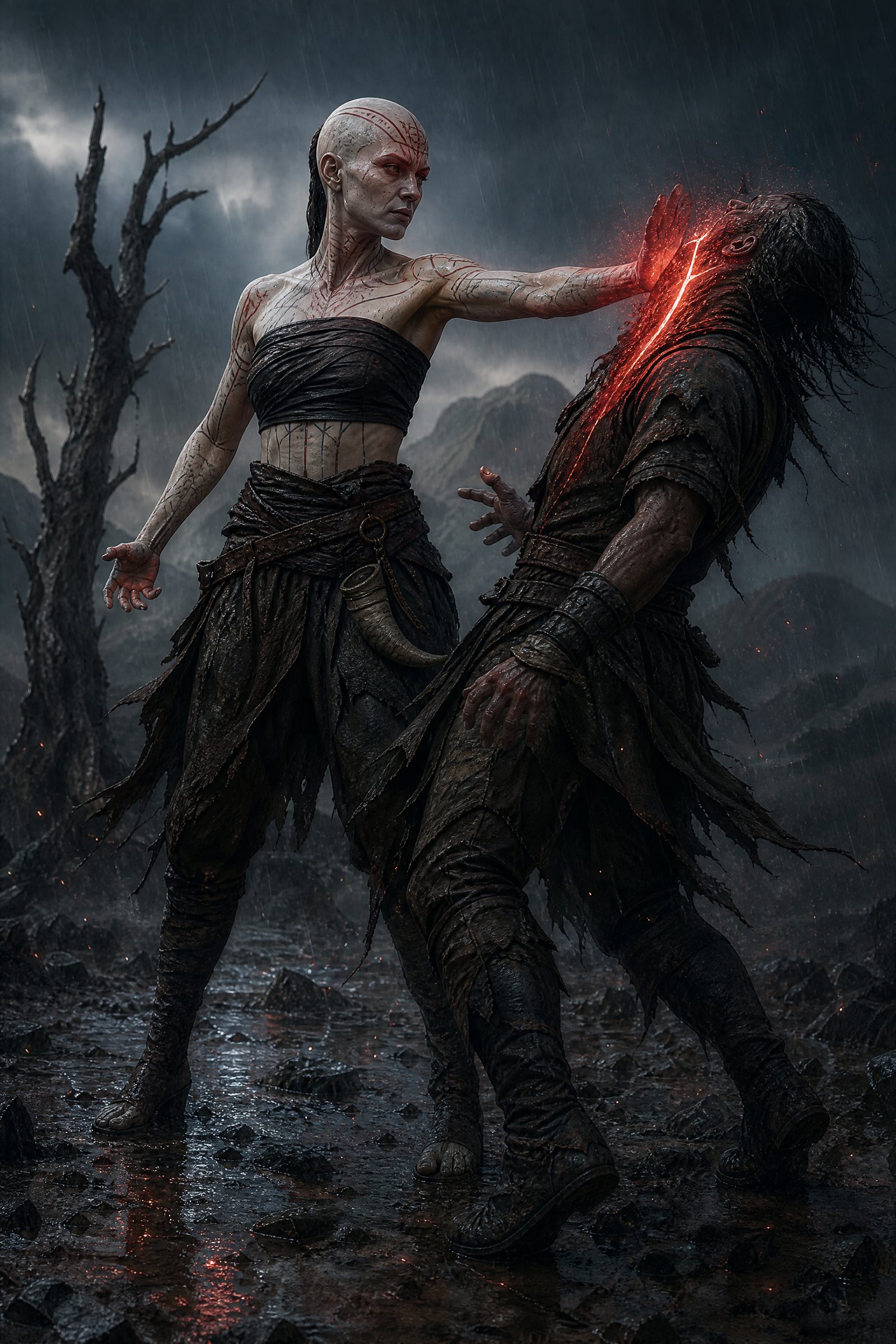
Campaign rules apply. Thirteen spells are banned, two are modified, and every spellcaster uses spell points instead of spell slots in this campaign — see Campaign Rules. This document already conforms: banned spells have been removed and replaced at the same level, modified spells are annotated where they appear, and spell slots have been converted to spell points.
Identity
An attrition fighter who writes power into their own skin and pays for it in Hit Point maximum.
The oldest story your teachers tell has no name in it: someone hung nine nights on a tree in the wind, wounded and given to themselves, and at the end did not receive the staves — they took them up, screaming, and fell back down. Every Reddened knows the lesson by heart: this power is not granted. It is taken, the taking costs, and the cost is paid in the only surface you actually own. In a story you are the one who arrives already decided — marked, a little diminished, and very hard to stop.
A stave is a true name. Cut a true name into a surface and the surface acquires what the name says — this is not metaphor, it is the craft, and it is why a stave cut into a doorframe keeps what it keeps and a stave cut into you keeps what it keeps. You started with a mark on the back of one hand, done with a bone needle and ash, and you were sick for two days afterward. There are more now. Your Staves are permanent: eight sites on a body, eight marks a lifetime, and a carver who runs out of skin has finished learning. The marks lie dormant as grey scarwork until you red them — ochre worked into the lines, and blood when the ochre isn’t enough. A reddened stave is awake and you can feel it, the way you can feel a splinter. It also means there is that much less of you to kill.
The Reddened is an attrition fighter who buys capability with Hit Point maximum and then makes the fight go long enough to be worth it. Your baseline weapon is the Graven Strike, a blow that cuts a mark into whatever it lands on; your identity is the Reddening, the standing decision about how many of your staves are awake today and how much of your body you are prepared to spend keeping them that way. Constitution is not your furnace — that belongs to another discipline. Constitution is how much writing you can bear.
This class belongs to the monk-caster family and is built to SPEC: Qi points, a Surge (here the Graven Strike), Martial Arts, Unarmored Movement and Mystic Arcanum. Its power is inscribed — written into the body, not generated inside it, conducted through it from outside, or given in return for devotion. Its cost is standing, not transactional. The Reddening is a flat reduction in Hit Point maximum for as long as a stave is awake, paid to nothing and to no one. Paying a price each time a power is used, to the current, is the Tithed Fist‘s shape; a Reddened feature that charges Hit Points per use of an effect has crossed into it.
Class Overview
| Primary Abilities | Dexterity and Constitution |
| Hit Point Die | d8 per Reddened level |
| Saving Throws | Strength and Dexterity |
| Skills | Choose 2: Athletics, History, Insight, Intimidation, Medicine, Religion, or Survival |
| Weapons | Simple weapons |
| Armor | None |
| Tools | Leatherworker’s Tools (needles, ochre, bone) |
| Starting Equipment | Leatherworker’s Tools, a bone needle-case and three stoppered horns of ochre, a wax tablet of practice-cuts, an Explorer’s Pack, and 10 GP |
| Spellcasting | Half-caster, the Reddened spell list (closed; mostly Primal, centred on Abjuration, Divination and Transmutation, plus one Enchantment worked by naming aloud), Constitution, prepared, Long Rest spell points |
Reddened Table
| Level | Proficiency Bonus | Martial Arts Die | Qi | Staves | Reddened | Cantrips | Features | Spell Points | Max Spell Level |
|---|---|---|---|---|---|---|---|---|---|
| 1 | +2 | 1d6 | 1 | — | — | — | Martial Arts, Unarmored Defense, Qi Points, Graven Strike | — | — |
| 2 | +2 | 1d6 | 2 | 2 | 2 | 1 | Spellcasting, Utility Cantrips, Staves, The Reddening, Unarmored Movement, Flurry of Blows, Step of the Wind | 4 | 1st |
| 3 | +2 | 1d6 | 3 | 2 | 2 | 1 | Stave Row, Deflect Attacks | 6 | 1st |
| 4 | +2 | 1d6 | 4 | 2 | 2 | 1 | Ability Score Improvement | 6 | 1st |
| 5 | +3 | 1d8 | 5 | 3 | 3 | 1 | Extra Attack | 14 | 2nd |
| 6 | +3 | 1d8 | 6 | 3 | 3 | 1 | Row Feature, Empowered Strikes | 14 | 2nd |
| 7 | +3 | 1d8 | 7 | 4 | 3 | 2 | Evasion | 17 | 2nd |
| 8 | +3 | 1d8 | 8 | 4 | 3 | 2 | Ability Score Improvement | 17 | 2nd |
| 9 | +4 | 1d8 | 9 | 5 | 4 | 2 | Iron and Ochre | 27 | 3rd |
| 10 | +4 | 1d8 | 10 | 5 | 4 | 2 | Self-Restoration | 27 | 3rd |
| 11 | +4 | 1d10 | 11 | 5 | 4 | 2 | Row Feature, Deep Carving | 32 | 3rd |
| 12 | +4 | 1d10 | 12 | 6 | 4 | 2 | Ability Score Improvement | 32 | 3rd |
| 13 | +5 | 1d10 | 13 | 6 | 5 | 3 | Mystic Arcanum (6th level) | 38 | 4th |
| 14 | +5 | 1d10 | 14 | 6 | 5 | 3 | The Unquenched | 38 | 4th |
| 15 | +5 | 1d10 | 15 | 7 | 5 | 3 | The Ninth Night | 44 | 4th |
| 16 | +5 | 1d10 | 16 | 7 | 5 | 3 | Ability Score Improvement, Mystic Arcanum (7th level) | 44 | 4th |
| 17 | +6 | 1d12 | 17 | 7 | 6 | 3 | Row Feature | 57 | 5th |
| 18 | +6 | 1d12 | 18 | 8 | 6 | 3 | Written Through | 57 | 5th |
| 19 | +6 | 1d12 | 19 | 8 | 6 | 3 | Epic Boon, Mystic Arcanum (8th level) | 64 | 5th |
| 20 | +6 | 1d12 | 20 | 8 | 6 | 3 | Taken, Not Given | 64 | 5th |
Prepared spells by level: 2 (L2), 3, 4, 5, 6, 6, 7, 8, 9, 9, 10, 10, 11, 11, 12, 12, 13, 13, 14, 14 (L20).
Unarmored Movement by level: +10 ft (2), +15 (6), +20 (10), +25 (14), +30 (18), plus vertical surfaces and liquids from level 9.
Class Features
Martial Arts
Level 1
Your practice grants you these benefits while you are unarmed or wielding a simple weapon and you aren’t wearing armor or wielding a Shield:
- Dexterity. You can use Dexterity instead of Strength for the attack and damage rolls of your Unarmed Strikes and simple weapons.
- Martial Arts Die. You can roll 1d6 in place of the normal damage of your Unarmed Strike or simple weapons. This die changes as you gain Reddened levels, as shown in the Martial Arts Die column.
- Bonus Unarmed Strike. When you take the Attack action on your turn, you can make one Unarmed Strike as a Bonus Action.
Unarmored Defense
Level 1
While you aren’t wearing armor or wielding a Shield, your base Armor Class equals 10 plus your Dexterity and Constitution modifiers.
Qi Points
Level 1
You have a number of Qi Points equal to your Reddened level, as shown in the Qi column. You regain all expended Qi Points when you finish a Short or Long Rest.
Qi Save DC. Some Reddened features require a saving throw. The DC equals 8 + your Proficiency Bonus + your Constitution modifier — the same number as your spell save DC.
A Reddened’s Qi is what is still moving under the ink.
Graven Strike (the Surge)
Level 1
Once on each of your turns, immediately after you hit a creature with an Unarmed Strike or a simple weapon, you can spend Qi Points to cut a mark into it and add extra damage to that hit as a free rider. This costs no action, Bonus Action, or Reaction, and doesn’t replace any other part of your turn.
Graven Strike costs 1 Qi Point at levels 1–10, 2 at levels 11–16, and 3 at levels 17–20. Roll a number of your Martial Arts dice and add your Constitution modifier; the extra damage is Force damage or the strike’s own type (your choice). The number of dice is 1 at levels 1–10, 3 at levels 11–16, and 5 at levels 17–20. At levels 17–20 you do not add your Constitution modifier.
Form — The Carried Mark. When you use Graven Strike, you can leave the mark open on the target. To do so at levels 1–16, you forgo adding your Constitution modifier to the damage; at levels 17–20, where Graven Strike adds no modifier, you instead roll one fewer of its dice. The next time any creature deals damage to the target before the start of your next turn, that damage increases by one roll of your Martial Arts die. A creature can carry only one open mark at a time.
The mark closes over in about a minute and leaves nothing. What it does in the meantime is make the target easier for everyone else to read.
Spellcasting
Level 2
Singing a stave is not petition and it is not bargaining. It is saying a thing’s name correctly and loudly enough that the thing has to agree.
Spells Prepared. You prepare the list of Reddened spells available for you to cast, choosing from the Reddened spell list. You prepare the number shown in the Prepared Spells note under the Reddened table, and the spells must be of a level no higher than your Max Spell Level. Whenever you finish a Long Rest, you can replace one prepared spell with another.
Spell Points. This campaign uses spell points in place of spell slots (see Campaign Rules). Your pool is shown in the Spell Points column of the class table, and the Max Spell Level column shows the highest level of spell you can cast from it (1st at level 2, 2nd at 5, 3rd at 9, 4th at 13, 5th at 17). To cast a spell of 1st level or higher, spend spell points equal to its cost — 1st 2, 2nd 3, 3rd 5, 4th 6, 5th 7. You can cast a spell at any higher level up to your Max Spell Level by paying that level’s cost, and it takes effect as a higher-level version, exactly as the spell describes. You regain all spent spell points when you finish a Long Rest. Your spell points and your Qi points are separate pools: neither can pay for the other, and they recover on their own schedules. You can never spend spell points on a spell of 6th level or higher — those come only from Mystic Arcanum. If you also have long-rest spell points from another class, combine them as described under Multiclassing.
Spellcasting Ability. Constitution is your spellcasting ability.
- Spell save DC = 8 + your Proficiency Bonus + your Constitution modifier
- Spell attack modifier = your Proficiency Bonus + your Constitution modifier
Spellcasting Focus. Your needle-case, or any stave inked on your own body.
Utility Cantrips
Level 2
Your magic refuses to trickle into damage — a stave that merely stings is a stave cut wrong — but it can be shaped to small, useful ends. You learn 1 cantrip from the Reddened cantrip list, a 2nd at level 7, and a 3rd at level 13. You can’t learn a cantrip that makes an attack roll, deals damage, or imposes a saving throw to avoid damage. Constitution is your spellcasting ability for them. Whenever you gain a level in this class, you can replace one with another eligible cantrip.
Staves
Level 2
You bear staves cut into your skin. You know the number shown in the Staves column, chosen from the Stave list later in this document, and you gain more as you level. Whenever you gain a Reddened level you can replace one stave you know with another for which you qualify — this takes an hour of work and leaves the old site grey.
The eight sites. A body has eight places a stave will hold: brow, throat, chest, back, left arm, right arm, hands, feet. Each site bears one stave, which is why no Reddened ever knows more than eight. Choose a site for each stave when you take it; some staves specify their site, and the Stave list groups them accordingly.
A stave is permanent. It is visible. It cannot be concealed by anything short of magic or a great deal of cloth, and people who know what they are looking at will read you across a room.
The Reddening
Level 2
A stave lies dormant as grey scarwork until you wake it. Reddening a stave takes 10 minutes and works ochre — and, when the ochre is not enough, your own blood — into the lines.
- You can have a number of staves reddened at once shown in the Reddened column of the table.
- While a stave is reddened, your Hit Point maximum is reduced by 2. This reduction lasts until you quench the stave.
- Quenching a stave takes 1 minute and can be done at any time; the stave goes grey and the Hit Point maximum reduction ends.
- Reddened staves stay reddened through rests, through unconsciousness, and through death. They do not go out on their own.
A stave does nothing at all while dormant. Only reddened staves grant their benefits, and only reddened staves can be Quickened.
Quickening. Some staves have an active effect marked (Quicken), fired by spending the listed Qi Points. A stave must be reddened to be Quickened.
The whole class in one sentence: every morning you decide how much of your body to spend, and you cannot change your mind cheaply.
Unarmored Movement
Level 2
While you aren’t wearing armor or wielding a Shield, your Speed increases by 10 feet. This bonus increases to 15 feet at level 6, 20 feet at level 10, 25 feet at level 14, and 30 feet at level 18.
Starting at level 9, you can move along vertical surfaces and across liquids on your turn without falling during that move. Carvers call this “walking the hanging tree.”
Flurry of Blows
Level 2
You can spend 1 Qi Point to make two Unarmed Strikes as a Bonus Action.
Step of the Wind
Level 2
You can spend 1 Qi Point to take the Disengage or Dash action as a Bonus Action, and your jump distance is doubled for the turn.
Stave Row
Level 3
Staves fall into families, set out in rows, and every carver eventually belongs to one row more than the others. Choose Row of the Helm, Row of the Wayfinder, Row of the Boar, Row of the Ash, Row of the Millstone, or Row of the Cauldron. You gain features from it at levels 3, 6, 11, and 17.
Your Row grants you one stave immediately. It does not count against your Staves known, it occupies no site, and it is always reddened at no Hit Point cost. It is the mark you were given rather than the ones you chose.
Deflect Attacks
Level 3
When you are hit by a Melee or Ranged attack that deals Bludgeoning, Piercing, or Slashing damage, you can take a Reaction to reduce the damage by 1d10 plus your Dexterity modifier and your Reddened level.
If you reduce the damage to 0, you can expend 1 Qi Point to cut the force loose. One creature you can see within 30 feet must succeed on a Dexterity saving throw against your Qi save DC or take Force damage equal to two rolls of your Martial Arts die plus your Constitution modifier.
Ability Score Improvement
Levels 4, 8, 12, and 16
You gain the Ability Score Improvement feat or another feat of your choice for which you qualify.
Extra Attack
Level 5
You can attack twice, instead of once, whenever you take the Attack action on your turn.
Empowered Strikes
Level 6
When you hit with an Unarmed Strike, you can choose for it to deal Force damage instead of its normal damage type.
Evasion
Level 7
When you’re subjected to an effect that allows you to make a Dexterity saving throw to take only half damage, you instead take no damage on a success and only half damage on a failure. You can’t use this feature if you have the Incapacitated condition.
Iron and Ochre
Level 9
You have learned to cut shallower for the same result. The Hit Point maximum reduction for each reddened stave becomes 1 instead of 2.
In addition, reddening a stave now takes 1 minute rather than 10.
Self-Restoration
Level 10
Through sheer discipline, you can end one effect on yourself that is causing you to have the Charmed or Frightened condition. In addition, you no longer need food or drink of an ordinary kind, though you still need rest.
Deep Carving
Level 11
Once on each of your turns, when you Quicken a reddened stave, you can also Quicken a second, different reddened stave at the same time. Both must be Quickened with the same kind of action (both with a Bonus Action, both with a Magic action, both with a Reaction, or both with no action), and that one action covers both: the second stave takes no action of its own. The second stave’s own requirements (its trigger, range and target) must also be met. You pay each stave’s own Quicken cost plus 1 additional Qi Point.
Example: Quickening the Faltering Word and the Cold Read together takes one Bonus Action and costs 1 + 1 + 1 = 3 Qi Points.
Mystic Arcanum
Levels 13, 16, and 19
Three times in a career you cut something into yourself that should not hold — the carver’s ninth night. At level 13, choose one 6th-level spell from the Reddened spell list as your Arcanum. You can cast it once without spending spell points or Qi, and you regain the ability to do so when you finish a Long Rest. At level 16 you learn a 7th-level spell and at level 19 an 8th-level spell, each cast once per Long Rest in the same way. Each is a separate use.
Whenever you gain a level in this class, you can replace one of these spells with another of the same level from the Reddened spell list. They use Constitution as your spellcasting ability.
The Unquenched
Level 14
When you roll Initiative and have no Qi Points remaining, you regain Qi Points equal to your Constitution modifier (minimum 1).
In addition, your reddened staves can no longer be suppressed, dispelled, or turned off by any effect short of Wish. They are not magic laid on you. They are what you are made of now.
The Ninth Night
Level 15
When you are reduced to 0 Hit Points without being killed outright, you can choose to stay conscious and standing with 1 Hit Point instead. You gain one level of Exhaustion, and your Hit Point maximum is reduced by 5 until you finish a Long Rest.
Once you use this feature, you can’t use it again until you finish a Long Rest.
Written Through
Level 18
Your staves have run out of clean skin and started overlapping. You can have one additional stave reddened beyond your maximum, and the Hit Point maximum reduction for all your reddened staves becomes 0.
There is nothing left to pay with. That is not the same as it being free.
Epic Boon
Level 19
You gain an Epic Boon feat or another feat of your choice for which you qualify. Boon of Irresistible Offense or Boon of Fortitude are thematically apt.
Taken, Not Given
Level 20
Your Constitution or Dexterity score increases by 2, to a maximum of 24.
In addition, once per Long Rest as a Magic action you can hang yourself on the moment — you have the Incapacitated condition until the end of your next turn, and when it ends you may re-cut every stave you know: replace any number of your staves with any others you qualify for, red as many as your maximum allows, and regain all expended Qi Points.
The Stave List
Two staves exist for each of the eight sites; you choose which site each of your staves occupies, within the site it is listed under. (Reddened) effects apply passively while the stave is reddened. (Quicken N) effects cost N Qi Points and require the stave to be reddened.
Brow
The Watcher’s Eye. (Reddened) You have Advantage on Wisdom (Perception) checks, and while you are conscious, being surprised doesn’t give you Disadvantage on your Initiative roll.
The Cold Read. (Quicken 1, Bonus Action) Choose a creature you can see within 60 feet. You learn its damage vulnerabilities, resistances and immunities, and whether it currently has Legendary Resistance uses remaining.
Throat
The Faltering Word. (Quicken 1, Bonus Action) One creature within 30 feet that can hear you makes a Constitution saving throw against your Qi save DC. On a failed save, it has Disadvantage on the next attack roll it makes before the start of your next turn.
The Oath-Cut. (Reddened) You have Advantage on saving throws against being Charmed. In addition, when a creature you can hear makes a promise or swears an oath, you know whether it intends to keep it. You learn nothing else about its thoughts.
Chest
The Ash-Rooted. (Reddened) You can’t be moved against your will or given the Prone condition by any effect that doesn’t also deal damage to you.
The Kept Wound. (Quicken 2, Reaction when you take damage) Reduce the damage by twice your Constitution modifier. An amount equal to the damage you prevented is instead subtracted from your Hit Point maximum until you finish a Long Rest.
Back
The Nine Nights. (Reddened) While you are below half your Hit Point maximum, you gain a +2 bonus to all saving throws.
The Burden-Borne. (Reddened; prerequisite: level 9) When a creature within 5 feet of you takes damage, you can use your Reaction to take half of it instead. The damage you take this way can’t be reduced or prevented.
Left Arm
Boar-Bristle. (Reddened) The first time on each of your turns that you hit a creature within 5 feet of one of your allies, the attack deals extra damage equal to your Proficiency Bonus.
The Grinding Mark. (Quicken 1, once per turn on a hit) Until the start of your next turn, the target’s Speed is reduced by 10 feet and it can’t take the Disengage action.
Right Arm
The Ready Hand. (Quicken 1, Reaction) When a creature within 5 feet of you hits you with a Melee attack, make one Unarmed Strike against it.
The Held Thing. (Reddened) A creature has Disadvantage on its saving throw against your Grapple, and a creature you have Grappled can’t teleport or use planar travel.
Hands
Needle and Ash. (Reddened) You can cut a temporary stave into a willing creature over 10 minutes. Choose one: it gains a +1 bonus to AC, or Advantage on saving throws against one damage type you name. The stave lasts 8 hours, one creature at a time, and reduces that creature’s Hit Point maximum by 2 for the duration.
Stonecutter. (Reddened) You can carve a stave into any nonmagical surface in 1 minute. Choose Alarm, Arcane Lock, or a mark legible only to those you name; it lasts 24 hours. You can have one such carving active at a time.
Feet
Wayfooted. (Reddened) Difficult terrain that isn’t magical costs you no extra movement, and you leave no tracks unless you choose to.
The Long Stride. (Quicken 1, no action, once per turn) Teleport up to 15 feet to an unoccupied space you can see.
Rows
A Row is the Reddened’s subclass: one family of staves — dread, direction, formation, ordeal, attrition or the sung stave — that you belong to more than the others. You choose one with the Stave Row feature, which grants you its stave at once and its further features at the levels listed there. A Row is a kind of writing you carry, not a power you serve, and nothing in it needs a god, a people or a place to exist. Each world gives the six Rows its own names (see In Different Worlds).
Row of the Helm
“They are looking at the mark between my eyes. Good. Then they are not looking at my hands.”
The Dread Helm sits between the brows and does the oldest work a stave knows: it makes the thing in front of you decide, very quickly, that this is not worth it.
The Dread Helm
Level 3
Granted stave. This stave is always reddened; it occupies no site, costs no Hit Points, and doesn’t count against your Staves known.
(Reddened) You have Advantage on Charisma (Intimidation) checks. (Quicken 1, Bonus Action) Each creature of your choice within 10 feet makes a Wisdom saving throw against your Qi save DC or has the Frightened condition (of you) until the end of your next turn.
Terror Cut
Level 6
Once on each of your turns when you hit a creature that is Frightened of you, the attack deals extra Psychic damage equal to one roll of your Martial Arts die.
A creature Frightened by your Dread Helm can’t willingly move to within 5 feet of you.
The Unlooked-At
Level 11
While at least three of your staves are reddened (your Dread Helm, which is always reddened, counts as one of them), attack rolls against you from creatures that are Frightened of you have Disadvantage, and you have Resistance to Psychic damage.
Helm-Wearer
Level 17
As a Magic action, you unhood the mark fully for 1 minute. Each creature of your choice that starts its turn within 30 feet of you and can see you makes a Wisdom saving throw against your Qi save DC. On a failed save, it has the Frightened condition until the start of its next turn, and the first time it fails this save it takes 4d10 Psychic damage.
Once you use this feature, you can’t use it again until you finish a Long Rest.
Playing a Row of the Helm: you are the reason the room goes quiet, and you will have to decide whether you enjoy that.
Row of the Wayfinder
“The weather does not care where you were going. The stave does.”
The Inner Compass keeps a traveller from losing the way in foul weather, and the carvers who wear it have extended the idea considerably: a way is a way, whether through a storm, a city, or an argument.
The Inner Compass
Level 3
Granted stave. This stave is always reddened; it occupies no site, costs no Hit Points, and doesn’t count against your Staves known.
(Reddened) You always know which way is north, how long until the next sunrise or sunset, and the direction of any place you have physically stood before.
Reader of Signs
Level 6
You gain proficiency in Survival and Investigation if you don’t have it, and your Proficiency Bonus is doubled for any check you make to read writing, follow tracks, or navigate.
(Quicken 1, Magic action) You learn the general direction and rough distance of the nearest creature or object you name specifically and have seen before, within 1 mile.
Foul Weather
Level 11
You and up to five companions ignore the effects of extreme heat, extreme cold, and heavy precipitation, and can travel at a fast pace without penalty.
In addition, once per Short or Long Rest as a Magic action, you can carve a way-mark that lets you and up to five willing creatures within 10 feet ignore all nonmagical difficult terrain for 1 hour.
The Road Cut Short
Level 17
As a Magic action taking 10 minutes to carve, you and up to five willing creatures within 30 feet travel to any location within 10 miles that you have physically stood before, arriving in unoccupied spaces near it. The journey is along real ground at impossible speed and can be interrupted.
You can use this feature twice per Long Rest.
Playing a Row of the Wayfinder: you are the reason the party arrives, and the campaign’s geography is going to have to work harder because of you.
Row of the Boar
“The wedge. Two at the tip, four behind, and nobody turns round.”
The boar’s-snout formation puts the two hardest people at the point and lets the rest of the line arrive intact. You are one of the two. The stave is cut across the shoulders so the people behind you can see it.
The Boar’s Snout
Level 3
Granted stave. This stave is always reddened; it occupies no site, costs no Hit Points, and doesn’t count against your Staves known.
(Reddened) While at least one ally is within 5 feet of you, you and that ally each gain a +1 bonus to AC.
Wedge
Level 6
Once on each of your turns when you hit a creature, you can spend 1 Qi Point to let one ally within 30 feet who can see you move up to half its Speed without provoking Opportunity Attacks. If that movement ends within 5 feet of the creature you hit, the ally gains Temporary Hit Points equal to your Constitution modifier.
Nobody Turns Round
Level 11
While you are conscious, allies within 10 feet of you can’t be given the Frightened condition, and when damage would reduce an ally within 10 feet of you to 0 Hit Points, you can take a Reaction to give it Temporary Hit Points equal to twice your Proficiency Bonus; they apply to that damage.
Once you use the Reaction part of this feature, you can’t use it again until you finish a Short or Long Rest.
The Golden Charge
Level 17
As a Bonus Action, you create a 15-foot Emanation of bristling golden light around yourself for 1 minute. Allies of your choice in the Emanation have their Speed increased by 10 feet, can’t have their Speed reduced, and deal extra damage equal to your Proficiency Bonus the first time each turn they hit a creature within 5 feet of another ally.
Once you use this feature, you can’t use it again until you finish a Long Rest.
Playing a Row of the Boar: your damage is not the point, and you will need to make peace with that early.
Row of the Ash
“Nine nights on the tree, and whoever hung there did not die and did not stop. Those are two separate achievements.”
The ash tree is the ordeal-stave: the staves taken by hanging, wounded, given to oneself. Carvers of this row cut deeper than is wise and are very hard to finish.
The Hanging Tree
Level 3
Granted stave. This stave is always reddened; it occupies no site, costs no Hit Points, and doesn’t count against your Staves known.
(Reddened) You have Advantage on Death Saving Throws, and when you roll Hit Dice to regain Hit Points you treat any roll of 1 or 2 as a 3.
Given to Myself
Level 6
As a Bonus Action, you can reduce your Hit Point maximum by 5 to regain 1 expended Qi Point per 5 Hit Points spent, up to your Proficiency Bonus in Qi Points. The reduction lasts until you finish a Long Rest.
What Does Not Kill
Level 11
For every 10 Hit Points by which your Hit Point maximum is currently reduced (from reddening, from Given to Myself, or from any other source), you gain a +1 bonus to damage rolls with Unarmed Strikes and simple weapons, to a maximum of +3.
Wounded With My Own Spear
Level 17
Once per Long Rest as a Bonus Action, you hang for nine breaths: until the end of your next turn you have Immunity to all damage, you can’t be Incapacitated, and you automatically succeed on saving throws.
When the effect ends, your Hit Point maximum is reduced by 20 until you finish a Long Rest, and you regain all expended Qi Points.
Playing a Row of the Ash: you are running an economy nobody else at the table can read, and the DM should be told once, clearly, how it works.
Row of the Millstone
“The mill ground out gold, then peace, then an army. It was never going to stop. That was the deal.”
The mill that grinds whatever it is asked for and cannot be told to stop. This row is attrition made into a discipline: you do not hit hardest, you hit for longest, and the thing in front of you gets steadily worse at being alive.
The Second Turn
Level 3
Granted stave. This stave is always reddened; it occupies no site, costs no Hit Points, and doesn’t count against your Staves known.
(Reddened) The first time on each of your turns that you hit a creature you also hit on your previous turn, the attack deals extra damage equal to your Proficiency Bonus.
Ground Down
Level 6
When you use Graven Strike against a creature, it has Disadvantage on the next saving throw it makes before the start of your next turn.
The Mill Does Not Stop
Level 11
Once on each of your turns when you hit a creature with the open mark from your Carried Mark form, you regain 1 Qi Point.
In addition, when you reduce a creature to 0 Hit Points, your next Graven Strike before the end of your next turn costs no Qi Points.
Both Stones Turning
Level 17
As a Bonus Action, you set the mill turning for 1 minute. For the duration, Graven Strike costs you 1 Qi Point regardless of tier, and once on each of your turns you can apply Graven Strike to a second creature you hit in the same turn at the same cost.
Once you use this feature, you can’t use it again until you finish a Long Rest.
Playing a Row of the Millstone: you win the fights other people would have lost in round six, and you are insufferable about round six.
Row of the Cauldron
“They called the mead the stirrer of inspiration. The thief stole it in the shape of a bird and spat most of it out over the wall — the rest, they say, he lost out the other end. That is where bad poets come from.”
The mead of song, brewed in a cauldron from a murdered wise man’s blood and honey. This row carries the sung tradition: the stave sung rather than cut, and the carver who can put something back into a person.
The Brimming Cauldron
Level 3
Granted stave. This stave is always reddened; it occupies no site, costs no Hit Points, and doesn’t count against your Staves known.
(Reddened) You know one additional language, and you have Advantage on Charisma (Performance) checks. (Quicken 1, Bonus Action) One creature within 30 feet that can hear you gains Temporary Hit Points equal to one roll of your Martial Arts die + your Constitution modifier.
The Drink Passed Round
Level 6
When you finish a Short Rest, you can sing over up to six creatures who rested with you. Each regains Hit Points equal to one roll of your Martial Arts die + your Constitution modifier, and can end one effect on itself causing the Frightened condition.
The Sage’s Blood
Level 11
Once on each of your turns when you hit a creature, you can spend 1 Qi Point to restore Hit Points to one creature you can see within 30 feet equal to one roll of your Martial Arts die + your Constitution modifier. A creature can benefit from this only once per turn.
The Mead Shared Out
Level 17
Once per Long Rest as a Magic action, choose up to six creatures you can see within 30 feet. Each regains 4d8 Hit Points plus your Constitution modifier, gains Advantage on all saving throws until the end of your next turn, and can end one effect on itself causing the Charmed, Frightened, or Poisoned condition.
Playing a Row of the Cauldron: you are the only Reddened anyone is pleased to see, and you should use that.
Reddened Spell List
You prepare your spells only from this list. It is a closed list: every spell you prepare of 1st through 5th level comes from it, and the DM does not add others. It holds 75 spells (17 / 22 / 16 / 10 / 10 at 1st–5th level, about three-quarters of the 2024 Player’s Handbook Sorcerer list at each level), sorted alphabetically within each level. It is drawn mostly from the Primal list (the 2024 Druid and Ranger lists) and centred on Abjuration, Divination and Transmutation, plus one Enchantment that works by naming a thing aloud (Dominate Beast). A Reddened’s magic wards, endures, reads and reshapes; it does not conjure beasts, and below the Mystic Arcanum it does not burn things down. The 6th-, 7th- and 8th-level entries are Mystic Arcanum options only — they are never prepared and can’t be cast with spell points.
Exceptions. The utility cantrips sit outside the three schools, as every monk-caster’s do (Light is Evocation, Spare the Dying Necromancy). Five levelled spells are outside the three schools: Silence (Illusion), Daylight, Wind Wall and Wall of Stone (Evocation), and Contagion (Necromancy). The Mystic Arcanum options range wider still: Sunbeam, Fire Storm, Whirlwind and Sunburst are Evocation, and Wall of Thorns and Tsunami are Conjuration. Light, Comprehend Languages, Feather Fall, Legend Lore and Passwall come from the Arcane or Divine list rather than the Primal one. Class additions: the Primal list holds too few Abjuration, Divination and Transmutation spells that are neither healing nor damage to reach the list’s size, so these spells of the three schools come from the other lists: Detect Evil and Good, Expeditious Retreat, Identify, Sanctuary, Shield and Shield of Faith (1st); Alter Self, Arcane Lock, Blindness/Deafness, Detect Thoughts, Knock, Levitate, See Invisibility, Spider Climb and Warding Bond (2nd); Clairvoyance, Gaseous Form, Magic Circle, Remove Curse, Slow and Tongues (3rd); Death Ward, Fabricate and Mordenkainen’s Private Sanctum (4th); and Commune (5th). Sources: every spell is from the 2024 Player’s Handbook except Absorb Elements and Whirlwind, which are from Xanathar’s Guide to Everything.
Utility cantrips (non-damaging only). Druidcraft, Elementalism, Guidance, Light, Mending, Message, Resistance, Spare the Dying.
1st level (17). Absorb Elements, Alarm, Comprehend Languages, Detect Evil and Good, Detect Magic, Detect Poison and Disease, Expeditious Retreat, Feather Fall, Identify, Jump, Longstrider, Protection from Evil and Good, Purify Food and Drink, Sanctuary, Shield, Shield of Faith, Speak with Animals.
2nd level (22). Aid, Alter Self, Arcane Lock, Augury, Barkskin, Beast Sense, Blindness/Deafness, Darkvision, Detect Thoughts, Enhance Ability, Enlarge/Reduce, Knock, Lesser Restoration, Levitate, Locate Animals or Plants, Locate Object, Pass without Trace, Protection from Poison, See Invisibility, Silence, Spider Climb, Warding Bond.
3rd level (16). Clairvoyance, Daylight, Dispel Magic, Gaseous Form, Magic Circle, Meld into Stone, Nondetection, Plant Growth, Protection from Energy, Remove Curse, Slow, Speak with Plants, Tongues, Water Breathing, Water Walk, Wind Wall.
4th level (10). Control Water, Death Ward, Divination, Dominate Beast, Fabricate, Freedom of Movement, Locate Creature, Mordenkainen’s Private Sanctum, Stone Shape, Stoneskin.
5th level (10). Antilife Shell, Awaken, Commune, Commune with Nature, Contagion, Greater Restoration, Legend Lore (campaign-modified: it reveals where the knowledge physically resides, not the knowledge itself), Passwall, Scrying, Wall of Stone.
Mystic Arcanum options.
- 6th level: Heal, Move Earth, Sunbeam, Wall of Thorns
- 7th level: Fire Storm, Regenerate, Reverse Gravity, Whirlwind
- 8th level: Control Weather, Earthquake, Sunburst, Tsunami
Flagged for the DM: Stone Shape, Passwall, Meld into Stone and Fabricate all reward a class that carves. Expect a Reddened to solve architecture. That is intended; the spell list is deliberately thin on direct damage to pay for it.
Multiclassing
Prerequisite: Dexterity 13 and Constitution 13.
What you gain: proficiency with simple weapons; Martial Arts and Unarmored Defense if you don’t already have them; Qi Points (this class’s Qi entry), Staves and a Reddened maximum sized to your Reddened levels only. Your Martial Arts die and Graven Strike dice are set by your Reddened level, not your character level.
Qi from more than one class. If another class in this library also gives you Qi points, or the Monk class gives you Focus Points, you have a single pool of Qi points; your Monk features spend it as Focus Points. Its maximum is the total of each class’s Qi or Focus entry for your level in that class (including any feature that raises a class’s maximum). A feature from any of those classes can spend from it. Each class’s share recovers by that class’s own rule, and a feature that reduces one class’s maximum reduces only that class’s share. Each feature keeps its own limits (once per turn, Surge dice, and so on). While your pool combines more than one class, you can use each class’s Surge no more times between one rest and the next than your level in that class. A feature that restores all of a class’s Qi or Focus Points restores no more than that class’s entry.
Reddened spell points combine with other long-rest spell point pools under the standard multiclass spellcaster rules (see the multiclass spell point table in Campaign Rules); your Mystic Arcanum uses do not.
Note for the Furnace Adept. Both classes cast on Constitution, and the combination is legal and tempting. It is also the single worst durability build in the library: a Furnace Adept/Reddened runs two d8 classes on one Constitution score and then voluntarily reduces its Hit Point maximum. It works. It is not good.
In Different Worlds
Setting layer. Everything above this heading works unchanged in each of these worlds; only names, looks and stories differ. Names here are setting names, each mapped to the neutral name the rules use.
Mythic culture — Norse-inspired (the class’s origin)
Who has it. Rune-carvers of the northern farmsteads and war-bands who cut their own skin rather than wood or stone. Their precedent is Odin, who hung nine nights on the windy tree, wounded with his own spear, given to himself, and at the end did not receive the runes but took them up. They are called the Reddened because they stain what they cut.
What they call it. The class is the Reddened; staves are rune-staves; Rows are ættir (singular ætt), after the three families of eight into which the runic row divides. Spellcasting is galdr, the rune sung rather than cut, and the capstone is He Who Took Up the Runes.
How it looks and sounds. Grey scar-lines in the shapes of the old runes, reddened from a horn of ochre or a nicked thumb. The Ætt of the Helm wears Ægishjálmur between the brows; Gullinbursti is a bristling golden glow around the point of the wedge; Galdr-Throat sounds like a word spat into the wind.
Story hook. A ship comes back from the west with eight crewmen, each bearing one fresh rune-stave, reddened, that none remembers cutting. Side by side the eight read as one inscription no carver recognises, and the jarl wants to know who cut it, and why.
Rules caveat. None. Odin is the class’s precedent, not its patron. No feature needs him to exist, answer or approve, and the Reddening is not a sacrifice: nothing receives it.
| Neutral name (rules) | Norse-inspired name |
|---|---|
| Row · Rows · Stave Row · Row Feature | Ætt · Ættir · Ætt · Ætt Feature |
| Row of the Helm · Wayfinder · Boar | Ætt of the Helm · Wayfinder · Boar |
| Row of the Ash · Millstone · Cauldron | Ætt of the Ash · Millstone · Cauldron |
| The Dread Helm · The Inner Compass · The Golden Charge | The Helm of Awe (Ægishjálmur) · Vegvísir · Gullinbursti |
| The Second Turn · Both Stones Turning | Grotti’s Turn · Fenja and Menja |
| The Brimming Cauldron · The Sage’s Blood | Óðrœrir · Kvasir’s Blood |
| The Faltering Word (Throat stave) · Taken, Not Given (level 20) | Galdr-Throat · He Who Took Up the Runes |
| staves · stave-carver · the sung stave · the mead of song | rune-staves · Rune-Carver · galdr · the mead of poetry |
| in the Row descriptions: the ash tree · the wedge · the mill · the thief | Yggdrasil · the svínfylking · Grotti · Odin |
Urban intrigue
Who has it. In one great river-city, the Reddened belong to the ink-houses: tattoo guilds whose members wear the house’s work as their credentials. Being written on by a house is how a dock-brawler becomes a bodyguard, and a bodyguard someone a duke will seat at the far end of the table.
What they call it. The class is the Signed. Staves are clauses; reddening one is going live; the Graven Strike is the signature. Rows are the six houses:
| Row | Ink-house |
|---|---|
| Helm · Wayfinder · Boar | House Glower · House Waybill · House Shoulder |
| Ash · Millstone · Cauldron | House Scar · House Grist · House Loving-Cup |
How it looks and sounds. Clauses are cut in black and edged in gold leaf. Going live is done with cinnabar ink that smells of hot iron, and a live clause shows a thin red line under the gold. High collars and long gloves are the fashion among the Signed, but a clause is still read across a ballroom by anyone who knows the houses. The signature lands with a sound like a seal pressed into wax.
Story hook. Someone has begun painting House Glower’s brow-clause onto hired thugs. The forgeries do nothing, but the city has stopped testing whether a Glower is bluffing. The house wants the forger found before somebody calls a real bluff.
Rules caveat. None. A painted forgery is not a stave and grants nothing.
Planar crossroads
Who has it. In a hub-city where doors open onto a dozen planes, the Reddened are travellers whose skin is the one document no gate can confiscate. A Lettered learns to stand so the right stave faces the right clerk.
What they call it. The class is the Lettered; staves are indelibles; the Reddening is wetting the ink; the Graven Strike is the stamp; the Inner Compass is the needle. Rows go by bazaar nicknames:
| Row | Nickname |
|---|---|
| Helm · Wayfinder · Boar | the Glare · the Lodestar · the Phalanx |
| Ash · Millstone · Cauldron | the Gallows · the Grind · the Ladle |
How it looks and sounds. Indelibles are drawn in the script of whatever plane the carver learned on: brass-coloured strokes, curling shadow-script, letters like knots of smoke. Wetting the ink uses whatever pigment the plane provides, so one arm may be cinnabar and the other soot.
Story hook. A delegation must cross four wards before the closing bell. One ward takes a brow-stave of the Glare as a declaration of war, and the Lettered escorting it wears one.
Rules caveat. The Inner Compass assumes a north and a sun. Where there are neither, the DM names one fixed bearing (the city’s spire) and one daily mark (the closing bell), and the stave reports those; for a place on another plane, the safe ruling is that it gives no direction. The Held Thing’s planar-travel ban and The Road Cut Short stand as written; the latter never crosses a plane.
Wilds and courts of the fey
Who has it. Mortals who went under the hill and came back written on. Fey skin forgets by morning, so a mortal who keeps a permanent stave is a curiosity and a status symbol, courted, collected and occasionally stolen.
What they call it. The class is the thorn-written. Staves are briars, cut with a blackthorn spine; the Reddening is keeping the thorn in and quenching is drawing it out. Rows are courtly titles:
| Row | Title |
|---|---|
| Helm · Wayfinder · Boar | the Frost-Glare · the Hedge-Path · the Tusk |
| Ash · Millstone · Cauldron | the Hanged Lord’s · the Mill under the Hill · the Dew-Cup |
How it looks and sounds. Briars are fine dark lines like bramble shadows. Kept in, they flush red and smell of crushed leaves; drawn out, they go the grey of old bark. The Golden Charge comes up as late-summer light.
Story hook. A courtier offers to carry a thorn-written’s price for a year and a day, for one favour to be named later. The offer is empty, but the courtier doesn’t know it, and the court will enforce the bargain anyway.
Rules caveat. None, with one note. The Reddening is not a bargain: nothing receives the Hit Point maximum a reddened stave costs, so no patron can waive, carry or collect it. A version in which one could would make a standing cost transactional — the Tithed Fist‘s shape, not this class’s. “Fey skin forgets” is this world’s story, not a rule: a fey-born character can take the class like anyone else, and here would be the rarest curiosity of all.
Origins and Inspiration
Inspiration, not setting. Nothing here is a rule, and nothing here is assumed by one.
The ordeal on the tree. In Hávamál 138–141 Odin says that he hung on a windy tree for nine whole nights, wounded with a spear and “given to Odin, myself to myself”, without bread or drink. At the end he looked down, took up the runes, screaming he took them (nam ek upp rúnar, æpandi nam), and fell back from there; the next stanzas give him nine mighty songs, a drink of the mead poured from Óðrerir, and the beginning of wisdom. The poem calls the tree only the one “of which no one knows from what roots it rises”; reading it as Yggdrasil is the usual inference (“Ygg’s horse”, Yggr being an Odin name), not a statement of the text. The class takes its core claim from this passage — the runes are taken, not given — and its capstone’s Norse-inspired name from stanza 139.
Cutting and reddening. Hávamál 144 asks the carver a run of questions — do you know how to cut, how to read, how to stain (fá)? — and staining is part of the craft. In Egils saga (ch. 44) Egill Skallagrímsson suspects a poisoned horn at a feast, cuts runes on it, stabs his palm and reddens the runes with his blood, and the horn bursts. Many runestones were painted, and traces of red pigment survive on some. Rjóða, “to redden”, gives the class its name.
Staves and rows. The class’s staves borrow the word and the look of the Icelandic galdrastafir, magical staves recorded in early-modern grimoires. The Elder Futhark’s twenty-four runes fall into three groups of eight, called ættir. The word is usually glossed “families”, though some scholars connect it with átta, “eight”; the split itself is old (some early inscriptions already show it), but the names of the groups come from later Icelandic tradition. That count of eight became the class’s eight body sites. Galdr is incantation, the sung or chanted side of rune-magic, often in the metre called galdralag.
Skin. There is no firm evidence that Norse people tattooed runes into skin, and the class’s skin-staves are an invention. The nearest real source is a single outsider’s account: Ibn Faḍlān, describing the Rūs on the Volga in 922, says each man was marked from his nails (or toes, in another reading) to his neck with dark green trees and figures. Whether he meant tattoos or paint is still debated.
The Rows and their touchstones
| Row (neutral) | Norse-inspired name | Mythic centre | Second touchstone | Alt-culture reskin |
|---|---|---|---|---|
| Helm | Ætt of the Helm | Ægishjálmur, the Helm of Awe | Fáfnir, who wore it and was killed anyway | Yoruba ojú inú |
| Wayfinder | Ætt of the Wayfinder | Vegvísir, the storm-signpost | The sunstone and the lodestone | Polynesian wayfinding |
| Boar | Ætt of the Boar | The svínfylking wedge | Gullinbursti | Greek othismos |
| Ash | Ætt of the Ash | Hávamál 138–141, the nine nights | Odin’s eye in Mímir’s well | South Asian tapas |
| Millstone | Ætt of the Millstone | Grottasöngr, Fenja and Menja | The Sampo of the Kalevala | Kaizen as menace |
| Cauldron | Ætt of the Cauldron | Óðrerir and the mead of poetry | The sumbl oath-round | Irish imbas forosnai |
- Helm. In Fáfnismál and the Völsunga saga the ægishjálmr (“helm of terror”) is something the dragon Fáfnir wore, and boasted of, before Sigurðr killed him anyway. The stave form, a ring of spiked arms, comes from early-modern Icelandic books of magic. One manuscript instruction is to press the sign in lead between the brows. Old Norse svipr, a sudden look or turn of the face, gives the Row its glare. Reskin: in a West African frame, the Yoruba ojú inú, the “inner eye”: insight, the discernment that sees past the surface, a concept still current in Yoruba thought and art criticism. The class borrows only its image and makes it a regard felt before it is seen; that turn is the class’s own, not the tradition’s.
- Wayfinder. Vegvísir is a nineteenth-century Icelandic stave from the Huld manuscript, glossed as keeping its bearer from losing the way in storms and bad weather; it is not a Viking-Age symbol, though it is often sold as one. The sólarsteinn (“sunstone”) appears in saga literature: in Rauðúlfs þáttr, King Óláfr holds one up on a snowy, overcast day to find where the sun is. That seafarers used such stones (perhaps Iceland spar) to navigate under cloud is a modern hypothesis, not a recorded practice. The leiðarsteinn is the lodestone. Reskin: in a Polynesian frame, wayfinding by star paths, swells and birds — a way held in the body rather than on a chart. It is a living practice, revived and taught today; the teaching “star compass” was developed in the modern Hawaiian voyaging revival.
- Boar. In Saxo Grammaticus’s Gesta Danorum, Odin teaches the wedge formation (two in front, then four, then eight) to Danish kings: Hadingus, and later Harald Wartooth, whom he afterwards betrays by teaching the same wedge to Harald’s enemy Ring before the battle of Brávellir. The Romans called the same shape caput porcinum, “pig’s head” (Vegetius). Gullinbursti is Freyr’s golden-bristled boar, made by the dwarf Brokkr and his brother (Sindri or Eitri, by manuscript), whose bristles light the night. Hildisvíni, “battle-swine”, is Freyja’s boar in Hyndluljóð — her favourite Óttarr in disguise, or so the giantess Hyndla claims. Reskin: in a Greek frame, the othismos of the hoplite line, the shove in which the man beside you is the whole tactic. How literal that shove was is still argued.
- Ash. The nine nights of Hávamál 138–141. Adam of Bremen (c. 1075) describes sacrificial victims hung in the grove beside the temple at Uppsala. Odin pledged one of his eyes in Mímir’s well for a drink of its wisdom (Völuspá 28 in the usual numbering; Gylfaginning). Reskin: in a South Asian frame, tapas, the heat generated by austerity, in which the ordeal itself is the power. It is a living idea in Hindu, Jain and Buddhist practice, and the class borrows only its shape.
- Millstone. In the Grottasöngr and Snorri’s prose frame for it, King Fróði buys two giantesses, Fenja and Menja, to turn the magic quern Grotti. They grind him gold, peace and plenty, but he will not let them rest, so they grind out an army against him instead. The poem foretells his fall; Snorri’s prose has the sea-king Mýsingr kill him, then set the women to grind salt until his ship sinks, which is why the sea is salt. The Sampo of the Kalevala is forged by Ilmarinen and grinds flour, salt and coin; it is fought over until it breaks in the sea. Hand-querns were everyday household equipment across the Norse world, turned mostly by women. Reskin: in a Japanese frame, kaizen — a modern management ideal of continuous improvement, used here as a joke about an improvement that never stops arriving.
- Cauldron. In Snorri’s Skáldskaparmál, the wise Kvasir, made from the spittle of two divine peoples at their truce, is murdered by the dwarves Fjalar and Galarr. They mix his blood with honey in three vessels: Óðrerir (also spelled Óðrœrir), a kettle, and Boðn and Són, two crocks. In Hávamál, Óðrerir seems to name the mead itself. Odin wins the mead from the giant Suttungr by way of Gunnlöð, flees as an eagle, and lets some fall behind him as he goes — “the rhymester’s share”, which is where bad poets come from. The sumbl is the formal drinking-round at which, as the poems and sagas tell it, boasts and oaths were spoken before witnesses and held binding. Reskin: in an Irish frame, imbas forosnai, described in Cormac’s Glossary: the poet chews the raw flesh of a pig, a dog or a cat, chants over it, and sleeps to receive the vision — at least honest about the cost.
How the material was adapted
The class began as a Norse rune-carver and kept that root, but no god, artefact or people now appears in its rules. Odin’s ordeal became an unnamed story that any world can tell about its first carver. The ættir became Rows, keeping the count of eight. The named staves — Ægishjálmur, Vegvísir, Gullinbursti, Grotti, Óðrerir — became plain descriptions of what each one does: dread, direction, a golden charge, a second turn, a brimming cauldron. Two things were kept as design rather than story. The power is inscribed: a true name cut into a surface. The cost is standing: Hit Point maximum given up for as long as a stave is awake, paid to nothing. Neither needs a cosmology; both survive every example above. The setting names now live in the Norse-inspired example, beside other worlds’ names for the same things, and the touchstones stay here as credit for where the shapes came from.
Playing a Reddened
The core dramatic question: how much of yourself will you overwrite? Eight sites, and a stave is permanent. Every one you take is a decision you cannot unmake, and the arc of the class is a person becoming a document. At level 2 you have two marks and a story about each. At level 18 you have eight, they overlap, and strangers read you before you speak.
The physicality of the power. Carving is slow and unpleasant and you do it yourself where you can reach, and ask a friend where you can’t. Reddening is worse: ten minutes of working ochre into old lines with a bone point until they take, and blood when the ochre won’t hold. A reddened stave itches. You will catch yourself scratching at your own chest in the middle of a negotiation. Nobody who has not done it understands why you don’t simply leave them all lit, and the answer is that you have tried, and it is a way of getting killed.
Origin prompts. Who cut your first stave, and did you ask them to? What is on the site you will not show anyone? Which stave did you replace, and what is the grey mark under the new one? What are you saving your last free site for?
Quirks (d6)
| d6 | Quirk |
|---|---|
| 1 | You red a stave before conversations you expect to go badly, and everyone has learned to read that. |
| 2 | You keep your ochre horns in a strict order and cannot be hurried while working. |
| 3 | You name your staves out loud when you wake them, quietly, like a roll call. |
| 4 | You will not let anyone touch the mark on your throat. |
| 5 | You practise cuts on a wax tablet whenever you are nervous, and the tablet is a mess. |
| 6 | You read every inscription you pass, out loud, including the boring ones. |
Bonds & Hooks (d6)
| d6 | Bond or hook |
|---|---|
| 1 | The carver who taught you is cutting staves into people who did not consent. |
| 2 | One of your marks is not one you chose, and you don’t remember the night you got it. |
| 3 | A rival wears the same stave on the opposite site and claims yours is upside down. |
| 4 | Someone is paying good money for a corpse with eight staves on it, intact. |
| 5 | You owe your last free site to someone who has not yet named what goes there. |
| 6 | A stave you quenched years ago has started itching again. |
The Arc
- Levels 1–4. Two marks, two sites used, and a daily decision that already matters: four points of Hit Point maximum is a lot when you have twenty.
- Levels 5–10. Extra Attack, Evasion, a Row, and at level 9 Iron and Ochre halves the price of everything — this is the tier where the class stops feeling like a tax and starts feeling like a toolkit.
- Levels 11–16. Deep Carving lets you fire two staves at once and the Arcanum arrives. You are running a standing wardrobe of five reddened marks and changing it between adventures rather than between fights.
- Levels 17–20. Written Through at 18 makes the reddening free, which is the payoff the whole class has been saving for. At 20 you can re-cut the entire set once a day.
Party role. A durable attrition fighter with a deep bench of always-on utility. Your damage is mid-table and your survivability is second only to the Anchorite. What you actually sell is that you arrive at every problem with the right four marks lit, because you thought about it this morning.