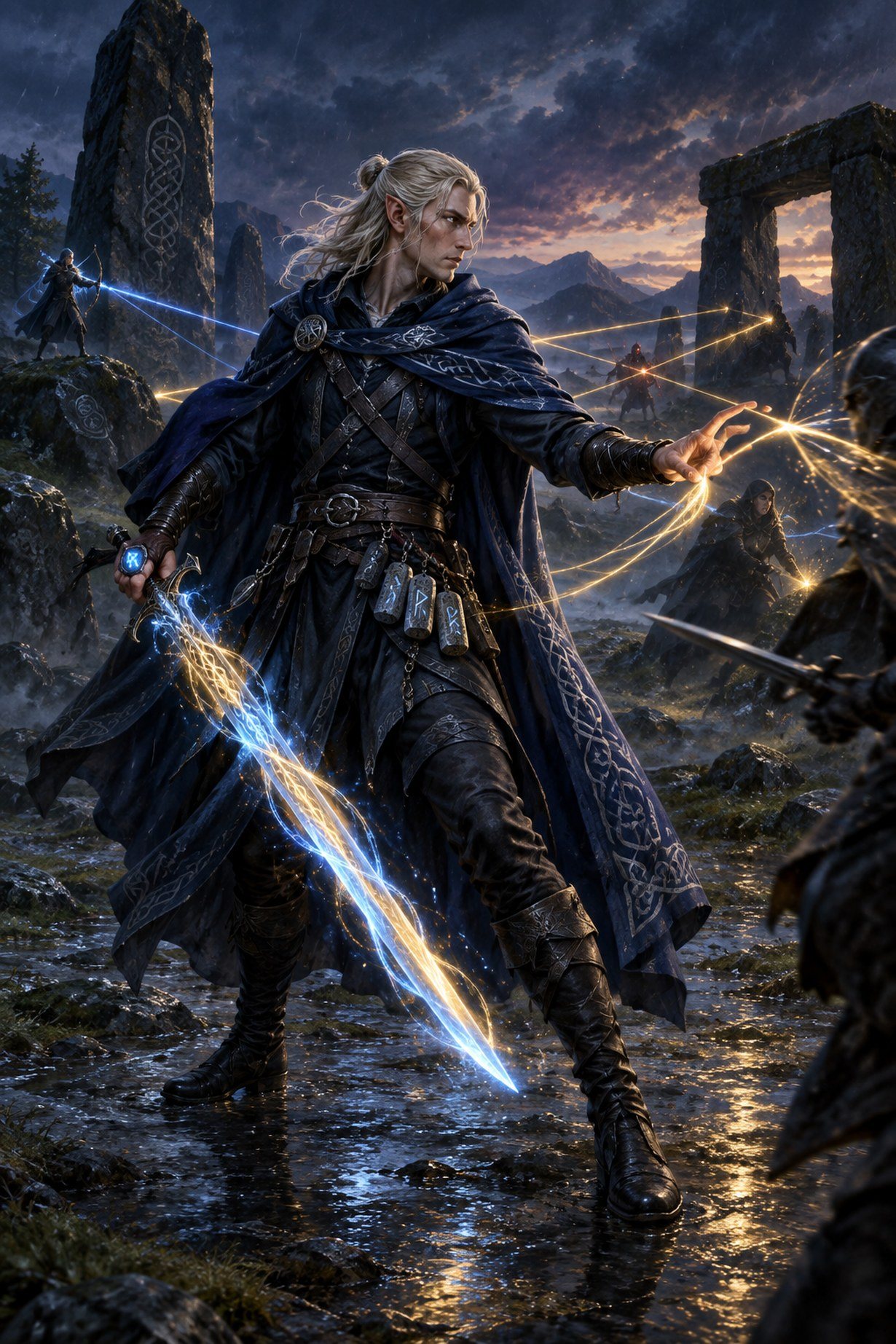
A blade-mystic who reads the moment before the moment, and spends a small bank of corrections on other people’s dice.
Campaign rules apply. Thirteen spells are banned, two are modified, and every spellcaster uses spell points instead of spell slots in this campaign — see Campaign Rules. This document already conforms: banned spells have been removed and replaced at the same level, modified spells are annotated where they appear, and spell slots have been converted to spell points.
Identity
You learned to see the instant before the instant: the weight shifting onto a back foot, the breath drawn before a lie, the thin bright line running from a friend’s next step to a bad end. Nobody taught you the whole of it, and nobody could — whatever spins the pattern does not take students. What you were taught was smaller and harder: how to find the one thread under tension, and how to touch it once, correctly, while there is still time. In a story you are the quiet one at the edge of the fight, half-trusted and wholly relied on: a reader of consequence who carries a blade made of what is about to happen.
The Fateskald is an Intelligence-based blade-mystic: a d8 unarmored duelist who conjures a Fateblade, throws it and calls it back, turns aside the blow that was meant to land, and cuts a Severed Thread once a turn. Its engine is the Weft — a scarce, daily bank of Threads spent as Reactions to add to or subtract from any d20 within thirty feet, after the die lands and before anyone knows what it means. It is not a nova class and not a healer. It is the reason the ambush missed.
This class belongs to the blade-mystic family, not the monk-caster family. It has no Unarmed Strike machinery, no Flurry of Blows, no Unarmored Movement ladder, no Qi points, and only a short list of utility cantrips. Its pool is Poise points, its rider is the Cut, and it is built to SPEC BLADE MYSTIC.
Class Overview
| Primary Abilities | Dexterity and Intelligence |
| Hit Point Die | D8 per Fateskald level |
| Saving Throw Proficiencies | Dexterity and Intelligence |
| Skill Proficiencies | Choose 2: Acrobatics, History, Insight, Investigation, Perception, Religion |
| Tool Proficiency | Woodcarver’s Tools |
| Weapon Proficiencies | Simple weapons, and your Fateblade |
| Armor Training | None |
| Starting Equipment | A pattern-carved hilt (the focus for your Fateblade), Woodcarver’s Tools, a set of carved lots, an Explorer’s Pack, and 10 GP |
| Spellcasting | Half-caster, the closed Fateskald spell list (mainly Abjuration, Divination, Enchantment, Illusion; 75 spells of 1st–5th level), Intelligence, prepared, Long Rest spell points. Cantrips: 2 known at level 2, 3 at level 11, from a short utility list. |
Fateskald Table
| Level | Proficiency Bonus | Blade Die | Poise | Threads | Thread Die | Invocations Known | Features | Spell Points | Max Spell Level |
|---|---|---|---|---|---|---|---|---|---|
| 1 | +2 | 1d8 | 1 | — | — | — | Unarmored Defense, Fateblade, Poise Points, Severed Thread | — | — |
| 2 | +2 | 1d8 | 2 | 2 | 1d4 | 2 | Spellcasting, The Weft, Invocations | 4 | 1st |
| 3 | +2 | 1d8 | 3 | 2 | 1d4 | 2 | Fate Pattern, Thread-Sight | 6 | 1st |
| 4 | +2 | 1d8 | 4 | 2 | 1d4 | 2 | Ability Score Improvement | 6 | 1st |
| 5 | +3 | 1d8 | 5 | 3 | 1d4 | 3 | Extra Attack | 14 | 2nd |
| 6 | +3 | 1d8 | 6 | 3 | 1d4 | 3 | Pattern Feature, Quickened Step | 14 | 2nd |
| 7 | +3 | 1d8 | 7 | 3 | 1d6 | 4 | Read the Room, Evasion | 17 | 2nd |
| 8 | +3 | 1d8 | 8 | 3 | 1d6 | 4 | Ability Score Improvement | 17 | 2nd |
| 9 | +4 | 1d8 | 9 | 4 | 1d6 | 5 | Second Thread | 27 | 3rd |
| 10 | +4 | 1d8 | 10 | 4 | 1d6 | 5 | Unbroken Thread | 27 | 3rd |
| 11 | +4 | 1d10 | 11 | 4 | 1d6 | 5 | Pattern Feature | 32 | 3rd |
| 12 | +4 | 1d10 | 12 | 4 | 1d6 | 6 | Ability Score Improvement | 32 | 3rd |
| 13 | +5 | 1d10 | 13 | 5 | 1d8 | 6 | Mystic Arcanum (6th level), Greater Weft | 38 | 4th |
| 14 | +5 | 1d10 | 14 | 5 | 1d8 | 6 | Quickened Step (+20 ft), Timeless Fate | 38 | 4th |
| 15 | +5 | 1d10 | 15 | 5 | 1d8 | 7 | Sight Beyond Time | 44 | 4th |
| 16 | +5 | 1d10 | 16 | 5 | 1d8 | 7 | Ability Score Improvement | 44 | 4th |
| 17 | +6 | 1d12 | 17 | 6 | 1d8 | 7 | Pattern Feature, Mystic Arcanum (7th level) | 57 | 5th |
| 18 | +6 | 1d12 | 18 | 6 | 1d8 | 8 | The Verdict | 57 | 5th |
| 19 | +6 | 1d12 | 19 | 6 | 1d8 | 8 | Epic Boon | 64 | 5th |
| 20 | +6 | 1d12 | 20 | 6 | 1d8 | 8 | Avatar of Fate | 64 | 5th |
Prepared spells by level: 2 (L2), 3, 4, 5, 6, 6, 7, 8, 9, 9, 10, 10, 11, 11, 12, 12, 13, 13, 14, 14 (L20).
Cantrips known: 2 at level 2, 3 at level 11.
Class Features
Fateskald powers at a glance
Every Fateskald power that costs a resource, takes an action, or produces a discrete effect, with what it costs, what it takes, how far it reaches, how long it lasts, what the target rolls, what it deals, and what anyone watching sees. A field reads “—” where it does not apply. Features shared with the 2024 rules — Unarmored Defense, Extra Attack and Evasion — this class’s own Mystic Arcanum (written out below), and purely passive states such as Quickened Step, Read the Room, Timeless Fate and Sight Beyond Time are not repeated here.
Display and Counterspell. A Fateskald’s magic runs in two registers and the Display column keeps them apart. The blade is banded light: bright, loud, impossible to miss. The fate-work — the Weft, Alter Probability, The Verdict — is close to invisible, and that is the part the campaign’s subtlety ruling governs. No Fateskald power is immune to Counterspell or Dispel Magic; where a power’s Display below reads subtle, a creature must first succeed on a Wisdom (Insight) or Wisdom (Perception) check against your spell save DC to recognise that anything is being done, and may then answer normally. A Thread spent on a Weft that is countered is not expended.
Class features.
| Power | Cost | Action | Range | Duration | Save and damage | Display |
|---|---|---|---|---|---|---|
| Fateblade | — | Bonus Action to manifest; no action to dismiss | Self | Until dismissed or displaced | — · Blade Die, Radiant, Cold or Lightning | visual (obvious) — a blade of banded light in your hand |
| The Long Throw | — | Bonus Action, once on each of your turns; only while you wear no armor and wield no Shield | 30 feet | Instantaneous | ranged attack roll, no Disadvantage within 5 feet of an enemy · Blade Die | visual (obvious) — the blade goes out and comes back |
| Severed Thread (the Cut) | 1 Poise at 1–10, 2 at 11–16, 3 at 17–20 | No action, once on each of your turns, after a hit | The creature you hit | Instantaneous | — · 1 / 2 / 3 Blade Dice + Intelligence modifier, Force or the blade’s type | visual (subtle) — one bright thread parts at the wrist |
| — Form: Foretold Miss (2) | as the Cut | part of the Cut | The creature you hit | To the start of your next turn | — · forgoes the modifier to mark the target instead | visual (subtle) — the cut mark stays a moment too long |
| The Weft | 1 Thread | Reaction, on a D20 Test you can see | 30 feet | Instantaneous | — · your Thread die added to or taken from the roll | subtle — see the note above; the check is Insight or Perception |
| Thread-Sight (the Guard) | — | Reaction, when you are hit by an attack you can see | Self | Instantaneous | — · reduces by 1d10 + Dexterity modifier + your level | visual (subtle) — the blow arrives a half-inch off where it was aimed |
| — Rider | 1 Poise | part of the Guard | 30 feet | Instantaneous | Dexterity | visual (obvious) — the stopped force goes somewhere else, visibly |
| Second Thread (9) | 2 Poise in place of a Thread | part of the Weft’s Reaction, once per turn (any creature’s turn) | as the Weft | as the Weft | — | as the Weft |
| Unbroken Thread (10) | — | No action, on Initiative | Self | Instantaneous | — · regain Intelligence modifier in Poise and 1 Thread | visual (subtle) — the hilt warms before the first blow |
| Greater Weft (13) | as the Weft | as the Weft | as the Weft | as the Weft | — · Thread die becomes 1d8; Advantage on Concentration saves | as the Weft |
| The Verdict (18) | — , once per Long Rest | Reaction, on a D20 Test you can see | 60 feet | Instantaneous | — · declares the d20 a 1 or a 20; never a Critical Hit | subtle — you say it first, and it was already true |
| Avatar of Fate (20) | — | No action, on Initiative | Self | Instantaneous | — · regain all expended Threads | visual (subtle) — every lot you carry turns face up at once |
Pattern of the Chooser.
| Power | Cost | Action | Range | Duration | Save and damage | Display |
|---|---|---|---|---|---|---|
| Storm-Leap (3) | 1 Poise | Bonus Action | Self | To the end of your turn | — · your first blade hit that turn denies the target its Reactions | visual and auditory (obvious) — a lightning-crack and you are up |
| Shield of the Fallen (6) | 2 Poise, once per Short or Long Rest | Reaction, when a creature drops to 0 Hit Points | 30 feet | Instantaneous | — · to 1 Hit Point, plus Temporary Hit Points | visual (obvious) — a wing-shadow falls across the dying |
| Bearer of the Wounded (11) | — , or the Magic action’s use | part of Shield of the Fallen; or Magic action | 5 feet to arrive; Touch to heal | Instantaneous | — · 3d8 + Intelligence modifier | visual (obvious) — you are simply there, and the wound closes |
| Chooser’s Mercy (17) | — , per the feature’s clock | Magic action | 30 feet, up to five creatures | Instantaneous | — · 4d8 + Intelligence modifier each | visual (obvious) — the choosing is made in front of everyone |
Pattern of the Loom.
| Power | Cost | Action | Range | Duration | Save and damage | Display |
|---|---|---|---|---|---|---|
| Weaver’s Sight (3) | — , once per Long Rest free | Detect Thoughts‘ casting time | the spell’s | the spell’s | the spell’s | as the spell’s, unchanged |
| Alter Probability (6) | 2 Poise | Reaction, on a D20 Test you can see; or part of the Weft’s Reaction on the same roll | 30 feet | Instantaneous | — · your Thread die added or subtracted | subtle — a lot turns over somewhere you are not looking |
| Sever the Strand (11) | 3 Poise | No action, once on each of your turns, after a hit | The creature you hit | as the feature states | Charisma | visual (subtle) — something under the target goes slack |
| Master of the Loom (17) | — | Bonus Action | Self | 1 minute | — | visual (subtle) — you stop reacting to things and start preceding them |
Pattern of the Undying.
| Power | Cost | Action | Range | Duration | Save and damage | Display |
|---|---|---|---|---|---|---|
| Undying Grip (3) | — | No action, once on each of your turns, when you spend Poise | Self | Until spent | — · Temporary Hit Points per the feature | visual (subtle) — a wound closes over as if it had been argued with |
| Storm of Blades (6) | 1 Poise | part of the Long Throw’s Bonus Action | 15 feet from the first target | Instantaneous | ranged attack roll, no Disadvantage within 5 feet of an enemy · Blade Die | visual (obvious) — the blade strikes twice on one flight |
| Blade Storm (11) | — | Magic action | 30 feet, up to three creatures | Instantaneous | ranged attack roll each, no Disadvantage within 5 feet of an enemy · Blade Die | visual (obvious) — three flights, one throw |
| The Final Stand (17) | — , per the feature’s clock | Reaction-equivalent, when you drop to 0 Hit Points | Self, and the field around you | Instantaneous | — · 3d8 + Intelligence modifier | visual (obvious) — you get up, and everyone sees you get up |
Pattern of the Giant.
| Power | Cost | Action | Range | Duration | Save and damage | Display |
|---|---|---|---|---|---|---|
| Giant’s Grip (3) | — | part of manifesting the blade | Self | While manifested | — | visual (obvious) — the blade comes out long |
| Glacial Slam (6) | 2 Poise | Magic action | 10 feet | Instantaneous | Dexterity | visual and auditory (obvious) — the ground goes, and is heard to go |
| Immovable Object (11) | 3 Poise | Bonus Action | Self | 1 minute | — | visual (obvious) — you set, and nothing about you moves again |
| Giant’s Wrath (17) | — | Bonus Action | Self, reach +5 feet | 1 minute | — | visual (obvious) — you are Large, which is not subtle |
Pattern of the Mask.
| Power | Cost | Action | Range | Duration | Save and damage | Display |
|---|---|---|---|---|---|---|
| Borrowed Faces (3) | — , once per Long Rest free | Mirror Image‘s casting time | the spell’s | the spell’s | — | as the spell’s, unchanged |
| Switcheroo (6) | 2 Poise | Reaction, when an attack targets you or a creature you can see | 30 feet | Instantaneous | — | visual (subtle) — the two of you were standing the other way round |
| Silver Tongue (11) | 2 Poise | No action, once on each of your turns, on a successful save against your spell | the spell’s | Instantaneous | the spell’s, rerolled | visual (subtle) — the target’s own certainty slips once |
| Army of One (17) | — | Bonus Action to make; Bonus Action to move | Self; duplicates within 30 feet | 1 minute | — | visual (obvious) — there are three of you now |
Pattern of the Binder.
| Power | Cost | Action | Range | Duration | Save and damage | Display |
|---|---|---|---|---|---|---|
| The Unbreakable Cord (3) | 1 Poise | No action, once on each of your turns, after a hit | The creature you hit | To the start of your next turn | — · Speed −15 ft, no Disengage, Disadvantage on attacks against others | visual (obvious) — a ribbon of light closes on the limb |
| The Jaw (6) | — | Reaction, when a creature leaves your reach | Your reach | Instantaneous | attack roll · Blade Die | visual (obvious) — the blade takes the leg as it goes |
| Fetter (11) | 2 Poise | No action, once on each of your turns, after a hit | The creature you hit | Save ends | Strength | visual (obvious) — the ribbon becomes a chain |
| Breaking of the Chain (17) | 3 Poise | Bonus Action | Self | 1 minute | — | visual and auditory (obvious) — something comes off you and does not go back on |
Unarmored Defense
Level 1
While you aren’t wearing armor or wielding a Shield, your base Armor Class equals 10 plus your Dexterity and Intelligence modifiers.
Fateblade
Level 1
As a Bonus Action, you manifest a blade of banded light in one free hand, drawn from your pattern-carved hilt. It is a magical weapon with the Finesse property, you are proficient with it, and it deals Blade Die damage of the Radiant, Cold, or Lightning type, chosen when you manifest it. You use Dexterity or Intelligence for its attack and damage rolls, chosen when you manifest it.
The blade lasts until you dismiss it (dismissing it costs no action, Bonus Action, or Reaction), until you manifest another, or until it has been more than 5 feet from you for 1 minute.
The Long Throw. Once on each of your turns, you can take a Bonus Action to hurl the blade at a creature you can see within 30 feet, making one ranged attack with it. The blade returns to your hand immediately after the attack, whether or not it hits. Being within 5 feet of an enemy doesn’t impose Disadvantage on this attack roll. You can use the Long Throw only while you aren’t wearing armor or wielding a Shield.
Poise Points
Level 1
You have a number of Poise points equal to your Fateskald level, as shown in the Poise column. You regain all expended Poise points when you finish a Short or Long Rest.
Poise Save DC. Some Fateskald features require a saving throw. The DC equals 8 + your Proficiency Bonus + your Intelligence modifier — the same number as your spell save DC.
A Fateskald’s Poise is the tension in a thread just before it is plucked.
Severed Thread (the Cut)
Level 1
Once on each of your turns, immediately after you hit a creature with your Fateblade, you can spend Poise points to cut the thread running out of that moment and add extra damage to the hit as a free rider. This costs no action, Bonus Action, or Reaction, and doesn’t replace any other part of your turn.
Severed Thread costs 1 Poise point at levels 1–10, 2 at levels 11–16, and 3 at levels 17–20. Roll a number of Blade Dice and add your Intelligence modifier; the extra damage is Force damage or the blade’s own type (your choice). The number of dice is 1 at levels 1–10, 2 at levels 11–16, and 3 at levels 17–20.
Form — Foretold Miss (level 2). Starting at level 2, when you use Severed Thread, you can forgo adding your Intelligence modifier to the damage to instead mark the moment you just cut. The next time the target makes a D20 Test before the start of your next turn, it subtracts your Thread die from the roll. A creature can be marked by Foretold Miss only once at a time.
Some Fateskalds call this “the shears.” That is bravado. The thread is not cut so much as told, briefly, what it already was.
Spellcasting
Level 2
Your spells are findings, not makings: each one locates a truth and pins it still long enough to be used. You have learned to pin enough of them at once to be dangerous.
Spells Prepared. You prepare the list of Fateskald spells available for you to cast, choosing from the Fateskald spell list. You prepare the number shown in the Prepared Spells note under the Fateskald table, and the spells must be of a level no higher than your Max Spell Level. Whenever you finish a Long Rest, you can replace one prepared spell with another.
Spell Points. This campaign uses spell points in place of spell slots (see Campaign Rules). Your pool is shown in the Spell Points column of the class table, and the Max Spell Level column shows the highest level of spell you can cast from it (1st at level 2, 2nd at 5, 3rd at 9, 4th at 13, 5th at 17). To cast a spell of 1st level or higher, spend spell points equal to its cost — 1st 2, 2nd 3, 3rd 5, 4th 6, 5th 7. You can cast a spell at any higher level up to your Max Spell Level by paying that level’s cost, and it takes effect as a higher-level version, exactly as the spell describes. You regain all spent spell points when you finish a Long Rest. Your spell points and your Poise points are separate pools: neither can pay for the other, and they recover on their own schedules. You can never spend spell points on a spell of 6th level or higher — those come only from Mystic Arcanum. If you also have long-rest spell points from another class, combine them as described under Multiclassing.
Spellcasting Ability. Intelligence is your spellcasting ability.
- Spell save DC = 8 + your Proficiency Bonus + your Intelligence modifier
- Spell attack modifier = your Proficiency Bonus + your Intelligence modifier
Spellcasting Focus. Your pattern-carved hilt.
Cantrips. At 2nd level you know two cantrips of your choice from the Fateskald cantrip list; at 11th level you know three. Whenever you gain a Fateskald level you may replace one with another from that list. They are small, wordless habits of the hands rather than workings, and none of them does damage — a Fateskald’s fighting magic is its Invocations and its blade, not its at-will spells.
The Weft
Level 2
You keep a small bank of corrections — moments you have already read and can still spend. You have a number of Threads shown in the Threads column. You regain all expended Threads when you finish a Long Rest. Unlike Poise, a Short Rest does not restore them.
When a creature you can see within 30 feet makes a D20 Test, you can take a Reaction and spend 1 Thread to add or subtract your Thread die from the roll. You must use this after the d20 is rolled but before the DM says whether the roll succeeds or fails, and only one Thread can affect a given roll. Choose whether to add or subtract before you roll the Thread die.
Noticing the Weft. Spending a Thread is a magical effect, and it is not immune to Counterspell or Dispel Magic. It is, however, quiet, so the campaign’s subtlety form applies: a creature that would react to your Weft must first succeed on a Wisdom (Insight) or Wisdom (Perception) check against your spell save DC to recognise that anything is being done to the roll — Insight if it is watching you, Perception if it is watching the die. A creature that succeeds may answer normally, Counterspell included; the check gates recognition, never the answer. As compensation, a Thread spent on a Weft that is countered is not expended.
Invocations
Level 2
You have studied a handful of things until they became true rather than cast. You learn 2 Invocations of your choice from the shared blade-mystic list or the Fateskald list, both below, and more at levels 5, 7, 9, 12, 15 and 18, as shown in the Invocations Known column. Whenever you gain a level in this class, you can replace one Invocation you know with another for which you qualify.
Invocations and Counterspell. An Invocation is something you have made true about yourself, not something you cast, so in most cases there is no casting for anyone to interrupt. That is a description, not an immunity — no Fateskald power is immune to Counterspell or Dispel Magic. Where an Invocation makes you cast a spell (Bound Lot‘s Augury, for instance), that spell is answered exactly like any other; where one produces a discrete magical effect as you spend a resource, so is that.
Fate Pattern
Level 3
You commit to one of the great patterns and let it organize everything smaller. Choose Pattern of the Chooser, Pattern of the Loom, Pattern of the Undying, Pattern of the Giant, Pattern of the Mask, or Pattern of the Binder. You gain features from that Pattern at levels 3, 6, 11, and 17.
Thread-Sight (the Guard)
Level 3
When you are hit by an attack you can see, you can take a Reaction to reduce the damage by 1d10 + your Dexterity modifier + your Fateskald level.
Rider. If you reduce the damage to 0, you can spend 1 Poise point to give the stopped force somewhere else to go. One creature you can see within 30 feet must succeed on a Dexterity saving throw against your Poise save DC or take Force damage equal to one Blade Die plus your Intelligence modifier.
Ability Score Improvement
Levels 4, 8, 12, and 16
You gain the Ability Score Improvement feat or another feat of your choice for which you qualify.
Extra Attack
Level 5
You can attack twice, instead of once, whenever you take the Attack action on your turn.
Quickened Step
Levels 6 and 14
While you aren’t wearing armor or wielding a Shield, your Speed increases by 10 feet. This increases to 20 feet at level 14.
Read the Room
Level 7
You add your Intelligence modifier to your Initiative rolls, and while you are conscious, being surprised doesn’t give you Disadvantage on your Initiative roll.
Evasion
Level 7
When you’re subjected to an effect that allows you to make a Dexterity saving throw to take only half damage, you instead take no damage if you succeed on the saving throw and only half damage if you fail. You can’t use this feature if you have the Incapacitated condition.
Second Thread
Level 9
Once per turn, on your turn or another creature’s, when you would spend a Thread to use the Weft, you can spend 2 Poise points instead, even if you have no Threads remaining. You still take the Weft’s Reaction; this changes only what you pay for it. It doesn’t let you place two Threads on the same roll.
Unbroken Thread
Level 10
When you roll Initiative and have no Poise points remaining, you regain Poise points equal to your Intelligence modifier (minimum 1) and 1 expended Thread.
Mystic Arcanum
Levels 13 and 17
Twice in a career the pattern opens further than you can normally read — the Fateskald’s long look. At level 13, choose one 6th-level spell from the Fateskald spell list. You can cast it once without spending spell points, regaining that use on a Long Rest. At level 17 you learn a 7th-level spell on the same terms. Each is a separate use.
Whenever you gain a level in this class, you can replace one of these spells with another of the same level from the Fateskald spell list. They use Intelligence as your spellcasting ability. A Fateskald never learns an 8th-level spell.
Greater Weft
Level 13
Your Thread die becomes 1d8, as shown on the table. In addition, when you use the Weft on a saving throw, you can decide whether to add or subtract after seeing whether your die would change the outcome, an exception to the Weft’s rule that you choose before you roll.
You also have Advantage on Constitution saving throws that you make to maintain Concentration.
Timeless Fate
Level 14
You suffer none of the frailty of old age, and you can’t be aged magically.
Sight Beyond Time
Level 15
You have Truesight out to 30 feet, and you can see Invisible creatures within 60 feet of you.
The Verdict
Level 18
Some outcomes were never in question; you simply say so first. When a creature you can see within 60 feet makes a D20 Test, you can take a Reaction to declare the d20 to have rolled a 1 or a 20 (your choice) instead of its rolled number. A 20 declared this way is not a Critical Hit.
Once you use this feature, you can’t use it again until you finish a Long Rest.
Epic Boon
Level 19
You gain an Epic Boon feat or another feat of your choice for which you qualify. Boon of Fate is thematically apt.
Avatar of Fate
Level 20
Your Dexterity or Intelligence score increases by 2, to a maximum of 24. In addition, when you roll Initiative, you regain all expended Threads.
Shared Blade-Mystic Invocations
These Invocations belong to every blade-mystic class, and a Fateskald can learn them alongside the Fateskald list. Listed in order of prerequisite. Prerequisites are noted; you must meet them to learn the Invocation and to keep it.
Blade Recall. As a Bonus Action, you can teleport your manifested weapon into your free hand from anywhere within 60 feet, provided you can see its space.
Bladeless. You can roll your Blade Die in place of the normal damage of your Unarmed Strike, and whenever you deal damage with your Unarmed Strike, it can deal your choice of Force damage or its normal damage type. You can use your Cut on an Unarmed Strike.
Reaching Hand. You know the Mage Hand cantrip, and the hand is invisible. When you take the Attack action, you can replace one of your attacks with an Unarmed Strike made through the hand against a creature within 5 feet of it, using the Shove option; the target makes its saving throw against your Poise save DC instead of the usual DC.
Turning Step. When you use your Guard, you can move up to 10 feet without provoking Opportunity Attacks.
Unblinking. While your manifested weapon exists, being surprised doesn’t give you Disadvantage on your Initiative roll.
Steady Hand. When you roll a 1 on a Blade Die for your Cut, you can reroll it once and must use the new roll.
Second Manifestation. Prerequisite: level 5. You can manifest a second weapon in your other free hand. When you take the Attack action, you can make one attack with it as a Bonus Action; you add no ability modifier to that attack’s damage. You can’t use the Long Throw on a turn you do this. You can make this attack only while you aren’t wearing armor or wielding a Shield.
The Held Breath. Prerequisite: level 9. When you reduce an attack’s damage to 0 with your Guard, you regain 1 Poise point. This can happen only once per round.
Deep Guard. Prerequisite: level 12. You can use your Guard against an attack you can’t see; when you do, roll the Guard’s d10 twice and use the lower roll.
Long Study. Prerequisite: level 15. Choose one 3rd-level spell from the Fateskald spell list. You can cast it once without spending spell points, and you regain the ability to do so when you finish a Long Rest.
Fateskald Invocations
Listed alphabetically. Prerequisites are noted; you must meet them to learn the Invocation and to keep it.
Bound Lot. You always have Augury prepared, and it doesn’t count against the number of spells you can prepare. You can cast it once per Long Rest without spending spell points.
Cast the Lots. By spending 10 minutes reading your carved lots, you gain Advantage on your next Initiative roll. You can’t do this again until you finish a Short or Long Rest.
Colder Edge. When you hit with your Fateblade, you can choose for the attack to deal Force damage instead of the blade’s chosen type.
Cutting Both Ways. Prerequisite: level 7. When you use Foretold Miss, the die the target subtracts is one size larger than your Thread die.
Foreseen Opening. Prerequisite: level 7. When you use the Weft on an enemy’s attack roll and that attack misses, you can use your Long Throw against that creature as part of the same Reaction. You can’t do this again until you finish a Short or Long Rest.
Given Thread. When you use the Weft on a creature other than yourself, that creature gains Temporary Hit Points equal to your Intelligence modifier.
Hilt of Lots. You can use your pattern-carved hilt as an Arcane Focus for any spell, and you have Advantage on Intelligence (Investigation) checks made to read, decipher or date writing.
One Step Ahead. Prerequisite: level 5. When you roll Initiative, you gain Temporary Hit Points equal to your Intelligence modifier plus your Proficiency Bonus.
Patient Thread. Prerequisite: level 9. You regain 1 expended Thread when you finish a Short Rest.
Severing Reach. The range of your Long Throw increases to 60 feet.
Thread the Needle. Prerequisite: level 12. Your Thread-Sight rider deals one additional Blade Die of damage.
Woven Ward. You can use the Weft on a creature’s Death Saving Throw at any distance at which you can see it, ignoring the 30-foot limit.
Patterns
A Pattern is the Fateskald’s subclass: one shape of consequence — rescue, probability, endurance, weight, deception or binding — that you have learned to read so well it organizes everything smaller. You choose one with the Fate Pattern feature, and it grants features at the levels that feature names. A Pattern is an image you work through, not a power you serve; nothing in it needs a god, a people or a place to exist. Each world gives the six Patterns its own names (see In Different Worlds).
Pattern of the Chooser
“I do not decide who dies. I decide who does not die yet.”
The Chooser’s pattern is a rescue discipline. You arrive where the fall is about to happen, carrying the thing that stops it.
Storm-Leap
Level 3
As a Bonus Action, you can spend 1 Poise point to gain a Fly Speed equal to your Speed until the end of your turn. If you are airborne when the turn ends, you fall.
The first time you hit a creature with your Fateblade during a turn in which you used Storm-Leap, it can’t take Reactions until the start of its next turn — the stroke that follows the thunder-crack.
Shield of the Fallen
Level 6
When a creature you can see within 30 feet drops to 0 Hit Points without being killed outright, you can take a Reaction and spend 2 Poise points. That creature drops to 1 Hit Point instead and gains Temporary Hit Points equal to your Intelligence modifier.
Once you use this feature, you can’t use it again until you finish a Short or Long Rest.
Bearer of the Wounded
Level 11
When you use Shield of the Fallen, you can first teleport to an unoccupied space within 5 feet of that creature.
In addition, as a Magic action you can touch a willing creature and restore 3d8 Hit Points plus your Intelligence modifier. The creature can also end one effect on itself causing the Charmed, Frightened, or Poisoned condition. Once you use this part of the feature, you can’t use it again until you finish a Long Rest.
Chooser’s Mercy
Level 17
As a Magic action, choose up to five willing creatures you can see within 30 feet. Each regains 4d8 Hit Points plus your Intelligence modifier, can stand up from Prone without spending movement, and can end one effect on itself causing the Charmed, Frightened, or Poisoned condition.
Once you use this feature, you can’t use it again until you finish a Long Rest.
Playing a Pattern of the Chooser: you are the party’s second chance, and you will spend most fights deciding whose it is.
Pattern of the Loom
“The loom does not care what you wanted. It cares what you did next.”
The Loom reads probability directly and makes small, early corrections — the pattern of the practitioner who would rather bend a die than block a blade.
Weaver’s Sight
Level 3
You always have Detect Thoughts prepared, and it doesn’t count against the number of spells you can prepare. Once per Long Rest you can cast it without spending spell points.
In addition, your Thread die is one size larger when you use the Weft on a saving throw.
Alter Probability
Level 6
When a creature you can see within 30 feet makes a D20 Test, you can take a Reaction and spend 2 Poise points to roll your Thread die and either add it to or subtract it from the roll. As with the Weft, you use this after the d20 is rolled but before the DM says whether the roll succeeds or fails, and you choose whether to add or subtract before you roll the Thread die. If you use the Weft on the same roll, you can use this feature as part of the Weft’s Reaction instead of taking a second Reaction; its die is in addition to the Thread’s. Weaver’s Sight makes this die one size larger on a saving throw, as it does the Thread’s. You can use this feature once per round.
Sever the Strand
Level 11
Once on each of your turns when you hit a creature with your Fateblade, you can spend 3 Poise points to force it to make a Charisma saving throw against your Poise save DC. On a failed save, it can’t take Reactions until the end of your next turn, and you choose one: it has Disadvantage on attack rolls, or it has Disadvantage on saving throws, for the same duration.
Master of the Loom
Level 17
As a Bonus Action, you read forward for 1 minute. For the duration, being surprised doesn’t give you Disadvantage on your Initiative roll, you have Advantage on the first attack roll and the first saving throw you make on each of your turns, and the first attack roll made against you in each round has Disadvantage.
This doesn’t duplicate or stack with the Foresight spell. Once you use this feature, you can’t use it again until you finish a Long Rest.
Playing a Pattern of the Loom: you will be the least visible and most decisive person in the fight, and you will be resented for it in the best way.
Pattern of the Undying
“Get up. That was not the last one.”
The pattern of those who keep rising: an endurance discipline for the Fateskald who intends to be the last one standing and has arranged for it.
Undying Grip
Level 3
You have Advantage on Death Saving Throws. In addition, once on each of your turns when you spend one or more Poise points, you gain Temporary Hit Points equal to your Proficiency Bonus.
Storm of Blades
Level 6
When you use the Long Throw, you can spend 1 Poise point to have the blade strike twice: make a second ranged attack with it against a different creature within 15 feet of the first target. The blade returns after the second attack. Being within 5 feet of an enemy doesn’t impose Disadvantage on the second attack roll.
Severed Thread can be applied to only one of these attacks.
Blade Storm
Level 11
As a Magic action, choose up to three creatures you can see within 30 feet. Make one ranged attack with your Fateblade against each. The blade returns to your hand after the final attack. Being within 5 feet of an enemy doesn’t impose Disadvantage on these attack rolls. Severed Thread can be applied to only one of these attacks.
Once you use this feature, you can’t use it again until you finish a Short or Long Rest.
The Final Stand
Level 17
When you are reduced to 0 Hit Points without being killed outright, you can drop to 1 Hit Point instead and regain 3d8 Hit Points plus your Intelligence modifier. Each creature of your choice within 10 feet of you must succeed on a Strength saving throw against your Poise save DC or have the Prone condition.
Once you use this feature, you can’t use it again until you finish a Long Rest.
Playing a Pattern of the Undying: your character arc is an argument with the idea of a last stand, conducted one last stand at a time.
Pattern of the Giant
“Weight is an argument. Very few things can answer it.”
The Giant’s pattern governs mass, cold, and momentum — the Fateskald who stops being a skirmisher and starts being terrain.
Giant’s Grip
Level 3
When you manifest your Fateblade, you can choose for it to have the Reach property instead of Finesse. While it has Reach, it uses Intelligence for attack and damage rolls and you can’t use the Long Throw with it.
In addition, once on each of your turns when a creature fails a saving throw against a Fateskald feature of yours, it takes Cold damage equal to your Intelligence modifier.
Glacial Slam
Level 6
As a Magic action, you can spend 2 Poise points to strike the ground. Each creature of your choice within 10 feet of you makes a Dexterity saving throw against your Poise save DC. On a failed save, a creature takes 2d6 Cold damage, has the Prone condition, and its Speed is reduced by 10 feet until the start of your next turn. On a successful save, it takes half as much damage only.
Immovable Object
Level 11
As a Bonus Action, you can spend 3 Poise points to anchor yourself for 1 minute. For the duration, you can’t be moved against your will or given the Prone condition, and you have Resistance to Bludgeoning, Piercing, and Slashing damage from attacks. The effect ends early if you have the Incapacitated condition.
Giant’s Wrath
Level 17
As a Bonus Action, you grow to Large size for 1 minute if there is room. For the duration, your reach increases by 5 feet, and once on each of your turns when you hit with your Fateblade, the attack deals extra Cold damage equal to one Blade Die.
Once you use this feature, you can’t use it again until you finish a Long Rest.
Playing a Pattern of the Giant: you are the slowest-moving idea in the room and the one everything else has to route around.
Pattern of the Mask
“The trouble with being seen is that then they know where to aim.”
The trickster’s pattern is the discipline of the uncertain target: duplicates, swapped places, and attacks that land where you used to be.
Borrowed Faces
Level 3
You always have Mirror Image prepared, and it doesn’t count against the number of spells you can prepare. Once per Long Rest you can cast it without spending spell points.
Switcheroo
Level 6
When you or a creature you can see within 30 feet is targeted by an attack roll, you can take a Reaction and spend 2 Poise points to swap the positions of yourself and one willing creature within 30 feet by teleportation. The attack then resolves against whoever now occupies the original target’s space, and that creature gains a +2 bonus to AC against it. You must use this before the attack roll is made.
Silver Tongue
Level 11
Once on each of your turns, when a creature succeeds on a saving throw against an Enchantment or Illusion spell you cast, you can spend 2 Poise points to force it to reroll the save and use the new result.
In addition, a creature that fails a saving throw against your Enchantment or Illusion spells doesn’t automatically know it was influenced when the effect ends, unless the spell says otherwise or the effect was unmistakably supernatural.
Army of One
Level 17
As a Bonus Action, you create two illusory duplicates of yourself for 1 minute. As a Bonus Action you can move any duplicate within 30 feet of you up to 30 feet; duplicates can pass through creatures and objects but can’t end their movement in another creature’s space.
When you or a creature within 5 feet of a duplicate is targeted by an attack, you can take a Reaction to make the attack target that duplicate instead. A duplicate is destroyed if it is hit by an attack or fails a saving throw.
When you take the Attack action, you can make one attack from a duplicate’s space using your own attack roll; that duplicate then vanishes.
Once you use this feature, you can’t use it again until you finish a Long Rest.
Playing a Pattern of the Mask: the question your table will keep asking is which of you is the real one, and your answer should not always be honest.
Pattern of the Binder
“Everything that can be bound can be unbound. They built the chain believing otherwise.”
The Binder’s pattern is the discipline of bonds: setting them on others, and slipping every one laid on you.
The Unbreakable Cord
Level 3
Once on each of your turns when you hit a creature with your Fateblade, you can spend 1 Poise point to bind it: until the start of your next turn its Speed is reduced by 15 feet, it can’t take the Disengage action, and it has Disadvantage on attack rolls against any creature other than you.
In addition, you have Advantage on saving throws and ability checks made to escape a Grapple or to end the Restrained condition on yourself.
The Jaw
Level 6
When a creature within your reach tries to move away from you, you can take a Reaction to make one attack against it with your Fateblade. On a hit, its Speed becomes 0 until the end of its turn.
In addition, you can spend 1 Poise point as a Bonus Action to end one effect on yourself causing the Grappled, Restrained, or Paralyzed condition.
Fetter
Level 11
Once on each of your turns when you hit a creature with your Fateblade, you can spend 2 Poise points to force a Strength saving throw against your Poise save DC. On a failed save, it has the Restrained condition until the end of your next turn; it can repeat the save at the end of each of its turns, ending the effect on a success.
A creature Restrained this way can’t teleport or use planar travel for the duration.
Breaking of the Chain
Level 17
As a Bonus Action, you can spend 3 Poise points to enter a loosed state for 1 minute. For the duration:
- You can’t be Grappled, Restrained, Paralyzed, Petrified, or Stunned.
- Your Speed increases by 20 feet and Opportunity Attacks against you have Disadvantage.
- Once on each of your turns when you hit a creature that is Restrained or Grappled, the attack deals extra Force damage equal to one Blade Die.
Once you use this feature, you can’t use it again until you finish a Long Rest.
Playing a Pattern of the Binder: you are the thing in the story that the powerful had to lie to, and the table should never be quite sure you were wrong to resent it.
Fateskald Spell List
This is a closed list: every spell of 1st through 5th level you prepare comes from it, and the DM does not add others. It holds 75 spells (17 / 22 / 16 / 10 / 10 at 1st–5th level, about three-quarters of the 2024 Player’s Handbook Sorcerer list at each level), sorted alphabetically within each level. Every spell on it is from the 2024 Player’s Handbook and on the Bard, Sorcerer, Warlock or Wizard list. The list is mainly Abjuration, Divination, Enchantment, Illusion, plus Force effects (Otiluke’s Resilient Sphere, Wall of Force). The movement, timing, body-warding and sight spells from other schools are class additions: Expeditious Retreat, Feather Fall and Longstrider; Darkvision, Enhance Ability, Levitate, Misty Step, Spider Climb; Blink, Fly, Haste and Slow; Dimension Door and Stoneskin. A Fateskald’s magic reads, wards, redirects and misleads; it does not burn things down, it does not heal, and it never takes the wheel of another creature’s turn without a Magic action and Concentration.
Cantrips. Blade Ward, Friends, Light, Mage Hand, Mending, Message, Minor Illusion, Prestidigitation.
The cantrip list is deliberately short and sits outside the four core schools that shape the levelled list: these are hand-habits, not workings, and none of them deals damage or makes an attack roll. (Friends does call for a saving throw — against being Charmed, never against harm.)
1st level (17). Alarm, Bane, Charm Person, Color Spray, Comprehend Languages, Detect Magic, Disguise Self, Expeditious Retreat, Feather Fall, Heroism, Identify, Longstrider, Protection from Evil and Good, Shield, Silent Image, Sleep, Tasha’s Hideous Laughter.
2nd level (22). Arcane Lock, Augury, Blur, Calm Emotions, Darkvision, Detect Thoughts, Enhance Ability, Hold Person, Invisibility, Levitate, Locate Animals or Plants, Locate Object, Magic Mouth, Mirror Image, Misty Step, Nystul’s Magic Aura, Phantasmal Force, See Invisibility, Silence, Spider Climb, Suggestion, Zone of Truth (campaign-modified: Advantage on Wisdom (Insight) checks; it compels nothing).
3rd level (16). Blink, Clairvoyance, Counterspell, Dispel Magic, Fear, Fly, Glyph of Warding, Haste, Hypnotic Pattern, Magic Circle, Major Image, Nondetection, Protection from Energy, Remove Curse, Slow, Tongues.
4th level (10). Banishment, Charm Monster, Dimension Door, Divination, Freedom of Movement, Greater Invisibility, Hallucinatory Terrain, Locate Creature, Otiluke’s Resilient Sphere, Stoneskin.
5th level (10). Contact Other Plane, Dominate Person, Hold Monster, Legend Lore (campaign-modified: it reveals where the knowledge physically resides, not the knowledge itself), Mislead, Modify Memory, Rary’s Telepathic Bond, Scrying, Seeming, Wall of Force.
Mystic Arcanum options.
- 6th level: Contingency, Globe of Invulnerability, Mass Suggestion, True Seeing
- 7th level: Etherealness, Forcecage, Project Image, Sequester
Flagged for the DM: Contingency and Forcecage both reward a class that already sees a round ahead. A Pattern of the Loom pairing Master of the Loom with Forcecage will end an encounter on its own once per day — intended as a capstone moment, not a rotation.
Multiclassing
Prerequisite: Dexterity 13 and Intelligence 13.
What you gain: proficiency with simple weapons; Unarmored Defense if you don’t already have it; the Fateblade and the Long Throw; and Poise points, Threads and Invocations sized to your Fateskald levels only. Your Blade Die, Severed Thread dice and Thread die are set by your Fateskald level, not your character level. You can use the Long Throw only while you aren’t wearing armor or wielding a Shield, so a character in armor or with a Shield keeps the blade and Severed Thread but not the Bonus Action attack.
Poise points and Qi points are separate pools and never merge. A Fateskald/monk-caster multiclass tracks both independently, spends each only on its own class’s features, and gains no benefit from having two pools beyond having two pools.
Fateskald spell points combine with other long-rest spell point pools under the standard multiclass spellcaster rules (see the multiclass spell point table in Campaign Rules); your Mystic Arcanum uses do not.
In Different Worlds
Setting layer. Everything above this heading works unchanged in each of these worlds; only names, looks and stories differ. Names here are setting names, each mapped to the neutral name the rules use.
Mythic culture — Norse-inspired (the class’s origin)
Who has it. Skalds who learned more than verse: hall-poets who keep a lord’s memory and, quietly, read where it is going. They swear to no god. They carve lots, cast them on a cloak, and are paid in arm-rings to be wrong in a useful direction. Older songs call them Runeweavers.
What they call it. The class is the Fateskald; the blade is the Bifrost Blade, drawn from a runestone hilt; the Weft keeps its name, and spending a Thread is reading the wyrd. Patterns are Master Runes, cut into the hilt one at a time.
How it looks and sounds. The blade comes out in bands of rune-light, red through violet, like the bridge seen edge-on. A Thread spent shows nothing at all; somewhere a lot turns face up. The Rune of the Valkyrie throws a wing-shadow, and Ymir’s Wrath arrives with the sound of river ice breaking.
Story hook. A völva has cut a runestone naming a Fateskald as the death of the jarl’s son. The jarl hires that Fateskald to keep the boy alive through the winter, and to learn whether reading the stone is what made it true.
Rules caveat. None. The Norns are the class’s image, not its patron; no feature needs them to exist, answer or approve.
| Neutral name (rules) | Norse-inspired name |
|---|---|
| Fateblade · pattern-carved hilt · set of carved lots · banded light | Bifrost Blade · runestone hilt · bag of nine carved fate-lots · banded rune-light |
| Pattern · Fate Pattern · Pattern Feature | Master Rune · Master Rune · Master Rune Feature |
| Pattern of the Chooser · Loom · Undying · Giant · Mask · Binder | Rune of the Valkyrie · Norn · Einherjar · Jotun · Mask · Wolf |
| The Unbreakable Cord · Giant’s Wrath | Gleipnir’s Lesson · Ymir’s Wrath |
| Timeless Fate · The Verdict · Avatar of Fate | Timeless Wyrd · Norn’s Verdict · Avatar of the Norns |
| Cast the Lots · Hilt of Lots · Patient Thread | Cast the Runes · Hilt of Nine Lots · Norn’s Patience |
Urban intrigue
Who has it. The Underwriters’ Guild of one sprawling port city: risk-readers retained by trading houses, banks and the occasional duke to price a voyage, a marriage or a life. Every Underwriter is bonded, and every reading is a contract with a penalty clause.
What they call it. The class is an Underwriter. The Fateblade is the Ledger Knife, drawn from an ivory pen-case that serves as the hilt. The Weft is the Margin, and a Thread is a line in the margin. Patterns are guild Houses:
| Pattern | House |
|---|---|
| Chooser · Loom · Undying | House Surety · House Loom · House Renewal |
| Giant · Mask · Binder | House Bulwark · House Proxy · House Covenant |
How it looks and sounds. The Ledger Knife is a stroke of ink-dark light ruled with fine gold lines. Spending a Thread sounds like an abacus bead sliding home somewhere across the room. The carved lots are bone tally-sticks, read on a clerk’s blotter, and the Verdict is pronounced like a judgment from the bench.
Story hook. House Loom has guaranteed that the Duke of the Salt Gate will survive the season. Three factions want him dead before midwinter, and the Underwriter who wrote the policy — ruined if it ever pays out — hires the party to keep the Duke breathing.
Rules caveat. None.
Gritty low magic
Who has it. Nobody admits to it. Fateskalds here are hunted as witches, so they drift into mercenary companies as luck-takers: the quiet hire at the back of the line whose enemies’ crossbows somehow jam. They never show the blade in daylight.
What they call it. The class is a luck-taker. The Fateblade is the pale edge, drawn from a whittled hilt wrapped in leather so it passes for a broken knife. The Weft is taking the luck. Patterns are camp nicknames:
| Pattern | Nickname |
|---|---|
| Chooser · Loom · Undying | the Corpse-Thief · the Dicer · the Stubborn |
| Giant · Mask · Binder | the Millstone · the Turncoat · the Hobbler |
How it looks and sounds. The pale edge is dim and grey, like light through a dirty window, and it makes no sound. Taking the luck gives no sign either: a horse shies, a boot slips in the mud, a bowstring parts. The lots are knucklebones shaken in a hat.
Story hook. A captain hires a luck-taker to make sure a duel goes wrong. The challenger is the captain’s own son, and the captain has not said which way “wrong” runs.
Rules caveat. Worlds like this often have no other planes. If so, Contact Other Plane and Etherealness reach nothing; let the player swap each for another spell of the same level from the Fateskald list. Banishment‘s demiplane can be described as “a pocket of nowhere”. Fetter’s ban on planar travel stays as written and simply rarely matters. The pale edge is dim, not hidden: under the campaign’s subtlety ruling it is still visual (obvious).
Arcane-industrial
Who has it. Licensed Tolerancers of the Assay Bureau: engineers who certify that a bridge, a boiler or a rail junction will not fail, by reading the moment it would. The licence is a brass badge and a ledger number, and unlicensed practice is a crime.
What they call it. The class is a Tolerancer. The Fateblade is the gauge-blade, drawn from a pattern-carved hilt capped in brass and stamped with the Bureau’s mark. The Weft is the Tolerance, and spending a Thread is taking up slack. Patterns are Bureau divisions:
| Pattern | Division |
|---|---|
| Chooser · Loom · Undying | Rescue and Salvage · Statistics · Endurance Testing |
| Giant · Mask · Binder | Load-Bearing · Counterfeits · Couplings and Restraint |
How it looks and sounds. The gauge-blade is banded in signal-lamp colours and hums like a transformer under load. Taking up slack sounds like a governor ticking over, very faintly, somewhere in the walls. The lots are numbered steel punches, read on a drafting board.
Story hook. The Northline viaduct came down at noon, and a Tolerancer had certified it to the hour. The Bureau wants it ruled an act of chance. The Tolerancer knows someone spent a Thread on the inspector’s check that morning, and that only licensed hands could have.
Rules caveat. None. The licence and the Bureau are fiction; no feature needs infrastructure to work.
Origins and Inspiration
Inspiration, not setting. Nothing here is a rule, and nothing here is assumed by one.
The skald. The Old Norse skáld was a court poet of Norway and Iceland, roughly the ninth to the thirteenth centuries, whose dense, kenning-laden verse kept a ruler’s deeds in memory; Egill Skallagrímsson is the best known, and Snorri Sturluson’s Skáldskaparmál is the handbook of the craft. The class keeps the word for a person whose job is to say what happened, and who turns out to be able to say what is about to.
The Norns and the weaving of wyrd. In the Völuspá, three maidens come from the water (sær) beneath the world-tree Yggdrasil — Snorri’s Gylfaginning makes it the well of Urðr: Urðr, Verðandi and Skuld, often glossed as what has become, what is becoming, and what shall be (Skuld is nearer “what is owed”). They “laid down laws, chose lives” and “carved on wood” (skáru á skíði) — the source of the Fateskald’s carved lots. In Helgakviða Hundingsbana I Norns come at Helgi’s birth and twist and fasten the strands of his fate; the weaving image is starkest in the Darraðarljóð of Njáls saga, where valkyries weave a battle on a loom of men’s entrails. Old English wyrd, cognate with urðr, is fate as “what comes to pass”.
The Bifrost. Bifröst (Bilröst in Grímnismál) is the burning rainbow bridge between Midgard and Asgard, guarded by Heimdallr and fated to break at Ragnarök. In Gylfaginning the gods ride over it each day to hold court at the well of Urðr, so the bridge leads to the Norns. The house reading of it as a bridge between what is and what will be is an interpretation, not a source claim.
The Patterns and their touchstones
| Pattern (neutral) | Norse-inspired name | Mythic centre | Second touchstone | Alt-culture reskin |
|---|---|---|---|---|
| Chooser | Rune of the Valkyrie | The choosers of the slain | Brynhildr’s punishment | Mesoamerican cihuateteo |
| Loom | Rune of the Norn | Urðr, Verðandi, Skuld | The Moirai | Yoruba orí |
| Undying | Rune of the Einherjar | The daily war in Valhöll | Cú Chulainn at the stone | Spartan shield-saying |
| Giant | Rune of the Jotun | Ymir’s body as the world | Skaði’s demand for redress | Japanese Daidarabotchi |
| Mask | Rune of the Mask | Loki in the Lokasenna | Gwydion’s illusions | Akan and Caribbean Anansi |
| Binder | Rune of the Wolf | Fenrir and Gleipnir | Týr’s hand | Slavic volkolak |
- Chooser. The Valkyrjur of the Poetic Edda, choosers of the slain; Brynhildr, punished for choosing wrongly; the Irish badb who decides a battle by arriving. Reskin: in a Mesoamerican frame, a cihuatéotl — a woman dead in childbirth, honoured as a fallen warrior, who carries the sun down to the west and haunts the crossroads on her days.
- Loom. Urðr, Verðandi and Skuld at the well; the Moirai and their thread; the Slavic Rozhanitsy and the South Slavic Sudice (Orisnitsi), who decide or write a fate at a birth. Reskin: in a West African frame, the Yoruba concept of orí — the head one chose before birth, argued with ever after.
- Undying. The einherjar who fight each day in Valhöll and feast each night, whole again; Hildr waking the fallen of the Hjaðningavíg; Cú Chulainn tied upright to a standing stone. Reskin: in a Greek frame, the Spartan shield-saying — come back with your shield or on it.
- Giant. Ymir, whose body is the world; Þrymr demanding a bride for a hammer; Skaði walking down out of the mountains to demand redress in person. Reskin: in a Japanese frame, Daidarabotchi, the giant whose footprints became lakes and whose load became mountains.
- Mask. Loki in the Lokasenna, correct and unbearable; the shape-shifted Odin travelling under a dozen names; the Welsh Gwydion, whose illusions start a war that others die in. Reskin: in an Akan and Caribbean frame, Anansi — small, outmatched, and never once cornered.
- Binder. Fenrir and the ribbon Gleipnir, and Týr’s hand as the price of the lie; Garmr at the mouth of Gnipahellir; Geri and Freki, appetite made loyal. Reskin: in a Slavic frame, the volkolak — the bound shape that is never quite recaptured.
How the material was adapted
The class began as a Norse fate-reader and kept that root, but no god, place or people appears in its rules. The Norns, the Bifrost, Gleipnir and Ymir became images rather than patrons: a Pattern borrows the shape of a myth — the chooser who arrives where the fall happens, the ribbon that should not hold and does, the giant whose weight is the world — and turns it into a discipline anyone can learn, in any world, without anyone’s leave. The setting names now live in the Norse-inspired example above, beside other worlds’ names for the same things, and the touchstones stay here as credit for where the shapes came from.
Playing a Fateskald
The core dramatic question: if you can see it coming, whose fault is it when it happens? A Fateskald has a limited number of corrections and an unlimited number of moments that deserve one. Every Thread you spend is a judgment about which disaster mattered more, and your table will remember the one you let through.
The physicality of the power. Reading fate is not a trance. It is closer to listening to a room — a hand moving toward a belt, a merchant’s pause, a floorboard worn on one side only. The lots you carve are a working aid: a handful of ash-wood slips you cast on a cloak, read in ten seconds, and pocket. When you spend a Thread, witnesses see nothing at all; the arrow simply goes wide, and someone else gets the credit.
Origin prompts. Who taught you to cast the lots, and did they finish teaching you? What did you read and refuse to act on? Where is your pattern-carved hilt from, and who is still looking for it? What is the one future you have stopped checking?
Quirks (d6)
| d6 | Quirk |
|---|---|
| 1 | You narrate the immediate future under your breath, badly, and are frequently wrong out loud. |
| 2 | You refuse to say anyone’s name on the day of a fight. |
| 3 | You carve a small mark on any door you intend to come back through. |
| 4 | You will not be thanked for a rescue; you change the subject immediately. |
| 5 | You keep a written tally of every correction you’ve spent and on whom. |
| 6 | You touch the hilt before speaking a lie, as though checking it still works. |
Bonds & Hooks (d6)
| d6 | Bond or hook |
|---|---|
| 1 | Someone you refused to save is alive anyway, and wants to know why you didn’t. |
| 2 | Your teacher cast one lot they never read, and left it to you sealed. |
| 3 | A diviner in another city is making corrections that undo yours. |
| 4 | A noble house pays you to read for them and has begun acting on readings you did not give. |
| 5 | You have seen one party member’s death clearly, once, and told nobody. |
| 6 | Something is following the pattern backwards toward you, and it is patient. |
The Arc
- Levels 1–4. A duelist with a blade that isn’t there until it is, a throw that always reaches thirty feet, two corrections a day, and the beginning of a reputation for being where the trouble is early.
- Levels 5–10. Extra Attack and a Pattern make you a real combatant, and the Guard and Evasion make you very hard to finish. Your Threads still run out by mid-afternoon; learning when to hold them is the whole tier, and from level 9 Second Thread lets Poise subsidise the Weft.
- Levels 11–16. The Arcanum gives you one enormous reach per day. You become the party’s insurance policy and its opening move.
- Levels 17–20. The Verdict means that once a day a die simply is what you said. Avatar of Fate refreshes the bank at Initiative, so every fight opens with a full hand.
Party role. A control-leaning duelist and the party’s reliability engine. You add less damage than a Fighter and heal less than a Cleric, but you decide which enemy save lands and which ally save doesn’t — which is why parties that have one stop losing fights to single bad rolls.