Campaign rules apply. Thirteen spells are banned, two are modified, and every spellcaster uses spell points instead of spell slots in this campaign — see Campaign Rules. This document already conforms: banned spells have been removed and replaced at the same level, modified spells are annotated where they appear, and spell slots have been converted to spell points.
Identity
A performer-combatant who hears the beat under every fight, lends it to friends, and steals it from enemies.
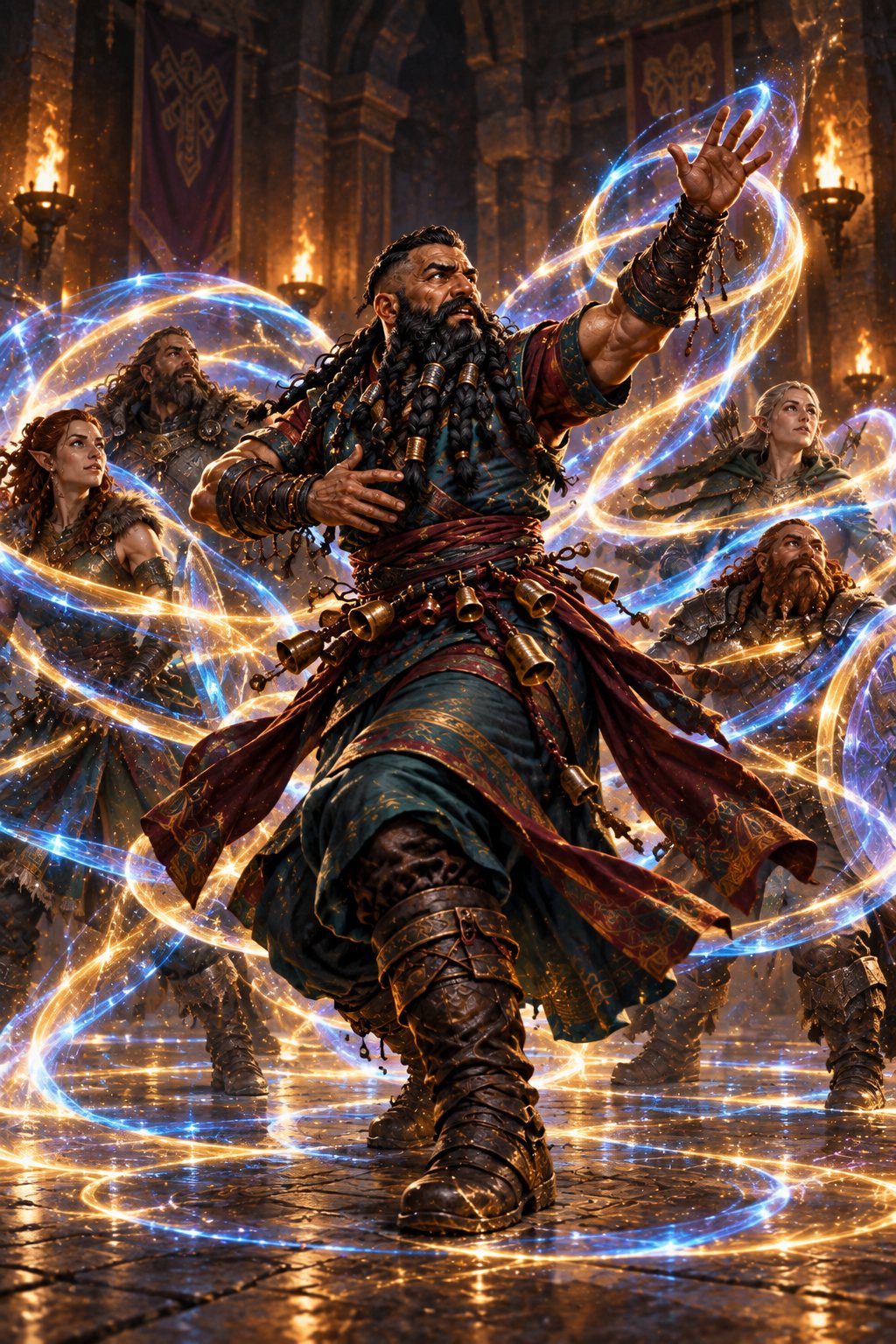
You learned to fight the way you learned to dance, which is to say you learned them as the same thing. Somewhere behind the sword and the shield and the shouted order there is a beat — the war has one, the same as the wedding and the harvest and the funeral — and while everyone else marches to it badly, out of step and stumbling, you are the one who can hear it. So you move. Your feet find the ground on the downbeat and the enemy’s blade finds the air where you used to be; your allies feel the rhythm come up through the soles of their boots and, without quite knowing why, they fight better, cleaner, together. And the thing across from you — the thing that came here so sure of its own timing — you take that from it. You pull it a half-step off its beat and watch its whole plan fall apart in its hands. In a story you are the one everybody can hear: the drummer, the caller, the singer at the front of the line, trusted by everyone moving to your beat and hunted first by any enemy who has worked out that silencing you silences the whole company.
The Wardancer is a performer-combatant whose magic lives in motion. Your baseline weapon is the Downbeat, a struck beat that lands like thunder in the body; your engine is Tempo, a rhythm that builds across turns as long as you keep dancing and collapses the instant you’re stopped, pinned, or silenced. Where a Bard hands out a die and hopes you use it well, you don’t hand out anything — you set the pace, and everyone who can hear you moves inside it. Charisma is not your charm here; it is your carrying power, the thing that makes a beat land on a hundred bodies at once. This is the selfless art. Your numbers alone will never be the biggest at the table. The table’s numbers will be, and that is the point.
This class belongs to the monk-caster family. Its pool is Qi points, its Surge is the Downbeat, and it is built to SPEC.
Class Overview
| Primary Abilities | Dexterity and Charisma |
| Hit Point Die | d8 per Wardancer level |
| Saving Throws | Dexterity and Charisma |
| Skills | Choose 2: Acrobatics, Athletics, History, Insight, Intimidation, Performance, or Persuasion |
| Weapons | Simple weapons |
| Armor | None |
| Starting Equipment | Dancer’s regalia hung with small bells and cord, a hand-drum or other portable instrument (your spellcasting focus, no mechanical effect of its own), a length of weighted sash you fight and flourish with, a traveler’s kit, and 10 GP |
Spellcasting summary. You cast spells from the Wardancer spell list, a closed list built on the Arcane Enchantment and Illusion schools and a set of movement, thunder and support spells, using Charisma as your spellcasting ability. You are a half-caster who casts spells you know (you never prepare from a book), from the half-caster spell point pool, recovered on a Long Rest. No damage cantrips — your Unarmed Strikes and the beat they keep are your at-will offense — but you learn a few utility cantrips (see Utility Cantrips at level 2). Spell save DC = 8 + your Charisma modifier + your Proficiency Bonus; spell attack modifier = your Charisma modifier + your Proficiency Bonus.
Class Table
| Level | Proficiency Bonus | Martial Arts Die | Downbeat | Qi | Max Tempo | Spells Known | Spell Points | Max Spell Level | Features |
|---|---|---|---|---|---|---|---|---|---|
| 1 | +2 | 1d6 | 1 die | 1 | III | — | — | — | Martial Arts, Unarmored Defense, Qi points, Downbeat, Tempo |
| 2 | +2 | 1d6 | 1 die | 2 | III | 2 | 4 | 1st | Spellcasting, The Beat, Utility Cantrips, Unarmored Movement |
| 3 | +2 | 1d6 | 1 die | 3 | III | 3 | 6 | 1st | Measure |
| 4 | +2 | 1d6 | 1 die | 4 | III | 3 | 6 | 1st | Ability Score Improvement |
| 5 | +3 | 1d8 | 1 die | 5 | III | 4 | 14 | 2nd | Extra Attack, Off-Beat |
| 6 | +3 | 1d8 | 1 die | 6 | III | 4 | 14 | 2nd | Measure feature, Unarmored Movement (+15 ft) |
| 7 | +3 | 1d8 | 1 die | 7 | III | 5 | 17 | 2nd | Unbroken Step |
| 8 | +3 | 1d8 | 1 die | 8 | III | 5 | 17 | 2nd | Ability Score Improvement |
| 9 | +4 | 1d8 | 1 die | 9 | III | 6 | 27 | 3rd | Crescendo, Unarmored Movement (vertical surfaces and liquids) |
| 10 | +4 | 1d8 | 1 die | 10 | III | 6 | 27 | 3rd | Call and Response, Unarmored Movement (+20 ft) |
| 11 | +4 | 1d10 | 3 dice | 11 | III | 7 | 32 | 3rd | Measure feature |
| 12 | +4 | 1d10 | 3 dice | 12 | III | 7 | 32 | 3rd | Ability Score Improvement |
| 13 | +5 | 1d10 | 3 dice | 13 | III | 8 | 38 | 4th | Countertime, Mystic Arcanum (6th) |
| 14 | +5 | 1d10 | 3 dice | 14 | III | 8 | 38 | 4th | Deaf to No Music, Unarmored Movement (+25 ft) |
| 15 | +5 | 1d10 | 3 dice | 15 | III | 9 | 44 | 4th | Perfect Time |
| 16 | +5 | 1d10 | 3 dice | 16 | III | 9 | 44 | 4th | Ability Score Improvement, Mystic Arcanum (7th) |
| 17 | +6 | 1d12 | 5 dice | 17 | III | 10 | 57 | 5th | Measure feature |
| 18 | +6 | 1d12 | 5 dice | 18 | IV | 10 | 57 | 5th | The Break, Unarmored Movement (+30 ft) |
| 19 | +6 | 1d12 | 5 dice | 19 | IV | 11 | 64 | 5th | Epic Boon, Mystic Arcanum (8th) |
| 20 | +6 | 1d12 | 5 dice | 20 | IV | 11 | 64 | 5th | The Longest Dance |
Cantrips Known: 1 at level 2, 2 at level 7, 3 at level 13 — utility only (see Utility Cantrips).
Unarmored Movement: +10 ft at level 2, +15 ft at level 6, +20 ft at level 10, +25 ft at level 14, +30 ft at level 18; vertical surfaces and liquids from level 9.
Mystic Arcanum: one 6th-level spell at 13, one 7th-level at 16, one 8th-level at 19 — each cast once per Long Rest without spending spell points or Qi.
Class Features
Wardancer powers at a glance
Every Wardancer power that costs a resource, takes an action, or produces a discrete effect, with what it costs, what it takes, how far it reaches, how long it lasts, what the target rolls, what it deals, and what anyone watching sees. A field reads “—” where it does not apply. Chassis features shared with the 2024 Monk — Martial Arts, Unarmored Defense, Extra Attack, Unarmored Movement — and this class’s own version of Mystic Arcanum (written out below) are not repeated here, and Tempo’s own stage benefits are a passive state rather than a power, so they stay in the Tempo section where they belong.
Display and Counterspell. The Wardancer is the least subtle caster in the library, and that is the design rather than an oversight. There is no subtlety clause anywhere in this class and there should not be one: Casting requires the dance already establishes that the magic is sung, drummed and stepped, that a Silence effect stops its spells with a Verbal component, and that a Wardancer who cannot be heard is a Wardancer at Tempo 0. The Display column below records the consequence — nearly every entry is audible at a distance — and that same property is what makes the Silence and Incapacitated counters work. No Wardancer feature claims immunity to Counterspell or dispel magic, and its spells are published spells answered exactly as printed.
Class features.
| Power | Cost | Action | Range | Duration | Save and damage | Display |
|---|---|---|---|---|---|---|
| Downbeat | 1 Qi at 1–10, 2 at 11–16, 3 at 17–20 | No action, once on each of your turns, after a hit’s damage roll | The creature you hit | Instantaneous | — · 1 / 3 / 5 Martial Arts dice + Charisma modifier, thunder | auditory (obvious) — the room feels the beat land in its chest |
| — Shared Downbeat | as the Downbeat | part of the Downbeat | 30 feet, one ally who can hear you | To the start of your next turn | — · one die of the same size for that ally | auditory (obvious) — the beat carries past you to them |
| The Beat (2) | — , while Tempo is I or higher | No action, passive aura | 30 feet, allies who can hear you | While the Tempo holds | — · at Tempo III, Charisma modifier thunder, once per ally per turn | auditory (obvious) — everyone within earshot is inside the rhythm |
| Off-Beat (5) | — | No action, once on each of your turns, on Downbeat damage | The creature you hit | as the feature states | Charisma | auditory (obvious) — the enemy is handed your rhythm and drops it |
| Crescendo (9) | 2 Qi | No action, at the start of your turn | Self | Instantaneous | — · advances your Tempo one stage | auditory (obvious) — you force the tempo up and it is heard |
| Call and Response (10) | — | No action, triggered by an ally’s Critical Hit or kill | 30 feet | Instantaneous | — · your Tempo rises one stage; you roll Initiative at Tempo II | auditory (obvious) — you answer what they just did |
| Countertime (13) | — | Reaction, when a creature hits you or an ally in earshot | 30 feet | as the feature states | — | auditory (obvious) — a hard counterbeat off the broken one |
| The Break (18) | — | No action, passive | Self and The Beat’s range | While at Tempo IV | — | auditory (obvious) — the drummer drops out and you are still going |
| The Longest Dance (20) | — , per the feature’s clock | Bonus Action | Self | 1 minute | — · the Downbeat costs no Qi | auditory and visual (obvious) — nothing stops this, and nothing hides it |
Measure of the Sway.
| Power | Cost | Action | Range | Duration | Save and damage | Display |
|---|---|---|---|---|---|---|
| Guile (3) | — | Reaction, when a creature misses you | Self, moving 10 feet | Instantaneous | — | visual (obvious) — you go under the blow and come up elsewhere |
| Low Sweep (6) | — | No action, on Downbeat damage to an off-beat creature | The creature you hit | Instantaneous | Dexterity | visual (obvious) — the feet go out from under them |
| The Endless Game (17) | — , while you hold 1 Qi and Tempo I+ | No action, passive; the redirect costs no action, once per turn | Self | Continuous | — | visual (obvious) — nobody can find the beat you are on |
Measure of the Whirl.
| Power | Cost | Action | Range | Duration | Save and damage | Display |
|---|---|---|---|---|---|---|
| The Turning (3) | — | part of the Attack action, replacing one strike | 5 feet, widening later | Instantaneous | as the feature states | visual (obvious) — a blur of radiant motion |
| Ascending Trance (6) | — , while Tempo is II or higher | No action, passive | Self | While the Tempo holds | — | visual (obvious) — you are turning, a hand’s breadth off the floor |
| The Twofold Light (11) | — | part of The Turning | 15-foot radius | Instantaneous | — · Charisma modifier healing to allies in the radius | visual (obvious) — the light burns one way and bathes the other |
| Union (17) | — , while Tempo is III or higher (4 Qi to use again before a Long Rest) | Bonus Action | 20-foot Emanation | 1 minute | as the feature states | visual (obvious) — you are a pillar of turning light |
Measure of the Chronicle.
| Power | Cost | Action | Range | Duration | Save and damage | Display |
|---|---|---|---|---|---|---|
| Praise-Song (3) | — | Bonus Action | 30 feet, one ally | 1 minute, no Concentration | — | auditory (obvious) — you are singing their legend, out loud |
| Name the Foe (6) | — | Magic action | 60 feet | 1 minute, no Concentration | — | auditory (obvious) — you narrate their flaws to the whole field |
| Living Legend (11) | 3 Qi | Magic action | 30 feet, one willing ally | as the feature states | — | auditory (obvious) — the story reaches in and pulls something out |
| The Song That Does Not End (17) | 5 Qi | Magic action | as the feature states | 1 minute, no Concentration | — | auditory (obvious) — an epic large enough to hold the whole party |
Measure of the War-Drum.
| Power | Cost | Action | Range | Duration | Save and damage | Display |
|---|---|---|---|---|---|---|
| The Marching Beat (3) | — | No action, on Initiative | Allies who can hear you | Instantaneous | — · your Charisma modifier to their Initiative | auditory (obvious) — the drum goes before anyone has moved |
| On the Downbeat (6) | — | part of the Marching Beat call | as the call | Instantaneous | — · the chosen ally moves up to half its Speed, then makes a full weapon attack | auditory (obvious) — the beat carries a strike with it |
| Double-Time (11) | — , on reaching Tempo III | No action, on reaching the stage | Up to two allies you can hear | Until your Tempo drops below III | — | auditory (obvious) — two of them are suddenly moving at your speed |
| The Final Charge (17) | 5 Qi | Bonus Action | Every ally you can hear | Instantaneous | — · each takes one additional turn (no spells of 1st level or higher) | auditory (obvious) — you beat the charge, and the line goes |
Measure of the Gauntlet.
| Power | Cost | Action | Range | Duration | Save and damage | Display |
|---|---|---|---|---|---|---|
| The Challenge (3) | — | Bonus Action | 30 feet, enemies who can see and hear you | as the feature states | Charisma | auditory and visual (obvious) — the challenge is the whole point |
| Defiant Stance (6) | — , while a creature is Challenged | No action, passive | Self | While the Challenge holds | — | visual (obvious) — you are standing where they have to come |
| Terror of the Line (11) | — | part of the Challenge | as the Challenge | as the Challenge | Charisma | auditory and visual (obvious) — as the Challenge, and worse |
| The One Who Stands (17) | — , while Challenged and above 0 Hit Points | No action, passive | Self | Continuous | — | visual (obvious) — you cannot be moved from the front |
Measure of the Sung Word.
| Power | Cost | Action | Range | Duration | Save and damage | Display |
|---|---|---|---|---|---|---|
| The Binding Song (3) | — | Magic action | 30 feet, a creature that can hear you | as the feature states | Charisma | auditory (obvious) — your voice reaches into what hears it |
| The Sinking Verse (6) | 2 Qi | Magic action | 60 feet, a 15-foot-radius Sphere | as the feature states | as the feature states | auditory (obvious) — you sing over the whole area |
| The Word That Stops the World (11) | 3 Qi (6 Qi to use again before a Short or Long Rest) | Magic action | 30 feet, creatures that can hear you | as the feature states | Charisma | auditory (obvious) — the still-note, and everyone hears it |
| The Last Verse (17) | as the feature states | Magic action | as the feature states | as the feature states | as the feature states | auditory (obvious) — the oldest song, the one a singer carried back out of the dark |
Level 1: Martial Arts
Your body is the only instrument you truly need. While you are unarmed or wielding a simple weapon and you aren’t wearing armor or wielding a Shield, you gain the following benefits.
- Martial Arts die. You can roll your Martial Arts die (see the class table) in place of the normal damage of your Unarmed Strikes and simple weapons.
- Dexterous strikes. You can use Dexterity instead of Strength for the attack and damage rolls of your Unarmed Strikes and simple weapons.
- Second step. When you take the Attack action with an Unarmed Strike or a simple weapon on your turn, you can make one Unarmed Strike as a Bonus Action.
Your strikes are not silent. A Wardancer’s blow lands with the crack of a struck drumhead — heel, palm, sash, and bell all keeping time — and that sound is part of the magic. You are always, faintly, making music.
Level 1: Unarmored Defense
While you aren’t wearing armor or wielding a Shield, your base Armor Class equals 10 + your Dexterity modifier + your Charisma modifier. Half of your defense is footwork; the other half is that the blow simply cannot decide where you’ll be by the time it arrives, and neither, quite, can you.
Level 1: Qi points
You carry your rhythm as a pool of Qi points equal to your Wardancer level — what the disciplines call Qi, the breath-force the monasteries count and spend; in you it keeps time. You regain all expended Qi points when you finish a Short or Long Rest — a few minutes to catch your breath and reset the count is enough. Qi fuels your Downbeat and many of your Measure features; every feature that costs it says so.
Qi is not stamina and it is not spell energy. It is the countable part of the beat — the strikes you have left in you that will land on time rather than merely land. When you run out, you don’t tire and your magic doesn’t fail; your blows simply come down between the beats, ordinary, and the world stops moving to them until you find the pulse again.
Level 1: Downbeat
Every dance has one strike the whole thing is built around — the one the drummer leans into, the one the room feels in its chest. Once on each of your turns, when you hit a creature with an Unarmed Strike or a simple weapon, you can spend Qi points after you roll the strike’s damage to bring that strike down on the beat as a free rider — this costs no action, Bonus Action, or Reaction, and doesn’t replace any other part of your turn. Because you decide after the damage roll, if the strike’s own damage drops the creature to 0 Hit Points you can decline: you keep the Qi, and your Downbeat stays available for a later hit this turn. The cost climbs as the beat grows heavier: 1 Qi at levels 1–10, 2 Qi at levels 11–16, and 3 Qi at levels 17–20.
Roll a number of dice of your Martial Arts die size and add your Charisma modifier; the target takes that much extra thunder damage (or, if you prefer, the strike’s own damage type) as the beat lands in its body. The number of dice is 1 at levels 1–10, 3 at levels 11–16, and 5 at levels 17–20, as shown in the Downbeat column.
Because the Downbeat is limited to once per turn, throwing more strikes only gives you more chances to land it on time — it never fires twice on the same turn (the one exception is Countertime, at level 13), and no Measure feature adds Downbeat dice onto the same strike. This is the intentional ceiling on your single-turn burst; your reach was never meant to come from one enormous blow. It comes from everything the beat does to the people around it.
Shared Downbeat. The beat carries past you. When you use the Downbeat, choose one ally within 30 feet who can hear you; before the start of your next turn, they can add one roll of your Martial Arts die to one damage roll, or add your Charisma modifier to one saving throw. A creature can benefit from only one Shared Downbeat at a time. This is not Bardic Inspiration and doesn’t use its rules: it costs no separate resource beyond the Downbeat itself, it rides on an attack you already landed, it expires at the start of your next turn rather than lasting minutes, and it can only be added to a damage roll or a saving throw — never to an attack roll or ability check.
Level 1: Tempo
This is the whole of your art: a rhythm that builds the longer you keep dancing, and dies the moment you’re made to stop. You have a Tempo that rises through stages — I, II, and III (and IV at level 18) — or sits at 0 when the music has stopped.
Keeping the beat. At the end of each of your turns, if you kept the beat this turn, your Tempo rises by one stage (to your maximum). You kept the beat on any turn where you moved at least 10 feet or took the Attack action or cast a spell. A turn spent doing none of those — standing still, only Dodging, hesitating — is a turn you fell out of rhythm, and your Tempo drops to 0. A turn on which an effect prevented you from moving and from taking actions (the Command spell’s Halt, for example) isn’t a turn you fell out of rhythm: your Tempo neither rises nor drops at its end. This exception covers only falling out of rhythm. Losing the beat (below) still applies as written, so if you have the Incapacitated condition or can’t be heard, your Tempo still drops to 0.
Losing the beat. Your Tempo drops immediately to 0 whenever any of the following is true: you can’t be heard (you’re within a Silence effect, Deafened targets aside — the point is that you make no sound), you have the Incapacitated condition, you’re Grappled or Restrained, or your Speed is reduced to 0. Stillness and silence are the counter to everything you do; a canny enemy who pins you or shuts the sound off has turned your engine off with it.
What Tempo grants you. Your current stage sharpens your own dance, as follows. These benefits apply only while you aren’t wearing armor or wielding a Shield.
| Tempo | Your benefit |
|---|---|
| I | Your Speed increases by 5 feet. |
| II | Your Speed increases by 10 feet, and you have Advantage on Dexterity (Acrobatics) checks and on saving throws to avoid being Grappled, Restrained, or knocked Prone. |
| III | Your Speed increases by 15 feet, and Opportunity Attacks made against you are rolled with Disadvantage. |
When you roll Initiative, your Tempo becomes I (II from level 10; see Call and Response), whatever it was before. If anything under Losing the beat is true at that moment, that rule applies at once. No damage cantrips fill the quiet moments before the beat catches: your at-will offense is the strike and the rhythm it keeps, and neither of those does small favors. The utility cantrips you learn are flourishes for small useful ends, not a way to throw spellfire between beats.
Level 2: Spellcasting
You have found the songs behind the steps. See the end of this document for the full Spellcasting rules, your spell point progression, and the Wardancer spell list. In brief:
- You are a half-caster using Charisma. Your spell save DC = 8 + your Charisma modifier + your Proficiency Bonus; your spell attack modifier = your Charisma modifier + your Proficiency Bonus.
- You cast spells you know (you do not prepare from a book). You know a number of spells set by the Spells Known column, chosen from the Wardancer spell list, and can swap one known spell for another from that list whenever you gain a level.
- Your spell points follow the half-caster progression on the class table and are regained on a Long Rest.
- You cast with voice and body; your instrument, your bells, or your own drumming palms serve as your spellcasting focus. You can’t cast a spell with a Verbal component while you can’t make sound, or one with a Somatic component while you have the Restrained condition (see Casting requires the dance) — the same stillness that kills your Tempo silences your spells.
- No damage cantrips, but you learn utility cantrips (see Utility Cantrips, below). The beat is your at-will offense; the cantrips serve only small useful ends.
Level 2: The Beat
You’ve stopped dancing only for yourself. While your Tempo is at Stage I or higher, each ally who can hear you within 30 feet falls into your rhythm and shares in it. The benefit scales with your current Tempo stage:
| Tempo | Your allies in earshot gain |
|---|---|
| I | +5 feet of Speed. |
| II | +5 feet of Speed, and Advantage on saving throws against being Charmed or Frightened (nothing rattles a body that’s keeping time). |
| III | +5 feet of Speed, Advantage against Charmed and Frightened, and once on each of their turns, when an ally hits a creature with an attack, that attack deals extra thunder damage equal to your Charisma modifier — the beat landing through their hands as well as yours. |
The Beat is not a die you spend or a resource your allies track. It is ambient: while the rhythm holds and they can hear it, it is simply on, growing as your Tempo climbs and vanishing the instant you’re stopped. An ally who is Deafened, or who steps out of earshot, falls out of it until they can hear you again.
Level 2: Utility Cantrips
Your art is percussion and motion, not small spellfire — but a flourish can serve small useful ends. You learn 1 cantrip at level 2, a 2nd at level 7, and a 3rd at level 13, from the list below — utility cantrips only (no attack roll, no damage, no save-for-damage). They use Charisma. You can swap one when you gain a level. Choose from: Message, Minor Illusion, Prestidigitation, Mending, Light, Dancing Lights, Mage Hand, Friends.
Level 2: Unarmored Movement
Unarmored Movement — what the dance calls the Long Measure: a measure in the musical sense, the span of ground a dancer crosses between one downbeat and the next, and yours has been getting longer since you started counting. While you aren’t wearing armor or wielding a Shield, your Speed increases by 10 feet. This bonus increases to +15 feet at level 6, +20 feet at level 10, +25 feet at level 14, and +30 feet at level 18.
Starting at level 9, the measure carries you where there is no floor to speak of: on your turn you can move along vertical surfaces and across liquids without falling during that movement — you are only ever between steps, and nothing that brief has time to sink.
This bonus is separate from, and stacks with, the Speed increase your current Tempo grants. It does not change how Tempo is built: keeping the beat asks only that you move at least 10 feet on your turn, and your Tempo still rises by at most one stage per turn to your maximum, no matter how far you actually travel.
Level 3: Measure
A dance of war is never danced the same way twice; every people that ever fought put their own step to it. Choose a Measure — the tradition your dance descends from: the Sway, the Whirl, the Chronicle, the War-Drum, the Gauntlet, or the Sung Word, each described later in this document. You gain its level 3 features, and additional features at levels 6, 11, and 17.
Level 4, 8, 12, 16: Ability Score Improvement
You gain the Ability Score Improvement feat or another feat of your choice for which you qualify.
Level 5: Extra Attack
You can attack twice, instead of once, whenever you take the Attack action on your turn.
Level 5: Off-Beat
You’ve learned to give the enemy your rhythm the way you give it to your friends — except for them it’s a gift, and for the enemy it’s a theft. Once on each of your turns, when a creature takes damage from your Downbeat, it must succeed on a Charisma saving throw (your spell save DC) or be pulled off its own beat until the start of your next turn. The severity depends on your current Tempo stage; while a creature is off the beat:
- Tempo I: its Speed is reduced by 10 feet.
- Tempo II: its Speed is reduced by 10 feet, and it can’t take Reactions.
- Tempo III: its Speed is reduced by 10 feet, it can’t take Reactions, and it has Disadvantage on attack rolls.
A creature already off the beat that fails another save gains no additional effect from a lower or equal Tempo, but a higher Tempo overwrites the effect with its stronger version. The higher you’ve climbed, the more of the enemy’s tempo you take when you finally connect.
Level 7: Unbroken Step
The dance has become hard to interrupt. Your Tempo no longer drops from being Grappled or Restrained or from having your Speed reduced to 0, so long as you can still be heard — you keep the beat in your shoulders and voice while your feet are held. (Silence and Incapacitation still stop you cold; those remain your true counters.) In addition, difficult terrain no longer costs you extra movement, and you can move through the space of any creature as though it were difficult terrain. In addition, you gain proficiency in Wisdom saving throws (Intelligence saving throws if you already have it) — the dance keeps going even when something reaches for your mind.
Level 9: Crescendo
You can force the rhythm up rather than wait for it. At the start of your turn, you can spend 2 Qi to immediately advance your Tempo by one stage (this can raise it above 0 after a drop, restarting the climb without waiting a turn). In addition, whenever you score a Critical Hit with an Unarmed Strike or reduce a creature to 0 Hit Points, your Tempo rises by one stage — the dance feeds on the fallen.
Level 10: Call and Response
The music no longer depends on you alone. Whenever an ally you can hear within 30 feet scores a Critical Hit or reduces a creature to 0 Hit Points, your Tempo rises by one stage (to your maximum) — they answer your call and you climb on their beat. In addition, when you roll Initiative, you begin combat already at Tempo II, and you regain expended Qi points equal to half your Wardancer level (round down). You no longer walk into fights cold.
Level 13: Countertime
You’ve learned to answer a broken beat with one of your own. When a creature you can see within 30 feet hits you or an ally in earshot with an attack, you can take a Reaction to strike back on the counterbeat: the attacking creature has Disadvantage on its next attack roll before the end of its next turn, and if it’s within your reach, you can make one Unarmed Strike against it as part of this Reaction. That strike can carry your Downbeat, paying its Qi cost as usual — a counter is a beat all its own. This is an exception to the Downbeat’s once-on-each-of-your-turns limit.
Level 13: Mystic Arcanum
Mystic Arcanum — what the dance calls the Long Song. Everything else you do is a step, and steps are cheap; you can always take another. This is the piece. It takes the whole of you to perform and you can only give it once between rests, and every troupe that ever kept one kept it for the night the ordinary dancing wasn’t going to be enough.
You learn one 6th-level spell from the Wardancer spell list. You cast each Arcanum spell once without spending spell points or Qi, and you regain the ability to do so when you finish a Long Rest. At level 16 you learn a 7th-level spell, and at level 19 an 8th-level spell, each cast once per Long Rest in the same way. Whenever you gain a Wardancer level, you can replace one of these spells with another of the same level from your class’s list. These spells use your Charisma.
Each Arcanum has its own separate use — casting the 6th-level spell doesn’t spend the 7th or the 8th. An Arcanum is not a Tempo spend and costs no Qi, so nothing in your engine recovers it and nothing in your engine is spent by it; casting one does, however, count as casting a spell for keeping the beat, so the Long Song raises your Tempo at the end of that turn like any other. See the Spellcasting section for the 6th-, 7th-, and 8th-level options.
Level 14: Deaf to No Music
You carry the beat too deep now to be shaken loose from it. You have Advantage on saving throws against being Charmed or Frightened, you can’t be Deafened, and while you are conscious, being surprised doesn’t give you Disadvantage on your Initiative roll. A body already keeping this much time has no spare rhythm for anyone else to hijack.
Level 15: Perfect Time
The music never fully stops for you anymore. When your Tempo would drop to 0 from any cause other than the Incapacitated condition or a true Silence, it instead drops only to Tempo I — you stagger but you never lose the count entirely. In addition, you add your Charisma modifier to your Initiative rolls. And once on each of your turns, when you could use your Downbeat (after you roll a hit’s damage, as that feature says), you can spend the beat on distance rather than damage: pay the Downbeat’s Qi cost as usual, but instead of dealing its damage (and granting a Shared Downbeat), move up to your Speed without provoking Opportunity Attacks (this movement doesn’t use any of your own movement). This costs no action, Bonus Action or Reaction, and it counts as your Downbeat for that turn. Because it deals no Downbeat damage, it doesn’t trigger features that need your Downbeat to hit or deal damage, such as Off-Beat, the Sway’s Low Sweep or the War-Drum’s Marching Beat call.
Level 18: The Break
You’ve found the stage past the top of the climb — the moment in every great dance where the drummer drops out and the dancer flies alone. Your Tempo can now rise to Stage IV. While at Tempo IV:
- You gain all your Tempo III benefits; your Speed increase becomes +20 feet; and once on each of your turns, when you take the Attack action, you can make one additional Unarmed Strike as part of that action.
- Your allies in earshot gain all their Tempo III benefits, and the first attack roll each of them makes on each of their turns is made with Advantage.
- Off-Beat at Tempo IV also causes a creature that fails its save to have Disadvantage on its own saving throws until the start of your next turn — a body this far off the beat can’t brace for anything.
Level 19: Epic Boon
You gain an Epic Boon feat or another feat of your choice for which you qualify. The Boon of Speed and the Boon of Irresistible Offense both suit a Wardancer, but any Boon your DM allows fits the dancer who has outlasted the music.
Level 20: The Longest Dance
Once, you could keep the beat until something stopped you. Now you can decide that nothing will. As a Bonus Action, you begin the longest dance for 1 minute. For the duration:
- Your Tempo is treated as Stage IV and cannot drop for any reason — not silence, not a grapple, not being knocked unconscious and standing back up; the beat is simply always there while the dance lasts.
- Your Downbeat costs no Qi points.
- Your allies in earshot gain the Tempo IV benefits of The Beat regardless of your actual stage, and being Deafened no longer removes them from it — they feel the beat in the floor.
- Once on each of your turns, when you use Off-Beat, the target makes its saving throw with Disadvantage.
When the minute ends, you gain 1 Exhaustion level; a dance this long is paid for by the body that danced it. Once you use this feature, you can’t use it again until you finish a Long Rest.
Measures (Subclasses)
Six Measures describe the tradition your dance descends from. Each grants features at 3rd, 6th, 11th, and 17th level. A Measure is a way of dancing that you learned, not a people you belong to: nothing in it needs a particular culture, faith or place to exist. Each world gives the six Measures its own names (see In Different Worlds), and the real traditions that inspired them are credited under Origins and Inspiration.
Measure of the Sway
The dance is a lie the whole body tells, and the truth is a kick you never saw coming. Dancers of the Sway fight from the sway itself — the endless rocking back-and-forth that is never a stance and never a rest, that hides the strike inside the step and the step inside the strike. They win by making the enemy commit to a thing that isn’t there, and answering the empty air with a heel.
Level 3: Guile. You fight from the sway, all deception and low cunning. When a creature misses you with an attack, you can take a Reaction to sway under the blow: move up to 10 feet without provoking Opportunity Attacks, and the attacker has Disadvantage on its next attack roll against you before the end of its next turn. In addition, once on each of your turns when you hit a creature with an Unarmed Strike, you can feint instead of dealing your Downbeat: the next attack roll made against that creature by you or an ally before the start of your next turn has Advantage.
Level 6: Low Sweep. Your dance takes their feet out from under them. When a creature that is off the beat (see Off-Beat) takes damage from your Downbeat, it must succeed on a Dexterity saving throw or be knocked Prone — the sweep was always the point of the sway. In addition, you can stand up from Prone for no movement, and being Prone never reduces your Tempo or your Speed benefits.
Level 11: Evasion — what the dance calls the inside game. You have Evasion: when you make a Dexterity saving throw against an effect that deals half damage on a success, you take no damage on a success and half on a failure. When a creature misses you with an attack and you take the Reaction from Guile, you can also make one Unarmed Strike against the attacker as part of that same Reaction, before or after Guile’s movement, if the attacker is within your reach at that moment.
Level 17: The Endless Game. While you have at least 1 Qi point and your Tempo is I or higher, attack rolls against you are made with Disadvantage — no one can find the beat you’re actually on. Once per turn, when a creature misses you, you can redirect the miss: the attack strikes a creature of your choice within 5 feet of you instead, using the original roll. This costs no action, Bonus Action or Reaction, and you can do it on other creatures’ turns.
Playing a dancer of the Sway: you are the fight’s most frustrating problem — never where the blow lands, always where the counter comes from. Delight in the enemy that swings a third time, furious, at a place you left two beats ago.
Measure of the Whirl
You do not spin to escape the world. You spin until you and it are the same turning thing. Dancers of the Whirl spin — arms flung wide, turning and turning until the self burns off and only the turning is left. Their war-dance is centrifugal and luminous; the longer they spin the higher they rise and the brighter they burn, and everything in reach is caught in the light. This Measure folds the tradition once called the Whirling Adept.
Level 3: The Turning. You fight by whirling in place, a blur of radiant motion. When you take the Attack action, you can replace one of your Unarmed Strikes with a whirl: each creature of your choice within 5 feet of you takes radiant damage equal to one roll of your Martial Arts die + your Charisma modifier (a Dexterity saving throw halves it). In addition, while your Tempo is I or higher, you shed dim light in a 10-foot radius, and your Downbeat can deal radiant damage instead of thunder.
Level 6: Ascending Trance. The longer you turn, the higher you rise. While your Tempo is II or higher, you gain a flying Speed equal to your walking Speed (you hover, turning, a hand’s breadth to a body’s height off the ground). While your Tempo is III or higher, at the start of each of your turns, each enemy within 10 feet of you takes radiant damage equal to one roll of your Martial Arts die — the light thrown off by the turning.
Level 11: The Twofold Light. Your whirl’s radius becomes 15 feet. When you whirl, allies within that radius are bathed in the light instead of burned: each regains Hit Points equal to your Charisma modifier (once per turn per ally). In addition, you have Resistance to radiant and necrotic damage, and you can’t be knocked Prone or moved against your will while your Tempo is II or higher — a spinning top does not tip.
Level 17: Union. As a Bonus Action while your Tempo is III or higher, you become a pillar of turning light for 1 minute. Radiant light fills a 20-foot-radius Emanation around you; each enemy that starts its turn there takes radiant damage equal to two rolls of your Martial Arts die + your Charisma modifier (a Dexterity save halves it), and each ally that starts its turn there regains Hit Points equal to your Charisma modifier and has Advantage on its next saving throw. You have a flying Speed and can’t be Blinded. Once you use this feature, you can’t use it again until you finish a Long Rest, unless you spend 4 Qi when you use it; using it again still takes a Bonus Action and needs Tempo III or higher. If Union is active when you use it again, its 1-minute duration restarts instead of a second pillar forming.
Playing a dancer of the Whirl: you are the fixed bright point the battle turns around. The interesting play is choosing when to stop — because you can spin past exhaustion, past sense, and the dance would happily take everything you have.
Measure of the Chronicle
A hero is only as strong as the person willing to sing them into being. Fortunately, I am here. Dancers of the Chronicle are the keepers of the line — the praise-singers who carry a people’s names, deeds, and genealogies in memory and hand them back as courage. Their war-dance is narration: they sing an ally’s legend as it happens, and the legend, being sung, comes true a little harder than it otherwise would. They are the loremaster, the diplomat, and the reason your best fighter suddenly fights like the story about them.
Level 3: Praise-Song. As a Bonus Action, you begin singing the legend of one ally you can see within 30 feet; the song lasts 1 minute or until you sing another (no Concentration). While the song lasts and the ally can hear you, they gain temporary Hit Points equal to your Charisma modifier at the start of each of their turns, and the first time each turn they hit a creature, they deal extra thunder damage equal to one roll of your Martial Arts die. In addition, you have proficiency in the History skill and can add double your Proficiency Bonus to any Intelligence (History) check about a person, lineage, or deed; if you already have proficiency, you learn one language of your choice.
Level 6: Name the Foe. As a Magic action, you narrate an enemy’s flaws aloud to the whole field. Choose a creature you can see within 60 feet; for 1 minute (no Concentration), you and your allies know its damage Resistances, Immunities, and Vulnerabilities, it can’t benefit from being unseen or hidden against you and your allies, and the first time each turn any of you hits it, the attack deals an extra 1d6 damage of its own type. The named foe can end the effect early only by moving out of your sight and earshot for a full round.
Level 11: Living Legend. Your stories reach back into an ally and pull out something that was always there. As a Magic action, spend 3 Qi to make one willing ally you can see within 30 feet a legend for 1 minute (no Concentration): they gain temporary Hit Points equal to your Wardancer level, they can’t be Frightened or Charmed, they add your Charisma modifier to all their saving throws, and once on each of their turns they can add one roll of your Martial Arts die to an attack roll, ability check, or saving throw. Once you use this feature, you can’t use it again until you finish a Short or Long Rest.
Level 17: The Song That Does Not End. You sing a story large enough to hold the whole party. As a Magic action, spend 5 Qi to begin an epic that lasts 1 minute (no Concentration) while you can be heard. Each ally in earshot gains the benefits of your Praise-Song at once, has Advantage on death saving throws and on saving throws against being Incapacitated, and when one of them drops to 0 Hit Points, you can end the effect for that ally to instead leave them at 1 Hit Point — the story refuses to let them fall here. Once you use this feature, you can’t use it again until you finish a Long Rest.
Playing a dancer of the Chronicle: you are the least selfish fighter on any field, and the most necessary. Your triumphs are borrowed and your best moments happen in someone else’s hands — learn to love that, or pick another Measure.
Measure of the War-Drum
I don’t tell them when to move. I make it impossible for them to move at any other time. War-drummers are the pulse of an army — the beat that turns a mob into a line and a line into a charge, the sound that lets a thousand people act as one body. Their dance is percussion and command; they don’t buff a single hero, they synchronize the whole party’s action economy, letting allies move and strike on a beat they didn’t have to spend their own turn to reach.
Level 3: The Marching Beat. Your drumming lets your allies act ahead of their own rhythm. When you roll Initiative, each ally who can hear you adds your Charisma modifier to their Initiative roll. In addition, once on each of your turns when you hit a creature with your Downbeat, you can strike the call: one ally you can hear within 30 feet can immediately use their Reaction to move up to half their Speed without provoking Opportunity Attacks, make one weapon attack, or both, moving first.
Level 6: On the Downbeat. The beat now carries a strike. When you use the Marching Beat call (above), the chosen ally’s attack becomes a full weapon attack (not merely one attack — if they have Extra Attack, all of it), still after moving up to half their Speed if they choose; or they can Dash instead of moving and attacking. You can use the call this way once on each of your turns; a given ally can be called by you only once per round.
Level 11: Double-Time. When you reach Tempo III, choose up to two allies you can hear; until your Tempo drops below III, each chosen ally has their Speed doubled, gains a +1 bonus to AC and Dexterity saving throws, and can take one additional action on each of their turns (as the Haste spell, but with no Concentration and no lethargy when it ends). You can shift the choice to different allies as a Bonus Action. No ally can be under this effect and a Haste spell at once.
Level 17: The Final Charge. As a Bonus Action, spend 5 Qi to beat the charge: each ally you can hear immediately takes one additional turn after your current turn, resolved in initiative order after you, on which they can move and take one action. They can’t cast a spell of 1st level or higher during that turn, whether with that action, a Bonus Action or a Reaction; a cantrip is fine. The rush is total but brief — when it passes, you and each ally that took the extra turn can’t take Reactions until the start of your next turn. Once you use this feature, you can’t use it again until you finish a Long Rest.
Playing a War-Drum dancer: your genius is measured in other people’s turns. A party that has learned to listen for your beat gets two rounds of value out of every one — you are the closest a Wardancer comes to bending time.
Measure of the Gauntlet
Look at me. Do not look at them, or the door, or your own hands. Look at me — because whatever happens next, I am the thing it happens to. Dancers of the Gauntlet fight the whole enemy line with their faces first — the stamp, the glare, the roar that says I am already unafraid of you and you should be very afraid of that. Their war-dance is challenge and provocation. They draw every eye and every blade to themselves, and having drawn them, they refuse to fall.
Level 3: The Challenge. As a Bonus Action, you issue the challenge to each enemy of your choice you can see within 30 feet that can hear and see you; each must succeed on a Charisma saving throw or be Challenged by you for 1 minute (no Concentration). A Challenged creature has Disadvantage on attack rolls against anyone other than you, and the first time each turn it attacks anyone other than you, it takes thunder damage equal to one roll of your Martial Arts die + your Charisma modifier. A creature repeats the save at the end of each of its turns, ending the effect on a success. Once you Challenge, you can’t do so again until the start of your next turn.
Level 6: Defiant Stance. You are built to be the one they hit. While at least one creature is Challenged by you, you gain a +1 bonus to AC and Resistance to the first instance of damage you take on each turn. When a Challenged creature hits you with an attack, you can take a Reaction to make one Unarmed Strike against it — it swung at you, which is exactly what you wanted.
Level 11: Terror of the Line. When you issue the Challenge, creatures that fail the save are also Frightened of you until the effect ends, and while Frightened this way they have their Speed halved as your presence pins them in place. In addition, an ally within 30 feet of you can’t be Frightened while you have a creature Challenged — you’ve taken all the fear in the room for yourself.
Level 17: The One Who Stands. You cannot be moved from the front. While you have at least 1 Hit Point and at least one creature is Challenged by you, you have Resistance to all damage, you can’t be moved against your will or knocked Prone, and when an ally you can see within 30 feet takes damage, you can take a Reaction to intercept it: you take that damage instead (after your Resistance), stepping into its path. Once per Long Rest, when you would drop to 0 Hit Points, you instead drop to 1 and each enemy within 30 feet must succeed on a Charisma saving throw or be Frightened of you until the end of your next turn.
Playing a dancer of the Gauntlet: you are the party’s front door, and you have decided that everything is coming through you. The role is protection by provocation — every blow you soak is one your friends didn’t, and you carry that math like a banner.
Measure of the Sung Word
The old singers did not chase their enemies. They sang, and their enemies stayed to listen, and stayed, and stayed, until the singing was done. Singers of the Word carry the oldest and most dangerous strain of the art — the song that acts directly on the listener, that charms, stills, sinks into sleep, or roots a running thing to the spot. Where every other Measure is about your motion, this one is about theirs: you are the dancer who makes the whole world hold still and listen.
Level 3: The Binding Song. Your voice reaches into what hears it. As a Magic action, choose a creature you can see within 30 feet that can hear you; it must succeed on a Charisma saving throw or be Charmed by you until the end of your next turn, its attention snared by the song. While Charmed this way it has Disadvantage on attack rolls and its Speed is halved. You can extend the effect by continuing to sing: on each of your subsequent turns, you can use a Bonus Action to force the creature to repeat the save, ending the effect on a success and maintaining it on a failure. In addition, when you cast an Enchantment or Illusion spell, one creature affected by it takes thunder damage equal to one roll of your Martial Arts die.
Level 6: The Sinking Verse. Your song can put a thing down entirely. As a Magic action, spend 2 Qi to sing over a 15-foot-radius Sphere centered on a point you can see within 60 feet; each enemy in it that can hear you makes a Charisma saving throw or falls into a magical daze until the end of your next turn (Incapacitated, and its Speed is 0). A dazed creature repeats the save at the end of each of its turns and if it takes any damage, ending the effect on a success or on taking damage. You can sustain the daze on creatures still affected by using a Bonus Action on later turns.
Level 11: The Word That Stops the World. As a Magic action, spend 3 Qi to sing the still-note: each creature of your choice you can see within 30 feet that can hear you makes a Charisma saving throw or has the Restrained condition until the start of your next turn as the song roots it where it stands, unable to make any sound of its own. A creature that fails also can’t cast spells with Verbal components until the start of your next turn. Once you use this feature, you can’t use it again until you finish a Short or Long Rest, unless you spend 3 additional Qi when you use it (6 Qi in all).
Level 17: The Last Verse. You sing the oldest song there is, the one the old stories say a singer once carried out of the dark and back into the world — the one that stops a thing where it stands and will not let it go. As a Magic action, choose a creature you can see within 60 feet; it must succeed on a Charisma saving throw or be Stunned for 1 minute as the song holds it whole. It repeats the save at the end of each of its turns, and each time it fails, it takes psychic damage equal to two rolls of your Martial Arts die + your Charisma modifier. If it’s still Stunned after a full minute, or if it drops to 0 Hit Points while Stunned, the song has it; the effect ends and it is Charmed by you until it takes damage from someone other than you. Once you use this feature, you can’t use it again until you finish a Long Rest.
Playing a Sung Word dancer: you are the quietest kind of terrifying — the one who ends fights before they’re fought, who empties a room of its violence one listener at a time. Your dance moves so that theirs cannot.
Spellcasting
You have found the songs that were always hiding inside the steps. Your Wardancer spellcasting is governed by the rules below.
Casting ability. Charisma. Spell save DC = 8 + your Charisma modifier + your Proficiency Bonus. Spell attack modifier = your Charisma modifier + your Proficiency Bonus.
Spells known. You cast spells you have committed to memory and body, not spells prepared from a book. You know a number of Wardancer spells set by the Spells Known column of the class table, chosen from the Wardancer spell list below. Whenever you gain a Wardancer level, you can replace one spell you know with another from the Wardancer spell list. All Wardancer spells must be of a level no higher than your Max Spell Level.
Spell Points (half-caster, long-rest). This campaign uses spell points in place of spell slots (see Campaign Rules). Your pool is shown in the Spell Points column of the class table, and the Max Spell Level column shows the highest level of spell you can cast from it (1st at level 2, 2nd at 5, 3rd at 9, 4th at 13, 5th at 17). To cast a spell of 1st level or higher, spend spell points equal to its cost — 1st 2, 2nd 3, 3rd 5, 4th 6, 5th 7. You can cast a spell at any higher level up to your Max Spell Level by paying that level’s cost, and it takes effect as a higher-level version, exactly as the spell describes. You regain all spent spell points when you finish a Long Rest. Your spell points and your Qi points are separate pools: neither can pay for the other, and they recover on their own schedules. You can never spend spell points on a spell of 6th level or higher — those come only from Mystic Arcanum. If you also have long-rest spell points from another class, combine them as described under Multiclassing.
Casting requires the dance. Your spells are sung, chanted, drummed, and stepped, so silence or the Restrained condition can stop them. You can’t cast a Wardancer spell that has a Verbal component while you can’t make sound (inside a Silence, for example), or one that has a Somatic component while you have the Restrained condition. Such a spell can’t be cast at all, so no spell points are spent on it. Being Grappled or having a Speed of 0 doesn’t stop your spells. Unbroken Step (level 7) keeps your Tempo while you’re Restrained, but it doesn’t let you cast these spells. Your instrument, bells, or drumming hands are your spellcasting focus.
Spell list source. You choose your spells only from the Wardancer spell list below, a closed list built on the Enchantment and Illusion schools of the Arcane list — the two grammars of getting inside a listener — together with the movement, thunder, and support spells that have always traveled with the dance (Longstrider, Thunderwave, Shatter, Misty Step, Tongues, Haste, Slow, Freedom of Movement, Dimension Door, Animate Objects, and Faerie Fire), which are on the list even though their schools sit outside your two. Because the two schools run short of the list’s size at every level, the list also carries class additions in the same movement, thunder and support lane: Feather Fall (1st); Blindness/Deafness, Cloud of Daggers, Detect Thoughts, Enhance Ability, Enlarge/Reduce, Gust of Wind and Levitate (2nd); Bestow Curse, Blink, Counterspell, Dispel Magic, Fly, Gaseous Form, Sending and Thunder Step (3rd); and Otiluke’s Resilient Sphere (4th). One more class addition sits outside that lane: Cause Fear (1st). Every one is on the Arcane list.
Wardancer Spell List
This is a closed list: every spell you know of 1st through 5th level comes from it, and the DM does not add others. It holds 75 spells (17 / 22 / 16 / 10 / 10 at 1st–5th level), sorted alphabetically within each level; each is an Arcane spell in one of your favored schools, a traveling companion, or a class addition. Every spell is from the 2024 Player’s Handbook except Catnap, Cause Fear, Enemies Abound and Thunder Step and the Arcanum option Whirlwind, which are from Xanathar’s Guide to Everything (Synaptic Static, first printed there, is in the 2024 Player’s Handbook). Zone of Truth follows its campaign text (Campaign Rules, Modified spells). The Mystic Arcanum options are not bound by the school preference. The 6th-, 7th-, and 8th-level entries are Mystic Arcanum options only — they are never known spells and can’t be cast with spell points.
1st level (17) (available at 2).
- Animal Friendship (Enchantment) — a soft rhythm that tells a beast you mean no harm
- Bane (Enchantment) — a jeering rhythm that throws the enemy off
- Cause Fear (Necromancy; class addition) — a beat that tells one creature to run
- Charm Person (Enchantment) — the song that makes a stranger a friend
- Color Spray (Illusion) — a flourish of blinding light
- Disguise Self (Illusion) — a costume sung on in a breath
- Dissonant Whispers (Enchantment) — a note pitched to send a creature reeling
- Faerie Fire (Evocation; traveling companion) — light that dances and clings
- Feather Fall (Transmutation; class addition) — the troupe lands as lightly as the dancer
- Heroism (Enchantment) — you sing the fear out of an ally and courage in
- Hex (Enchantment) — a taunt that finds the weak step and keeps finding it
- Illusory Script (Illusion) — a set-list only the troupe can read
- Longstrider (Transmutation; traveling companion) — the road grows short under a dancer’s feet
- Silent Image (Illusion) — a painted backdrop that moves on cue
- Sleep (Enchantment) — a lullaby with teeth
- Tasha’s Hideous Laughter (Enchantment) — a joke timed so well the target can’t stand up
- Thunderwave (Evocation; traveling companion) — a struck beat made a wall of sound
2nd level (22) (available at 5).
- Blindness/Deafness (Transmutation; class addition) — a crash of cymbals that takes a sense away
- Blur (Illusion) — your outline smears with the speed of the step
- Calm Emotions (Enchantment) — you sing the heat out of a room
- Cloud of Daggers (Conjuration; class addition) — the sword dance, danced by the swords alone
- Crown of Madness (Enchantment) — a beat that turns a mind against its friends
- Detect Thoughts (Divination; class addition) — you hear the tune a listener is humming inside
- Enhance Ability (Transmutation; class addition) — the step lent to an ally’s limbs
- Enlarge/Reduce (Transmutation; class addition) — the giant’s stamp or the sprite’s skip
- Enthrall (Enchantment) — every eye on you and no attention left over
- Gust of Wind (Evocation; class addition) — the turn that blows the stage clear
- Hold Person (Enchantment) — the still-note, aimed at one
- Invisibility (Illusion) — the dancer no one can find
- Levitate (Transmutation; class addition) — the lift held at the top of the leap
- Magic Mouth (Illusion) — a refrain left behind to sing on cue
- Mirror Image (Illusion) — three of you, all on slightly different beats
- Misty Step (Conjuration; traveling companion) — a step through the fold in the air
- Nystul’s Magic Aura (Illusion) — a prop dressed as something else
- Phantasmal Force (Illusion) — a scene played for an audience of one
- Shatter (Evocation; traveling companion) — a ringing note that breaks stone
- Silence (Illusion) — the rest in the music, laid over someone else
- Suggestion (Enchantment) — a reasonable idea, set to music
- Zone of Truth (Enchantment) — a ring where every false note is easier to hear
3rd level (16) (available at 9).
- Bestow Curse (Necromancy; class addition) — a jeering verse that sticks for a minute
- Blink (Transmutation; class addition) — the step that lands half out of the world
- Catnap (Enchantment) — a brief, deep rest sung over your allies
- Counterspell (Abjuration; class addition) — a louder note over another’s casting
- Dispel Magic (Abjuration; class addition) — the song that ends someone else’s song
- Enemies Abound (Enchantment) — you make a mind mistake its friends for foes
- Fear (Illusion) — the roar that empties a line
- Fly (Transmutation; class addition) — the leap that forgets to come down
- Gaseous Form (Transmutation; class addition) — the dancer turned to drifting mist
- Haste (Transmutation; traveling companion) — the beat, given to one ally, doubled
- Hypnotic Pattern (Illusion) — a weaving of light that stops a crowd where it stands
- Major Image (Illusion) — a scene sung whole into the air
- Sending (Divination; class addition) — a short verse carried to a far listener
- Slow (Transmutation; traveling companion) — the off-beat, imposed on a crowd
- Thunder Step (Conjuration; class addition) — a stamp of thunder, and you are elsewhere
- Tongues (Divination; traveling companion) — the song is understood in every language at once
4th level (10) (available at 13).
- Charm Monster (Enchantment) — the song reaches even the great and strange
- Compulsion (Enchantment) — you set the direction and they must dance it
- Confusion (Enchantment) — a crowd that can’t find its own beat
- Dimension Door (Conjuration; traveling companion) — a leap through the space between beats
- Dominate Beast (Enchantment) — the drum that a beast’s heart falls into step with
- Freedom of Movement (Abjuration; traveling companion) — nothing holds the dancer
- Greater Invisibility (Illusion) — unseen even mid-step
- Hallucinatory Terrain (Illusion) — a false stage laid over a true field
- Otiluke’s Resilient Sphere (Evocation; class addition) — a held breath made into a bubble
- Phantasmal Killer (Illusion) — a private terror rendered in exact detail
5th level (10) (available at 17).
- Animate Objects (Transmutation; traveling companion) — you make the furniture keep time
- Dominate Person (Enchantment) — the song that takes the wheel
- Dream (Illusion) — the song follows a sleeper into the dark
- Geas (Enchantment) — a command laid down as a rhythm the body must go on keeping
- Hold Monster (Enchantment) — the still-note, aimed at anything
- Mislead (Illusion) — you send a perfect false dancer and step out of sight
- Modify Memory (Enchantment) — the last verse sung over, and the old words gone
- Seeming (Illusion) — a new look sung over the whole troupe
- Synaptic Static (Enchantment) — a psychic chord struck through a whole area
- Yolande’s Regal Presence (Enchantment) — the star’s entrance, and the crowd falls back
6th level (Mystic Arcanum at 13 — not castable with spell points).
- Otto’s Irresistible Dance (Enchantment) — the signature, and a 6th-level spell in the 2024 rules: your enemy must dance, badly, and cannot stop
- Mass Suggestion (Enchantment) — one reasonable idea, set to music, handed to a dozen listeners at once
- Arcane Gate (Conjuration) — two doors in the air, and the whole troupe crossing the field in a single step
- True Seeing (Divination) — you stop watching the performance and start watching the footwork
7th level (Mystic Arcanum at 16 — not castable with spell points).
- Power Word Fortify (Enchantment) — the verse that puts a party back on its feet, all of them, at once
- Forcecage (Evocation) — you take away the one thing the enemy still had: somewhere to move
- Whirlwind (Evocation) — the turn taken so fast the floor comes with you, and everyone standing on it
- Mirage Arcane (Illusion) — the troupe’s largest set-piece: a square mile dressed as somewhere else, and it holds for ten days
8th level (Mystic Arcanum at 19 — not castable with spell points).
- Dominate Monster (Enchantment) — the song takes the wheel, and this time it doesn’t much matter what’s driving
- Power Word Stun (Enchantment) — one syllable, on the beat, and a body forgets how to continue
- Glibness (Enchantment) — for twenty-four hours nothing you say lands wrong; the Chronicle’s true 8th-level spell
- Mind Blank (Abjuration) — the one listener the song cannot reach, which is sometimes the listener you need to be
Three cautions on the Arcanum picks. Otto’s Irresistible Dance overlaps your own Off-Beat almost completely at Tempo III — both strip Reactions-worth of tempo and foul the target’s attacks — so it is worth far more spent on a second creature than doubled onto the one you’re already striking. Forcecage is the hardest control in the game and the Sung Word already owns The Word That Stops the World; a Sung Word dancer taking it should agree with the DM in advance how much of an encounter that combination is allowed to end. And Power Word Fortify‘s Temporary Hit Points don’t stack with the Chronicle’s Praise-Song or Living Legend — a creature takes the higher, never both.
Multiclassing
To take your first level of Wardancer while multiclassing, you need Dexterity 13 and Charisma 13. When you enter the class you gain proficiency with simple weapons; if you don’t already have them, you gain Martial Arts and Unarmored Defense (10 + Dex + Cha). You gain Qi points, Downbeat, and Tempo, but all three are sized to your Wardancer levels only — this class’s Qi entry and your Martial Arts die follow your Wardancer level on this class’s table, never your total character level. Your spell points are those of a half-caster: they combine with the long-rest spell points of other spellcasting classes under the standard multiclass spellcaster rules and the multiclass spell point table in Campaign Rules (count your Wardancer levels as half, rounded down, when adding up your combined caster level), and you always cast Wardancer spells you know using Charisma. You reach features like Extra Attack based on Wardancer level, and Extra Attack doesn’t stack with the same feature from another class.
Qi from more than one class. If another class in this library also gives you Qi points, or the Monk class gives you Focus Points, you have a single pool of Qi points; your Monk features spend it as Focus Points. Its maximum is the total of each class’s Qi or Focus entry for your level in that class (including any feature that raises a class’s maximum). A feature from any of those classes can spend from it. Each class’s share recovers by that class’s own rule, and a feature that reduces one class’s maximum reduces only that class’s share. Each feature keeps its own limits (once per turn, Surge dice, and so on). While your pool combines more than one class, you can use each class’s Surge no more times between one rest and the next than your level in that class. A feature that restores all of a class’s Qi or Focus Points restores no more than that class’s entry.
In Different Worlds
Setting layer. Everything above this heading works unchanged in each of these worlds; only names, looks and stories differ. Names here are setting names, each mapped to the neutral name the rules use.
Planar crossroads — the dance-hall at the gate
Who has it. A hub city where gates from many worlds meet keeps one great dance-hall. The six Measures came to it as six troupes from six worlds, and each kept the name it arrived with. The hall has one law: anyone may learn any Measure, but you learn it from someone who keeps it, and when you dance it in public you say whose it is.
What they call it. The class is the Wardancer; the Downbeat, Tempo and The Beat keep their names. The Measures, and the features that carried their troupes’ words, go by the names their troupes arrived with:
| Neutral name (rules) | Name in the hall |
|---|---|
| Measure of the Sway · Guile · Low Sweep · Evasion, the inside game | Measure of the Ginga · Malícia · Rasteira · Evasion, Jogo de Dentro |
| Measure of the Whirl · The Twofold Light | Measure of the Sema · Sema-i |
| Measure of the Chronicle | Measure of the Griot |
| Measure of the Gauntlet · The One Who Stands | Measure of the Haka · He Who Stands |
| a dancer of the Sway · Whirl · Chronicle · Gauntlet | a Ginga · Sema · Griot · Haka dancer |
| Measure of the War-Drum · Measure of the Sung Word, and every class feature | unchanged |
How it looks and sounds. The hall is never quiet; someone is always drumming. A Ginga dancer’s feint is a low, rocking sway that never settles. A Sema dancer’s whirl throws white-gold light into the rafters, and a Haka troupe’s Challenge is a stamp that shakes dust from the beams.
Story hook. A new gate opens, and the troupe that comes through it says one of the six names is theirs and was carried here without anyone asking. The hall must decide what it owes them, and the party’s Wardancer dances that Measure.
Rules caveat. None. A note for the table, not a rule: four of these names belong to living traditions (see Origins and Inspiration). Treat the troupes as homage, not portrayal, and never stage a real haka’s words or the sema’s prayers as spells.
Mythic culture — Aegean-inspired: the shield-dancers
Who has it. In a world of island city-states and mountain shrines, every young citizen learns the armed dance before the spear. The best join the shield-dancers, who keep an old story: that they once danced all night around a hidden child, clashing bronze so loudly that the child’s devouring father never heard it cry. They serve no god by it; they keep a promise that noise can protect.
What they call it. A Wardancer is a koures, and the dancers together are the kouretes. The Downbeat is the clash, Tempo is the rhythmos, and The Beat is the chorus. The Measures are the old dances:
| Measure | Dance |
|---|---|
| Sway · Whirl · Chronicle | the Fox-Dance · the Sun-Wheel · the Hymn of Deeds |
| War-Drum · Gauntlet · Sung Word | the Pipe-March · the Champion’s Stamp · the Siren’s Verse |
How it looks and sounds. Bronze on bronze, bare feet on beaten earth, and the reedy drone of the double pipe, which keeps a Pipe-March line in step where other worlds use a drum. The Sun-Wheel’s light is noon on white stone.
Story hook. A tyrant has decreed that no child born in the city this year will live. The shield-dancers are asked to dance, loudly, every night, around one house where a child must not be heard.
Rules caveat. The shields are part of the dance, not Shields. A Wardancer who wields a Shield loses Martial Arts, Unarmored Defense and the Tempo benefits, as written. Describe the clash as a bronze hand-drum (the spellcasting focus the class already carries) or plates worn at the wrist.
Arcane-industrial — the callers of the rail gangs
Who has it. In a world of rail lines and steam foundries, heavy work still runs on rhythm. Spike-driving gangs and rivet crews work to a caller, who keeps a hundred hammers falling together through the long shift. The Callers’ Lodge trains them, and every foreman knows a gang with a good caller lays track faster and buries fewer of its own.
What they call it. The class is a caller. The Downbeat is the drive, Tempo is the gang’s pace, and The Beat is the line. The Measures are crews:
| Measure | Crew |
|---|---|
| Sway · Whirl · Chronicle | Yard Dodgers · Converter Hands · Roll-Callers |
| War-Drum · Gauntlet · Sung Word | Steam-Whistles · the Picket · Night-Shift Singers |
How it looks and sounds. The Downbeat rings like a sledge on a spike. A rising Tempo sounds like an engine finding its speed, and the Whirl burns white, like the mouth of a converter. Roll-Callers open every shift by singing the names of everyone the line has killed.
Story hook. The rail company has bought a steam-driven pacing engine to replace the callers. The first gang to work to it has lost three workers in a week, and the Lodge asks the party’s caller to race the machine in front of the whole yard.
Rules caveat. None. Loud machinery is not Silence. What takes someone out of the beat is what the rules already name: a Silence effect, the Deafened condition on a listener, or distance (The Beat reaches 30 feet). A DM who wants the noise of the yard to matter uses those, not a new rule.
Wilds and courts of the fey — the revel-touched
Who has it. Mortals who followed music into a hollow hill, danced what felt like one night and came home years later, keeping time with something that wasn’t there. Nobody teaches the art here: every Wardancer learned it from a fey piper, and every one of them still owes that piper a dance.
What they call it. The class is the revel-touched. The Downbeat is the heel-strike, Tempo is the reel, and The Beat is the piping. The Measures are named for the courts’ dances:
| Measure | Dance |
|---|---|
| Sway · Whirl · Chronicle | the Will-o’-Step · the Midsummer Wheel · the Remembering |
| War-Drum · Gauntlet · Sung Word | the Hunting Drum · the Thorn-Challenge · the Court Lullaby |
How it looks and sounds. Where a revel-touched dancer’s feet land, pale rings of mushrooms stand for a moment and then are gone. The Beat sounds like piping, though there is no piper, and everyone in earshot knows exactly who is keeping it. The Midsummer Wheel’s light is the long gold of a summer midnight.
Story hook. The piper has come to collect. The debt is one dance at a mortal wedding, where the bride must not leave the floor before dawn, and three different courts want her to.
Rules caveat. None in the class. Some fey creatures resist or are immune to the Charmed condition, which blunts the Binding Song, the end of The Last Verse and much of the spell list. That is a fact about this world’s monsters, not the class; a player in an all-fey campaign may prefer another Measure.
Origins and Inspiration
Inspiration, not setting. Nothing here is a rule, and nothing here is assumed by one.
The war-dance and the beat that others hear. Armed dances run through many cultures, and the class takes one idea from them all: the rhythm works because other people can hear it. In later Greek tellings (Callimachus’s Hymn to Zeus, the Library attributed to Apollodorus), the Kouretes danced in arms on Crete, beating their weapons on their shields so that Kronos would not hear the infant Zeus crying. The Salii of Rome, priests of Mars, carried sacred shields (ancilia) through the city in leaping processional dances in March and October. The Greek pyrrhichē was an armed dance taught to the young and performed at festivals such as the Panathenaia, and Plato’s Laws describes it as imitating how to dodge blows by ducking, giving way and springing aside. The Zulu indlamu, a dance of high kicks and stamping performed with shield and stick, is often called a war-dance, though it is danced at weddings and other ceremonies too.
The Measures and their touchstones
| Measure (neutral) | Name in the hall | Root tradition | Second touchstones | One-line reskin |
|---|---|---|---|---|
| Sway | Ginga | Capoeira (Afro-Brazilian) | the trickster whose retreat is a set-up; the fencer who invites the lunge; Plato’s pyrrhic | The Malandro — all feint and low cunning, and the enemy never strikes the you that’s actually there |
| Whirl | Sema | The Mevlevi sema (Sufi) | Shiva Nataraja; the saint who turns past the self into union | The Turner — you whirl until you and the light are one thing |
| Chronicle | Griot | The Mande jeli (griot) | Homer’s singers; Taliesin | The Praise-Singer — you carry a people’s names and deeds and hand them back as courage |
| War-Drum | War-Drum | Military drum and pipe | the Ottoman mehter; Japanese jindaiko; the Spartan pipers; the nagara kettledrums | The Pulse — the beat a whole line moves on |
| Gauntlet | Haka | The Māori haka | Cú Chulainn’s ríastrad; Hector’s challenge; indlamu | The Challenger — you take the enemy’s whole attention and refuse, roaring, to fall |
| Sung Word | Sung Word | Väinämöinen’s singing | Orpheus; the Sirens; Kvothe | The Singer — the oldest song, which makes the whole world hold still |
- Sway — capoeira. Capoeira is an Afro-Brazilian art of fighting, dance, music and play, created by enslaved Africans and their descendants in Brazil. Its roots are debated; Central African movement traditions, especially from Angola, are often cited. It is played as a jogo (game) inside a roda, a circle of players and musicians led by the berimbau. The ginga is its constant rocking base step, malícia is the cunning that reads and deceives a partner, the malandro is the street-wise trickster its songs celebrate, a rasteira is a sweep, and the jogo de dentro is the close, low “inside game”. Brazil’s penal code of 1890 made capoeira a crime. In the 1930s and 1940s Mestre Bimba and Mestre Pastinha opened academies in Bahia, and UNESCO inscribed the roda de capoeira as Intangible Cultural Heritage in 2014. It is a living art, taught by mestres today.
- Whirl — the Mevlevi sema. The Mevlevi are a Sufi order that grew up in Konya around the memory and teaching of the poet Jalāl al-Dīn Rūmī (died 1273), organised chiefly by his son Sultan Walad. In the sema, the semazens turn, traditionally with the right palm up and the left down, which the tradition reads as receiving from God and passing it on to the earth. The sema is worship and remembrance (dhikr). It is not a show, and it has never been a war-dance. A later story says Rūmī began to turn on hearing the goldsmiths’ hammers in the Konya bazaar. Turkey closed the Sufi lodges in 1925, and the ceremony has since been performed publicly as heritage. UNESCO proclaimed the Mevlevi Sema Ceremony a Masterpiece of the Oral and Intangible Heritage of Humanity in 2005, and it joined the Representative List in 2008. Shiva as Nataraja, “Lord of the Dance”, dances within a ring of flame, a dance usually read as both ending the world and renewing it; Shiva is worshipped today, and the Nataraja image is a sacred one. The class takes the image of turning that becomes light from both, and leaves the posture, garments and prayers of the sema out of its rules.
- Chronicle — the jeli. Among the Mande peoples of today’s Mali, Guinea, Senegal, the Gambia and their neighbours, the jeli (plural jeliw; French griot, whose origin is uncertain) belongs to a hereditary profession of historians, genealogists, praise-singers, advisers and musicians on the kora, balafon and ngoni. In the epic of Sunjata, Balla Fasséké is the jeli of Sunjata Keita, founder of the Mali Empire in the thirteenth century, and the Kouyaté jeliw count him as their ancestor. The epic is still performed by jeliw. D. T. Niane’s 1960 prose version came from the jeli Mamadou Kouyaté. Praise in this tradition does more than flatter: reciting someone’s lineage and deeds is often described as calling them to live up to it, and the Praise-Song borrows that shape. The most important difference is that a jeli’s place is inherited, and anyone can learn the Chronicle. The other touchstones are Demodocus and the singers of the Odyssey, and Taliesin, the sixth-century Welsh poet to whom the poems of the much later Book of Taliesin are attributed, and who became the legendary bard of medieval Welsh tales.
- War-Drum — the drum and pipe of armies. The class draws on the drum and fife of early-modern European armies; the Ottoman mehter, among the oldest military bands, whose kettledrums and shawms marched with the Janissaries and later shaped European “Janissary music”; and the Japanese jindaiko, drums used to signal on the battlefield. At Mantinea, Thucydides says, the Spartans advanced to many pipers, not for religious reasons, but so that they would move in step and not break ranks. The nagara kettledrums of north Indian courts and armies marched to war as well.
- Gauntlet — the haka. In Māori culture, haka is a family of posture dances, chanted with stamping, slapping and strong facial expression (pūkana, the widened eyes; whetero, the thrust tongue). Haka welcome guests, honour the dead at a tangihanga, mark achievements and occasions, and also, in forms such as the peruperu, challenge an enemy before battle. The best known, Ka Mate, was composed around 1820 by Te Rauparaha of Ngāti Toa Rangatira. New Zealand’s Haka Ka Mate Attribution Act 2014 gives Ngāti Toa Rangatira a right of attribution for it, and acknowledges the iwi’s statement that it is the haka’s kaitiaki (guardian). Haka are taonga (treasures), and particular haka belong to particular iwi and occasions. The class takes only the role of the challenger who draws every eye. Its rules leave out the haka’s gestures and words, and a table should not have a character perform a real haka as a spell. The other touchstones are Cú Chulainn’s ríastrad, the battle-frenzy of the Táin Bó Cúailnge; Hector calling out the Achaean champions in Iliad 7; and the indlamu above.
- Sung Word — the song that holds. In the Kalevala, which Elias Lönnrot compiled from Finnish and Karelian oral poetry (1835, enlarged 1849), Väinämöinen sings the young Joukahainen into a swamp in a singing contest. Orpheus’s song moved beasts, trees and stones, and in the best-known versions it carried him into the underworld for Eurydice and back out again, though not with her; that is the root of The Last Verse. The Sirens of Odyssey 12 sing sailors to their deaths. From modern fantasy, Kvothe in Patrick Rothfuss’s The Name of the Wind (2007) calls the wind by its name.
How the material was adapted
The class borrows rhythm and role, not ritual. Each Measure takes a role from its touchstones: the trickster who is never where the blow lands, the turner who becomes light, the praise-singer who makes a hero, the drummer who moves an army, the challenger who draws every eye, and the singer whose song holds a listener still. It leaves behind the movements, words, garments, instruments and sacred meanings that belong to the people who practise them. Four of the six Measures’ root traditions are living ones: capoeira, the Mevlevi sema, the jeli’s art and the haka. Some of these are worship, some are inherited by birth, and some are guarded by the communities they belong to, in ways no game class can be. That is why the rules use plain names. The traditions’ own words appear only as one setting’s names, under In Different Worlds, and as credit here. The “theft” origin under Playing a Wardancer, a dance learned without being offered, is the same question told as a story, and it is there on purpose.
Playing a Wardancer
The core of the character is the distance between the performance and the person performing. You fight in front of people, by making a spectacle, by being watched — the beat you keep is only magic because it carries to an audience, and an audience changes what a thing means. So the question that follows you is whether any of it is sincere. When you sing an ally’s legend, do you mean it, or is it a technique? When you draw the whole enemy line’s fury onto your own face, are you brave, or are you performing bravery so convincingly that it does the same work? A Wardancer can go a whole career without ever being sure, and the best of them stop needing to be — they learn that a thing done for an audience is not automatically a lie, that the performance and the feeling can be the same motion, the way the dance and the fight are. But you’ll meet the doubt at every table: the ally who asks, quietly, whether you’d have done that if no one were looking. Have an answer, or have an honest lack of one.
A physical relationship with power. A Sorcerer has blood and a Wizard has a book, but you have sound and motion, and both must be real at the table. Give your Qi points a body: a full count is a beat you can feel in your sternum, low Qi is the drag of strikes that keep landing a hair late, an empty pool is the awful silence of a blow that lands with no music in it at all. Name your Tempo out loud — call the stage as it climbs, “one,” “two,” “three,” so the table feels the meter build and dreads the turn it drops. And describe the drop when it comes: the grapple that pins your hips, the Silence that swallows your bells, the moment the whole party feels the floor go quiet under them because you were made to stop. Your magic is the only magic in the game that everyone in the room can hear, and that should be true in the fiction every round.
Where did the dance come from? Answer this in session zero, because it tells you who your audience is. A tradition (you were raised in a lineage of war-dancers and carry a people’s whole memory in your feet, and you are answerable to them); a stage (you were a performer first — a duelist’s exhibition, a temple troupe, a traveling show — and found the fight was already inside the art); a battlefield (you learned it the hard way, drumming a broken line back into order under fire, and the beauty came later); or a theft (you learned a dance that wasn’t offered to you, and someone who guards it wants to know why a stranger keeps their people’s time).
Quirks (d6). 1: You tap out a rhythm on every surface — table, hilt, your own thigh — and can’t hold still through a conversation. 2: You narrate fights like a caller at a dance (“and turn, and strike, and back“). 3: You refuse to enter a room without making an entrance, even a bad one, even a fatal one. 4: You judge people instantly by whether they can keep a beat, and you are never wrong and never kind about it. 5: You cannot let a silence sit; you hum, you drum, you fill it. 6: You keep count of everything — steps, coins, enemies, your own heartbeats — always, under your breath.
Bonds and hooks (d6). 1: There is a dance your tradition forbids you to perform, and you know exactly what it does. 2: You once kept a beat that a whole company died marching to, and you don’t know yet if the beat was wrong or the war was. 3: A rival performer claims your signature dance as their own invention, and one of you is lying. 4: You are the last person alive who knows a particular people’s funeral-dance, and their dead are piling up faster than you can honor them. 5: You taught the art to a lover who used it to lead others to slaughter, and you’re the only one who can still read their steps. 6: An audience of one — a teacher, a child, a ghost — is the person you are always secretly performing for, and you have never told them.
The arc by tier. Levels 1–4: you dance for yourself first, learning where the beat lives and how easily it dies — you fall out of rhythm constantly, you get pinned and silenced, and you feel every drop. Then, at 2nd level, someone near you catches the beat, and the whole point of you arrives. Levels 5–10: you become a battlefield’s pulse — the enemy comes off its rhythm when you land, your allies move faster and braver in your orbit, and you start choosing your Measure’s real work: sweep, whirl, sing, drum, challenge, or still. Levels 11–16: the music no longer depends on you alone — your allies feed the beat back, you keep dancing through grapples and silences that used to stop you, and your Measure blooms into something that can shape a whole engagement. Levels 17–20: you touch the stage past the top of the climb, the long dance that nothing can interrupt, and the question of the tier is the oldest performer’s question — what you owe the audience, and whether you’d still dance if the seats were empty.
In the party. You are a support-forward skirmisher and controller — among the lowest personal damage in this class family, and by a wide margin the highest team value. Your own turn is rarely about your own numbers; it’s about keeping Tempo alive so the aura holds, pulling the dangerous enemy off its beat so it wastes its round, and spending your Measure to make everyone else’s turn worth more. You pair beautifully with hard-hitting martials who cash in the +Cha thunder and the extra actions you feed them, with a controller who herds enemies into your Sung-Word stills or your Whirl’s light, and with anyone who understands that when your beat is going, they should never, ever let you get pinned or silenced. Out of combat you are the party’s voice: the performer who can read a room, hold a court, carry a lineage’s whole history in memory (the Chronicle especially), and turn a hostile hall friendly before a blade is drawn. You are the most fun to have around and the most catastrophic to lose mid-fight — protect the drummer.