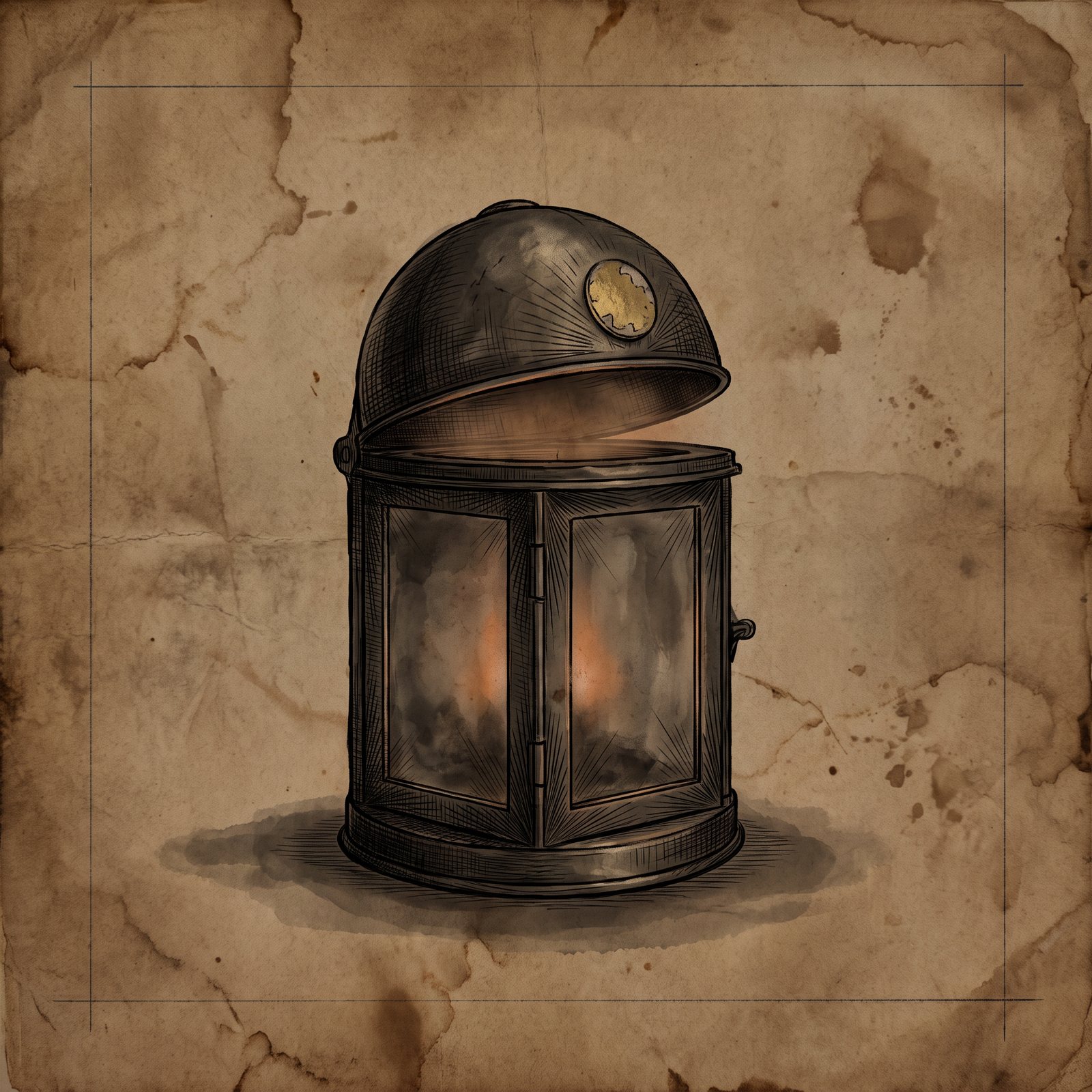
A lantern made to carry one fire a very long way, and to hold the dark back when it arrives. It was made for a journey, not a room: for the priests, couriers and pilgrims who had to bring a particular flame somewhere it had never been. Its bearers learn that the light is the easy part. Keeping the fire alive costs nothing; deciding where to take it costs everything.
Wondrous Item, Rare (Requires Attunement)
This hooded lantern of blackened iron and thick, smoky glass holds one fire at a time. While a fire burns in it, it sheds Bright Light in a 30-foot radius and Dim Light for an additional 30 feet. As a Bonus Action you can lower the hood, reducing the light to Dim Light in a 5-foot radius, or raise it again. Besides the hood, the lantern has shutters, which you open wide only to use Daybreak (below). You must be attuned to the lantern to use its properties.
Undying Flame. A fire inside the lantern needs no fuel, and while it is inside the lantern no nonmagical means can put it out, whether the hood is raised or lowered and even while the shutters are open: not wind, rain, cold or immersion in water. The fire doesn’t spread from the lantern. You can put it out as a Utilize action.
Carry a Fire. As a Magic action, you can take a flame from a fire you can reach, from a candle up to a bonfire, into the empty lantern; the fire you took it from is unchanged. You can instead place inside it one burning or glowing object of Tiny size, such as a coal. A burning or glowing object inside the lantern counts as a fire burning in it, and the lantern sheds its own light (above) in place of the object’s. A fire or object that is itself magical keeps all its other properties, including any duration, countdown or decline: the lantern only keeps it from being put out by nonmagical means and from spreading, and slows nothing.
Daybreak. As a Magic action, you open the lantern’s shutters wide. For 10 minutes its Bright Light is sunlight, and an Undead creature in that Bright Light can’t regain Hit Points. A trait that has an Undead creature rise or return from 0 Hit Points isn’t regaining Hit Points for this property. The effect ends early if you lower the hood or the fire goes out. If the hood is lowered, this action also raises it. Once this property is used, it can’t be used again until the next dawn.
In Different Worlds
Ashwinter (After the fall · Mythic culture)
- Who made it. The Crown’s sun temple, for the priests who carried fire from the Gate-Pyre to the provinces’ temples each year. Most were lost in the Ashfall, when the Gate-Pyre went cold.
- What it is called. An ember-keeper’s lantern; Daybreak is opening the Gate.
- How it looks and sounds. Crown work under four centuries of soot: blackened iron chased with sun-rays, a hood set with a disc of flaking gilt, glass gone smoky from the fires it has carried. The hood moves with the creak of an old door. Opened for the Gate, it doesn’t flare so much as remember: the light comes up gold-white and steady, the colour of a summer noon few living people have seen, and the dead caught in it stop mending.
- Where one is found. Rarely. Most went cold with the Gate-Pyre on the Ashfall day; one survives only where someone carried fire out of the sun temple in it.
- Story hook. The Order of the Unlit Pyre says the lantern belongs at the Pyrehold, beside the Gate-Pyre it was made for. The Bread-Lord says it belongs to the Crown’s heirs. The Road-Keepers say it belongs to whoever carries the fire.
- Rules caveat. None. A magical fire or object carried in the lantern keeps its own rules, except that the lantern’s light replaces its own: Carry a Fire keeps it from being put out and nothing more. The lantern’s sunlight is its own, not the fire’s.
A realm of sun-temples and crusading orders (Heroic high fantasy)
- Who made it. The glassworkers of the temple of the morning sun, for the lantern-bearers who walk ahead of a crusade’s dead-cart.
- What it is called. A dawn lantern; Daybreak is the dawn-word.
- How it looks and sounds. White glass caged in gold wire, with a hymn etched round the hood. When the shutters open for the dawn-word they ring like a struck bell, and the light smells, impossibly, of morning grass.
- Where one is found. In the hand of the oldest lantern-bearer of a vampire-haunted march, who has outlived three crusades.
- Story hook. The march’s last dawn lantern has gone dark in a vampire lord’s castle with the lantern-bearer who carried it. Someone has to bring it back before the long winter nights.
- Rules caveat. None.
The courts of the fey (Wilds and courts of the fey)
- Who made it. A will-o’-wisp’s prisoner, a mortal smith who forged a cage strong enough to hold a wisp’s light and carried it out of the bog.
- What it is called. A wisp-cage; Undying Flame is “what the bog can’t drown”.
- How it looks and sounds. A cage of hammered iron wire around a light that is green-white and never quite still, humming like a held breath. Opened wide, its light turns warm and gold, as if the wisp inside had remembered the sun.
- Where one is found. Hanging in a ferryman’s hut at the edge of the fey-marsh, where it has burned for a hundred years on nothing at all.
- Story hook. The wisps want their sister back, and they have begun leading travellers to the ferryman’s door instead of to their deaths.
- Rules caveat. None. Caged as a fire, a wisp’s light is an object, not a creature.
Origins and Inspiration
The lantern draws on the perpetual sacred fire: in Rome the fire of Vesta was kept burning in her temple by the Vestal Virgins and ritually renewed each year on 1 March, and its going out was an ill omen. Greek colonists are said to have carried fire from their mother city’s civic hearth to light the hearth of a new city (as some ancient writers describe it; the details vary by source). The relay of a carried flame is also the modern Olympic torch relay, first run in 1936. The will-o’-wisp, the bog light of English and continental folklore, lends the fey example its cage.