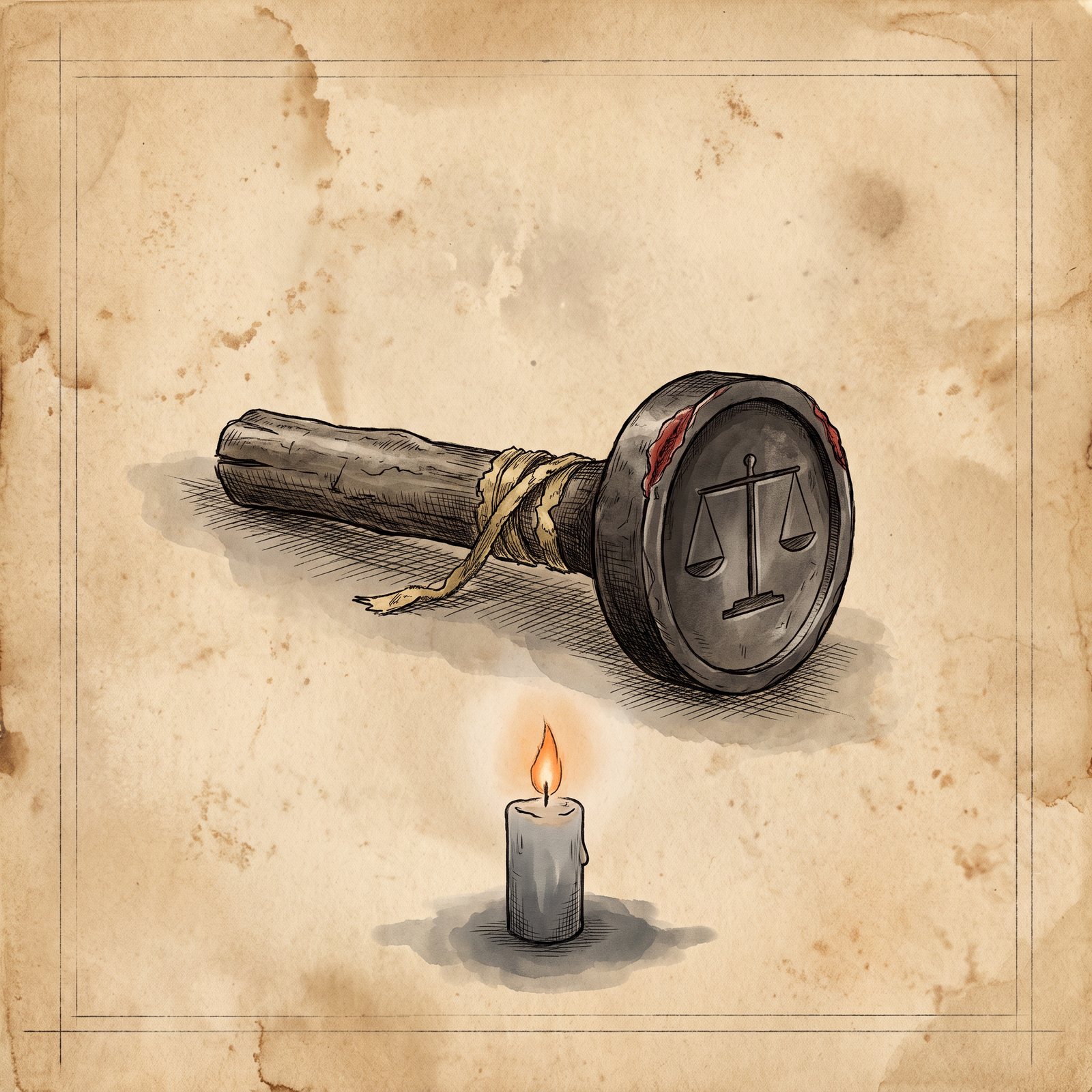
The seal an oath was sworn under, which still remembers who swore it. It turns up wherever an old promise has outlived the people who made it: a company that never stood down, a household still bound to a dead lord, a charter no one can repeal. Whoever holds it can tell the sworn from the free and speak to them in the oath’s own voice, and to some people that is worth more than the oath ever was.
Wondrous Item, Uncommon (Requires Attunement)
This heavy seal, a signet, a stamp or a pressed token, was used to witness one oath sworn by a group of creatures: a company’s muster, a household’s fealty, a guild’s charter. The seal’s oath is that oath, and the DM decides which creatures swore it. A creature is sworn under the oath while it is still bound by it; a creature released from the oath, or one that has broken it, isn’t. You must be attuned to the seal to use its properties.
Know the Sworn. While you are attuned to the seal, you know whether any creature you can see within 30 feet of you is sworn under its oath. This costs no action, Bonus Action or Reaction.
Voice of the Oath. While you hold the seal where a creature sworn under its oath can see it, you have Advantage on Charisma checks you make to influence that creature.
Hold Them to It. While holding the seal, you can take a Magic action to cast Suggestion (save DC 13) from it, targeting only a creature sworn under the seal’s oath. The casting needs no components and costs no spell points. Once this property is used, it can’t be used again until the next dawn. The spell follows its own rules, including Concentration, and it is the turn’s spell of 1st level or higher. Acting under Hold Them to It doesn’t break the oath.
An Oath Ended. If every creature that swore the oath is released from it, has broken it or is destroyed, the seal loses its magic.
In Different Worlds
Ashwinter (After the fall · Mythic culture)
- Who made it. The Ashen Crown’s muster-priests, who sealed each host’s oath before Rettmal, the Even Measure, on the Iron Claim’s terms. Every muster had a roll and a seal: the roll names the soldiers, and the seal witnessed their swearing.
- What it is called. A host-seal; the Third Muster’s is Kolgrim’s seal. Know the Sworn is reading the ranks, and Hold Them to It is calling the oath.
- How it looks and sounds. Crown work: a stamp of cold black iron the length of a hand, the Even Measure’s level beam cut into its face, its haft once wrapped in gilt cord that has long since flaked away. One that has lain under water comes up silted and green, with old red wax still in the cut. Reading the ranks feels like a hand laid on the bearer’s shoulder for each sworn soldier in sight; calling the oath puts the flat cadence of a roll read aloud into the bearer’s voice.
- Where one is found. With a host’s roll, in its muster-hall, or wherever the roll went.
- Story hook. The seal lets its bearer turn one creature at a time (a rank fighting as one counts as one); the roll and the thane’s blood command them all. The Bread-Lord offers a fortune for the seal, because he means to command the host by roll and blood, and he wants no single soldier of it turned against him.
- Rules caveat. None. The sworn hosts stay sworn under their muster’s oath until it is released. The seal doesn’t command a host; it works on one creature at a time (a rank fighting as one counts as one).
A city of guilds and great houses (Urban intrigue)
- Who made it. The notaries of the old Guild Hall, who sealed every charter with a stamp that took a drop of each signatory’s ink.
- What it is called. A charter stamp; calling the oath is “by the charter”.
- How it looks and sounds. A brass stamp with an inkwell set into its handle, smelling of old ink and strongroom dust. Read by it, the families who signed seem to the bearer to stand a little straighter, as if a clerk had just called their names.
- Where one is found. In the strongroom of a guild that no longer exists, whose charter still binds the families that signed it.
- Story hook. The Lamplighters’ charter of two hundred years ago bound its signatories’ heirs to keep the city’s lamps lit. The stamp has turned up at auction, and every one of the old families wants it destroyed.
- Rules caveat. None.
A hub city of planar contracts (Planar crossroads)
- Who made it. Infernal notaries, who seal a mercenary legion’s contract in brass and keep the seal as surety.
- What it is called. A surety seal; Know the Sworn is “reading the ledger”.
- How it looks and sounds. A brass seal always warm to the touch, smelling of sealing wax and struck matches. To its bearer, every creature bound by its contract shows a brief brass glint in the eyes.
- Where one is found. Pawned in a moneylender’s shop in the city’s lower ring by a legion’s paymaster who needed the money.
- Story hook. A legion of contract-bound devils is about to change sides in a war between two merchant princes. Whoever holds its surety seal can turn its officers one by one.
- Rules caveat. None.
Origins and Inspiration
Oaths sworn on an object run through Norse and Germanic custom: Old Icelandic sources (Eyrbyggja saga and Landnámabók among them) describe a sacred oath-ring kept on the temple’s altar, on which oaths were sworn; and the warrior band’s loyalty to its lord (the comitatus Tacitus describes in Germania, ch. 13–14) bound followers for life. The seal itself comes from medieval European practice, where a seal, not a signature, made a document binding, and a seal matrix was often defaced or broken when its owner died.