Identity
A keeper of the door between the living and the dead, who is owed favors by the people who pass through it.
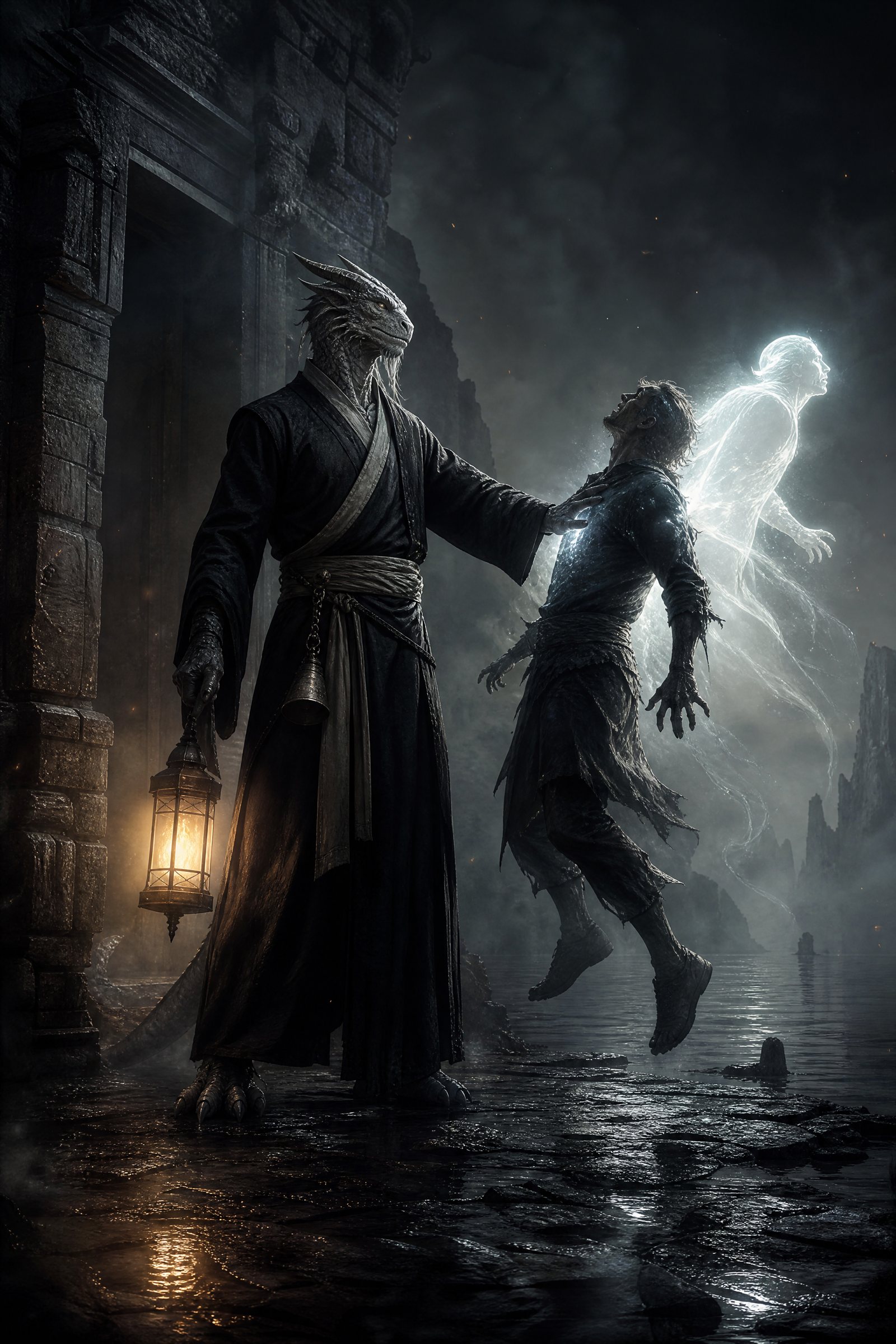
There is a door in every dying thing, and someone has to keep it. The keeper is not there to bar it: the dead are supposed to go through and the living are supposed to stay, and a door that never opens is as much a wound as a door that never shuts. You keep it the way a lockkeeper keeps a canal: you watch the water on both sides, let the right traffic through at the right time, and when something tries to cross that shouldn’t, put your hand against its chest and say not you, not yet. In a story you are the dignified psychopomp, never the necromancer the frightened take you for. You are neither the mourner nor the reaper; you are the one who stands in the frame with a lamp and a ledger, counting who goes and who stays, and making sure nobody is cheated in either direction.
The Thresholder is a funerary martial artist: part fighter, part medium, part civil servant of the border between breath and no-breath. It casts with Wisdom, the steadiness of your keeping. Your baseline weapon is the Parting Blow, a strike that briefly loosens the spirit from the flesh. Your identity is the Ledger of Favors, a running account of debts owed to you by the honored dead. You earn them by giving good deaths and paying proper respect, and you call them in when you need a spectral hand, a dead master’s craft, or a warning shouted from the far side of the door. You do not command the dead. You do not burn them for fuel. You negotiate with them, because they are people, and because a psychopomp who forgets that has already started becoming the thing they were posted to prevent. The drama of the Thresholder is not raising an army. It is being owed favors by the dead, and staying the kind of person the dead are glad to owe.
Campaign rules apply. Thirteen spells are banned, two are modified, and every spellcaster uses spell points instead of spell slots in this campaign — see Campaign Rules. This document already conforms: banned spells have been removed and replaced at the same level, modified spells are annotated where they appear, and spell slots have been converted to spell points.
Class Overview
| Primary Abilities | Dexterity and Wisdom |
| Hit Point Die | d8 per Thresholder level |
| Saving Throws | Dexterity and Charisma |
| Skills | Choose 2: Insight, Intimidation, Medicine, Perception, Religion, or Survival |
| Weapons | Simple weapons |
| Armor | None |
| Starting Equipment | A plain dark robe with a pale sash, a hand-bell or a small gong, a folio of blank funeral-paper and a stick of grave-ink, a hooded lantern that burns without much oil, a coin to leave with the dead, a waterskin, 10 days of rations, and 9 GP (the ferryman’s price, kept in odd coin so it is never quite spent) |
Spellcasting summary. You cast spells from the Thresholder spell list, a closed list drawn mostly from the Divine spells of death, warding, spirit-contact, and mercy (the Grave and death-domain tradition), using Wisdom as your spellcasting ability. You are a half-caster who prepares spells, casting from the half-caster spell point pool, recovered on a Long Rest. No damage cantrips, but you learn a few utility cantrips (see Utility Cantrips) — your Unarmed Strikes and the parting they carry are your at-will offense. Spell save DC = 8 + your Wisdom modifier + your Proficiency Bonus; spell attack modifier = your Wisdom modifier + your Proficiency Bonus.
Class Table
| Level | Proficiency Bonus | Martial Arts Die | Parting Blow | Qi | Favors | Prepared | Spell Points | Max Spell Level | Features |
|---|---|---|---|---|---|---|---|---|---|
| 1 | +2 | 1d6 | 1 die | 1 | 2 | — | — | — | Martial Arts, Unarmored Defense, Qi, Parting Blow, The Ledger of Favors (Favor callings: spend from level 2) |
| 2 | +2 | 1d6 | 1 die | 2 | 2 | 2 | 4 | 1st | Spellcasting, Utility Cantrips, The Usher’s Office, Unarmored Movement |
| 3 | +2 | 1d6 | 1 die | 3 | 2 | 3 | 6 | 1st | Rite |
| 4 | +2 | 1d6 | 1 die | 4 | 2 | 4 | 6 | 1st | Ability Score Improvement |
| 5 | +3 | 1d8 | 1 die | 5 | 3 | 5 | 14 | 2nd | Extra Attack, Held Breath |
| 6 | +3 | 1d8 | 1 die | 6 | 3 | 5 | 14 | 2nd | Rite feature, Unarmored Movement (+15 ft) |
| 7 | +3 | 1d8 | 1 die | 7 | 3 | 6 | 17 | 2nd | Grave-Sworn |
| 8 | +3 | 1d8 | 1 die | 8 | 3 | 6 | 17 | 2nd | Ability Score Improvement |
| 9 | +4 | 1d8 | 1 die | 9 | 4 | 7 | 27 | 3rd | Deathless Watch |
| 10 | +4 | 1d8 | 1 die | 10 | 4 | 7 | 27 | 3rd | The Wider Threshold, Unarmored Movement (+20 ft) |
| 11 | +4 | 1d10 | 3 dice | 11 | 4 | 8 | 32 | 3rd | Rite feature |
| 12 | +4 | 1d10 | 3 dice | 12 | 4 | 8 | 32 | 3rd | Ability Score Improvement |
| 13 | +5 | 1d10 | 3 dice | 13 | 5 | 9 | 38 | 4th | The Long Escort, Mystic Arcanum (6th) |
| 14 | +5 | 1d10 | 3 dice | 14 | 5 | 9 | 38 | 4th | Unbound Witness, Unarmored Movement (+25 ft) |
| 15 | +5 | 1d10 | 3 dice | 15 | 5 | 10 | 44 | 4th | Compound Interest |
| 16 | +5 | 1d10 | 3 dice | 16 | 5 | 10 | 44 | 4th | Ability Score Improvement, Mystic Arcanum (7th) |
| 17 | +6 | 1d12 | 5 dice | 17 | 6 | 11 | 57 | 5th | Rite feature |
| 18 | +6 | 1d12 | 5 dice | 18 | 6 | 11 | 57 | 5th | Standing at the Door, Unarmored Movement (+30 ft) |
| 19 | +6 | 1d12 | 5 dice | 19 | 6 | 12 | 64 | 5th | Epic Boon, Mystic Arcanum (8th) |
| 20 | +6 | 1d12 | 5 dice | 20 | 6 | 12 | 64 | 5th | Keeper of Both Shores |
Cantrips Known: 1 at level 2, 2 at level 7, 3 at level 13 — utility cantrips only (they use Wisdom).
Unarmored Movement: +10 ft at level 2, +15 ft at level 6, +20 ft at level 10, +25 ft at level 14, +30 ft at level 18. From level 9 you can also move along vertical surfaces and across liquids (see Unarmored Movement).
Mystic Arcanum: one 6th-level spell at 13, one 7th at 16, one 8th at 19 — each cast once per Long Rest without spending spell points or Qi, outside the spell point pool and costing no Favor (see Mystic Arcanum).
Class Features
Level 1: Martial Arts
Your body is the tool of your office — the lamp-hand and the closing-hand both. While you are unarmed or wielding a simple weapon and you aren’t wearing armor or wielding a Shield, you gain the following benefits.
- Martial Arts die. You can roll your Martial Arts die (see the class table) in place of the normal damage of your Unarmed Strikes and simple weapons.
- Funerary footwork. You can use Dexterity instead of Strength for the attack and damage rolls of your Unarmed Strikes and simple weapons.
- Second blow. When you take the Attack action with an Unarmed Strike or a simple weapon on your turn, you can make one Unarmed Strike as a Bonus Action.
Level 1: Unarmored Defense
While you aren’t wearing armor or wielding a Shield, your base Armor Class equals 10 + your Dexterity modifier + your Wisdom modifier. Part of it is footwork learned at bedsides and battlefields where a wrong step meant a second corpse; part of it is that a thing standing this close to the door is genuinely hard for a blow to find.
Level 1: Qi
Your attention to the border is a resource you carry as a pool of Qi points equal to your Thresholder level — what the disciplines call Qi; in you it is the breath held at the threshold. You regain all expended Qi when you finish a Short or Long Rest — a few minutes of steady breathing at the threshold is enough to gather yourself. Qi fuels your Parting Blow, powers most of your callings on the dead, and drives many of your Rite features; every feature that costs Qi says so.
Qi is not rage and it is not faith. It is watchfulness — the plain, tiring work of keeping both sides of a door in view at once. When your Qi runs dry you have not lost your power; you have simply stopped being able to be everywhere the door needs you, and the traffic starts slipping past.
(Note on the words: some traditions use vigil to name a whole funerary order, and a Thresholder still keeps vigil in the plain sense of the word. The pool itself is Qi — the name of your attention, kept as points. When this document says Qi, it means the pool.)
Level 1: Parting Blow
Every strike you throw carries a little of the office in it — a breath’s worth of separation, spirit eased a finger’s width out of flesh. Once on each of your turns, immediately after you hit a creature with an Unarmed Strike or a simple weapon, you can spend Qi to loosen the spirit inside the target as a free rider — this costs no action, Bonus Action, or Reaction, and doesn’t replace any other part of your turn. The Qi cost rises as the door you keep grows wider under your hand: 1 Qi at levels 1–10, 2 Qi at levels 11–16, and 3 Qi at levels 17–20 (the number of dice — 1, then 3, then 5 — is unchanged).
Roll a number of dice of your Martial Arts die size and add your Wisdom modifier; the target takes that much extra necrotic damage (or, if you prefer, the strike’s own damage type). The number of dice is 1 at levels 1–10, 3 at levels 11–16, and 5 at levels 17–20, as shown in the Parting Blow column.
Because the Parting Blow is limited to once per turn, throwing more strikes only gives you more chances to land it — it never fires twice on the same turn, and no Rite feature, calling, or spell adds Parting Blow dice onto the same strike. This is the intentional ceiling on your single-turn burst; your reach comes from the debts you are owed, not from stacking one blow.
A clean parting. When you reduce a creature to 0 Hit Points with an attack on your turn, you may give it a clean parting — a moment’s proper respect that costs no action: you close its eyes, name it if you can, and ease the spirit through the door rather than tearing it loose. When you do, you gain 1 Favor (see The Ledger of Favors). You can gain a Favor from a clean parting only once on each of your turns, and only from a creature that had a spirit to part with (not a construct, ooze, or most Undead — the door does not open for what never truly lived, or for what already refused to go).
Reaping Toll. A blow struck at the border collects what is owed. When you use your Parting Blow, check the target twice. If it was already below half its Hit Point maximum before the hit, you gain 1 Favor. If the hit’s damage (the Parting Blow included) reduces it to 0 Hit Points, you gain 1 Favor. Both can apply to the same Parting Blow, so a blow that finishes a creature already below half earns 2 Favors from the toll (and a clean parting can add a third). Favors are capped as described under the Ledger of Favors.
Level 1: The Ledger of Favors
You do not raise the dead. You are owed by them, and you keep the account in a real folio, in real ink. This is your thematic engine, and it has two halves: the Favors you bank, and the Callings you spend them on.
Favors. You can hold a number of Favors at once equal to the number in the Favors column of the class table for your Thresholder level. For a character whose only class is Thresholder, that is your Proficiency Bonus. A Favor is a debt of gratitude from an honored spirit — impersonal magic made personal, because you earned it from someone. Unspent Favors carry over between rests and even between days; the dead have long memories. You gain Favors by:
- A clean parting — once on each of your turns, as above.
- Proper rites — spending at least 1 minute performing the funeral office over a corpse, or over a creature that has died within the past hour, that has not yet received rites. You gain 1 Favor. (At 7th level, Grave-Sworn lets you perform this office in the middle of a fight.)
- Debts freely given — when a spirit you have helped, avenged, ushered, or treated well chooses to owe you (see Spirits are people, below). The DM awards these; they are the good stuff.
Callings — spending Qi and Favors on the dead. As your office, you can call the dead to lend a hand. Minor callings cost only Qi (the dead do these small offices freely, as courtesy to their keeper); the greater callings cost a Favor — a real debt, called in. You can spend Favors on callings once you have at least 2 Thresholder levels; until then, you bank them, and only the callings that cost Qi are open to you. Choose from the following.
- The Lending Hand (Bonus Action, 1 Qi). A pale spectral hand appears in an unoccupied space you can see within 30 feet and lasts 1 minute or until you dismiss it (no action). Once on each of your turns you can direct it (no action): it can take the Utilize action or the Help action, carry an object of up to 10 pounds, hold a door or a rope, or deliver a spell that has a range of touch. It can also attempt to Shove or Grapple a creature; the target makes its saving throw against your spell save DC instead of the usual DC. It has AC 10 and dissipates if it takes any damage.
- A Spirit’s Warning (Reaction, 1 Qi). When you or a creature you can see within 30 feet is targeted by an attack, or is about to make a Dexterity or Wisdom saving throw, the dead cry out. You either impose Disadvantage on the attack roll, or let the creature add your Martial Arts die to the saving throw.
- A Master’s Hand (no action, once on each of your turns, 1 Favor). Before or after you make an ability check, a dead master of that very craft lends you their hands for a heartbeat — a swordmaster, a locksmith, a courtier, a herbalist, whoever the fiction needs. You gain proficiency in that check if you lacked it (or add your Wisdom modifier again if you already had it), and you add your Martial Arts die to the roll.
- Borrowed Life (Bonus Action, 1 Favor). A dead healer sets a hand over a wound. A creature you can see within 30 feet regains Hit Points equal to one roll of your Martial Arts die + your Wisdom modifier, or, if it is dying, is stabilized and gains that many Temporary Hit Points instead.
- The Honored Guard (Reaction, 1 Favor). When you or an ally within 30 feet is hit by an attack, a dead warrior interposes: reduce that attack’s damage by one roll of your Martial Arts die + your Wisdom modifier. You can spend 1 additional Qi to have the guard answer the blow — it makes one spectral Unarmed Strike against the attacker (a spell attack) dealing your Martial Arts die + your Wisdom modifier necrotic damage on a hit.
- A Debt Called Due (varies, 1 Favor). You call in a specific favor from a named spirit you have honored. The DM adjudicates the aid in the fiction: a warning of an ambush ahead, a secret the dead carried to the grave, quiet passage through territory the hostile dead hold, the loan of a spectral guide for an hour, the location of a body or a buried thing. This is the true wealth of your office; treat it as an NPC doing you a genuine kindness, not a spell.
Spirits are people. Every spirit you weigh, usher, consult, or call is a character, and the DM should give it an attitude — Hostile, Indifferent, or Grateful — the same as any NPC. You move that attitude the way you move any relationship: with respect, honesty, and kept promises. Give a creature a clean parting and its spirit tends toward Grateful. Avenge a murdered ghost, return a body to its family, or keep a vow you made to the dying, and you may be owed — the DM hands you a Favor, or a standing debt you can call as A Debt Called Due. Desecrate the dead, break faith with a spirit, or feed on one carelessly (see the Rite of the Hungry Door) and you make Hostile dead, who resist your callings and may come collecting. Your power is a reputation among the dead. Guard it like one.
Level 2: Spellcasting
You keep the border so closely that the death-magic runs through you as a matter of course. See the end of this document for the full Spellcasting rules, your spell point progression, and the Thresholder spell list. In brief:
- You are a half-caster using Wisdom. Your spell save DC = 8 + your Wisdom modifier + your Proficiency Bonus; your spell attack modifier = your Wisdom modifier + your Proficiency Bonus.
- You prepare spells from the Thresholder spell list, choosing a number equal to the Prepared column each time you finish a Long Rest.
- Your spell points follow the half-caster progression on the class table and are regained on a Long Rest.
- No damage cantrips, but you learn utility cantrips (see the Utility Cantrips feature, below). Your at-will offense is your Martial Arts and the Parting Blow it carries; the dead are not troubled to sling harm for you, but a few quiet offices come easily to your hands.
Level 2: Utility Cantrips
The border does not trade in small harm, but a few quiet offices come easily to one who keeps it. You learn 1 cantrip at level 2, a 2nd at level 7, and a 3rd at level 13, chosen from the list below — utility cantrips only (no attack roll, no damage, no save-for-damage). They use Wisdom as their spellcasting ability. Whenever you gain a level in this class, you can replace one cantrip you know with another from the list.
Choose from: Spare the Dying, Guidance, Light, Mending, Message, Thaumaturgy, Resistance, and Druidcraft. All are 2024 Player’s Handbook cantrips; Message and Druidcraft are this class’s own additions from outside the Divine list.
Level 2: The Usher’s Office
Your hands learn the two motions every doorkeeper needs: the palm that eases a spirit out of a body that isn’t its own, and the palm that holds a spirit in a body a moment longer than it wanted to stay. As a Magic action, touch a creature (or make a melee spell attack against an unwilling one) and speak the office. Choose one effect:
- Usher Out. If the creature is being possessed, is host to another spirit, or is affected by an effect that placed a mind or will inside it (such as Dominate Monster, Magic Jar, or a possessing spirit), it makes a Wisdom saving throw against your spell save DC. On a failure, the intruding presence is expelled and that effect ends. Against an unwilling Undead within reach, on a failed save the same office wrenches at the spirit binding it: the Undead takes necrotic damage equal to one roll of your Martial Arts die + your Wisdom modifier and can’t take Reactions until the end of its next turn.
- Hold at the Door. Touch a dying creature to stabilize it, or touch a willing creature to ward it: until the end of your next turn, it can’t be possessed (see below), can’t be reduced below 1 Hit Point by necrotic damage, and has Advantage on saving throws against Undead and against death.
- A Word Through the Door. Touch a corpse or a creature that died within the past day and ask it a single brief question, receiving a short answer if the spirit is near and willing. This functions as Speak with Dead, except that you ask only one question, you spend no spell points or material components, and the target must have died within the past day. Treat the spirit’s willingness by its attitude toward you.
You can use The Usher’s Office a number of times equal to your Wisdom modifier (minimum once) per Long Rest, and beyond that for 1 Qi each.
Possession. Possession is not a condition. In this document a creature is possessed while another creature’s spirit or mind occupies its body or controls it from inside, as with a ghost’s Possession action or the Magic Jar spell. When a feature says a creature can’t be possessed, any such effect fails against it. When a feature gives Advantage against attempts to possess a creature, the Advantage applies to the saving throw that such an effect allows.
Level 2: Unarmored Movement
Unarmored Movement — what you call the Psychopomp’s Pace. The escort never falls behind the one being escorted. The dead do not hurry and they do not dawdle; they simply go, at the plain unarguable pace of going, and a keeper who cannot stay level with them is not escorting anybody — they are only watching someone leave. So you learn the walk. It is not a run. It is the gait of a person who intends to arrive at the same moment as the one they are seeing off.
While you aren’t wearing armor or wielding a Shield, your Speed increases by 10 feet. This bonus increases when you reach certain Thresholder levels, as shown on the class table: +15 feet at level 6, +20 feet at level 10, +25 feet at level 14, and +30 feet at level 18.
Starting at level 9, you can also move along vertical surfaces and across liquids on your turn without falling during that move. The road the dead take does not accept the living’s opinion about what can be walked on — it goes up the cliff face, over the wall, and straight out across the gray water without slowing for the bank. Most traditions put a river on that road somewhere, and a crossing; you have been on the far side of it often enough that your feet have stopped asking the question. You are not walking on the water. You are walking on the road, and the road happens to be there.
Level 3: Rite
The office is one thing; the tradition you keep it in is another. Choose a Rite — the funerary discipline you were trained in or came to on your own: the Scales, the Ferryman, the Muster, the Corpse-Herd, the Ancestor, or the Hungry Door, each described later in this document. You gain its level 3 features, and additional features at levels 6, 11, and 17.
Level 4, 8, 12, 16: Ability Score Improvement
You gain the Ability Score Improvement feat or another feat of your choice for which you qualify.
Level 5: Extra Attack
You can attack twice, instead of once, whenever you take the Attack action on your turn.
Level 5: Held Breath
The old technique: you take a breath and hold it, and hold the parting with it, until you let both go at once. On your turn, as part of making an Unarmed Strike, you can hold your breath — you take no Parting Blow that turn, and instead place a held parting on yourself. On a later turn of yours (up to 1 minute, while you have at least 1 Qi), when you hit a creature with an Unarmed Strike, you can exhale: spend your Parting Blow’s normal Qi cost (1 Qi at levels 5–10, 2 Qi at levels 11–16, 3 Qi at levels 17–20) to deliver your Parting Blow with one additional Martial Arts die, and the target must succeed on a Constitution saving throw against your spell save DC or be unable to regain Hit Points until the end of your next turn. Releasing the breath ends the held parting. You can carry only one held parting at a time.
This never breaks the once-per-turn ceiling: exhaling is your Parting Blow for that turn, merely a larger and better-aimed one, paid for by having gone without on the turn you inhaled.
Level 6: Unarmored Movement (+15 ft)
Your Unarmored Movement bonus increases to +15 feet.
Level 7: Grave-Sworn
You have kept the door long enough that the door keeps you a little in return. You gain Resistance to necrotic damage, you have Advantage on saving throws against being Frightened, and you can’t be possessed (see The Usher’s Office), so no other creature can inhabit or control your body from inside against your will. In addition, you no longer need calm and quiet to pay respect: you can perform the proper rites to earn a Favor (see The Ledger of Favors) as a Bonus Action in the middle of a fight, provided you are within 5 feet of an eligible corpse or dying creature. A body honored under fire counts the same to the dead as one honored in a house of mourning — perhaps more.
Level 9: Deathless Watch
The ordinary needs of a living body loosen their grip on a keeper of the border. You no longer need to eat, drink, or breathe, and four hours of standing trance serve you as a full night’s sleep. You are immune to disease, have Advantage on saving throws against the Poisoned condition, and stop aging visibly. You also have Advantage on Constitution saving throws made to maintain Concentration — a body that no longer needs breath does not lose its hold on the door for a blow. You can perceive what most cannot: you automatically sense the presence of Undead and of unquiet spirits within 30 feet of you (though not their exact location or nature), and you can see and speak with any spirit or incorporeal creature in that radius even when it is Invisible to others. The dead are simply part of the room to you now, the way weather is.
Level 10: The Wider Threshold
Your keeping is no longer a thing you hold alone at arm’s length; it spreads to the ground around you. While you aren’t Incapacitated, you and each ally within 10 feet of you gain the following: Advantage on saving throws against being Frightened or Charmed by Undead and against an Undead’s attempts to possess them, and the first time each round that one of you would drop to 0 Hit Points, you can take a Reaction (if it is not your own turn) or no action (if it is) and spend 1 Favor to leave that creature at 1 Hit Point instead — you put your hand against the door and hold it shut for them. You can hold the door this way once per round, no matter how many allies are inside your threshold.
Level 10: Unarmored Movement (+20 ft)
Your Unarmored Movement bonus increases to +20 feet.
Level 13: The Long Escort
Your reach across the border lengthens. The range of The Wider Threshold increases from 10 feet to 30 feet, matching the 30-foot range your Callings (see The Ledger of Favors) already have, and The Usher’s Office gains a reach of 10 feet (you can touch through the door now). In addition, once on each of your turns, when you hit a creature that is below half its Hit Point maximum, or a creature that is Undead or a Fiend, your Parting Blow deals an extra 1d10 necrotic damage — the door is nearer for the failing and the false, and the parting comes easier. This extra die is part of the same single Parting Blow, not a second one.
Level 13: Mystic Arcanum
Mystic Arcanum — what you call the Last Ledger-Line. Every other page of the folio records what the dead owe you, itemized and small: a hand, a warning, a name, a craft borrowed for a heartbeat. The last line on the last page is not like the others. It is not a debt from one spirit you can picture; it is a debt the world itself has run up with you — for every door kept, every parting made clean, every stranger’s body walked home when it would have been easier and cheaper to leave it. You do not call that in for a lending hand. You call it in once, for the thing that cannot be done any other way, and then the line stands blank until you have slept and gone back to work.
You learn one 6th-level spell from the Divine spell list or the Arcanum options in the Spellcasting section. You cast it once without spending spell points or Qi, and you regain the ability to do so when you finish a Long Rest. At level 16 you learn a 7th-level spell, and at level 19 an 8th-level spell, each cast once per Long Rest in the same way. Whenever you gain a level in this class, you can replace one of these spells with another of the same level from the same choices. These spells use Wisdom. See the Spellcasting section for the 6th-, 7th-, and 8th-level options, which are Arcanum-only — you can never prepare them or cast them with spell points.
Three lines, three ledgers. Each Arcanum spell has its own once-per-Long-Rest use; they are not a shared pool. Casting the 6th-level spell does not spend the 7th or the 8th.
The line is not drawn on your account. The Last Ledger-Line costs no Favor and no Qi. This is the one place in your office where the debt runs the other way: the Ledger of Favors tracks what particular dead have chosen to owe you, and this is not that — it is owed to you by the door itself, and the door does not take payment from the keeper. Keep the two straight in your bookkeeping and at the table. Nothing you do to your Favor total changes what the Arcanum can do, and nothing the Arcanum does adds to or spends from your Favors.
Level 14: Unbound Witness
Nothing on either side of the door can take hold of a mind that has spent this long looking through it. You can’t be Charmed or Frightened, you can’t be possessed by any means (see The Usher’s Office), and while you are conscious, being surprised doesn’t give you Disadvantage on your Initiative roll. You also gain Truesight out to 30 feet against Undead, spirits, and the Invisible — the far side of the door is never dark to you again.
Level 14: Unarmored Movement (+25 ft)
Your Unarmored Movement bonus increases to +25 feet.
Level 15: Compound Interest
An account kept honestly this long begins to pay its own interest. When a creature dies within 30 feet of you, when you score a Critical Hit with an Unarmed Strike, or when you give a creature a clean parting, you regain 1 Qi. In addition, whenever you finish a Long Rest you begin the day already owed: you gain Favors equal to your Wisdom modifier (up to your maximum), the standing goodwill of dead you have served well. Finally, when you would gain a Favor while already at your maximum, you can spend it immediately on a Calling as though you had it in hand — the debt paid the instant it is owed.
Level 18: Standing at the Door
You no longer stand before the threshold; you stand in it, and it holds you as surely as you hold it. You can’t be forced across the door: any effect that would kill you outright instead leaves you at 1 Hit Point (once per Long Rest), and you succeed on death saving throws on a roll of 5 or higher rather than needing a 10. When you would drop to 0 Hit Points, you can spend 3 Favors to remain at 1 instead and stay on your feet. And once per Long Rest, you can cast one Thresholder spell you have prepared without spending spell points — a rite the dead perform for you, for free, in honor of long service.
Level 18: Unarmored Movement (+30 ft)
Your Unarmored Movement bonus increases to +30 feet.
Level 19: Epic Boon
You gain an Epic Boon feat or another feat of your choice for which you qualify. The Boon of Fate, the Boon of Truesight, and the Boon of Undeath (reflavored as a keeper’s kinship with the border, not a taint) all suit a Thresholder, but any Boon your DM allows fits a life spent this far into the doorway.
Level 20: Keeper of Both Shores
For one clean minute you are the door itself — open to the exact width the world needs, and no wider. As a Bonus Action, for 1 minute:
- Your Parting Blow costs no Qi, and your Callings cost no Qi (Favor costs are unchanged).
- The save DC of your Thresholder spells, Usher’s Office, and Rite features increases by 2.
- Your Favor total is treated as full, and clean partings and rites still add to it above your normal maximum for the duration.
- Once on each of your turns, when you reduce a creature to 0 Hit Points, you may immediately grant a creature you can see within 30 feet the benefit of Borrowed Life for free — the parting of one paying for the mending of another, traffic balanced across the door in a single motion.
When the minute ends, you gain 1 Exhaustion level; standing in the doorway that fully open takes a while to step back out of. Once you use this feature, you can’t use it again until you finish a Long Rest.
Rites (Subclasses)
Six Rites describe the funerary tradition your discipline was trained in. Each grants features at 3rd, 6th, 11th, and 17th level. Each Rite’s real-world touchstones and one-line reskin are credited under Origins and Inspiration, and each world gives the six Rites its own names (see In Different Worlds), so you can frame the same mechanics in whichever lineage speaks to you. None of the Rites asks you to be cruel. Every one of them is a way of taking a hard, necessary job seriously.
Rite of the Scales
I do not hate you. I only weigh you, and the feather does the rest. You were trained to judge — to hold a heart against a feather and read the difference, and to let radiance and rot answer to the same honest balance. You are calm, exact, and very hard to lie to. You spare the light and part the guilty, and you never once pretend the two are the same act.
Level 3: The Weighing. As a Bonus Action, you weigh a creature you can see within 30 feet, learning its current and maximum Hit Points and whether it is an Undead, a Fiend, or a creature that has recently and knowingly killed the innocent. Until the start of your next turn, your Parting Blow against that creature can deal radiant or necrotic damage (your choice) and ignores Resistance to that type, and you have Advantage on Insight checks and on saving throws against its lies and effects. When you reduce a weighed creature to 0 Hit Points, you choose whether it falls Unconscious and stable or dies — mercy is always yours to grant at the scale.
Level 6: Feather and Scale. You keep a running balance between Mercy and Judgment, from 3 steps toward Mercy to 3 steps toward Judgment. It is level (no steps either way) when you gain this feature and returns to level whenever you finish a Long Rest; a step that would take it past 3 on either side is lost. Each time you restore Hit Points to one or more creatures (one step per spell or feature use) or spare a weighed creature, tilt one step toward Mercy; each time you deal necrotic damage (one step per attack, spell or feature use) or slay a weighed creature, tilt one step toward Judgment. At the start of each of your turns you gain a benefit for the side you currently lean toward, and none while the balance is level: on Mercy, the next time you restore Hit Points this turn, one of the dice you roll for it restores its maximum instead of rolling; on Judgment, one of the next Parting Blow’s extra dice this turn deals its maximum value instead of rolling. In addition, you radiate an aura of truth in a 10-foot Emanation. It compels nothing: a creature in it is free to lie, but you are much better placed to notice. When a creature you choose enters the Emanation for the first time on a turn or starts its turn there, it makes a Charisma saving throw against your spell save DC, and you know whether it succeeded. On a failed save, you and creatures you choose have Advantage on Wisdom (Insight) checks made against it while it is in the Emanation; on a successful save, the aura has no effect on it. Either result lasts until it next makes this save.
Level 11: The Final Weighing. Once on each of your turns, when you hit a weighed creature that is below half its Hit Points, it must succeed on a Wisdom saving throw against your spell save DC or be marked as judged until the end of your next turn: while judged, it has Disadvantage on attack rolls and Vulnerability to your Parting Blow’s damage. In addition, once per Long Rest you may render a final verdict in favor of the dead — what the rite calls reading the account clean: touch a creature that died within the past minute and, if you judge it worthy, return it to life. This functions as Revivify, spending no spell points and requiring no material components, except that the creature returns with Hit Points equal to your Thresholder level.
Level 17: Weigher of Hearts. As a Magic action, you open the court for 1 minute (no Concentration): a 30-foot Emanation of judgment surrounds you. Each enemy that starts its turn within it makes a Wisdom saving throw against your spell save DC, taking radiant or necrotic damage (your choice) equal to three rolls of your Martial Arts die + your Wisdom modifier on a failure (half on a success); Undead, Fiends, and creatures you have marked as judged have Disadvantage. Allies within the Emanation can’t be Frightened and have Advantage on saving throws. While the court is open, whenever you reduce a creature to 0 Hit Points you pronounce its sentence: rest, or unmaking — a slain Undead or Fiend is destroyed utterly and can’t be raised by any means short of a Wish. Once you use this feature, you can’t again until you finish a Long Rest.
Playing a Scales Thresholder: you are the party’s conscience with a mechanism attached — the one who decides, out loud and on the record, who is spared and who is parted. Play the mercy and the judgment as equally serious. The feather does not gloat.
Rite of the Ferryman
The crossing has a price. It has always had a price. I only make sure it is paid to the right side. You keep the passage itself — the line, the bank, the gray water between one state and the next. You decide who crosses and who is held back, and you take a toll for it, because a border with no toll is a border no one respects. You are patient, immovable, and quietly relentless: the far shore is not going anywhere, and neither, when you plant your feet, are you.
Level 3: The Toll. You keep a threshold wherever you stand. Once per round, when a creature within 5 feet of you moves so that it is no longer within 5 feet of you (it crosses the edge of the threshold you keep), it must pay the toll; this costs no action, Bonus Action, or Reaction. You choose which: it takes necrotic damage equal to your Wisdom modifier (no save), or its Speed becomes 0 until the start of its next turn. In addition, when you hit a creature with a Parting Blow, you can spend 1 Qi to drag it one step toward the door: move it up to 10 feet toward or away from you, and it can’t take Reactions until the start of its next turn.
Level 6: The Crossing. As a Bonus Action, spend 1 Qi to work a short crossing: teleport yourself, or a willing or Grappled creature you touch, up to 30 feet to an unoccupied space you can see — you push it across the gray water and out the other side. If you cross a dying ally this way, it is stabilized and regains Hit Points equal to your Wisdom modifier on arrival. You can use this a number of times equal to your Wisdom modifier per Long Rest, and beyond that for 1 Favor each.
Level 11: The River Between. As a Magic action, spend 2 Qi to call the gray river up around you for 1 minute (Concentration): a 15-foot Emanation of drifting mist and slow water moves with you. The area is Difficult Terrain for your enemies, creatures that start their turn in it and try to leave pay The Toll’s damage, and any creature that dies within it is held at the bank — its body can’t be raised, reanimated, or possessed by anyone but you while the river lasts, and you gain 1 Favor when it dies (up to once per turn). You and your allies move through the river freely.
Level 17: Ferryman of the Last River. As a Magic action, you become the crossing entire for 1 minute (no Concentration). Choose up to your Wisdom modifier in creatures you can see within 30 feet; each unwilling one makes a Charisma saving throw against your spell save DC or is banished to the far shore — this functions as Banishment, spending no spell points and requiring no Concentration — until the effect ends. While it lasts, no creature within 60 feet of you can be raised, resurrected, or reanimated against your will, and you can pay the toll for those you favor: as a Bonus Action, you can carry yourself and every willing ally within 30 feet up to 60 feet across the water to spaces you can see. Once you use this feature, you can’t again until you finish a Long Rest.
Playing a Ferryman Thresholder: you are the party’s gatekeeper and its escape hatch both — the one who decides who is stuck on which side of a line. Set your threshold before the fight starts. Make the enemy understand that leaving is going to cost them.
Rite of the Muster
I do not mourn the worthy dead. I recruit them. Fall well and you may yet fight beside me. You walk the battlefield choosing — marking who has earned an honored passage and who will lend their strength to the living before they take it. You are loud where other keepers are quiet, a rallying banner rather than a bell, and your grace is the grace of a warrior who has decided that a good death is a beginning, not an end.
Level 3: Mark the Worthy. At the start of combat, and as a Bonus Action on later turns, you can mark one creature you can see within 30 feet as chosen — a worthy foe, or an ally you have sworn to bear up. While your chosen foe lives, your first Unarmed Strike against it each turn gains a +2 bonus to the attack roll. When a chosen foe drops to 0 Hit Points, its strength passes to the living: a creature of your choice within 30 feet (including you) gains Temporary Hit Points equal to your Wisdom modifier + half your Thresholder level. When a chosen ally is hit, you can take a Reaction to reduce the damage by one roll of your Martial Arts die + your Wisdom modifier — you get a shield under them in time.
Level 6: The Winged Escort. While you have at least 1 Qi, you gain a flying speed equal to your Speed and can hover, and you can carry one willing creature of your size or smaller with you when you fly. In addition, as a Bonus Action, spend 1 Qi to lend an ally within 30 feet the strength of a fallen warrior for 1 minute: once on each of its turns it can add your Martial Arts die to one attack roll, ability check, or saving throw. You can maintain this on a number of allies equal to your Wisdom modifier at once.
Level 11: Lend the Dead’s Strength. As a Bonus Action, spend 1 Favor to fill an ally within 30 feet with the honored dead for 1 minute (Concentration): while filled, the ally gains Temporary Hit Points equal to your Thresholder level, has Advantage on attack rolls against your chosen foe, and can make one additional attack whenever it takes the Attack action. In addition, once per Long Rest, when an ally within 30 feet drops to 0 Hit Points, you can call them back to their feet at once with Hit Points equal to half your Thresholder level — the dead refuse to let the worthy fall unfinished.
Level 17: The Worthy Host. As a Magic action, spend 5 Qi to throw open the door for the worthy dead for 1 minute (no Concentration): summon a number of spectral warriors equal to your Wisdom modifier into unoccupied spaces within 30 feet. Each warrior is a spectral force: it can’t be targeted or damaged, it doesn’t block other creatures’ movement, and it ends when the feature ends. On your turn (no action), they move up to 30 feet and each can make one Unarmed Strike (a spell attack) dealing your Martial Arts die + your Wisdom modifier necrotic or radiant damage, or take the Help action for an ally. While the host stands, any ally that drops to 0 Hit Points within 30 feet of you doesn’t fall: it keeps fighting with 1 Hit Point until the effect ends, one of the chosen for as long as the light lasts. Once you use this feature, you can’t again until you finish a Long Rest.
Playing a Muster Thresholder: you are the party’s battlefield escort and its rally point — the one who turns a good death into more life for everyone still standing. Mark the worthy, honor the fallen out loud, and hand their strength forward. Death, to you, is a promotion.
Rite of the Corpse-Herd
They died far from home. My whole job is getting them there — and until we arrive, they walk behind me and they keep me safe on the road. You are a driver of the honored dead — a keeper who marshals the recently deceased and marches them home for proper burial, and who is not above having them stand in the way of a blade or two along the road. You work with talismans of grave-paper and grave-ink, a bell to set the step, and a firm, respectful command in your voice. The dead you herd are borrowed, not owned; you march them toward rest, never away from it.
Level 3: Talisman and Bell. You can inscribe grave-paper talismans. As a Magic action, spend 1 Qi to raise or take command of the recently dead: choose a corpse of a Medium or Small creature within 10 feet that died within the past day, or an uncontrolled Undead of CR 1 or lower within 10 feet, and place a talisman on it. It becomes a driven corpse under your command for 1 hour (or until destroyed). When the hour ends, a raised corpse falls inanimate, and a commanded Undead is no longer under your command. A raised corpse uses the Zombie stat block (Monster Manual), and a commanded Undead keeps its own stat block. Either way, it acts on your turn (you decide its action as part of your own turn, no action required), uses your spell save DC and Proficiency Bonus, and in place of the attacks in its stat block it makes a slam that uses your spell attack modifier and deals 1d8 + your Wisdom modifier bludgeoning damage. As a Bonus Action you can also slap a talisman on any Undead within 10 feet, forcing it to make a Wisdom saving throw against your spell save DC; on a failure it is unable to move or take Reactions until the end of its next turn — pinned by the seal. You can control a number of driven corpses equal to your Proficiency Bonus at once. Creatures you control through Animate Dead and Summon Undead count toward this limit as driven corpses do (a Large one counts as two). Either spell raises or summons only as many new creatures as you have room for under the limit (you choose which), so while you’re at your limit, casting it doesn’t give you control of another creature, and it raises or summons nothing. Using Animate Dead to reassert control over creatures you already control doesn’t change the count.
Level 6: The Marshaled Dead. Your driven corpses keep the old road-step: their Speed increases to 40 feet, they gain Temporary Hit Points equal to your Wisdom modifier when raised, and when one is within 5 feet of you it grants you Half Cover. Once on each of your turns, when a driven corpse hits a creature, you can spend 1 Qi to have it deliver a lesser parting — the target takes extra necrotic damage equal to one roll of your Martial Arts die. In addition, you can now command driven corpses of Large size (they count as two toward your limit; a raised Large corpse uses the Ogre Zombie stat block, Monster Manual, with the same slam as your other driven corpses) and Undead of CR 2 or lower.
Level 11: Drover’s Command. You march a proper procession. Your control limit rises to your Proficiency Bonus + your Wisdom modifier driven corpses, and directing all of them still costs only your normal turn. As a Bonus Action, spend 2 Qi to give the whole herd a single order at once — all driven corpses within 60 feet immediately move up to their Speed and make one attack. When a driven corpse is destroyed, you can have it burst as a final courtesy: each creature of your choice within 5 feet of it makes a Dexterity saving throw against your spell save DC, taking necrotic damage equal to two rolls of your Martial Arts die + your Wisdom modifier on a failure, or half on a success.
Level 17: Procession of the Dead. As a Magic action, spend 5 Qi to call the full procession for 1 minute (no Concentration): every eligible corpse and uncontrolled lesser Undead within 60 feet rises at once as driven corpses under your command, ignoring your normal control limit for the duration, each with Temporary Hit Points equal to your Thresholder level. While the procession marches, you and every ally within 15 feet of you have Half Cover from the press of the dead, and once on each of your turns you can command the entire procession to move and attack as a single Bonus Action. When the minute ends, the borrowed dead lie back down and are at peace: every corpse and Undead that rose falls inanimate. You gain 1 Favor for every four of them that were destroyed in your defense before the minute ended. Once you use this feature, you can’t again until you finish a Long Rest.
Playing a Corpse-Herd Thresholder: you are the party’s swarm-commander and its walking wall — the one whose bodyguards are, literally, bodies you are escorting home. Keep the framing straight at the table: you march the dead toward rest, you thank them, and you bury them at the end. The moment it becomes an army instead of a funeral, you have started down the Hungry Door’s road.
Rite of the Ancestor
I am never alone in a fight. I have a whole line standing behind me, and every one of them has advice. You keep one particular door: the one your own family passed through. Your line is whoever you count as yours — blood kin, adoptive kin, or the keepers who taught you — and you are a medium of those ancestors, consulting them for knowledge, borrowing their forgotten skills, and letting them stand at your shoulder when the living need more than one lifetime’s strength. Your dead are not strangers to be negotiated with — they are kin, and their favors are given freely, in the way of family, though family has its own kind of price.
Level 3: Consult the Line. Your ancestors attend you. As a Bonus Action, or as a Reaction when you make an ability check or saving throw, spend 1 Qi to consult them: add your Martial Arts die to the roll, and, if it was a check, you may treat yourself as proficient with the relevant skill or tool (an ancestor who had that craft lends it). In addition, you always have Guidance and Thaumaturgy available to you as the murmured attention of the line — no spell points, no Concentration, described as the dead leaning in. Once per Short or Long Rest, you can ask the line a single question about the past, a place, or a lineage, and receive whatever a well-informed ancestor might have known.
Level 6: Ancestral Channel. As a Bonus Action, spend 2 Qi to seat an ancestor at your shoulder for 1 minute (no Concentration). Choose the ancestor’s calling; you gain its boon while channeled:
- The Warrior. Your Unarmed Strikes score a Critical Hit on a 19 or 20, and you can’t be knocked Prone.
- The Sage. You gain Advantage on Intelligence and Wisdom checks, and your spell save DC increases by 1.
- The Healer. Whenever you deal Parting Blow damage, you can restore Hit Points to a creature within 30 feet equal to one roll of your Martial Arts die (no action, once per turn).
- The Guardian. You and allies within 5 feet gain a +1 bonus to AC and to saving throws.
You can channel a number of times equal to your Wisdom modifier per Long Rest, and beyond that for 1 Favor each.
Level 11: The Assembled Ancestors. The whole line stands with your party now. While you have at least 1 Qi, you project a 15-foot Emanation of ancestral presence: allies within it can add your Wisdom modifier to their Initiative rolls (rolled once at combat’s start) and, once per round, can add your Martial Arts die to a saving throw as the dead steady them. In addition, when you use Ancestral Channel, you can seat two ancestors at once, gaining both boons for the duration.
Level 17: The Whole Lineage. As a Magic action, spend 4 Qi to call your entire line to the field for 1 minute (no Concentration). While it stands: your Emanation from The Assembled Ancestors grows to 30 feet and grants its allies all four Ancestral Channel boons at once; you have Advantage on all attack rolls, checks, and saving throws (the line catches every mistake); and once per Long Rest, as part of activating this feature or during it, you can return a dead ally to life — this functions as Raise Dead, welcomed back by the crowd of your kin, spending no spell points and requiring no material components. When the minute ends, the line withdraws with its blessing spent. Once you use this feature, you can’t again until you finish a Long Rest.
Playing an Ancestor Thresholder: you are the party’s oracle and its buff-battery — never alone, always advised, and generous with a strength that is not entirely your own. Give your ancestors names and opinions. Let the table hear the family arguing in your head about how to handle the dragon.
Rite of the Hungry Door
The border is failing. Things are coming through that should not. Someone has to eat them before they reach the living — and that someone had better keep count of what it swallows. Yours is the hard branch, the one the other Rites glance at sideways. The door does not always hold, and when it strains, spirits leak through that no rite can send back — so you consume them, taking the leak into yourself to keep it off the world. It is duty, not appetite, and the whole discipline is in knowing the difference, because the power feels exactly like appetite and the day you stop counting is the day the door starts keeping you.
Level 3: The Straining Border. You can feed on what parts. When you reduce a creature to 0 Hit Points, or when a creature dies within 5 feet of you, you can reap its parting: you gain Temporary Hit Points equal to your Wisdom modifier + half your Thresholder level and 1 Qi, and you gain a stack of Surfeit (to a maximum equal to your Proficiency Bonus). While you have any Surfeit, your Parting Blow deals +1 necrotic damage per stack. Surfeit is the risk: at the end of each of your turns while you hold any, you make a Constitution saving throw (DC 10, or DC equal to twice your Surfeit if higher). On a failure, the door pushes back — you take necrotic damage equal to your Surfeit and lose 1 stack. You can also, as a Bonus Action, deliberately exhale all your Surfeit to shed the risk, losing the bonus with it.
Level 6: Reap. Once on each of your turns, when you hit a creature that is below half its Hit Point maximum, you can spend 1 Qi to reap the living too — dealing necrotic damage equal to one roll of your Martial Arts die + your Wisdom modifier and regaining that many Hit Points (not Temporary; true healing). Each time you use this, you gain a stack of Surfeit. In addition, your reaping now feeds your account as well as your body: whenever you gain Surfeit, if you did so by giving a creature a clean parting rather than a torn one, you also gain 1 Favor — restraint at the door is its own kind of respect, and the dead notice which keepers still bother.
Level 11: The Door Opens. As a Magic action, spend 3 Qi to open the straining door wide for 1 minute (Concentration): a 20-foot Emanation of grasping cold surrounds you. Each enemy that starts its turn within it makes a Constitution saving throw against your spell save DC, taking necrotic damage equal to two rolls of your Martial Arts die + your Wisdom modifier on a failure (half on a success), and you regain Hit Points equal to half the total damage dealt this way each round. Every creature slain within the Emanation grants you Surfeit as normal. But an open door is an open door: while it stands, your maximum Surfeit doubles, and if you ever reach that doubled maximum you must succeed on a Wisdom saving throw against your own spell save DC or the hunger takes the wheel for a round (you attack the nearest creature, friend or foe, chosen by the DM), then the door slams and all your Surfeit is spent.
Level 17: Keeper of the Hungry Door. You have become the seal on the worst threshold there is, and the seal is your own restraint. Your maximum Surfeit rises to your Proficiency Bonus + your Wisdom modifier, and while you hold any Surfeit you have Resistance to all damage and your Speed increases by 10 feet. Once per Long Rest, as a Magic action, you can feast — release everything at once: each creature of your choice within 30 feet makes a Constitution saving throw against your spell save DC, taking necrotic damage equal to (three rolls of your Martial Arts die + your Wisdom modifier) plus your current Surfeit on a failure (half on a success). You regain Hit Points equal to half the total dealt and are cured of one level of Exhaustion, and every eligible slain creature is sealed beyond raising. Then your Surfeit resets to 0 and the door is quiet again — because you chose to close it, which is the only thing that has ever separated your Rite from the things it was made to stop.
Playing a Hungry Door Thresholder: you are the party’s grim engine and its cautionary tale in one body — a keeper whose power is genuinely dangerous to hold and who holds it anyway, on purpose, so no one else has to. Track your Surfeit like a person watching their own temper. The horror and the heroism are the same: you eat the thing at the door so it never reaches the child behind you, and you count every bite, out loud, so the table knows you still can.
Spellcasting
You keep the border so closely that the death-magic comes through you as a matter of office. Your Thresholder spellcasting is governed by the rules below.
Casting ability. Wisdom. Spell save DC = 8 + your Wisdom modifier + your Proficiency Bonus. Spell attack modifier = your Wisdom modifier + your Proficiency Bonus.
Preparing spells. Whenever you finish a Long Rest, you prepare a list of spells from the Thresholder spell list below, choosing a number equal to the Prepared column of the class table (the spells must be of a level no higher than your Max Spell Level). You cast prepared spells by spending spell points. You can change your prepared list only when you finish a Long Rest, in the quiet of your keeping.
Spell Points (half-caster, long-rest). This campaign uses spell points in place of spell slots (see Campaign Rules). Your pool is shown in the Spell Points column of the class table, and the Max Spell Level column shows the highest level of spell you can cast from it (1st at level 2, 2nd at 5, 3rd at 9, 4th at 13, 5th at 17). To cast a spell of 1st level or higher, spend spell points equal to its cost — 1st 2, 2nd 3, 3rd 5, 4th 6, 5th 7. You can cast a spell at any higher level up to your Max Spell Level by paying that level’s cost, and it takes effect as a higher-level version, exactly as the spell describes. You regain all spent spell points when you finish a Long Rest. Your spell points and your Qi points are separate pools: neither can pay for the other, and they recover on their own schedules. You can never spend spell points on a spell of 6th level or higher — those come only from Mystic Arcanum. If you also have long-rest spell points from another class, combine them as described under Multiclassing.
Spell list source. Every spell you prepare of 1st through 5th level comes from the Thresholder spell list below, and from nowhere else. It is drawn from the Divine spell list to the Thresholder’s office — death and necrotic control, warding and protection from death, contact with spirits, and mercy (the Grave and death-domain tradition) — with a few spells from outside the Divine list as the Thresholder’s own additions, each named there. Its Necromancy entries, Animate Dead and Summon Undead among them, are the borrowed, escorted dead of your tradition, and every Thresholder can prepare them.
No damage cantrips, but you learn utility cantrips (see the level-2 Utility Cantrips feature). Your at-will offense is your Martial Arts, your Parting Blow, and the callings your ledger buys; the dead are not troubled to sling harm for you, but the small quiet offices — a light, a mending, a steadying word — come easily to your hands.
Thresholder Spell List
This is a closed list: every spell you prepare of 1st through 5th level comes from it, and the DM does not add others. It holds 75 spells (17 / 22 / 16 / 10 / 10 at 1st–5th level, about three-quarters of the 2024 Player’s Handbook Sorcerer list at each level), sorted alphabetically within each level. Most are on the Divine (Cleric and Paladin) lists of the 2024 Player’s Handbook. Ceremony and Life Transference come from Xanathar’s Guide to Everything, where they are Cleric spells; Cause Fear, from the same book (Warlock and Wizard there), is a class addition. Ten are 2024 Player’s Handbook spells from outside the Divine list, included as this class’s own additions: False Life, Ray of Enfeeblement, See Invisibility, Unseen Servant, Vampiric Touch, Summon Undead and Forcecage (Arcane; Forcecage is a Mystic Arcanum option), Blight (Arcane and Primal), Darkvision (Arcane and Primal) and Antilife Shell (Primal). The list carries no smite spells, and its healing stops at the spells it already held: the Anchorite is the library’s healer. The 6th-, 7th-, and 8th-level entries are Mystic Arcanum options only.
1st level (17; available at 2).
- Bane — a curse of failing luck, pressed onto a foe
- Bless — the steadying attention of the well-wishing dead
- Cause Fear — the dread of the open door, pressed onto one foe (Xanathar’s Guide to Everything)
- Ceremony — the proper rites: funerals, wardings, and blessings of passage
- Compelled Duel — one soul called to account, its attention held on you alone
- Cure Wounds — a mending laid on by hand
- Detect Evil and Good — the keeper’s sense for what stands on the wrong side
- Detect Magic — the keeper’s sense for a working that should not be there
- Detect Poison and Disease — the smell of a death that has already started
- False Life — a thin borrowed vitality, the door’s own chill kept close
- Healing Word — a word of holding-on called across the room
- Heroism — the courage of those who have already crossed, lent to one who must not
- Inflict Wounds — a torn parting driven into a body on contact
- Protection from Evil and Good — a ward drawn against the intruding dead
- Sanctuary — a hush of safe passage laid on one you guard
- Shield of Faith — a borrowed ancestor’s hand set between an ally and the blow
- Unseen Servant — a quiet spirit lent to fetch and carry for an hour
2nd level (22; available at 5).
- Aid — the line’s strength shared out to those you keep
- Augury — the near future read in the drift of the dead
- Blindness/Deafness — a foretaste of the grave’s dark or quiet
- Calm Emotions — the hush of the wake, laid over the grieving and the furious
- Continual Flame — the grave-light that never gutters
- Darkvision — the dead’s eyes, which never needed the sun
- Enhance Ability — an ancestor’s knack lent for an hour
- Find Steed — the psychopomp’s mount, which knows every road between the shores
- Find Traps — the sense of where death waits in a passage
- Gentle Repose — the corpse held from rot and from raising; the office’s staple
- Hold Person — a spirit held a half-step out of its own body, freezing it
- Lesser Restoration — an affliction unmade by touch
- Locate Object — the dead’s lost belongings, found and returned
- Magic Weapon — an ancestor’s blessing on the blade in your hand
- Prayer of Healing — the long touch-rite over the gathered wounded
- Protection from Poison — a body warded against the slow death in the cup
- Ray of Enfeeblement — a wasting laid on a striking arm
- See Invisibility — the unseen dead made plain
- Silence — the stillness of the wake, worn or placed
- Spiritual Weapon — an honored dead’s weapon, swung at your word
- Warding Bond — a mark shared between you and one you escort
- Zone of Truth — the weighing-ground, where the dead are watching. Campaign modification: it compels nothing; you and those you designate gain Advantage on Insight checks against creatures in the area
3rd level (16; available at 9).
- Animate Dead — the escorted dead raised to walk home (Necromancy)
- Aura of Vitality — a well of mending you carry and pour
- Bestow Curse — a debt of misfortune fixed on a wrongdoer
- Dispel Magic — a false binding on the dead or the living cut loose
- Feign Death — a living creature laid across the threshold and drawn back
- Glyph of Warding — a tomb-ward written on the door
- Life Transference — your own vitality spent into another’s wound
- Magic Circle — a threshold drawn on the ground that the intruding dead can’t cross
- Remove Curse — a false binding cut loose by hand
- Revivify — the door held open one moment past the last breath
- Sending — a message carried across by the willing dead
- Speak with Dead — the full consultation, spirit treated as the person it was
- Spirit Guardians — the honored dead marshaled into a storm of escort around you
- Summon Undead — a single escorted spirit-servant called for a time (Necromancy)
- Tongues — the dead speak every language, and lend it
- Vampiric Touch — a reaping palm that returns what it takes
4th level (10; available at 13).
- Aura of Life — life-keeping worn as an Emanation against the necrotic
- Aura of Purity — the clean air of the well-kept tomb, worn around you
- Banishment — a thing sent across to the far shore
- Blight — a great withering drawn out of a living thing
- Death Ward — the last-door ward pressed onto one you guard
- Divination — the deeper page, questioned of the dead in stillness
- Freedom of Movement — an ally unbound, ushered free of every hold
- Guardian of Faith — a standing sentinel of the honored dead set at your side
- Locate Creature — the missing found, living or not
- Stone Shape — the tomb opened, or sealed, by hand
5th level (10; available at 17).
- Antilife Shell — a border of the grave walked into being, that the living can’t cross
- Circle of Power — a warding field against magic, worn as an Emanation
- Commune — three questions asked of those long across
- Contagion — a mortal sickness pressed into a foe on contact
- Dispel Evil and Good — the keeping made a shield against the profane and the intruding dead
- Greater Restoration — the deep mending, given by hand
- Hallow — a ground consecrated, its door set exactly as you wish it
- Legend Lore — the dead point to where the record lies. Campaign modification: it reveals where the knowledge physically resides, not the knowledge itself
- Mass Cure Wounds — grace poured to all you keep at once
- Raise Dead — the door reopened, the account read again, by touch
6th–8th Level — Mystic Arcanum only
You can never spend spell points on a spell of 6th level or higher, and none of the spells below can be prepared or cast with spell points. They are reachable only through Mystic Arcanum — one 6th-level spell at level 13, one 7th at 16, one 8th at 19, each cast once without spending spell points and regained on a Long Rest. They do not count against your Prepared column, they cost no Qi, and they cost no Favor.
6th level (Mystic Arcanum at 13 — Arcanum only, never cast with spell points).
- Heal — the door held shut with both hands: seventy points of life put back into a body that had started to leave
- Planar Ally — the largest entry the ledger can hold: you call, by name, on something that lives on the other side, and you negotiate its price like the professional you are
- Forbiddance — a threshold drawn around a whole building and kept; the office’s plain work at the scale of a temple
- Create Undead — the borrowed dead raised in earnest, bound for a day (see the note below before you take this one)
7th level (Mystic Arcanum at 16 — Arcanum only, never cast with spell points).
- Resurrection — the deepest line in the book: the account read again, the door opened the whole way, and someone walked back through it
- Divine Word — the one time you raise your voice, and nothing false or fiendish in the room can stay standing to hear it
- Forcecage — the door held shut from your side, for the thing that would not accept its reading and tried to push past you
- Etherealness — you step into the frame itself and stand in the doorway rather than beside it
8th level (Mystic Arcanum at 19 — Arcanum only, never cast with spell points).
- Antimagic Field — a room in which nothing is raised, bound, possessed, or cheated, because nothing works at all
- Holy Aura — the keeping made wide enough to cover everyone standing inside it, for one full minute
- Earthquake — the ground itself asked to answer, for a debt large enough to be worth the asking
- Control Weather — the long patient office over a place: the siege-storm called, the burial-rain given
A note on the two summoning picks. Create Undead and Planar Ally both produce creatures that act independently of your own summoning features, and the Thresholder already has several. They are legal and thematic — but read the Balance Appendix’s flag 8 before you take one, and settle the action economy with your DM before the session rather than during it. Create Undead‘s ghouls are also Undead, which means they are not eligible targets for a clean parting; you cannot mill your own summons for Favors, and the fiction agrees with the rules here — a thing you raised and spent is exactly the kind of death the office exists to prevent.
Multiclassing
To take your first level of Thresholder while multiclassing, you need Dexterity 13 and Wisdom 13. When you enter the class you gain proficiency with simple weapons; if you don’t already have them, you gain Martial Arts and Unarmored Defense (10 + Dex + Wis). You gain the Qi pool, the Parting Blow, and The Ledger of Favors (Favors and Callings; you can spend Favors on callings once you have at least 2 Thresholder levels). Your Thresholder Qi entry, your Favor maximum and your Martial Arts die are sized to your Thresholder levels only — your Thresholder Qi entry equals your Thresholder level (not your total character level), your Parting Blow dice follow your Thresholder level on this class’s table, and your Favor cap follows the Favors column for your Thresholder level. Your spell points are those of a half-caster: they combine with the long-rest spell points of other spellcasting classes under the standard multiclass spellcaster rules and the multiclass spell point table in Campaign Rules (count your Thresholder levels as half, rounded down, when adding up your combined caster level), and you always prepare spells from the Thresholder spell list using Wisdom. You reach features like Extra Attack based on Thresholder level, and Extra Attack doesn’t stack with the same feature from another class.
Qi from more than one class. If another class in this library also gives you Qi points, or the Monk class gives you Focus Points, you have a single pool of Qi points; your Monk features spend it as Focus Points. Its maximum is the total of each class’s Qi or Focus entry for your level in that class (including any feature that raises a class’s maximum). A feature from any of those classes can spend from it. Each class’s share recovers by that class’s own rule, and a feature that reduces one class’s maximum reduces only that class’s share. Each feature keeps its own limits (once per turn, Surge dice, and so on). While your pool combines more than one class, you can use each class’s Surge no more times between one rest and the next than your level in that class. A feature that restores all of a class’s Qi or Focus Points restores no more than that class’s entry.
In Different Worlds
Setting layer. Everything above this heading works unchanged in each of these worlds; only names, looks and stories differ. Names here are setting names, each mapped to the neutral name the rules use. One thing does not change from world to world: the Thresholder is a dignified psychopomp, never a necromancer villain. The dead it works with are people with attitudes, not disposable minions, so an example that needs the class to be cruel is using the wrong class.
House setting — the funerary orders (the class’s origin)
Who has it. The house setting’s six funerary orders, each grown from a different people’s way with its dead and each sure the other five do it slightly wrong. Some Thresholders still serve an order; some left it; a few were called by a failing door near home and taught themselves.
What they call it. Thresholder, the Parting Blow and the Ledger of Favors, whose last page is the Last Ledger-Line (Mystic Arcanum); the walk is the Psychopomp’s Pace. The Rites keep their first names: Scales, Ferryman, Chooser, Corpse-Herd, Ancestor, Hungry Door.
How it looks and sounds. A dark robe and pale sash, a hand-bell, grave-ink and a hooded lantern. A coin goes under the tongue of the dead, and nine gold in odd coin, the ferryman’s price, rides unspent in every purse. A Corpse-Herd’s dead hop the old road-step behind the bell, a paper seal on every brow.
Story hook. A Thresholder of the Rite of the Chooser and a Fateskald who cut the Rune of the Valkyrie reach the same dying hero together: one to choose the worthy slain, one to keep this hero from dying yet. The hero is still conscious enough to have opinions.
Rules caveat. None. The house setting’s afterlife is one picture of the far shore, and no feature needs it.
| Neutral name (rules) | House-setting name |
|---|---|
| Rite of the Muster | Rite of the Chooser |
| Mark the Worthy · The Winged Escort · The Worthy Host (Muster, levels 3, 6, 17) | Choose the Slain · Shieldmaiden’s Escort · Hall of the Honored Slain |
| The Final Weighing (Scales, level 11) | The Verdict |
| Deathless Watch (level 9) | Deathless Vigil |
| Drover’s Command (Corpse-Herd, level 11) | Corpse-Herd |
| a coin to leave with the dead | a coin to weigh under the tongue of the dead |
| Rite; Scales · Ferryman · Corpse-Herd · Ancestor · Hungry Door; every other feature, Calling and Office | unchanged |
After the fall
Who has it. The fallen empire left more dead than living, almost none given rites. Lamplighters walk its broken necropolis-roads with hooded lanterns, giving the unburied clean partings one at a time and trading what the grateful dead tell them for food. Every settlement keeps one, and is a little afraid of her.
What they call it. Lamplighter; the Parting Blow is trimming the wick; the Ledger of Favors is the lamp-book, kept on the backs of imperial forms, and a Favor is a light owed. The Rites are lantern-guilds:
| Rite | Lantern-guild |
|---|---|
| Scales · Ferryman · Muster | the Assessors · the Bridgewardens · the Last Company |
| Corpse-Herd · Ancestor · Hungry Door | the Carriers · the Rememberers · the Wick-Eaters |
How it looks and sounds. Patched robes in ruin-dust grey, a sash cut from a fallen banner, a bell salvaged from a broken tower, lantern glass that never matches. The Carriers’ dead walk in single file and stop when the bell does.
Story hook. The empire filed its dead in a sealed vault of numbered ash-urns. A survivor town wants the bronze. The Lamplighter who opens the first urn finds a name scratched inside the lid, and an attitude.
Rules caveat. If the gods died with the empire, the Divine spell list still works: in the 2024 rules it is a list of spells, not a line to a god. Hostile dead are common here; that is the DM setting attitudes, not a rule change. If the dead never come back in this world, rule on The Final Weighing’s and The Whole Lineage’s returns exactly as you rule on Revivify and Raise Dead for every other class.
Arcane-industrial
Who has it. The Civic Mortuary Service of a rail-and-foundry state, where no death certificate is valid until a licensed Registrar has signed it beside the body. Registrars run inquests, send the dead home by night freight, and have the quiet regard of everyone who ever lost someone to a mill.
What they call it. Registrar; the Parting Blow is the countersign; the Ledger of Favors is the Register, and a Favor is an open account; A Debt Called Due is a sworn statement. The Rites are divisions:
| Rite | Division |
|---|---|
| Scales · Ferryman · Muster | Inquests · Transit and Customs · the Veterans’ Detail |
| Corpse-Herd · Ancestor · Hungry Door | Remains Transport · Records and Lineage · Containment |
How it looks and sounds. A dark uniform coat with a pale armband, a brass hand-bell on a lanyard, a copying-pencil for grave-ink, a hooded lamp regulations require to stay lit. Remains Transport walks its dead to the railhead at night, bound home for burial; the Service’s oldest scandal is the foundry that tried to keep them working.
Story hook. A boiler explosion has killed a shift, and the company wants them certified “accident, no claim.” The dead disagree. The Registrar who takes their statements needs protecting until the inquest sits.
Rules caveat. None. The Service is fiction; A Debt Called Due stays DM-adjudicated help from a spirit, never a legal power.
Planar crossroads
Who has it. In a hub city of many planes, travellers die far from the afterlife that expects them. The Consuls of Passage learn a hundred funeral customs, keep the dead of every faith from being stranded or stolen, and see each to the far shore its own people believe in.
What they call it. Consul of Passage; the Parting Blow is the exit stamp; the Ledger of Favors is the passport book, a Favor a visa owed; Keeper of Both Shores is the open border. The Rites are consular desks:
| Rite | Desk |
|---|---|
| Scales · Ferryman · Muster | the Assize · the Wharf · the Free Company |
| Corpse-Herd · Ancestor · Hungry Door | Repatriation · the Lineage Desk · the Breakwater |
How it looks and sounds. A sash stitched from twenty peoples’ mourning colours, so every grieving family finds its own; a bell that is a gong in one district and a rattle in the next; a ledger in whatever script the dead one read.
Story hook. Two faiths claim one pilgrim who converted on the voyage, and each afterlife has sent an envoy to collect her. Her spirit is Indifferent to both, and Grateful only to the Consul who has not yet decided.
Rules caveat. None. The rules never name the far shore, so each cosmology supplies its own; Ferryman of the Last River sends a creature wherever Banishment does. Where a faith holds that the dead go on at once, the spirits a Consul deals with are the ones still at the door, and the Ledger works unchanged.
Origins and Inspiration
Inspiration, not setting. Nothing here is a rule, and nothing here is assumed by one.
The psychopomp. The Greek psychopompós, “guide of souls”, is above all an epithet of Hermes, who leads the dead down to the underworld. In the last book of the Odyssey he drives the suitors’ shades before him with his golden wand, and they follow, squeaking like bats. The word has since become the general name for any figure who escorts the dead: Anubis, Charon, the valkyries, angels, reapers, and in Aztec belief the dog who helps the dead across a river on the road to Mictlan, a role linked with the god Xolotl. The Thresholder takes the job rather than any one of these figures. It is the escort as a profession, with the dignity of a professional.
The threshold and the ledger. “Liminal” comes from the Latin limen, “threshold”. Arnold van Gennep’s Les Rites de passage (1909) and Victor Turner’s “betwixt and between” made the threshold the anthropologist’s word for every crossing from one state to the next, and death is the last of them. The ledger has its own roots:
- The register of the dead. The Chinese underworld is a bureaucracy whose courts keep a register of life and death. In Journey to the West the Monkey King blots his own name out of it.
- Reciprocity with the dead. The Roman calendar kept a festival for both kinds of dead: the Parentalia honoured the family dead, and at the Lemuria the restless lemures were paid off with black beans (Ovid, Fasti 5).
The Ledger of Favors joins the two halves: the dead are owed, and they owe in return.
The Rites and their touchstones
The mechanics don’t change; only the lineage you claim does. A player can take a row, or blend two, to frame a Rite in a tradition that speaks to them.
| Rite (neutral) | House-setting name | Mythic and fantasy touchstones | One-line reskin |
|---|---|---|---|
| Scales | Scales | Anubis at the scale and the feather of Ma’at; Osiris, Foremost of the Westerners, presiding; Yama, judge of the dead | The Weigher: you hold each heart against a feather and let honest balance, not hatred, decide the passage |
| Ferryman | Ferryman | Charon and the coin for his fare; Urshanabi, boatman over the waters of death; Baron Samedi at the cemetery gate; the toll-keeper of the last river | The Gatekeeper: you keep the crossing itself and take the toll, deciding who is held on which side of the line |
| Muster | Chooser | The valkyries who choose the slain; the einherjar in Valhöll; Freyja’s Fólkvangr; the swan-maidens | The Escort: you choose the worthy dead and lend their strength to the living, and a good death is a promotion |
| Corpse-Herd | Corpse-Herd | The corpse-drivers of western Hunan; the paper talisman and the bell; the hopping jiangshi of Hong Kong cinema | The Corpse-Driver: you marshal the recent dead and march them home for burial, and they guard the road as you go |
| Ancestor | Ancestor | Día de Muertos and the marigold road home; the household ancestor altar of East Asia; the Roman lares and the Parentalia; Yoruba Egúngún; the griot who keeps the line | The Medium: you keep your own family’s door, consult the line for its skills and knowledge, and let kin stand at your shoulder |
| Hungry Door | Hungry Door | The hungry ghosts (preta) of the Ghost Month; Ammit, Devourer of the Dead; Ereshkigal, queen of the underworld; the reaper whose mercy and menace are one hand; Baron Samedi, who can refuse to dig a grave | The Devourer: the border is failing, and you eat what leaks through before it reaches the living, counting every bite |
- Scales. In the Egyptian Book of the Dead (spell 125), the heart of the deceased is weighed against the feather of Ma’at, the principle of truth and right order. Anubis tends the balance, Thoth records the result, Ammit waits to devour a heart that fails, and Osiris, “Foremost of the Westerners”, presides. In Hindu tradition Yama is judge of the dead, and as King Yama (Yánluó in China, Enma in Japan) he judges in Buddhist traditions too. Further afield, two other weighers fit: Rashnu holds the scales at the Chinvat Bridge in Zoroastrian tradition, and in medieval Christian art the archangel Michael weighs souls.
- Ferryman. In Greek sources Charon’s water is usually the Acheron or the Acherusian lake; Roman poets and later retellings often make it the Styx, and Virgil’s underworld mixes the rivers. The coin for his fare, “Charon’s obol”, is placed in the mouth in the literary sources; coins turn up in Greek graves too, but in the mouth only some of the time, and the custom varied by place and period. “Under the tongue” is the common retelling, not a fixed rite. In the Epic of Gilgamesh, Urshanabi is the boatman who takes Gilgamesh across the waters of death to Utnapishtim.
- Baron Samedi. In Haitian Vodou the Baron heads the Gede, the lwa of the dead, and is above all the master of the cemetery and its gate. The crossroads where the way between worlds opens belongs chiefly to Papa Legba. Vodou is a living religion; both lwa are credited here as inspiration only, and a table that uses them should treat them as the people who serve them do.
- Muster (house-setting name: Chooser). Old Norse valkyrja means “chooser of the slain”. In the eddic poems and Snorri’s Gylfaginning, the valkyries choose who falls and bring the chosen to Valhöll, where the einherjar fight by day and feast by night. The Grímnismál gives Freyja half the slain each day for her field Fólkvangr, so the choosing was never one power’s alone. The swan-maidens of Völundarkviða are linked to the valkyries in the poem’s prose introduction. Another culture: the Florentine Codex records the Aztec belief that warriors who fell in battle or as sacrifices escorted the sun from its rising to noon, and returned after four years as hummingbirds and butterflies. The neutral name comes from the Rite’s own fiction: it does not mourn the worthy dead, it musters them to fight beside the living.
- Corpse-Herd. Gǎn shī, “driving corpses”, is a folk practice reported from western Hunan (Xiangxi). Taoist practitioners were said to walk the bodies of people who had died far from home back to be buried, travelling by night with a bell and a paper talisman. Accounts differ, and one common explanation is that the bodies were carried upright on bamboo poles.
- The hopping jiangshi. The hopping jiangshi with a talisman on its brow is largely the creation of Hong Kong cinema (Mr. Vampire, 1985, and its successors). Those films made their priests Maoshan Taoists. Maoshan was already a popular byword for Taoist magic and exorcism, but the films’ Maoshan corpse-driver, with its seal and bell, is a screen convention rather than history.
- Ancestor. In Mexico, Día de Muertos (1–2 November) brings ofrendas and paths of cempasúchil (marigold) petals that guide the dead home. The household altar and ancestral tablets belong to Chinese, Korean, Japanese and Vietnamese ancestor rites. Rome had the household lares (whether they were ancestral spirits is debated) and the Parentalia, the February days for the family dead.
- The griot. The Mande jeli (griot) keeps and recites a lineage’s history: a living memory, not a medium. The closer West African touchstone is the Yoruba Egúngún masquerade, in which the ancestors are understood to return and walk among the living.
- Hungry Door. The preta (Chinese èguǐ) are the hungry ghosts of Buddhist thought; in Hindu tradition a preta is the newly dead spirit still waiting on its funeral rites, which suits a class built on rites. Hungry ghosts are fed and appeased in the seventh lunar month, the Ghost Month of the Zhongyuan or Ullambana festival. The reaper whose mercy and menace are one hand is the late-medieval European personification of Death.
- Ereshkigal. She is queen of the Mesopotamian underworld, and in Inanna’s Descent her sister Inanna is struck dead before her and hung on a hook. The devourer among the class’s sources is Egyptian Ammit, “Devourer of the Dead”, who eats the heart that fails at the Scales.
- Baron Samedi’s mercy. The Baron is said to be able to refuse to dig a person’s grave, and then that person does not die: the same hand for death and for mercy.
How the material was adapted
The class keeps its gods at arm’s length. No Rite needs one, the touchstones live here, and the rules carry no “named for …” lines. Names that point at one tradition belong to the house setting: its Rite of the Chooser, which translates valkyrja, is the Rite of the Muster in the rules. The house-setting example above maps the rest, among them The Final Weighing, the Rite of the Scales’ last judgement, which answers The Weighing at level 3.
The door, the far shore, the gray water and the last river are the class’s own images, and they are deliberately unnamed, so that each world can say what lies on the other side. What holds in every world is the rule the class was built on. The Thresholder is a dignified psychopomp, never a necromancer villain; the dead are people with attitudes, whose favors are earned and can be lost; and even the Corpse-Herd marches its dead toward rest, never away from it.
Playing a Thresholder
The core of the character is a single question, asked over and over: was that a good death, or a death handled badly? Not did we win — that is the fighter’s question — and not was it just, though the Scales will make you ask. The Thresholder’s question is about craft: did the dying get what the dying are owed? Were they named, closed, and eased through, or were they torn loose and left to leak back as something hungry? You are a professional at the one thing every other adventurer treats as an accident. When a foe falls, you are the one who decides whether to spare it, whether to give it rites, whether it earned a clean parting or a torn one — and each of those choices is a real transaction with a real spirit who will remember. The interesting question is never “can I kill it?” It is “and then what did I do with the death, and what do the dead now think of me?” A Thresholder who forgets to ask stops earning favors, and a Thresholder who stops earning favors has stopped being a keeper and started being just another thing that makes corpses.
A physical relationship with power. Your magic is breath and touch, and you should keep it that close. You do not blast; you lay a hand on a chest and ease a spirit a finger’s width loose, and you feel it go. Give your Qi a somatic reality — full Qi as a wide, unhurried awareness of the whole room and both its shores, low Qi as a narrowing, a door you can only watch from one side at a time. Give the Ledger a real folio: describe the ink, the names, the coin for the dead, the bell. When you call a Favor, you are calling a person — say who, even if you invent them on the spot (“the swordmaster who owes me from the bridge fight”). And practice a good bedside manner, because half your office is done at bedsides: you are frequently the last kind voice a creature hears, friend or enemy, and the way you say it’s alright, you can go now is as much your class as any strike. Play the courtesy. The dead are watching how you treat the dying.
Where did the keeping come from? Answer this in session zero; it sets what your door is for. A funerary order that trained you (you learned the rites, the weighing, the corpse-roads in a real institution, and you either still serve it or left it over how it had started treating the dead); a death you witnessed handled badly (you saw someone torn loose, or raised wrong, or left to become a hungry thing, and you took up the office so it would not happen again where you stood); a debt of your own (you died, briefly, and were ushered kindly by someone on the other side, and the whole class is you paying that courtesy forward); or a border that is failing near your home (the door itself called you, because it needed a keeper and you were the one who could hear it).
Quirks (d6). 1: You close the eyes of the dead — everyone’s, enemies included — and are visibly bothered when you can’t. 2: You introduce yourself to spirits before you address the living in a room, and hold brief one-sided conversations others find unsettling. 3: You keep an actual ledger and note down debts owed and owing, including small ones the living have forgotten. 4: You narrate the dying gently and by name, even for foes, in a bedside voice that does not change for the battlefield. 5: You leave a coin, a cup, or a bite of food for the dead at every meal and every threshold, without comment. 6: You go very calm and very courteous right before violence, the way an undertaker is courteous, and it lands harder than shouting.
Bonds and hooks (d6). 1: A spirit you failed — parted badly, or promised rest and didn’t deliver — is now Hostile and following you, and you have not told the party what it wants. 2: You owe a very large Favor to a very powerful dead thing, and it has not yet named its price. 3: The order that trained you has started raising the dead as tools rather than escorting them home, and they have sent someone to bring their heretic back into the fold. 4: A creature you gave rites to turns out to have been someone’s murdered heir, and their family now treats you as kin — as do their enemies, differently. 5: You can feel a specific border failing, far away, and you know that if you do not get there in time it will become a Hungry Door with no keeper. 6: Someone in the party is going to die on this journey; you have known it since you met them, in the quiet way you know these things, and you have not decided whether to say so.
The arc by tier. Levels 1–4: one door, kept close — you learn the office at bedsides and in small fights, earn your first real Favors, and discover that the dead genuinely remember how you treat them. Levels 5–10: the craft deepens; you hold your breath and land bigger partings, the ordinary needs of a living body loosen, and the temptation of the tier is the professional’s oldest one — starting to treat deaths as inventory, farming clean partings for Favors and forgetting they were people. Levels 11–16: your keeping widens to cover the whole party, the dead you’re owed become a genuine force on the field, and the question becomes whether you still negotiate with spirits or have started to simply use them, which is the same slide the Hungry Door names out loud. Levels 17–20: you can stand fully in the doorway for a minute at a time, open to exactly the width the world needs — and the capstone question is what a person who has made themselves this comfortable with death still owes the frightened, breakable living who need the door kept precisely because they are not comfortable with it at all.
In the party. You are a durable frontline striker with an unusually deep support and utility bench — a melee body who fights in the thick of it and pays for the privilege in mercy. Your damage spine (the Parting Blow) is single-target and steady, gated on Qi; your distinct value is the Ledger, which turns the party’s kills into a bank of spectral help, healing, warnings, and guards that you spend where they matter most. You are the party’s specialist in death itself: the one who can talk to the murdered witness, ward the group against the risen dead, hold the door shut over a falling ally, and decide — with authority the table will come to respect — who gets spared and who gets parted. You pair beautifully with a controller who clusters enemies for your Rite auras, a hard-hitting striker whose kills feed your Favor economy, and any ally who would rather the last thing between them and a bad death be a professional who has done this a thousand times and is not, even a little, afraid of the door.