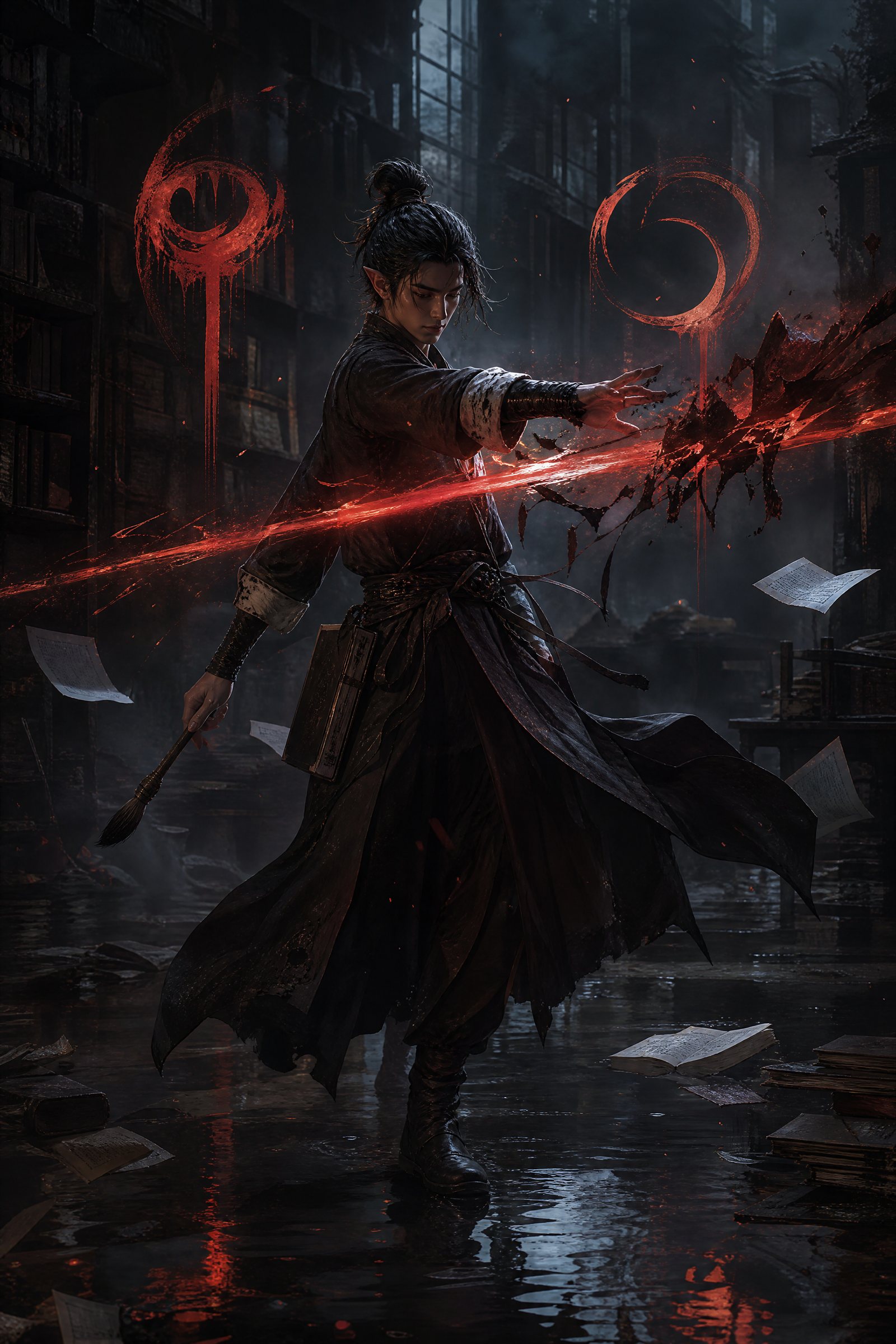
A scholar who fights by writing: every blow is a character, and the characters stay where they were drawn.
Campaign rules apply. Thirteen spells are banned, two are modified, and every spellcaster uses spell points instead of spell slots in this campaign — see Campaign Rules. This document already conforms: banned spells have been removed and replaced at the same level, modified spells are annotated where they appear, and spell slots have been converted to spell points.
Identity
Your master made you copy the same character ten thousand times before you were allowed to throw a single punch, and only when your wrist ached and your ink ran true did you understand: the punch was the character. Every technique you know is a glyph — a shape the world will obey if you draw it correctly — and where other mages speak a spell and lose it the instant it lands, you write yours into the air, where it hangs, wet and burning, until you close the stroke. A character drawn imperfectly is not a weaker character; it is simply not a character, and it does nothing at all. In a story you are the scholar who fights: the perfectionist with ink on the cuffs, who sets the terms of a battle two turns before anyone else notices, and who cannot quite forgive a stroke — or an ally — that only mostly worked.
The Calligrapher is a scholar-martial artist who learns the way a wizard learns — from manuals, from dissected forms, from a book carried against the heart — and fights by inscribing. Your baseline weapon is the Cutting Stroke, an inscribed slash of force drawn straight through a target; your artistry is Inscription, the placing of glyphs — hanging sigils that ward, snare, redirect, or detonate on a later trigger — and where a wizard’s magic is a word said and forgotten, yours is a mark that stays on the page until you decide to finish it. Intelligence is the steadiness of your hand.
Writing, not reading. The Calligrapher and the Fateskald both work in signs and cast on Intelligence, and the line between them is a design rule, not lore. The Calligrapher writes: its glyphs are inscribed into the world and persist there as marks and zones that act on their own triggers. The Fateskald reads: it never inscribes anything that acts on its own, and its carved lots are a working aid for foresight, not a delivery mechanism. A Fateskald feature that creates a persistent marked area has crossed into this class’s territory and belongs here instead.
Class Overview
| Primary Abilities | Dexterity and Intelligence |
| Hit Point Die | d8 per Calligrapher level |
| Saving Throws | Dexterity and Intelligence |
| Skills | Choose 2: Acrobatics, Arcana, History, Insight, Investigation, or Sleight of Hand |
| Weapons | Simple weapons |
| Armor | None |
| Starting Equipment | A scholar’s robe with ink-stained cuffs, a set of brushes and a stone of ground cinnabar (arcane focus, no mechanical effect of its own), your form-book (see below), a bundle of blank talisman-papers, and 12 GP |
Spellcasting summary. You cast spells from the Calligrapher spell list, a closed list drawn from the Arcane Abjuration, Evocation, Divination, and Illusion schools, using Intelligence as your spellcasting ability. You are a half-caster who prepares spells from a written form-book, casting from the half-caster spell point pool, recovered on a Long Rest. No damage cantrips, but you learn utility cantrips (see Utility Cantrips) — your Unarmed Strikes and the glyphs they leave behind are your at-will offense. Spell save DC = 8 + your Intelligence modifier + your Proficiency Bonus; spell attack modifier = your Intelligence modifier + your Proficiency Bonus.
Class Table
| Level | Proficiency Bonus | Martial Arts Die | Cutting Stroke | Qi | Glyph Forms | Prepared | Spell Points | Max Spell Level | Features |
|---|---|---|---|---|---|---|---|---|---|
| 1 | +2 | 1d6 | 1 die | 1 | — | — | — | — | Martial Arts, Unarmored Defense, Qi Points, Cutting Stroke, The Form-Book |
| 2 | +2 | 1d6 | 1 die | 2 | 2 | 2 | 4 | 1st | Spellcasting, Inscription, Utility Cantrips, Unarmored Movement |
| 3 | +2 | 1d6 | 1 die | 3 | 2 | 3 | 6 | 1st | Hand |
| 4 | +2 | 1d6 | 1 die | 4 | 2 | 4 | 6 | 1st | Ability Score Improvement |
| 5 | +3 | 1d8 | 1 die | 5 | 2 | 5 | 14 | 2nd | Extra Attack, Closing Stroke |
| 6 | +3 | 1d8 | 1 die | 6 | 2 | 5 | 14 | 2nd | Hand feature, Unarmored Movement (+15 ft) |
| 7 | +3 | 1d8 | 1 die | 7 | 3 | 6 | 17 | 2nd | Second Nature, Inscription (+1 form) |
| 8 | +3 | 1d8 | 1 die | 8 | 3 | 6 | 17 | 2nd | Ability Score Improvement |
| 9 | +4 | 1d8 | 1 die | 9 | 3 | 7 | 27 | 3rd | Perfect Stroke |
| 10 | +4 | 1d8 | 1 die | 10 | 4 | 7 | 27 | 3rd | Standing Ink, Inscription (+1 form), Unarmored Movement (+20 ft) |
| 11 | +4 | 1d10 | 3 dice | 11 | 4 | 8 | 32 | 3rd | Hand feature |
| 12 | +4 | 1d10 | 3 dice | 12 | 4 | 8 | 32 | 3rd | Ability Score Improvement |
| 13 | +5 | 1d10 | 3 dice | 13 | 5 | 9 | 38 | 4th | Wet Brush, Inscription (+1 form), Mystic Arcanum (6th) |
| 14 | +5 | 1d10 | 3 dice | 14 | 5 | 9 | 38 | 4th | Annotated Mind, Unarmored Movement (+25 ft) |
| 15 | +5 | 1d10 | 3 dice | 15 | 5 | 10 | 44 | 4th | Nothing Wasted |
| 16 | +5 | 1d10 | 3 dice | 16 | 5 | 10 | 44 | 4th | Ability Score Improvement, Mystic Arcanum (7th) |
| 17 | +6 | 1d12 | 5 dice | 17 | 6 | 11 | 57 | 5th | Hand feature (Off the Page for the Running Script), Inscription (+1 form) |
| 18 | +6 | 1d12 | 5 dice | 18 | 6 | 11 | 57 | 5th | The Standing Word, Unarmored Movement (+30 ft) |
| 19 | +6 | 1d12 | 5 dice | 19 | 6 | 12 | 64 | 5th | Epic Boon, Mystic Arcanum (8th) |
| 20 | +6 | 1d12 | 5 dice | 20 | 6 | 12 | 64 | 5th | Masterstroke |
Cantrips Known: 1 at level 2, 2 at level 7, 3 at level 13 — utility only.
Unarmored Movement: +10 ft at level 2, +15 ft at level 6, +20 ft at level 10, +25 ft at level 14, +30 ft at level 18; from level 9 you can also move along vertical surfaces and across liquids.
Mystic Arcanum: one 6th-level spell at level 13, one 7th-level spell at level 16, one 8th-level spell at level 19 — each cast once per Long Rest without spending spell points.
Class Features
Level 1: Martial Arts
Your body is the brush your master spent years correcting. While you are unarmed or wielding a simple weapon and you aren’t wearing armor or wielding a Shield, you gain the following benefits.
- Martial Arts die. You can roll your Martial Arts die (see the class table) in place of the normal damage of your Unarmed Strikes and simple weapons.
- Dexterous strikes. You can use Dexterity instead of Strength for the attack and damage rolls of your Unarmed Strikes and simple weapons.
- Second stroke. When you take the Attack action with an Unarmed Strike or a simple weapon on your turn, you can make one Unarmed Strike as a Bonus Action.
Level 1: Unarmored Defense
While you aren’t wearing armor or wielding a Shield, your base Armor Class equals 10 + your Dexterity modifier + your Intelligence modifier. Half of your defense is footwork; the other half is knowing, before the blow lands, exactly where it was always going to fall.
Level 1: Qi Points
You carry your art as a pool of Qi points equal to your Calligrapher level — what the disciplines call qi: the breath that moves the brush, the measured inhalation a true stroke is drawn on. You regain all expended Qi when you finish a Short or Long Rest — a few minutes of steady breathing while you grind a fresh stone is enough. Qi fuels your Cutting Stroke, your Inscription, and many of your Hand features; every feature that costs Qi says so.
Qi is not a metaphor for stamina — it is the breath your techniques are drawn on, and the ink only follows where the breath leads. When you run dry, you don’t tire; your strokes simply stop taking, the way a brush stops marking when the well is empty.
Level 1: Cutting Stroke
The first mark of any character is a line drawn clean through the space it will occupy. Once on each of your turns, immediately after you hit a creature with an Unarmed Strike or a simple weapon, you can spend Qi — 1 Qi at levels 1–10, 2 Qi at levels 11–16, and 3 Qi at levels 17–20 — to draw that line straight through the target as a free rider — this costs no action, Bonus Action, or Reaction, and doesn’t replace any other part of your turn.
Roll a number of dice of your Martial Arts die size and add your Intelligence modifier; the target takes that much extra force damage (or, if you prefer, the strike’s own damage type). The number of dice is 1 at levels 1–10, 3 at levels 11–16, and 5 at levels 17–20, as shown in the Cutting Stroke column.
Because the Cutting Stroke is limited to once per turn, throwing more strikes only gives you more chances to land it — it never fires twice on the same turn (the one exception is Riposte in Ink, in the Hand of the Clear Mirror), and no Inscription option or Hand feature adds Cutting Stroke dice onto the same strike. This is the intentional ceiling on your single-turn burst; your reach comes from the glyphs you leave standing, not from stacking one blow.
Detonating Stroke. When you use the Cutting Stroke, you can inscribe it as a burst rather than a single cut: the target and each creature of your choice within 5 feet of it make a Dexterity saving throw against your spell save DC, taking force damage equal to one roll of your Cutting Stroke dice (the number of Martial Arts dice shown in the Cutting Stroke column) on a failure, or half as much on a success. You don’t add your Intelligence modifier when you detonate — the ink is spent widening the mark, not deepening it.
Level 1: The Form-Book
You keep a form-book: a bound volume in which each technique you know is dissected into brushstrokes — a spell, a stance, a character copied ten thousand times until the hand no longer hesitates. It functions in every respect as a wizard’s spellbook — you learn spells from the Calligrapher spell list into it, including by copying them from found manuals, scrolls, and other spellcasters’ books, and you prepare your spells from what is written in it — and it is also your training log and the most valuable thing you own. If it is lost, you can transcribe a replacement from memory over a long stretch of quiet work, or recopy techniques from any manual you can find (see Spellcasting).
You can produce a thin line of glowing script from a fingertip or a dry brush at will, enough to write a shining word in the air that lingers for a minute, mark a surface with a sigil, or serve as your arcane focus. And you hold to the first law your master taught: a technique executed imperfectly simply fails. There is no sloppy version of your art. You either draw the character true — and it does everything it is meant to — or you don’t draw it at all, and nothing happens. Your glyphs do not backfire, misfire, or half-work. They land, or they were never there.
Level 2: Spellcasting
You have studied enough forms to write them off the page and into the world. See the end of this document for the full Spellcasting rules, your spell point progression, and the Calligrapher spell list. In brief:
- You are a half-caster using Intelligence. Your spell save DC = 8 + your Intelligence modifier + your Proficiency Bonus; your spell attack modifier = your Intelligence modifier + your Proficiency Bonus.
- You prepare spells from those written in your form-book, choosing a number equal to the Prepared column each time you finish a Long Rest. You can add new techniques from the Calligrapher spell list to your form-book by leveling and by copying manuals and scrolls you find.
- Your spell points follow the half-caster progression on the class table and are regained on a Long Rest.
- No damage cantrips, but you learn utility cantrips. Your at-will offense is your Martial Arts and the glyphs it inscribes; the brush does not throw small damage, but a brief mark can still serve small useful ends (see Utility Cantrips).
Level 2: Inscription
You learn to leave a character standing after the stroke that drew it. When you hit a creature with an Unarmed Strike, or as a Magic action targeting a creature or an unoccupied point you can see within 30 feet, you can spend 1 Qi to inscribe one glyph you know — a hanging sigil of wet, luminous force — in that space. (If the triggering strike misses, no glyph is inscribed: an imperfect stroke leaves no mark.) These glyphs are your own art and are not the spell Glyph of Warding, despite the shared word: yours are inscribed in an instant by a strike or a Magic action, hang openly on the air for a minute rather than lying dormant indefinitely, and require none of that spell’s casting time, incense, or gold.
Once on each of your turns you may inscribe in this way; a glyph persists for up to 1 minute, until it is triggered, or until you inscribe more glyphs than you can maintain. You can maintain a number of glyphs at once equal to your Intelligence modifier (minimum 1); if you inscribe another, the oldest glyph fades harmlessly. A creature, or a point, can bear only one of your glyphs at a time; inscribing another there replaces the first. Maintaining glyphs requires no Concentration. A creature that can see magic (or that succeeds on an Intelligence (Arcana) check against your spell save DC while studying the space) sees the sigil hanging there; most creatures feel only a prickle of pressure until it goes off.
Each glyph has a trigger and an effect, given below. Some glyphs trigger themselves automatically when their condition is met and cost you nothing further; others you finish deliberately (marked deliberate), which requires a Bonus Action to trigger a glyph you can see. When a glyph triggers, it discharges and vanishes. All saving throws use your spell save DC.
You know two Glyph forms of your choice from the list below, and you learn one additional form at levels 7, 10, 13, and 17. Whenever you finish a Long Rest, you can replace one form you know with another. Your Hand may also grant forms that don’t count against this number.
- Binding Glyph. Inscribed in a creature’s space. The first time the marked creature moves or is moved while the glyph persists, it makes a Strength saving throw; on a failure, its Speed becomes 0 until the end of its next turn, and it can’t teleport. The glyph then discharges.
- Rupturing Glyph. (deliberate) When you trigger this glyph, the marked creature makes a Dexterity saving throw, taking force damage equal to two rolls of your Martial Arts die + your Intelligence modifier on a failure, or half as much on a success (this increases to three rolls at 11th level). In addition, one other creature of your choice within 5 feet of the target makes the same saving throw; on a failure it takes half the damage the marked creature takes on a failed save, and on a success it takes none.
- Warding Glyph. Inscribed on yourself or a willing creature (an Unarmed Strike can be a light tap on an ally). The first time the warded creature takes damage or fails a saving throw while the glyph persists, it reduces that damage by, or adds to that save, one roll of your Martial Arts die + your Intelligence modifier. The glyph then discharges.
- Guiding Glyph. Inscribed in a creature’s space. The next attack roll made against the marked creature by you or an ally has Advantage, and if it hits, deals an extra one roll of your Martial Arts die force damage. The glyph then discharges.
- Anchoring Glyph. Inscribed at a point. A 5-foot-radius zone around the point becomes warded ground for the glyph’s full duration. The first time on a turn that an enemy enters or starts its turn in the zone, it makes a Dexterity saving throw, taking one roll of your Martial Arts die force damage and having its Speed halved until the end of that turn on a failure. This glyph doesn’t discharge when it triggers; it holds the ground for the full minute.
- Muting Glyph. Inscribed in a creature’s space. While the glyph persists, the marked creature has Disadvantage on Constitution saving throws to maintain Concentration, and the first time it casts a spell it takes force damage equal to one roll of your Martial Arts die + your Intelligence modifier. The glyph then discharges.
- Mirror Glyph. Inscribed on yourself or a willing creature. When the warded creature is hit by an attack while the glyph persists, it can use its Reaction — or you can, if it’s you — to discharge the glyph: the attacker takes force damage equal to one roll of your Martial Arts die + your Intelligence modifier, and the warded creature gains a +2 bonus to AC against that attack, possibly turning the hit into a miss.
- Blinding Glyph. (deliberate) When you trigger this glyph, the marked creature makes a Constitution saving throw or has the Blinded condition until the end of its next turn as searing white script flares across its eyes.
- Ferrying Glyph. Inscribed at a point. (deliberate) While the glyph persists, you can trigger it to step through the script and teleport to an unoccupied space within 5 feet of the glyph’s point, provided it’s within 30 feet of you. The glyph then discharges.
Level 2: Utility Cantrips
Your art does not waste itself on small damage, but a brief mark can serve small useful ends. You learn 1 cantrip at level 2, a 2nd at level 7, and a 3rd at level 13, from the list below — utility cantrips only (no attack roll, no damage, no save-for-damage). They use Intelligence. You can swap one when you gain a level. Choose from: Mage Hand, Message, Minor Illusion, Prestidigitation, Light, Mending, Guidance, Dancing Lights. Guidance is a class addition from outside the Arcane list.
Level 2: Unarmored Movement
Unarmored Movement — what the schools call the running hand, the fast cursive that never lifts the brush from the page. Your footwork has become one unbroken line. While you aren’t wearing armor or wielding a Shield, your Speed increases by 10 feet. This bonus increases to +15 feet at level 6, +20 feet at level 10, +25 feet at level 14, and +30 feet at level 18.
Starting at level 9, you can also move along vertical surfaces and across liquids on your turn without falling during that move — the stroke is drawn too fast for the wall or the water to finish objecting.
Level 3: Hand
The art is one; the hands that practice it are many. Choose a Hand — the Paper Talisman, the Vermilion Seal, the Running Script, the Broken Brush, the Clear Mirror, or the Standing Stone, each described later in this document. You gain its level 3 features, and additional features at levels 6, 11, and 17.
Level 4, 8, 12, 16: Ability Score Improvement
You gain the Ability Score Improvement feat or another feat of your choice for which you qualify.
Level 5: Extra Attack
You can attack twice, instead of once, whenever you take the Attack action on your turn.
Level 5: Closing Stroke
Your control of the finishing stroke sharpens. As a Bonus Action, you can trigger one glyph you can see. A deliberate glyph takes effect as usual (detonate a Rupturing Glyph, flare a Blinding Glyph, step through a Ferrying Glyph); a Binding Glyph takes effect at once, as though the marked creature had just moved; and any other glyph discharges early, without effect. In addition, once on each of your turns you can trigger one glyph other than a Rupturing Glyph in the same way as part of your Attack action, without spending a Bonus Action — the finishing stroke folds into the strike. Triggering the damaging Rupturing Glyph still costs your Bonus Action; the biggest characters take a breath to close.
Level 7: Second Nature
The brush has stopped waiting for permission. Your Inscription is no longer limited to once on each of your turns: each time you hit a creature with an Unarmed Strike, you can inscribe a glyph as a rider on it, paying 1 Qi for each. In addition, you can now maintain a number of glyphs at once equal to your Intelligence modifier + your Proficiency Bonus.
Level 9: Perfect Stroke
A master does not accept a stroke that failed to take. Once on each of your turns, when you miss with an Unarmed Strike, or when a creature succeeds on a saving throw against one of your glyphs or Calligrapher spells, you can spend 1 Qi to reinscribe the character: reroll the attack roll, or force that creature to reroll its save. You must use the new result.
Level 10: Standing Ink
You have learned to leave work standing overnight. When you roll Initiative, you regain expended Qi equal to half your Calligrapher level (round down) — the sight of a fight refills the well. In addition, when you inscribe a glyph outside of combat, you can choose for it to persist for up to 8 hours instead of 1 minute, letting you ward a door, seal a room, or set a trap in advance. Only glyphs inscribed while you have nothing else to do can be extended this way.
Level 13: Wet Brush
Your ink bites deeper and holds its shape longer. Your damaging glyphs (Rupturing, and any Hand glyph that deals damage) deal an extra one roll of your Martial Arts die, and once on each of your turns, the first creature to make a saving throw against a glyph you inscribe has Disadvantage on that save.
Level 13: Mystic Arcanum
Some characters are too large for an ordinary page. The masters call this one the Long Scroll — a single glyph whose form runs the whole length of an unrolled scroll, so long in the drawing that a hand can hold it true only once between one night’s rest and the next.
You learn one 6th-level spell from the Calligrapher spell list. You can cast it once without spending spell points or Qi, and you regain the ability to do so when you finish a Long Rest. At level 16 you learn a 7th-level spell, and at level 19 an 8th-level spell, each cast once per Long Rest in the same way. Each is its own separate use: casting your 6th-level Arcanum doesn’t spend your 7th or your 8th.
Whenever you gain a level in this class, you can replace one of these spells with another of the same level from the Calligrapher spell list. These spells use Intelligence.
An Arcanum is known, not written. It doesn’t go into your form-book, doesn’t count against your Prepared number, and can’t be cast with spell points — the scroll is too long to copy and too long to draw twice in a day. See the Spellcasting section for the 6th-, 7th-, and 8th-level options.
Level 14: Annotated Mind
Ten thousand repetitions have annotated your will as thoroughly as any manual. You gain proficiency in Wisdom saving throws; if you already have it, choose Charisma instead. While you are conscious, being surprised doesn’t give you Disadvantage on your Initiative roll, and you have Advantage on saving throws against being Charmed or Frightened — nothing writes itself over a mind this heavily revised.
Level 15: Nothing Wasted
The brush is never idle and the ink is never spilled. When a creature dies within 30 feet of one of your glyphs, or when you score a Critical Hit with an Unarmed Strike, you regain 1 Qi. In addition, when you finish a Short Rest, you can replace one Glyph form you know with another — a few minutes to reread the relevant page.
Level 18: The Standing Word
Your finest characters no longer fade. You can maintain any number of glyphs at once, with no limit. When you inscribe a glyph, you can designate it standing: it persists until you dismiss it (no action) or inscribe over it, and it does not discharge when it triggers — a standing Anchoring Glyph holds its ground indefinitely, a standing Warding Glyph rewards its ally again and again. You can have only one standing glyph at a time; designating a new one ends the old.
In addition, once per Long Rest, you can cast one Calligrapher spell you have prepared without spending spell points.
Level 19: Epic Boon
You gain an Epic Boon feat or another feat of your choice for which you qualify. The Boon of Combat Prowess and the Boon of Spell Recall both suit a Calligrapher, but any Boon your DM allows fits the scholar who has read past the last page.
Level 20: Masterstroke
You have found the single character that contains all the others, and for a moment you can write it. As a Bonus Action, for 1 minute:
- Your Inscription costs no Qi.
- The save DC of your glyphs increases by 2.
- You can inscribe a glyph as a free rider on every Unarmed Strike you hit with, with no limit.
- Once on each of your turns, you can trigger any number of your glyphs at once (as part of any action, no Bonus Action required).
When the minute ends, you gain 1 Exhaustion level; the hand that wrote the whole character needs to rest. Once you use this feature, you can’t use it again until you finish a Long Rest.
Hands (Subclasses)
Six Hands describe the school your brush was trained in, and each is one grammar of the art — binding, detonation, speed, unmaking, foresight or territory — that your strokes keep returning to. Each grants features at 3rd, 6th, 11th, and 17th level. A Hand is a school of technique, not a faith, a people or a place: every world writes its own names over the six (see In Different Worlds), and the traditions that first inked them are credited under Origins and Inspiration.
Hand of the Paper Talisman
A binding is only a sentence the world has not been allowed to finish. Paper-Talisman calligraphers write the oldest and strictest scripts — the sealing-scripts that hold demons in jars, keep the drowned in the river, and let a single sheet of paper stop a thing that could break a wall. Where others detonate, the Paper Talisman holds.
Level 3: Sealing Script. You always have the Binding Glyph and Warding Glyph prepared, and they don’t count against your number of Glyph forms known. When a creature fails the saving throw against your Binding Glyph, it also has the Restrained condition (rather than merely Speed 0), and the glyph doesn’t discharge: the condition lasts until the glyph ends, and the glyph still counts against the number you can maintain. The creature repeats the save at the end of each of its turns, ending the condition and the glyph on a success. In addition, when a creature you can see within 30 feet is hit by an attack, you can take a Reaction and spend 1 Qi to inscribe a Warding Glyph on it and trigger it immediately against that damage.
Level 6: Hundred-Talisman Barrier. As a Magic action, spend 2 Qi to hang a lattice of sealing-papers in a 15-foot-radius Emanation centered on a point you can see within 30 feet; it lasts 1 minute and requires no Concentration. While inside it, you and your allies gain a +1 bonus to AC and to saving throws against spells. The first time on each turn that an enemy of your choice enters the barrier or starts its turn there, it makes an Intelligence saving throw; on a failure, its Speed is halved until it leaves.
Level 11: Word That Holds. A creature Restrained by your Binding Glyph can’t teleport, travel through extradimensional space, or leave the plane, and it has Disadvantage on any ability check or saving throw made to escape. In addition, once on each of your turns, when you inscribe a Binding Glyph on a creature, you can end one spell of 3rd level or lower affecting it, as though you had cast Dispel Magic.
Level 17: The Full Stop. As a Reaction when you or a creature you can see within 30 feet takes damage, you inscribe the final seal: reduce that instance of damage to 0. If the attacker is within 60 feet, it makes an Intelligence saving throw or is Restrained (as by your Binding Glyph) until the end of your next turn. Once you use this feature, you can’t use it again until you finish a Long Rest — unless you spend 4 Qi, in which case you can use it again this rest.
Playing a Paper-Talisman calligrapher: you are the party’s full stop. Enemies come to you mid-sentence, sure of what they were about to do, and you end the sentence for them.
Hand of the Vermilion Seal
Red ink is for the words you mean to detonate. Vermilion adepts write in cinnabar — the ink of edicts and death-warrants, ground from the same red stone the alchemists cook for mercury. Their glyphs do not ward and do not bind. They wait, wet on the air, and then they go off.
Level 3: Cinnabar Ink. You always have the Rupturing Glyph prepared, and it doesn’t count against your forms known. When you detonate a Rupturing Glyph, its force damage increases by one roll of your Martial Arts die, and every creature of your choice within 5 feet of the target, not only one, makes the same saving throw, taking half the damage the marked creature takes on a failed save, or none on a success. If you also hit the target with an Unarmed Strike on the same turn that you detonate it, the target has Disadvantage on the save — the seal was already primed.
Level 6: Sympathetic Ignition. When you detonate a Rupturing Glyph, you can spend 1 Qi to detonate every other Rupturing Glyph you have inscribed at the same time, each against its own target. In addition, whenever a creature is reduced to 0 Hit Points by one of your detonations, the blast leaps: each creature of your choice within 5 feet of it takes force damage equal to one roll of your Martial Arts die + your Intelligence modifier. The leap is itself a detonation, so Edict of Fire widens it to 10 feet and it still affects only creatures of your choice; a creature the leap reduces to 0 Hit Points doesn’t make the blast leap again.
Level 11: Edict of Fire. The radius of your detonations grows to 10 feet; a detonation that affects creatures of your choice still affects only creatures of your choice in the larger area. As a Magic action, you can spend 3 Qi to inscribe a Rupturing Glyph at a point within 60 feet and detonate it in the same action — a written word thrown and finished in one breath. You can choose for any of your detonations to deal fire damage instead of force.
Level 17: The Last Word. Once on each of your turns, when you detonate a glyph, its area becomes a 20-foot-radius Sphere (a detonation that affects creatures of your choice still affects only creatures of your choice in it), and creatures that fail the saving throw also have the Prone condition. In addition, when you roll Initiative, you inscribe a Rupturing Glyph for free on a creature you can see within 30 feet — you always write the ending first.
Playing a Vermilion calligrapher: you write the whole sentence early, three characters at a time, and you savor the pause before the period.
Hand of the Running Script
The fastest hand never lifts the brush. Running script — cursive — values flow over legibility: a single unbroken line, drawn too fast to read, that leaves afterimages and half-truths in its wake. These calligraphers are never quite where the sentence ended.
Level 3: Cursive Step. You always have the Ferrying Glyph prepared, free. When you inscribe any glyph, you can immediately move up to 10 feet without provoking Opportunity Attacks. When you use a Ferrying Glyph to teleport, you leave a blurred double where you stood: the first attack roll against you before the start of your next turn has Disadvantage.
Level 6: Illegible. When a creature misses you with an attack, you can take a Reaction to smear a line of false script across the space: teleport up to 15 feet to an unoccupied space you can see, and the attacker has Disadvantage on its next attack roll before the end of its next turn. In addition, you can cast your prepared Illusion spells using an Unarmed Strike in place of their Somatic components.
Level 11: The Unbroken Line. On your turn, if you move at least 20 feet in a straight line, you can inscribe one glyph (paying 1 Qi total) in the space of each creature you pass within 5 feet of — a running line of script laid down as you go. In addition, while you have at least 1 Qi, you have the benefit of the Blur spell.
Level 17: Off the Page. Your Unarmored Movement — the running hand this school gave its name to — has been carrying you up walls and across water since level 9, and now the line stops touching the ground at all. Once on each of your turns, you can use a Ferrying Glyph’s teleport as part of your movement without discharging the glyph. In addition, when an attacker misses you with an attack, it must succeed on an Intelligence saving throw or the attack instead strikes a creature of your choice within 5 feet of you, using the same roll.
Playing a Running-Script calligrapher: you are a rumor that fights. Delight in the moment the enemy commits to where you were.
Hand of the Broken Brush
Some things are only finished when they are unwritten. Broken-brush calligraphers study the flaw — the smear, the split hair, the character whose whole purpose is to unmake another. Their glyphs degrade what they touch: armor, spell, and certainty alike.
Level 3: Unmaking Stroke. When you inscribe a glyph on a creature, it becomes marred until the glyph ends. Choose one when you inscribe: the marred creature takes a −2 penalty to AC, or a −2 penalty to its saving throws. In addition, your Cutting Stroke ignores Resistance to force damage, and the first time each turn a marred creature takes force damage from you, it has Disadvantage on its next attack roll.
Level 6: Erasure. As a Reaction when a creature you can see within 60 feet casts a spell, you can spend Qi equal to the spell’s level to inscribe an unmaking character over it; the caster makes an Intelligence saving throw against your spell save DC, and on a failure the spell fails and has no effect (as Counterspell, but Qi-fueled and save-based). In addition, as a Magic action you can spend 2 Qi to attempt to end one spell or magical effect within 60 feet, as Dispel Magic.
Level 11: Ruin. A creature marred by your glyphs has Vulnerability to the force damage of your Cutting Stroke and your detonations. When a marred creature drops to 0 Hit Points, you regain 1 Qi, and you can move the marring (and its −2 penalty) to a new creature within 30 feet at no cost.
Level 17: The Blank Page. As a Magic action, spend 4 Qi to inscribe the unwriting character on a creature within 30 feet. It makes an Intelligence saving throw. On a failure, until the end of your next turn it loses all Resistances and Immunities, can’t cast spells or regain Hit Points, and any Concentration it is maintaining ends. Once you use this feature, you can’t use it again until you finish a Short or Long Rest.
Playing a Broken-Brush calligrapher: you are the counter-argument made flesh. You are the reason their magic did not work, their armor did not hold, and their certainty did not survive contact with you.
Hand of the Clear Mirror
A still surface shows you the blow before it is thrown. Clear-Mirror calligraphers read intent the way others read text. They see the stroke coming — the tightening shoulder, the shifting weight, the word half-formed — and answer it with one of their own, already drawn.
Level 3: Reading the Stroke. When a creature you can see attacks you or an ally within 30 feet, you can take a Reaction to inscribe a Mirror Glyph on the target and trigger it immediately: the attacker takes force damage equal to one roll of your Martial Arts die + your Intelligence modifier, and the target gains a +2 bonus to AC against that attack, possibly turning a hit into a miss. This Mirror Glyph discharges at once, so it doesn’t replace a glyph already on the target. You can use this feature a number of times equal to your Intelligence modifier (minimum once) per Long Rest without spending Qi; after that, it costs 1 Qi each use.
Level 6: Foreseen. At the start of each of your turns, you can spend 1 Qi to read the next few seconds: until the start of your next turn, you have Advantage on attack rolls against one creature you can see, that creature’s attack rolls against you have Disadvantage, and if combat starts in that time, being surprised by that creature doesn’t give you Disadvantage on your Initiative roll. In addition, you can sense the presence, location, and school of any glyph, ward, or spell effect within 30 feet.
Level 11: Riposte in Ink. When your Mirror Glyph triggers and the attack misses (including one you turned into a miss), you can make one Unarmed Strike against the attacker as part of the same Reaction, if it’s within your reach. That strike can carry your Cutting Stroke, paying its Qi cost as usual. This is an exception to the Cutting Stroke’s once-on-each-of-your-turns limit.
Level 17: The Still Water. While you have at least 1 Qi, your mind is a mirror no motion escapes: attack rolls against you have Disadvantage, and you have Advantage on saving throws. In addition, once per round, when you would be hit by an attack or targeted by a spell that affects only you, you can inscribe a reflecting glyph as a Reaction (no Qi) to negate it entirely; if it was a spell or an attack from a source within 60 feet, that source becomes the target instead, using the original roll or your spell save DC.
Playing a Clear-Mirror calligrapher: you answer questions before they finish being asked. The interesting play is deciding what you let through anyway.
Hand of the Standing Stone
A word cut deep enough into stone becomes a border. Standing-Stone calligraphers do not write on paper. They carve — monuments, boundary-markers, standing stones — and their glyphs hold whole stretches of ground. Where you plant your characters, the map itself changes.
Level 3: Monument Script. You always have the Anchoring Glyph prepared, free. Your Anchoring Glyph’s warded zone has a 10-foot radius (instead of 5) and lasts 10 minutes, and your point-glyphs can be carved into the ground, a wall, or an object and can’t be moved or dispelled by any effect of a level lower than your Max Spell Level. While you’re within 10 feet of one of your own glyphs, you can’t be moved against your will and gain a +2 bonus to AC.
Level 6: Warded Ground. As a Magic action, spend 2 Qi to carve a Warded Ground glyph at a point you can see within 30 feet. Choose one effect, lasting 1 minute: a 10-foot square of difficult terrain that enemies alone are slowed by; a wall of glowing script up to 10 feet long and 10 feet high that provides Three-Quarters Cover and has AC 10 and 30 Hit Points; or a 10-foot-radius zone in which enemies have Disadvantage on attack rolls.
Level 11: The Standing Field. Your Anchoring Glyph deals three rolls of your Martial Arts die + your Intelligence modifier to an enemy that fails its save (instead of one roll of your Martial Arts die), and you can maintain two Anchoring Glyphs or Warded Ground glyphs beyond your normal maintenance limit. Your allies always treat the areas of your Anchoring Glyphs and Warded Ground as beneficial: they ignore your difficult terrain and gain any AC or save bonus the zone confers.
Level 17: Immovable Word. As a Magic action, spend 5 Qi to raise a monument of standing script: a 20-foot Cube of glowing characters at a point you can see within 60 feet, lasting 10 minutes and requiring no Concentration. Choose whether it is a barred cage (things can pass but not creatures) or a solid box (nothing crosses); a creature caught inside when it forms can attempt a Charisma saving throw to slip out as it closes, but otherwise the walls can’t be broken or teleported through by any means short of a Disintegrate or a wish. Once you use this feature, you can’t use it again until you finish a Long Rest.
Playing a Standing-Stone calligrapher: you decide where the lines of the map are, and then you make everyone — friend and enemy — respect them.
Spellcasting
You have studied the forms deeply enough to write them straight into the world. Your Calligrapher spellcasting is governed by the rules below.
Casting ability. Intelligence. Spell save DC = 8 + your Intelligence modifier + your Proficiency Bonus. Spell attack modifier = your Intelligence modifier + your Proficiency Bonus.
The form-book. Your written techniques live in your form-book, which is a wizard’s spellbook under another name: spells are learned into it and prepared from it by the wizard’s rules. It begins play holding six 1st-level spells of your choice from the Calligrapher spell list (see below). Each time you gain a Calligrapher level, you can add two spells from the Calligrapher spell list to your form-book, of any level no higher than your Max Spell Level. You can also copy a spell you find, if it is on the Calligrapher spell list — from another Calligrapher’s form-book, from a captured martial manual, or from any arcane scroll or spellbook — by spending time and materials studying and transcribing it (as the wizard copies spells: roughly 2 hours and 50 GP of fine ink per spell level). A dissected form is a dissected form, whatever hand first wrote it.
Preparing spells. Whenever you finish a Long Rest, you prepare a list of spells from those written in your form-book, choosing a number equal to the Prepared column of the class table (the spells must be of a level no higher than your Max Spell Level). You cast prepared spells by spending spell points. You can change your prepared list only when you finish a Long Rest, poring over the book by lamplight.
Spell Points (half-caster, long-rest). This campaign uses spell points in place of spell slots (see Campaign Rules). Your pool is shown in the Spell Points column of the class table, and the Max Spell Level column shows the highest level of spell you can cast from it (1st at level 2, 2nd at 5, 3rd at 9, 4th at 13, 5th at 17). To cast a spell of 1st level or higher, spend spell points equal to its cost — 1st 2, 2nd 3, 3rd 5, 4th 6, 5th 7. You can cast a spell at any higher level up to your Max Spell Level by paying that level’s cost, and it takes effect as a higher-level version, exactly as the spell describes. You regain all spent spell points when you finish a Long Rest. Your spell points and your Qi points are separate pools: neither can pay for the other, and they recover on their own schedules. You can never spend spell points on a spell of 6th level or higher — those come only from Mystic Arcanum. If you also have long-rest spell points from another class, combine them as described under Multiclassing.
Spell list source. You prepare spells only from the Calligrapher spell list below, a closed list drawn from the Arcane spells of the Abjuration, Evocation, Divination, and Illusion schools — the ward, the force, the foresight, and the misdirection that are the Calligrapher’s four grammars. Your tradition also preserves a handful of signature techniques from outside those schools that have always been taught in the form-books (Grease, Web, Misty Step, and Silvery Barbs, and the Mystic Arcanum options Arcane Gate and Maze); they are on the list even though their schools are not. Warding Bond and Circle of Power are on the list as class additions from outside the Arcane list. A spell that is not on the list can’t be copied into your form-book or prepared, whatever book or scroll it is found in.
No damage cantrips, but you learn utility cantrips. Your at-will offense is your Martial Arts, your Cutting Stroke, and the glyphs your strikes inscribe. The form-book does not waste a page on a spell too small to be worth writing twice — but a brief mark can serve small useful ends, and so you learn a handful of utility cantrips (see Utility Cantrips).
Calligrapher Spell List
This is a closed list: every spell of 1st through 5th level in your form-book comes from it, and the DM does not add others. It holds 75 spells (17 / 22 / 16 / 10 / 10 at 1st–5th level), each an official Arcane spell in one of your four schools or a listed signature technique or class addition, sorted alphabetically within each level. Every spell is from the 2024 Player’s Handbook except Absorb Elements (Xanathar’s Guide to Everything) and Silvery Barbs (Strixhaven: A Curriculum of Chaos). Warding Bond and Circle of Power are class additions from outside the Arcane list. Legend Lore follows its campaign text (Campaign Rules, Modified spells). The 6th-, 7th-, and 8th-level entries are Mystic Arcanum options only — they are never written in your form-book and can’t be cast with spell points.
1st level (17) (available at 2).
- Absorb Elements (Abjuration) — drink the incoming energy and write it back
- Alarm (Abjuration) — a sentry character inked across a threshold
- Chromatic Orb (Evocation) — a hurled bead of chosen element
- Color Spray (Illusion) — a flick of every pigment at once
- Comprehend Languages (Divination) — every script is legible to you
- Detect Magic (Divination) — read the ink already on the world
- Disguise Self (Illusion) — write a different face over your own
- Faerie Fire (Evocation) — glowing script that clings to whatever it outlines
- Grease (Conjuration; signature) — a slick character smeared across the floor
- Identify (Divination) — read the maker’s marks on a thing
- Illusory Script (Illusion) — a page only its intended reader can read
- Magic Missile (Evocation) — unerring darts of written force
- Protection from Evil and Good (Abjuration) — a warding character drawn on the skin
- Shield (Abjuration) — a wall of standing script between you and the blow
- Silent Image (Illusion) — a picture drawn in light
- Silvery Barbs (Enchantment; signature) — a hissed correction that unmakes a success
- Thunderwave (Evocation) — a concussive character shouted flat
2nd level (22) (available at 5).
- Arcane Lock (Abjuration) — seal a door with a written word
- Augury (Divination) — read the next page before it is turned
- Blur (Illusion) — your outline smears like wet ink
- Continual Flame (Evocation) — a character of light that never needs re-inking
- Darkness (Evocation) — a blot of ink spilled across the air
- Detect Thoughts (Divination) — the stroke before the word
- Gust of Wind (Evocation) — one long horizontal stroke that sweeps the line clear
- Invisibility (Illusion) — erase yourself from the page
- Locate Object (Divination) — the page remembers a thing and points the way to it
- Magic Mouth (Illusion) — a message written to speak itself later
- Melf’s Acid Arrow (Evocation) — a dart of corrosive ink
- Mind Spike (Divination) — a sharp stroke written into a mind
- Mirror Image (Illusion) — three afterimages of an unbroken line
- Misty Step (Conjuration; signature) — step through the fold in the paper
- Nystul’s Magic Aura (Illusion) — a forged seal over a thing’s true nature
- Phantasmal Force (Illusion) — a picture drawn inside one mind
- Scorching Ray (Evocation) — three darts of burning script
- See Invisibility (Divination) — read what was written to be unseen
- Shatter (Evocation) — a ringing character that breaks stone
- Silence (Illusion) — a blank margin no sound can cross
- Warding Bond (Abjuration; class addition) — a shared sigil between two allies
- Web (Conjuration; signature) — a sticky lattice of unfinished strokes strung across a gap
3rd level (16) (available at 9).
- Clairvoyance (Divination) — set an eye where you need to read
- Counterspell (Abjuration) — smother a casting mid-stroke
- Daylight (Evocation) — a character of noon drawn in the air
- Dispel Magic (Abjuration) — erase another’s ink
- Fear (Illusion) — a terrible character shown all at once
- Fireball (Evocation) — the loudest character in the book
- Glyph of Warding (Abjuration) — the tradition’s namesake, set to spring
- Hypnotic Pattern (Illusion) — a lattice of shifting script that holds the eye
- Lightning Bolt (Evocation) — a single line drawn very fast
- Magic Circle (Abjuration) — a ring of warding characters drawn on the floor
- Major Image (Illusion) — a scene rendered whole
- Nondetection (Abjuration) — write a page no scrying can read
- Protection from Energy (Abjuration) — ward the party against an element
- Remove Curse (Abjuration) — strike out someone else’s malediction
- Sending (Divination) — a short message written across any distance
- Tongues (Divination) — every spoken word becomes legible
4th level (10) (available at 13).
- Banishment (Abjuration) — write a thing back out of the room
- Divination (Divination) — ask the deeper page a question
- Fire Shield (Evocation) — a warm or cold character worn as a cloak
- Freedom of Movement (Abjuration) — a seal no binding can close
- Greater Invisibility (Illusion) — erased even in motion
- Hallucinatory Terrain (Illusion) — repaint the landscape with a wide brush
- Locate Creature (Divination) — the page remembers a shape, and points at it
- Otiluke’s Resilient Sphere (Evocation) — seal a threat in a bubble of force
- Phantasmal Killer (Illusion) — a fear rendered in exact, personal detail
- Wall of Fire (Evocation) — draw the line and set it alight
5th level (10) (available at 17).
- Bigby’s Hand (Evocation) — a great written fist, your own strikes writ enormous
- Circle of Power (Abjuration; class addition) — a warding field against magic
- Cone of Cold (Evocation) — a killing character in white
- Legend Lore (Divination) — the index points to the shelf where the answer waits
- Mislead (Illusion) — send a perfect false copy in your place
- Rary’s Telepathic Bond (Divination) — one page shared by several minds
- Scrying (Divination) — read a person across any distance
- Seeming (Illusion) — write new faces over a whole company
- Wall of Force (Evocation) — the character nothing crosses
- Wall of Stone (Evocation) — reshape the room with a stroke
6th level (Mystic Arcanum at 13 — not castable with spell points).
- Globe of Invulnerability (Abjuration) — a closed character drawn around your whole party
- Programmed Illusion (Illusion) — a scene written now and left to trigger later, the way a glyph is
- True Seeing (Divination) — read the world’s ink beneath every forgery
- Arcane Gate (Conjuration; signature) — two marks on two walls, and the space between them erased
7th level (Mystic Arcanum at 16 — not castable with spell points).
- Forcecage (Evocation) — the box of standing script, the Calligrapher’s oldest boast
- Symbol (Abjuration) — the tradition’s namesake, drawn at full size and left to wait
- Mirage Arcane (Illusion) — rewrite a square mile of the map in your own hand
- Prismatic Spray (Evocation) — every color of ink at once
8th level (Mystic Arcanum at 19 — not castable with spell points).
- Antimagic Field (Abjuration) — the blank page, carried with you
- Maze (Conjuration; signature) — fold a creature into a character it cannot read its way out of
- Telepathy (Divination) — a line of script written directly into another mind
- Mind Blank (Abjuration) — a page nothing can read and nothing can write on
These three are Arcanum spells, not form-book spells: you know them, you cast each once per Long Rest without spending spell points, and they never occupy a page or a Prepared slot (see Mystic Arcanum). Two cautions when you choose. Forcecage and the Hand of the Standing Stone’s Immovable Word do the same job at the same tier — if you carve monuments for a living, take Symbol or Mirage Arcane instead and keep two different answers. And Antimagic Field suppresses your own glyphs along with everyone else’s: it is the only technique in the book that unwrites your handwriting as readily as the enemy’s, which is either the point or a very expensive mistake.
Multiclassing
To take your first level of Calligrapher while multiclassing, you need Dexterity 13 and Intelligence 13. When you enter the class you gain proficiency with simple weapons; if you don’t already have them, you gain Martial Arts and Unarmored Defense (10 + Dex + Int). You gain the Qi point pool and Cutting Stroke: your Calligrapher Qi entry and your Martial Arts die follow your Calligrapher level on this class’s table, never your total character level. Your spell points are those of a half-caster: they combine with the long-rest spell points of other spellcasting classes under the standard multiclass spellcaster rules and the multiclass spell point table in Campaign Rules (count your Calligrapher levels as half, rounded down, when adding up your combined caster level), and you always prepare Calligrapher spells from your form-book using Intelligence. You reach features like Extra Attack based on Calligrapher level, and Extra Attack doesn’t stack with the same feature from another class.
Qi from more than one class. If another class in this library also gives you Qi points, or the Monk class gives you Focus Points, you have a single pool of Qi points; your Monk features spend it as Focus Points. Its maximum is the total of each class’s Qi or Focus entry for your level in that class (including any feature that raises a class’s maximum). A feature from any of those classes can spend from it. Each class’s share recovers by that class’s own rule, and a feature that reduces one class’s maximum reduces only that class’s share. Each feature keeps its own limits (once per turn, Surge dice, and so on). While your pool combines more than one class, you can use each class’s Surge no more times between one rest and the next than your level in that class. A feature that restores all of a class’s Qi or Focus Points restores no more than that class’s entry.
In Different Worlds
Setting layer. Everything above this heading works unchanged in each of these worlds; only names, looks and stories differ. Names here are setting names, each mapped to the neutral name the rules use. In every world a hanging glyph shows itself only to a creature that can see magic or that studies the space and succeeds on the Arcana check; everyone else feels only a prickle of pressure until it goes off.
Mythic culture — East Asian brush-and-ink inspired (the class’s origin)
Who has it. An empire governed by examination and seal, where the brush is law. Calligraphers are the scholar-officials’ dangerous cousins: copyists from mountain temples and from the academy’s back rooms who learned that the stroke that writes an edict can also carry one out. Each school traces its lineage through a chain of model-books, and a master’s rubbings are inherited like a sword.
What they call it. The class keeps its name; in the street, its practitioners are brush-masters. The six Hands go by the names below, the Hand of the Sutra among them; its capstone is The Unbreakable Sutra, and the Running Script’s is Grass-Script. Unarmored Movement is grass-script, and Mystic Arcanum is the Long Sutra.
How it looks and sounds. Glyphs are single characters in black ink, turning slowly in the air, except the Vermilion Seal’s, which are cinnabar-red and smell faintly of hot metal. The Sutra’s barrier is a lattice of fluttering paper strips. An inscription sounds like a brush’s hiss.
Story hook. At the palace examinations a candidate’s answer-sheet, folded around a Glyph of Warding, detonated in the hall and killed an examiner. The ink was red, so the Vermilion school is blamed. The party’s Calligrapher can read the hand that wrote the trigger, and it is their own master’s.
Rules caveat. None. The sutras are an image of sealing; no feature needs a temple, a scripture or a god.
| Neutral name (rules) | Brush-and-ink name |
|---|---|
| Hand of the Paper Talisman · The Full Stop (its level-17 feature) | Hand of the Sutra · The Unbreakable Sutra |
| Off the Page (Running Script, level 17) | Grass-Script |
| the running hand (nickname for Unarmored Movement) · the Long Scroll (nickname for Mystic Arcanum) | grass-script · the Long Sutra |
Wilds and courts of the fey
Who has it. The fey courts govern by bargain, and every promise is a document. Calligraphers are mortals taken young to copy the courts’ bargains until their hands could make a written word hold. Most escaped; all still write, and the courts send for them when a contract needs breaking.
What they call it. The class is a clausewright, and a glyph is a clause. The form-book is the book of terms. The Cutting Stroke is striking out, and Masterstroke is the True Signature. Hands are named for their clauses:
| Hand | Clause |
|---|---|
| Paper Talisman · Vermilion Seal · Running Script | the Binding Clause · the Red Signature · the Escape Clause |
| Broken Brush · Clear Mirror · Standing Stone | the Loophole · the Witness Clause · the Boundary Clause |
The Full Stop is null and void, and Off the Page is leaving without leave.
How it looks and sounds. Clauses are written in sap, never ink, and to eyes that can see them they hang as looped gold script smelling of crushed clover. A detonation bursts like a seed-pod. Boundary Clauses are carved into living oak, and Immovable Word rises as a box of lettered thorns.
Story hook. A duchess of the summer court holds the party’s village by a bargain no mortal can read. The clausewright who wrote it was the Calligrapher’s own teacher, still in the duchess’s service, and the teacher will unwrite it if the party buys back her indenture.
Rules caveat. None. If the courts lie on another plane, crossing to them is leaving the plane, which Word That Holds forbids; if they share the mortal world, crossing is ordinary travel. The rule stands either way.
After the fall
Who has it. The old civilization wrote its magic into its walls, and its ruins are still lettered with glyphs that half-work. Calligraphers are the survivors who learned to write over that script. Salvage crews hire them to make a ruin safe, or unsafe for the next crew. Every form-book here was rebuilt from fragments, and its owner knows which pages are guesses.
What they call it. The class is an overwriter, and a glyph is a tag. Mystic Arcanum is the old hand: the one time an overwriter writes as the ancients did. Hands are crew trades:
| Hand | Trade |
|---|---|
| Paper Talisman · Vermilion Seal · Running Script | Sealers · Red-taggers · Runners |
| Broken Brush · Clear Mirror · Standing Stone | Scrapers · Lookouts · Wall-raisers |
How it looks and sounds. Tags are chalk-white and rust-orange, written over cracked older script that still glows faintly underneath. A Ferrying Glyph looks like a doorway outline daubed on rubble. A detonation sounds like old masonry giving way.
Story hook. A Wall-raiser has found a cube of ancient script still holding something after four centuries. A Wall-raiser’s own cube stands for ten minutes, so who keeps rewriting this one — and is the thing inside the writer?
Rules caveat. If the fall closed the other planes, Banishment‘s clause that sends a creature away for good has nowhere to send it; the target simply returns when the spell ends, as any other creature does. Planar Binding still binds a creature of its types that is already in the world. Maze and Banishment‘s demiplane can be described as “a pocket of nowhere”. Word That Holds keeps its ban on leaving the plane, which simply rarely matters.
Arcane-industrial
Who has it. These Calligraphers are the licensed signwrights of a city of foundries and railheads. They set night-wards across rail junctions and boiler-yards, clear rockfalls in the quarries, and ride guard on the freight. Their unarmed fighting is the Guild’s drill, kept from the days when a signwright had to defend the line alone: the inscribing stroke is a strike, and apprentices learn both together.
What they call it. The class is a signwright, and a glyph is a sign. The form-book is the copybook, stamped with a license number. The Cutting Stroke is the cut-line, and Masterstroke is the full ticket. Hands are the Guild’s tickets:
| Hand | Ticket |
|---|---|
| Paper Talisman · Vermilion Seal · Running Script | Containment · Demolition · Dispatch |
| Broken Brush · Clear Mirror · Standing Stone | Decommissioning · Inspection · Survey |
How it looks and sounds. Signs come in signal-lamp colors: red for detonation, green for ground, white for wards. To anyone who can see them, they hang in the air like stenciled hazard notices. A detonation has the flat crack of a quarry charge, and the Standing Stone’s walls are ruled like engineering drawings.
Story hook. Someone overwrote the night-wards at the Eastgate junction, and the freight was robbed on a line that should have been sealed. The Guild suspects a Decommissioning signwright. The handwriting matches the specimen on the party Calligrapher’s own license.
Rules caveat. None. The license and the Guild are fiction; no feature needs infrastructure to work. A sign acts on creatures, not on rails or boilers, and one set outside a fight lasts at most 8 hours (Standing Ink; only a master’s one standing sign outlasts it, The Standing Word), which is why junction work runs in shifts.
Origins and Inspiration
Inspiration, not setting. Nothing here is a rule, and nothing here is assumed by one.
The brush as a weapon. East Asian calligraphy is a trained art, and the training is copying. In Chinese it is shūfǎ, in Japanese shodō, in Korean seoye. Students copy model works, often from rubbings of carved inscriptions, until the strokes live in the hand. Beginners still drill the eight basic strokes traditionally said to be contained in the character 永 (yǒng, “eternal”).
The idea that brushwork and swordwork are one discipline is old:
- The Tang calligrapher Zhang Xu is said to have grasped the secret of his wild cursive after watching Lady Gongsun’s sword dance; Du Fu tells the story in the preface to a poem.
- Miyamoto Musashi was an accomplished ink painter and calligrapher as well as a swordsman.
- Zhang Yimou’s film Hero (2002) ties swordsmanship to calligraphy outright, with key scenes in a calligraphy school.
The class’s ten-thousand-copies apprenticeship, its perfectionism and its “horizontal — hook — press” quirk come from here.
Written magic. Talismanic writing appears in many traditions.
- East Asian:
- Daoist fu, talismanic script often brushed in red on yellow paper;
- Japanese ofuda, and the paper charms of onmyōdō, whose most famous practitioner was Abe no Seimei (921–1005);
- in Journey to the West, the Buddha seals Sun Wukong under the Five Elements Mountain with a paper strip bearing a mantra in gold letters;
- the tale of Hōichi the Earless, retold in Lafcadio Hearn’s Kwaidan (1904): a priest and his acolyte cover Hōichi’s body with the text of the Heart Sutra so that the ghost cannot see him, except for the ears they forgot.
- Further west:
- the shem, the written name that animates the golem in Jewish legend. In a well-known version, the golem bears emet (“truth”) on its brow and is unmade when one letter is erased, leaving met (“dead”);
- the seal of Solomon, which in later legend bound demons and shut them in brass vessels;
- Egils saga, where Egill finds a whalebone carved with miswritten runes in a sick girl’s bed, scrapes them off, and cuts the right ones.
The class’s first law turns Egill’s lesson around: in the saga a miscut rune does harm, while in this class a mark drawn imperfectly does nothing at all. What survives is the saga’s warning that no one should cut signs they cannot read well.
The word “sutra”. Sanskrit sūtra, literally “thread”, names a class of Hindu, Buddhist and Jain texts, from terse aphorisms to the Buddha’s discourses. It is a religious term, so it lives here and in the origin example rather than in the rules.
Running script and grass script. These are two different styles in Chinese calligraphy:
- running script (xíngshū) is semi-cursive and stays legible;
- grass script (cǎoshū) is fully cursive and is often hard to read even for the trained.
The Hand of the Running Script takes the English name of the first, and its capstone’s brush-and-ink name, Grass-Script, takes the second.
The Hands and their touchstones
| Hand (neutral) | Brush-and-ink name | Touchstones | One-line reskin |
|---|---|---|---|
| Paper Talisman | Hand of the Sutra | ofuda and onmyōdō (Abe no Seimei); Daoist fu; Hōichi’s sutra-written body; the golem’s shem; Solomon’s sealed brass vessels | The Seal-Warden: your glyphs are consecrated names, and to write one is to bind a thing to a promise it can’t break |
| Vermilion Seal | Hand of the Vermilion Seal | the vermilion brush of Chinese emperors: Qing “vermilion rescripts” and, by most accounts, the vermilion tick that confirmed death sentences at the autumn assizes; cinnabar in Daoist alchemy; red seal paste; the calligrapher-swordsmen of Hero; Doctor Strange’s flaring mandala-seals | The Cinnabar Adept: you write in the red ink of edicts, and every edict is carried out |
| Running Script | Hand of the Running Script | running and grass script; Zhang Xu’s drunken wild cursive; wuxia lightness-skill (qīnggōng); the trickster who fights as an afterimage; the unbroken line too fast to read | The Grass-Script Dancer: your art is speed and misdirection; the ink is only a rumor of where you were |
| Broken Brush | Hand of the Broken Brush | wabi-sabi, the Japanese aesthetic of the imperfect and impermanent, and the flaw that carries power; damnatio memoriae, the erased name that unmakes a person from history; Egill scraping the wrong runes; the golem unmade by one erased letter | The Unwriter: you study the character that cancels another, and you are why the enemy’s magic failed |
| Clear Mirror | Hand of the Clear Mirror | “clear mirror, still water” (Chinese míngjìng zhǐshuǐ, Japanese meikyō shisui), an idiom drawn from the Zhuangzi‘s images of the sage’s mind as still water and as a mirror; the mirror verses of the Platform Sutra; mushin, “no-mind”, as Takuan Sōhō described it to a swordsman; the legend of Bodhidharma’s years of wall-gazing; mirror- and ink-scrying | The Mirror-Sage: you read the blow in the shoulder that throws it and answer before it lands |
| Standing Stone | Hand of the Standing Stone | Norse runestones, some cursing whoever breaks or moves them; Babylonian kudurru, the so-called boundary stones that recorded land grants and cursed anyone who moved or defaced them (many were probably kept in temples rather than in the fields); Terminus, the Roman god of boundary stones; the yantra and consecrated mandala-ground of Hindu and Buddhist tantric practice; megalithic standing stones and ward-posts | The Boundary-Carver: you don’t write on paper; you carve the map, and the ground obeys the line |
How the material was adapted
The class began as East Asian calligraphy imagined as a martial art, with other cultures’ talismanic writing folded into the Hands. Its rules layer keeps the image (a brush, a stroke, a mark that stays until it is finished) and drops the scripture, the empire and the named scripts:
- the Sutra became the Paper Talisman;
- Grass-Script became Off the Page;
- the Long Sutra became the Long Scroll.
The setting names now live in the origin example, beside other worlds’ names for the same things, and the touchstones stay here as credit. “East Asian” is itself several traditions, Chinese, Japanese and Korean, not one, and the touchstones above mix them as the original did. A table that wants a single tradition should pick one rather than take the blend as a culture.
Playing a Calligrapher
The core of the character is perfectionism — the long, private war between the technique as it should be drawn and the technique as your hand actually draws it. Every Calligrapher was made by repetition: the same character, ten thousand times, until the difference between a masterwork and a smudge became a thing you could feel in your wrist before you could see it on the page. That standard is your gift and your curse. It makes your art clean and your judgment merciless, and the interesting question at the table is never “am I skilled?” — you visibly are — it’s “can I forgive a stroke that only mostly worked, in myself and in the people I fight beside?” You come from a discipline where good enough is a contradiction in terms. Most of the world does not run that way, and learning to live in it is your arc.
A physical relationship with power. A sorcerer has moods and a wizard has a library, but you have a practice — a bodily memory of correct form that lives in the tendons. Give your Qi a somatic reality: describe a full well as a steadiness in the breath and in the hand, low Qi as a brush going dry mid-character, an empty well as the moment the stroke stops taking and you can feel it stop. Your glyphs are not gestures that vanish; they hang there, wet and luminous, and you should describe them staying — the sigil turning slowly over an enemy’s shoulder, the ward pulsing on your ally’s chest, the standing character carved into the flagstones that everyone in the fight is now walking around. When you inscribe, you are not casting. You are writing, and the page is the world.
Where did the practice come from? Answer this in session zero, because it defines the standard you hold yourself to. A monastery (you copied doctrine for a decade before you were allowed to fight, and the two turned out to be the same study); a lineage (a single master, a single surviving form-book, and a debt to keep the hand alive); a theft (you learned from manuals that weren’t yours to read, and someone wants them back); or a reconstruction (you are rebuilding a school that was erased, working from fragments, and every gap in the form-book is a wound).
Quirks (d6). 1: You correct other people’s handwriting, out loud, in the middle of a crisis. 2: You cannot leave a form half-practiced; you finish the set even under fire. 3: You keep your fingernails and cuffs perpetually ink-stained and are quietly vain about it. 4: You narrate your own strikes as brushstrokes (“horizontal — hook — press”). 5: You reread a page of the form-book before sleep, always, like a prayer. 6: You judge a stranger instantly and permanently by how they hold a pen.
Bonds and hooks (d6). 1: Your master’s form-book is missing three pages, and you have spent years hunting the person who tore them out. 2: A rival school claims your lineage stole its forms; one of them may be right. 3: You once drew a character perfectly, once, and something terrible answered it — you have never dared draw it again. 4: A noble library holds the only complete copy of a manual you need, and lends you pages as payment for services. 5: You taught the art to someone who used it for slaughter, and you are the only one who can read their glyphs at a scene. 6: You are copying yourself, page by page, into a successor’s form-book, and you are not sure how much of you will be left when it’s finished.
The arc by tier. Levels 1–4: the practice is effortful and visible — you count strokes, you fail a technique and it simply doesn’t land, and you learn which glyphs your hand can be trusted to draw under pressure. Levels 5–10: mastery arrives, and with it the temptation of the perfectionist — contempt for the messy, the improvised, the good-enough allies who keep somehow winning without a clean form. Levels 11–16: your work starts to stand on its own; glyphs hold ground for you, your standing characters outlast the fights that spawned them, and the art begins to feel less like something you do and more like something you are. Levels 17–20: you can, briefly, write the one character that contains all the others — and the question of the tier is what a person who has approached a perfect thing owes the imperfect people who love them.
In the party. You are a controller-striker: a durable frontline body who fights by rewriting the battlefield’s rules. Your glyphs turn ground into territory, protect the ally standing in the wrong place, snare the runner, and detonate on your schedule rather than the enemy’s — you set the terms two turns before the payoff. You pair beautifully with anyone who can herd enemies into your Anchoring zones and clustered targets under your Rupturing glyphs, and with a face who can talk while you quietly seal the exits. Your social niche is the scholar’s: you can read any script, recall the relevant page, and — because you were trained never to accept a sloppy version of anything — you are often the one who notices that the enemy’s plan, like a badly drawn character, does not quite close.