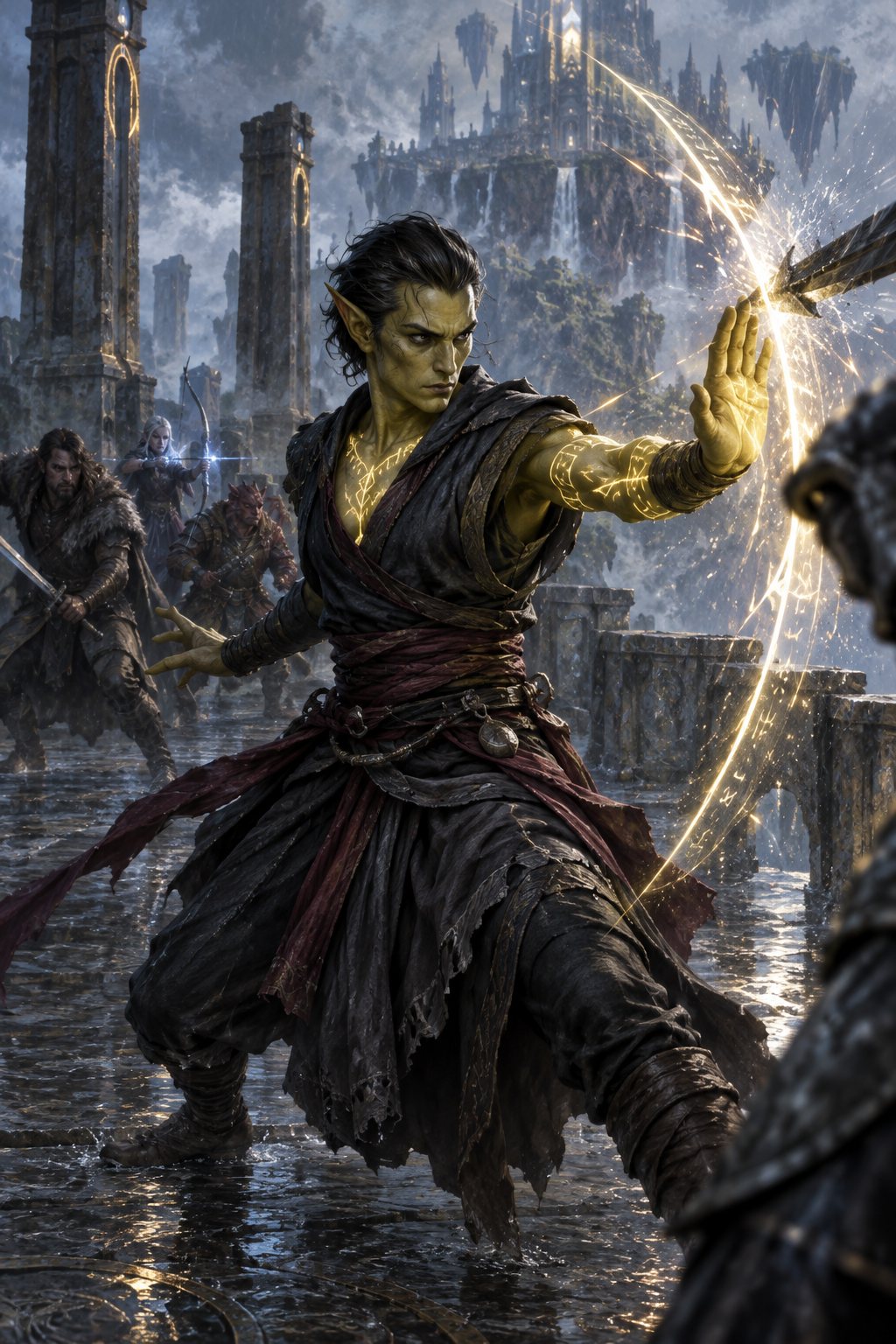
Identity
A marked warden who keeps every promise in ink, and spends their own inner power so that the blow lands smaller than it was going to.
You did not learn this from a book, and nobody granted it to you: you were marked, and each mark was a promise made at the moment it was cut. In a story you are the one who stands between, already moving when the blow starts and getting a hand, a word or a line of light in the way. People trust your word because they can read it on your skin, and that cuts both ways.
The Glyphwalker is a Wisdom-based monk-caster whose tattoos are standing arrangements rather than spells: knotwork over the collarbone, storm-spirals down one arm, a root-band at the ankle, oath-lines on the inside of the wrist where you can read them yourself. A sign held in the mind is a thought; a sign held in the skin is a thing you have agreed to keep doing, and the keeping is what makes it work. Its engine is Shared Pain, a Reaction that puts a line in the way of a blow aimed at anyone near you, and a broad menu of Knots paid for in Qi. It is not the healer who puts you back together afterward; that is a different discipline, kept at touch range by people who took different vows. The Glyphwalker prevents: the ward that turns a blade a finger’s width, the knot that holds a friend upright, the mark that lets someone else finish what you started. Wisdom is your casting ability because none of this works on cleverness. It works on paying attention.
Campaign rules apply. Thirteen spells are banned and two are modified in this campaign; the campaign’s spell point rule does not apply to this class, which pays for its magic in Qi — see Campaign Rules. This document already conforms: banned spells have been removed and replaced at the same level, and modified spells are annotated where they appear.
Class Overview
| Primary Abilities | Dexterity and Wisdom |
| Hit Point Die | d8 per Glyphwalker level |
| Saving Throws | Dexterity and Intelligence |
| Skills | Choose 2: Acrobatics, Athletics, Insight, Medicine, Nature, Perception, Religion, or Survival |
| Weapons | Simple weapons |
| Armor | None |
| Tools | Herbalism Kit or one musical instrument |
| Starting Equipment | A quarterstaff or spear, an Explorer’s Pack, a Healer’s Kit, an Herbalism Kit or one musical instrument, traveller’s clothes, and 10 GP |
| Spellcasting | Qi-cost casting (no spell slots), Wisdom, spells known from the Glyphwalker spell list, Qi cost equal to the spell’s level |
Glyphwalker Table
| Level | Proficiency Bonus | Martial Arts Die | Qi | Max Spell Level | Spells Known | Knots | Cantrips | Features |
|---|---|---|---|---|---|---|---|---|
| 1 | +2 | 1d6 | 1 | — | — | — | — | Martial Arts, Unarmored Defense, Living Ink, Qi Points |
| 2 | +2 | 1d6 | 2 | 1st | 2 | 2 | 1 | Qi Spellcasting, Utility Cantrips, Knotwork, Unarmored Movement, Flurry of Blows, Step of the Wind |
| 3 | +2 | 1d6 | 3 | 1st | 3 | 3 | 1 | Knot Lineage, Shared Pain |
| 4 | +2 | 1d6 | 4 | 1st | 4 | 3 | 1 | Ability Score Improvement |
| 5 | +3 | 1d8 | 5 | 2nd | 4 | 4 | 1 | Extra Attack |
| 6 | +3 | 1d8 | 6 | 2nd | 5 | 4 | 1 | Lineage Feature, Empowered Strikes, Unarmored Movement (+15 ft) |
| 7 | +3 | 1d8 | 7 | 2nd | 5 | 5 | 2 | Evasion |
| 8 | +3 | 1d8 | 8 | 2nd | 6 | 5 | 2 | Ability Score Improvement |
| 9 | +4 | 1d8 | 9 | 3rd | 6 | 6 | 2 | Effortless Ink |
| 10 | +4 | 1d8 | 10 | 3rd | 7 | 6 | 2 | Self-Restoration, Unarmored Movement (+20 ft) |
| 11 | +4 | 1d10 | 11 | 3rd | 7 | 7 | 2 | Lineage Feature, Greater Living Ink |
| 12 | +4 | 1d10 | 12 | 3rd | 8 | 7 | 2 | Ability Score Improvement |
| 13 | +5 | 1d10 | 13 | 4th | 8 | 8 | 3 | Mystic Arcanum (6th level) |
| 14 | +5 | 1d10 | 14 | 4th | 9 | 8 | 3 | Speaking Ink, Unarmored Movement (+25 ft) |
| 15 | +5 | 1d10 | 15 | 4th | 9 | 9 | 3 | The Kept Word |
| 16 | +5 | 1d10 | 16 | 4th | 10 | 9 | 3 | Ability Score Improvement, Mystic Arcanum (7th level) |
| 17 | +6 | 1d12 | 17 | 5th | 10 | 10 | 3 | Lineage Feature |
| 18 | +6 | 1d12 | 18 | 5th | 11 | 10 | 3 | Perfect Ink, Unarmored Movement (+30 ft) |
| 19 | +6 | 1d12 | 19 | 5th | 11 | 11 | 3 | Epic Boon, Mystic Arcanum (8th level) |
| 20 | +6 | 1d12 | 20 | 5th | 12 | 11 | 3 | Living Saga |
Unarmored Movement by level: +10 ft (2), +15 (6), +20 (10), +25 (14), +30 (18), plus vertical surfaces and liquids from level 9.
Class Features
Martial Arts
Level 1
While you aren’t wearing armor or wielding a Shield, you gain these benefits:
- You can use Dexterity instead of Strength for the attack and damage rolls of your Unarmed Strikes and simple weapons.
- You can roll your Martial Arts die in place of the normal damage of your Unarmed Strikes and simple weapons.
- When you take the Attack action on your turn, you can make one Unarmed Strike as a Bonus Action.
Unarmored Defense
Level 1
While you aren’t wearing armor or wielding a Shield, your base Armor Class equals 10 plus your Dexterity and Wisdom modifiers.
Living Ink (the Surge)
Level 1
Once on each of your turns, immediately after you hit a creature with an Unarmed Strike or a simple weapon, you can spend Qi Points to wake the line and add extra damage to that hit as a free rider. This costs no action, Bonus Action, or Reaction, and doesn’t replace any other part of your turn.
Living Ink costs 1 Qi Point at levels 1–10, 2 at levels 11–16, and 3 at levels 17–20. Roll a number of your Martial Arts dice and add your Wisdom modifier; the damage is Force, Radiant, Lightning, Psychic, or the strike’s own type (your choice). The number of dice is 1 at levels 1–10, 3 at levels 11–16, and 5 at levels 17–20. At levels 17–20 you do not add your Wisdom modifier.
Form — The Shared Line. When you use Living Ink, you can forgo adding your Wisdom modifier to the damage to instead run the line outward (at levels 17–20, when no Wisdom modifier is added, you instead forgo one of Living Ink’s Martial Arts dice): until the start of your next turn, the first time the target deals damage to any creature, that damage is reduced by one roll of your Martial Arts die.
Other disciplines put their signature into the wound. Yours puts it into what the wound does next.
Qi Points
Level 1
You have a number of Qi Points equal to your Glyphwalker level, as shown in the Qi column. You regain all expended Qi Points when you finish a Short or Long Rest, except that a Short Rest doesn’t restore Qi spent on a spell that is still in effect when the rest ends; a Long Rest restores all of it (see Qi Spellcasting).
Qi Save DC. Some Glyphwalker features require a saving throw. The DC equals 8 + your Proficiency Bonus + your Wisdom modifier — the same number as your spell save DC.
Qi Spellcasting
Level 2
You cast by spending Qi rather than by expending spell slots, in the same way a Harmonist does.
Spells Known. You know the number of Glyphwalker spells shown in the Spells Known column of the Glyphwalker Table, chosen from the Glyphwalker spell list. Whenever you gain a level in this class, you can replace one spell you know with another for which you qualify.
Qi Cost. Casting a spell costs Qi Points equal to the spell’s level: 1 Qi for a 1st-level spell, 2 for a 2nd, and so on. The highest-level spell you can cast is shown in the Max Spell Level column.
Long spells and the Short Rest. If a spell you cast with Qi is still in effect when you finish a Short Rest, that rest doesn’t restore the Qi you spent on it. The first Short Rest you finish after the spell ends restores that Qi as normal. A Long Rest always restores all your Qi, including Qi spent on a spell that is still in effect. A spell whose duration runs out as the rest ends isn’t still in effect. Example: you spend 3 Qi on a Glyph of Warding that hasn’t triggered, then take a Short Rest. That rest restores your other spent Qi but not those 3; your next Long Rest restores them, and the glyph stays where it is. The same applies to Arcane Lock, Hallow and any other spell that lasts until it is dispelled or triggered.
Rituals. You can cast a spell you know as a Ritual if it has the Ritual tag. Cast that way, it takes 10 minutes longer to cast than normal and costs no Qi.
Spellcasting Ability. Wisdom.
- Spell save DC = 8 + your Proficiency Bonus + your Wisdom modifier
- Spell attack modifier = your Proficiency Bonus + your Wisdom modifier
Spellcasting Focus. Any tattoo on your own body.
Utility Cantrips
Level 2
You learn 1 cantrip from the Glyphwalker cantrip list, a 2nd at level 7, and a 3rd at level 13. You can’t learn a cantrip that makes an attack roll, deals damage, or imposes a saving throw to avoid damage. Whenever you gain a level in this class, you can replace one with another eligible cantrip.
Knotwork
Level 2
Your tattoos are standing arrangements rather than spells: knotwork, ravens, storm spirals, root glyphs, spear-lines and hearth sigils.
You know the number of Knots shown in the Knots column, chosen from the Knot list later in this document. Whenever you gain a level in this class, you can replace one Knot you know with another for which you qualify.
Unless a Knot says otherwise, you can use it as often as you like, paying its Qi cost each time. Knots of the Second, Third and Fourth Circle have level prerequisites.
Unarmored Movement
Level 2
While you aren’t wearing armor or wielding a Shield, your Speed increases by 10 feet. This bonus increases to 15 feet at level 6, 20 feet at level 10, 25 feet at level 14, and 30 feet at level 18.
Starting at level 9, you can move along vertical surfaces and across liquids on your turn without falling during that move. Glyphwalkers call this ink-walking, and it is the single most common reason one of them is somewhere they were not invited.
Flurry of Blows
Level 2
You can spend 1 Qi Point to make two Unarmed Strikes as a Bonus Action.
Step of the Wind
Level 2
You can spend 1 Qi Point to take the Disengage or Dash action as a Bonus Action, and your jump distance is doubled for the turn.
Knot Lineage
Level 3
The meaning of your marks resolves into a lineage. Choose Knot of the Phoenix, Knot of the Thousand Eyes, Knot of the Storm, Knot of the Deep Root, Knot of the Hearth, or Knot of the Spear. You gain features from it at levels 3, 6, 11, and 17.
Shared Pain
Level 3
When a creature you can see within 30 feet takes damage, you can take a Reaction and spend 1 Qi Point to put a line in the way. Reduce the damage by 1d6 + your Wisdom modifier + half your Glyphwalker level (round down). The die becomes a d10 when you reach Glyphwalker level 5.
After reducing the damage, choose one:
- The source of the damage, if you can see it within 60 feet, takes Force, Radiant, Lightning, or Psychic damage equal to your Wisdom modifier.
- The ground in a 10-foot Emanation around the source becomes Difficult Terrain until the start of your next turn.
- The damaged creature gains Temporary Hit Points equal to your Wisdom modifier.
Reaction map. You have one Reaction a round, and most of what you do on other creatures’ turns competes for it. In order of the level each arrives:
- Your Reaction (choose one a round): the Knot Ward (level 2); Shared Pain (3); in the Knot of the Deep Root, Rooted Shelter (3) and Weight of the Grove (6); the Knots Fate-Lot (5), Second Telling (9) and Prophecy (13); the Reaction spells on your list (Shield, Absorb Elements and Feather Fall from 2, Counterspell from 9); and an Opportunity Attack. Ward answers the hit; Shared Pain answers the damage, so on any one attack you choose one or the other.
- Riding Shared Pain (no extra Reaction): The Answering Thunder (9) and The Kept Word (15).
- No Reaction, once per round: The Catching Wing (5; 2 Qi, once per Long Rest; with the Knot of the Phoenix’s Ember-Kept, twice).
- An ally’s own Reaction: Stormstep (Knot of the Storm, 6) and The Given Step (9).
Hold the Reaction for Shared Pain or Ward on a blow that would drop someone or carry them below half their Hit Points. Second Telling pays best when the creature needs 11 or lower on the d20 to succeed, an even chance or better.
Ability Score Improvement
Levels 4, 8, 12, and 16
You gain the Ability Score Improvement feat or another feat of your choice for which you qualify.
Extra Attack
Level 5
You can attack twice, instead of once, whenever you take the Attack action on your turn.
Empowered Strikes
Level 6
Whenever you deal damage with an Unarmed Strike, it can deal your choice of Force damage or its normal damage type.
Evasion
Level 7
When you’re subjected to an effect that allows you to make a Dexterity saving throw to take only half damage, you instead take no damage on a success and only half damage on a failure. You can’t use this feature if you have the Incapacitated condition.
Effortless Ink
Level 9
Choose one Knot you know that costs 1 Qi Point. Once on each of your turns you can use that Knot without spending Qi. On any other creature’s turn the Knot costs its normal Qi, so a Reaction Knot such as Ward is free only when its trigger falls on your own turn. You can change which Knot this applies to whenever you finish a Long Rest.
Self-Restoration
Level 10
At the end of each of your turns you can end one effect on yourself that is causing you to have the Charmed or Frightened condition. This costs no action. In addition, you no longer need food or drink of an ordinary kind, though you still need rest.
Greater Living Ink
Level 11
Your Living Ink deals 3 Martial Arts dice of extra damage, as shown in the feature. In addition, when you use its Shared Line form, the damage reduction applies to each creature the target damages before the start of your next turn, not only the first.
Mystic Arcanum
Levels 13, 16, and 19
Three times in a career a mark goes in deeper than you meant it to. At level 13, choose one 6th-level spell from the Glyphwalker Saga list. You can cast it once without spending Qi, and you regain the ability to do so when you finish a Long Rest. At level 16 you learn a 7th-level spell and at level 19 an 8th-level spell, each once per Long Rest in the same way. Each is a separate use.
Whenever you gain a level in this class, you can replace one of these spells with another of the same level from the Saga list.
Speaking Ink
Level 14
You understand all spoken languages, and you can communicate simple ideas to Beasts and Plants, which understand the intent of your words.
The Kept Word
Level 15
When you use Shared Pain, the creature you protected has Advantage on the next saving throw it makes before the end of your next turn.
In addition, you can use Shared Pain when you cannot see the creature taking damage, provided you can hear it and it is within 30 feet.
Perfect Ink
Level 18
When you roll Initiative and have no Qi Points remaining, you regain 4 Qi Points.
In addition, Effortless Ink now applies to two Knots rather than one, each usable once on each of your turns without spending Qi.
Epic Boon
Level 19
You gain an Epic Boon feat or another feat of your choice for which you qualify. Boon of Fortitude or Boon of Speed are thematically apt.
Living Saga
Level 20
As a Bonus Action, your tattoos blaze with mythic force for 1 minute. For the duration:
- Living Ink costs no Qi Points.
- Shared Pain costs no Qi Points, but you can still use it only once per round.
- You add your Wisdom modifier to all saving throws.
- Glyphwalker spells of 1st through 5th level cost 2 fewer Qi Points, to a minimum of 1.
- At the start of each of your turns, you regain 1 expended Qi Point.
Once you use this feature, you can’t use it again until you finish a Long Rest.
The Knots
The Knots at a glance
Every Knot with its cost, its action, its reach, how long it lasts, what the target rolls, and what it deals. A field reads “—” where it does not apply. Full entries follow.
Being seen, and Counterspell. A Glyphwalker’s magic runs in ink under the skin, and ink that is working shows. Every Knot is perceptible — the line lights, and anyone who can see you can see it happen. No Knot is immune to Counterspell or dispel magic, none claims to be, and none carries a subtlety clause: this class has no quiet option, which is the trade for a menu this broad.
Knots of the First Circle — available from level 2.
| Knot | Cost | Action | Range | Duration | Save and damage |
|---|---|---|---|---|---|
| Bearskin | 1 Qi | Bonus Action | Self | Until the Temporary Hit Points are gone | — · one Martial Arts die + Wisdom modifier as Temporary Hit Points |
| Fire-Reader | — passive; 1 Qi to cast | Detect Magic‘s casting time | Self | Detect Magic‘s | — |
| Hearthmark | 1 Qi | No action, spent as a Short Rest ends | Creatures at the rest | The rest | — |
| Oathmark | 1 Qi | No action, once on each of your turns, after a hit | The creature you hit | To the start of your next turn | — |
| Slipknot | — passive; 1 Qi to break free | Bonus Action | Self | Instantaneous | — |
| True North | — passive; 1 Qi to grant | Magic action | 30 feet | 1 hour | — |
| Ward | 1 Qi | Reaction, when you or a creature you can see is hit | 30 feet | Instantaneous | — |
| Whisper | 1 Qi | Magic action | 30 feet to open, 1 mile to keep | 10 minutes | — |
Knots of the Second Circle — prerequisite: level 5.
| Knot | Cost | Action | Range | Duration | Save and damage |
|---|---|---|---|---|---|
| The Catching Wing | 2 Qi | No action, once per round, when a creature drops to 0 Hit Points | You or 30 feet | Instantaneous | — · twice your Glyphwalker level as Temporary Hit Points |
| Fate-Lot | 2 Qi | Reaction, on a D20 Test you can see | 30 feet | Instantaneous | — · 1d6 added to or taken from the roll |
| Harvest-Mark | — | No action, triggered | 30 feet | Instantaneous | — |
| Raven’s Eye | 2 Qi | The spell’s casting time | The spell’s | The spell’s | — |
| Raven’s Memory | — passive; 2 Qi to cast | The spell’s casting time | The spell’s | The spell’s | — |
| River-Step | 2 Qi | Bonus Action | Self, up to your Speed | The movement | — |
| Sunwheel | 2 Qi | Magic action | Touch | Instantaneous | — · 2d8 + Wisdom modifier as Temporary Hit Points |
| Thornwall | 2 Qi | Magic action | 60 feet, a 10-foot square | 1 minute | — · Wisdom modifier, Radiant or Piercing, on entering or starting a turn there, no more than once per turn |
Knots of the Third Circle — prerequisite: level 9.
| Knot | Cost | Action | Range | Duration | Save and damage |
|---|---|---|---|---|---|
| The Answering Thunder | 2 Qi on top of Shared Pain | Part of the Shared Pain Reaction | 60 feet | Instantaneous | — · 2d8 + Wisdom modifier, Lightning or Thunder |
| The Given Step | — | No action; the ally spends its own Reaction | Your feature’s range | Instantaneous | — |
| Halting Awe | 3 Qi | Magic action | 15-foot Emanation | 1 minute (Concentration) | Wisdom |
| Homeward | 3 Qi | No action, spent during a Short or Long Rest | 20-foot-radius Sphere, touched | 8 hours | — |
| Life-Tree | 2 Qi on top of the Knot it rides | No action, once per round, triggered by your own Temporary Hit Points | 30 feet from the first creature | Instantaneous | — · half the original amount as Temporary Hit Points |
| Second Telling | 3 Qi | Reaction, when a creature fails a save | 30 feet | Instantaneous | — |
| Still-Ice | 3 Qi | The spell’s casting time | The spell’s | The spell’s | The spell’s |
| Trackless Trail | 3 Qi | Magic action | 30 feet | 8 hours | — |
Knots of the Fourth Circle — prerequisite: level 13.
| Knot | Cost | Action | Range | Duration | Save and damage |
|---|---|---|---|---|---|
| Bridge | 4 Qi | Magic action | 30 feet to gather, 120 feet to arrive | Instantaneous | — |
| Golden Tears | 4 Qi | Magic action | 30 feet | Instantaneous | — · 4d8 + Wisdom modifier as Temporary Hit Points |
| Heartwood | 4 Qi | The spell’s casting time | The spell’s | The spell’s | — |
| The Pledged Eye | 4 Qi | The spell’s casting time | The spell’s | The spell’s | — |
| Prophecy | 4 Qi | Reaction, on a d20 you can see | 60 feet | Instantaneous | — |
| Ring-Fence | 4 Qi | Magic action | 90 feet, a 20-foot-radius ring | 1 minute (Concentration) | Charisma |
| The Short Road | 4 Qi | The spell’s casting time | The spell’s | Instantaneous | — |
| The Shut Door | 4 Qi | The spell’s casting time | The spell’s | The spell’s | The spell’s |
Actions. Whisper, True North and Trackless Trail are out-of-combat grants and take a Magic action. Oathmark and Life-Tree spend no action, Bonus Action or Reaction: Oathmark works once on each of your turns and needs a hit, and Life-Tree rides a Temporary Hit Point grant you have already paid for.
Knots of the First Circle
Bearskin · First Circle · Bonus Action · 1 Qi Self · Until the Temporary Hit Points are gone · one Martial Arts die + Wisdom modifier as Temporary Hit Points · — As a Bonus Action, spend 1 Qi Point to gain Temporary Hit Points equal to one roll of your Martial Arts die + your Wisdom modifier.
Fire-Reader · First Circle · Detect Magic‘s casting time · — passive; 1 Qi to cast Self · Detect Magic‘s · — · — You gain Darkvision out to 60 feet, or increase existing Darkvision by 30 feet. You can spend 1 Qi Point to cast Detect Magic without Material components.
Hearthmark · First Circle · No action, spent as a Short Rest ends · 1 Qi Creatures at the rest · The rest · — · — When you finish a Short Rest, you can spend 1 Qi Point. Each creature of your choice that spends one or more Hit Dice during that rest regains additional Hit Points equal to your Wisdom modifier.
Oathmark · First Circle · No action, once on each of your turns, after a hit · 1 Qi The creature you hit · To the start of your next turn · — · — Once on each of your turns when you hit a creature, you can spend 1 Qi Point to mark it until the start of your next turn. The first ally other than you to hit the marked creature before then gains Temporary Hit Points equal to your Wisdom modifier.
Slipknot · First Circle · Bonus Action · — passive; 1 Qi to break free Self · Instantaneous · — · — You have Advantage on ability checks and saving throws made to avoid or end the Grappled or Restrained conditions. As a Bonus Action, you can spend 1 Qi Point to end either condition on yourself.
True North · First Circle · Magic action · — passive; 1 Qi to grant 30 feet · 1 hour · — · — You always know true north and can’t become lost by nonmagical means. Spend 1 Qi Point to grant yourself and up to five willing creatures within 30 feet a 10-foot bonus to Speed for 1 hour.
Ward · First Circle · Reaction, when you or a creature you can see is hit · 1 Qi 30 feet · Instantaneous · — · — When you or a creature you can see within 30 feet is hit by an attack, you can take a Reaction and spend 1 Qi Point to add your Wisdom modifier to the target’s AC against that attack, possibly causing it to miss.
Whisper · First Circle · Magic action · 1 Qi 30 feet to open, 1 mile to keep · 10 minutes · — · — Spend 1 Qi Point to establish silent mind-speech between yourself and one willing creature you can see within 30 feet for 10 minutes. You can communicate telepathically while within 1 mile of each other.
Knots of the Second Circle
Prerequisite: level 5
The Catching Wing · Second Circle · No action, once per round, when a creature drops to 0 Hit Points · 2 Qi You or 30 feet · Instantaneous · twice your Glyphwalker level as Temporary Hit Points · — When you or a creature you can see within 30 feet drops to 0 Hit Points without being killed outright, you can spend 2 Qi Points to have it drop to 1 Hit Point instead. It gains Temporary Hit Points equal to twice your Glyphwalker level, and the creature that dealt the damage can’t target it with attacks until the end of the current turn. This costs no action, Bonus Action, or Reaction, and you can use it on yourself as you drop. You can use it no more than once per round. Once you use this Knot, you can’t use it again until you finish a Long Rest.
Fate-Lot · Second Circle · Reaction, on a D20 Test you can see · 2 Qi 30 feet · Instantaneous · 1d6 added to or taken from the roll · — When a creature you can see within 30 feet makes a D20 Test, you can take a Reaction and spend 2 Qi Points to roll 1d6 and add it to or subtract it from the roll, after the d20 is rolled and before the outcome is known. You can use this Knot a number of times equal to your Proficiency Bonus, and you regain all uses on a Long Rest.
Harvest-Mark · Second Circle · No action, triggered · — 30 feet · Instantaneous · — · — Whenever you grant a creature Temporary Hit Points with a Knot or class feature, it also ends one effect on itself causing the Frightened condition.
Raven’s Eye · Second Circle · The spell’s casting time · 2 Qi The spell’s · The spell’s · — · — Spend 2 Qi Points to cast See Invisibility or Detect Thoughts without Material components.
Raven’s Memory · Second Circle · The spell’s casting time · — passive; 2 Qi to cast The spell’s · The spell’s · — · — You have Advantage on Intelligence checks to recall lore, names, places, writing, or symbols. Spend 2 Qi Points to cast Comprehend Languages or Locate Object without Material components.
River-Step · Second Circle · Bonus Action · 2 Qi Self, up to your Speed · The movement · — · — As a Bonus Action, spend 2 Qi Points to move up to your Speed across water, vertical surfaces, or unstable ground without falling during that movement.
Sunwheel · Second Circle · Magic action · 2 Qi Touch · Instantaneous · 2d8 + Wisdom modifier as Temporary Hit Points · — As a Magic action, spend 2 Qi Points to touch a creature and end one of the following conditions on it: Blinded, Charmed, Frightened, or Poisoned. It also gains Temporary Hit Points equal to 2d8 + your Wisdom modifier.
Thornwall · Second Circle · Magic action · 2 Qi 60 feet, a 10-foot square · 1 minute · Wisdom modifier, Radiant or Piercing · — As a Magic action, spend 2 Qi Points to ward a 10-foot square you can see within 60 feet for 1 minute. The area is Difficult Terrain for your enemies, and the first time an enemy enters it on a turn or starts its turn there it takes Radiant or Piercing damage equal to your Wisdom modifier. A creature takes this damage no more than once per turn.
Knots of the Third Circle
Prerequisite: level 9
The Answering Thunder · Third Circle · Part of the Shared Pain Reaction · 2 Qi on top of Shared Pain 60 feet · Instantaneous · 2d8 + Wisdom modifier, Lightning or Thunder · — When you use Shared Pain, you can spend 2 additional Qi Points to deal Lightning or Thunder damage equal to 2d8 + your Wisdom modifier to the source of the damage, provided it is within 60 feet and you can see it.
The Given Step · Third Circle · No action; the ally spends its own Reaction · — Your feature’s range · Instantaneous · — · — Whenever you grant a creature Temporary Hit Points, reduce damage to it, or cause it to succeed on a saving throw through one of your class features or Knots, it can use its Reaction to move up to half its Speed without provoking Opportunity Attacks.
Halting Awe · Third Circle · Magic action · 3 Qi 15-foot Emanation · 1 minute (Concentration) · — · Wisdom save As a Magic action, spend 3 Qi Points to create a 15-foot Emanation centred on yourself for 1 minute, requiring Concentration. Enemies in the Emanation have their Speed reduced by 10 feet, and a creature that enters it for the first time on a turn or starts its turn there must succeed on a Wisdom saving throw against your Qi save DC or have its Speed reduced to 0 until the start of its next turn.
Homeward · Third Circle · No action, spent during a Short or Long Rest · 3 Qi 20-foot-radius Sphere, touched · 8 hours · — · — During a Short or Long Rest, spend 3 Qi Points to establish a ward in a 20-foot-radius Sphere centred on a point you touch, lasting 8 hours. Creatures you choose inside don’t have Disadvantage on Initiative rolls from being surprised, and each of them that finishes a rest inside the ward gains Temporary Hit Points equal to your Wisdom modifier. The ward neither conceals the area nor hides those within it from divination.
Life-Tree · Third Circle · No action, once per round, triggered by your own Temporary Hit Points · 2 Qi on top of the Knot it rides 30 feet from the first creature · Instantaneous · half the original amount as Temporary Hit Points · — Once per round, when you grant a creature Temporary Hit Points with a Knot or class feature other than Life-Tree, you can spend 2 additional Qi Points to grant a second creature within 30 feet of the first Temporary Hit Points equal to half that amount.
Second Telling · Third Circle · Reaction, when a creature fails a save · 3 Qi 30 feet · Instantaneous · — · — When a creature you can see within 30 feet fails a saving throw, you can take a Reaction and spend 3 Qi Points to let it reroll the save. It must use the new result.
Still-Ice · Third Circle · The spell’s casting time · 3 Qi The spell’s · The spell’s · — · The spell’s save Spend 3 Qi Points to cast Hold Person, Slow, or Protection from Energy without Material components.
Trackless Trail · Third Circle · Magic action · 3 Qi 30 feet · 8 hours · — · — Spend 3 Qi Points to grant yourself and up to five willing creatures within 30 feet these benefits for 8 hours: nonmagical Difficult Terrain costs no extra movement while travelling, the group leaves no tracks unless it wishes to, and each has Advantage on Dexterity (Stealth) checks made while travelling.
Knots of the Fourth Circle
Prerequisite: level 13
Bridge · Fourth Circle · Magic action · 4 Qi 30 feet to gather, 120 feet to arrive · Instantaneous · — · — As a Magic action, spend 4 Qi Points to teleport yourself and up to three willing creatures you can see within 30 feet to unoccupied spaces you can see within 120 feet.
Golden Tears · Fourth Circle · Magic action · 4 Qi 30 feet · Instantaneous · 4d8 + Wisdom modifier as Temporary Hit Points · — As a Magic action, spend 4 Qi Points to grant one creature within 30 feet Temporary Hit Points equal to 4d8 + your Wisdom modifier. It can also end one effect causing it to be Charmed, Frightened, Poisoned, or diseased.
Heartwood · Fourth Circle · The spell’s casting time · 4 Qi The spell’s · The spell’s · — · — Spend 4 Qi Points to cast Freedom of Movement or Stoneskin without Material components.
The Pledged Eye · Fourth Circle · The spell’s casting time · 4 Qi The spell’s · The spell’s · — · — Spend 4 Qi Points to cast Divination or Locate Creature without Material components.
Prophecy · Fourth Circle · Reaction, on a d20 you can see · 4 Qi 60 feet · Instantaneous · — · — When a creature you can see within 60 feet rolls a d20, you can take a Reaction and spend 4 Qi Points to force it to reroll and use the new result. Once you use this Knot, you can’t use it again until you finish a Long Rest.
Ring-Fence · Fourth Circle · Magic action · 4 Qi 90 feet, a 20-foot-radius ring · 1 minute (Concentration) · — · Charisma save As a Magic action, spend 4 Qi Points to create a 20-foot-radius ring of coiled glyphs on the ground within 90 feet, lasting 1 minute and requiring Concentration. Enemies treat the ring as Difficult Terrain, and a creature attempting to teleport across its boundary must first succeed on a Charisma saving throw against your Qi save DC or the teleport fails.
The Short Road · Fourth Circle · The spell’s casting time · 4 Qi The spell’s · Instantaneous · — · — Spend 4 Qi Points to cast Dimension Door without Material components. When you do, you can bring one additional willing creature beyond the spell’s normal allowance.
The Shut Door · Fourth Circle · The spell’s casting time · 4 Qi The spell’s · The spell’s · — · The spell’s save Spend 4 Qi Points to cast Banishment or Otiluke’s Resilient Sphere without Material components.
Knot Lineages
A Knot Lineage is the Glyphwalker’s subclass: the meaning your marks resolve into once there are enough of them to read as one promise — rebirth, sight, motion, holding ground, keeping watch, or the chosen target. You choose one with the Knot Lineage feature, and it grants features at the levels that feature names. A Lineage is an image you keep, not a power you serve; nothing in it needs a god, a people or a place to exist. Each world gives the six Lineages its own names (see In Different Worlds).
Knot of the Phoenix
“Ash is not the end of a fire. It is a fire that has agreed to wait.”
Marks that preserve through burning and return.
Ashen Mending
Level 3
When you grant a creature Temporary Hit Points with a Knot or class feature, add your Wisdom modifier to the amount.
In addition, once on each of your turns when you use Living Ink, you can forgo its damage entirely: instead, one creature of your choice within 30 feet gains Temporary Hit Points equal to one roll of your Martial Arts die + your Wisdom modifier.
Ember-Kept
Level 6
When a creature within 30 feet of you makes a Death Saving Throw, it can add your Wisdom modifier to the roll.
In addition, you can use The Catching Wing without knowing it as a Knot, once per Long Rest, paying its Qi cost as normal. If you do know it, you can use it twice per Long Rest instead of once.
Undying Ember
Level 11
When a creature you can see within 30 feet gains Temporary Hit Points from one of your features, it can immediately end either the Charmed or the Frightened condition on itself.
In addition, a creature you catch with The Catching Wing has Resistance to all damage until the start of its next turn.
The Long Return
Level 17
Once per Long Rest as a Bonus Action, each ally of your choice within 30 feet gains Temporary Hit Points equal to 3d8 + your Wisdom modifier. For 1 minute afterwards, the first time each of those creatures would drop to 0 Hit Points, it drops to 1 Hit Point instead and the effect ends for it.
Playing a Knot of the Phoenix: nobody at your table dies on the turn they were supposed to, and you will be quietly exhausted by how much that is taken for granted.
Knot of the Thousand Eyes
“I have read four hundred inscriptions and two of them were honest. I remember which two.”
Mark-readers, watchers of roads, readers of hidden meaning.
Watcher’s Script
Level 3
You gain proficiency in Investigation; if you already have it, gain proficiency in Insight or Perception instead.
You can read all writing as though under Comprehend Languages for a number of minutes equal to your Wisdom modifier per Long Rest, divided as you choose.
No Blind Corners
Level 6
You add your Wisdom modifier to your Initiative rolls, and while you are conscious, being surprised doesn’t give you Disadvantage on your Initiative roll.
All-Seeing Passage
Level 11
You gain Truesight out to 10 feet. In addition, Raven’s Eye and The Pledged Eye each cost you 1 Qi Point less, to a minimum of 1.
The Whole Page
Level 17
Once per Long Rest as a Magic action, you read a 60-foot Emanation for 1 minute. For the duration you know the location of every creature in it, Invisible or not, you can see through Illusions there, and the first attack roll made against you by any creature in the Emanation each round has Disadvantage.
Playing a Knot of the Thousand Eyes: you are the reason the ambush didn’t work, and the campaign will have to get cleverer about ambushes.
Knot of the Storm
“Weather does not arrive. It is simply already somewhere else, and then it is here.”
Thunder, wind, and sudden movement, carved into those who cannot stay still.
Gale Mark
Level 3
When you deal damage with Living Ink, you can push the target up to 10 feet or pull it up to 10 feet.
You also learn Thunderwave. It counts as a Glyphwalker spell for you and doesn’t count against your spells known.
Stormstep
Level 6
Your Unarmored Movement bonus increases by an additional 10 feet.
In addition, when you use Step of the Wind, one ally you can see within 30 feet can use its Reaction to move up to half its Speed without provoking Opportunity Attacks.
Thunder Road
Level 11
Whenever you move at least 20 feet on your turn, the next time you hit with an Unarmed Strike before the end of that turn, one ally within 30 feet can move up to 10 feet without provoking Opportunity Attacks.
In addition, casting Thunderwave costs you 1 Qi Point less.
The Sky Comes Down
Level 17
Once per Long Rest as a Magic action, a storm answers for 1 minute, requiring Concentration. Each creature of your choice that starts its turn within 30 feet of you makes a Constitution saving throw against your Qi save DC, taking 3d8 Thunder damage on a failure and half as much on a success. Allies of your choice within 30 feet have their Speed increased by 15 feet and can’t have their Speed reduced.
Playing a Knot of the Storm: your job is that the party is never where the enemy prepared for, and you should be insufferable about arriving.
Knot of the Deep Root
“You cannot push over a thing that is holding the ground up.”
Endurance, shelter, memory, and sacred ground.
Rooted Shelter
Level 3
When you or an ally within 30 feet would be moved against its will, knocked Prone, or have its Speed reduced, you can take a Reaction and spend 1 Qi Point to cancel that effect.
Weight of the Grove
Level 6
You have Advantage on saving throws against being moved against your will or given the Prone condition. In addition, when a creature within 5 feet of you tries to move away from you, you can take a Reaction to reduce its Speed to 0 until the end of its turn.
Deep Hearth
Level 11
When you create an effect lasting at least 1 minute through a Knot or class feature, one creature of your choice within 30 feet gains Temporary Hit Points equal to your Wisdom modifier.
In addition, you and allies within 10 feet have Advantage on saving throws against being moved against your will or given the Prone condition.
The Root Holds
Level 17
Once per Long Rest as a Bonus Action, you set a 20-foot Emanation of root-light around yourself for 1 minute. Allies of your choice in it have Resistance to Bludgeoning, Piercing and Slashing damage, can’t be moved against their will, and can stand from Prone without spending movement. The ground in the Emanation is Difficult Terrain for your enemies.
Playing a Knot of the Deep Root: you decide where the line is, and then the line is there.
Knot of the Hearth
“The fire is not for you. You are the one who keeps it.”
The hearth-sigil is the oldest arrangement there is: someone stays up, someone else sleeps, and in the morning everybody is still alive.
Hearth-Keeper
Level 3
When you or friendly creatures finish a Short Rest with you, up to your Proficiency Bonus of them may each regain Hit Points equal to one roll of your Martial Arts die + your Wisdom modifier without spending Hit Dice.
You also gain proficiency with Cook’s Utensils, and food you prepare is never spoiled or tainted.
The Long Watch
Level 6
Allies who take a Short or Long Rest within 30 feet of you gain Temporary Hit Points equal to your Wisdom modifier at the end of the rest, and during it, being surprised doesn’t give you or them Disadvantage on Initiative rolls.
In addition, you need only 4 hours of rest to gain the benefit of a Long Rest, though you must still spend the full duration resting for your companions’ benefit.
Banked Coals
Level 11
When you finish a Short Rest, choose up to three creatures who rested with you. Each can, once before your next Short or Long Rest, add your Wisdom modifier to one D20 Test as a no-action decision after the roll.
Guest-Right
Level 17
Once per Long Rest as a Magic action, you declare a 30-foot-radius Sphere centred on a point you touch to be under guest-right for 1 hour. Inside it, allies of your choice have Advantage on saving throws, regain the maximum result when they spend Hit Dice, and any creature that attacks a creature it has accepted food or drink from inside the Sphere has Disadvantage on that attack.
Guest-right is an obligation, not a wall: it neither conceals the area nor prevents any creature from entering it.
Playing a Knot of the Hearth: your best rounds happen between the fights, and you will have to explain that to a table that measures by damage.
Knot of the Spear
“The spear does not miss. That is not a blessing. It means the choosing was the whole decision.”
Spear-lines, marked targets, and the throw that has already landed.
Spear-Marked
Level 3
As a Bonus Action, spend 1 Qi Point to mark one creature you can see within 60 feet for 1 minute, or until you mark another. Once on each of your turns when you hit the marked creature, it takes extra damage equal to your Proficiency Bonus, and you always know its direction while it is on the same plane.
The Thrown Spear
Level 6
When you take the Attack action, you can replace one attack with a thrown cast of a simple weapon you are holding against a creature within 60 feet, using your Martial Arts die for damage. The weapon returns to your hand immediately afterward.
Allies have Advantage on attack rolls against your marked creature when they are within 5 feet of it.
The Chosen
Level 11
Your marked creature has Disadvantage on saving throws against your spells and Knots.
In addition, once per round, when your marked creature drops to 0 Hit Points, you regain Qi Points equal to half your Proficiency Bonus (round down) and can immediately mark a new creature you can see within 60 feet, as Spear-Marked does but without spending Qi. This costs no action, Bonus Action, or Reaction.
The Marked Quarry
Level 17
Once per Long Rest as a Bonus Action, you declare a single creature you can see within 90 feet. If it isn’t your marked creature, it becomes your marked creature, as Spear-Marked but without spending Qi. For 1 minute it has no Resistances or Immunities to the damage types your Living Ink can deal, attacks against it from you and your allies score a Critical Hit on a 19 or 20, and it cannot regain Hit Points.
Playing a Knot of the Spear: you point, and the fight becomes about that. It is the only lineage here that is unkind, and you should know that going in.
Glyphwalker Spell List
Warding, movement, perception, travel and control. This class mostly prevents rather than restores. It heals through a handful of spells on this list (Cure Wounds, Healing Word, Aid, Lesser Restoration and Greater Restoration) and through its rest features, but it carries no mass healing, no Heal, no Regenerate, no Revivify and no resurrection magic of any kind. That lane belongs to the Anchorite, the family’s main healer.
Utility cantrips (non-damaging only). Druidcraft, Guidance, Light, Mage Hand, Mending, Message, Prestidigitation, Thaumaturgy.
Closed list. Every spell you know of 1st through 5th level comes from this list, and the DM does not add others. It holds 75 spells (17 / 22 / 16 / 10 / 10 at 1st–5th level, about three-quarters of the 2024 Player’s Handbook Sorcerer list at each level), sorted alphabetically within each level, drawn from the Arcane, Divine and Primal lists to the class’s five lanes. Every spell is from the 2024 Player’s Handbook except Absorb Elements and Skill Empowerment, which are from Xanathar’s Guide to Everything. Spells a Knot already casts for you (Comprehend Languages, Detect Thoughts, Stoneskin) stay with their Knots. The Saga list below holds the 6th–8th-level Mystic Arcanum options only.
1st level (17). Absorb Elements, Alarm, Bless, Cure Wounds, Detect Evil and Good, Detect Magic, Entangle, Expeditious Retreat, Feather Fall, Healing Word, Heroism, Jump, Longstrider, Protection from Evil and Good, Sanctuary, Shield, Shield of Faith.
2nd level (22). Aid, Arcane Lock, Augury, Barkskin, Blur, Calm Emotions, Find Steed, Find Traps, Gust of Wind, Hold Person, Knock, Lesser Restoration, Levitate, Locate Object, Magic Mouth, Misty Step, Pass without Trace, Protection from Poison, See Invisibility, Silence, Warding Bond, Web.
3rd level (16). Beacon of Hope, Clairvoyance, Counterspell, Dispel Magic, Fly, Glyph of Warding, Magic Circle, Nondetection, Protection from Energy, Remove Curse, Sending, Slow, Speak with Dead, Tongues, Water Walk, Wind Wall.
4th level (10). Aura of Purity, Banishment, Compulsion, Death Ward, Dimension Door, Divination, Freedom of Movement, Locate Creature, Otiluke’s Resilient Sphere, Stone Shape.
5th level (10). Circle of Power, Commune with Nature, Dispel Evil and Good, Greater Restoration, Hallow, Hold Monster, Rary’s Telepathic Bond, Scrying, Skill Empowerment, Wall of Force.
Saga List (Mystic Arcanum)
- 6th level: Blade Barrier, Globe of Invulnerability, True Seeing, Wall of Thorns
- 7th level: Divine Word, Etherealness, Mirage Arcane, Symbol
- 8th level: Animal Shapes, Control Weather, Holy Aura, Mind Blank
Flagged for the DM: Holy Aura and Circle of Power are both party-wide save boosters on a class that already rerolls saves with Second Telling and bends d20s with Fate-Lot. A Glyphwalker at 19 can make a party very hard to land an effect on. That is the intended ceiling; be aware of it when building save-or-suck encounters. Wall of Force is on the 5th-level list as well. It is a different ceiling, total denial rather than a save bonus, but it lands on the same class, so a Glyphwalker at 17 can stop a fight happening as well as make one hard to land.
Multiclassing
Prerequisite: Dexterity 13 and Wisdom 13.
What you gain: proficiency with simple weapons; Martial Arts and Unarmored Defense if you don’t already have them; Qi Points (this class’s Qi entry), Knots and Qi Spellcasting sized to your Glyphwalker levels only. Your Martial Arts die and Living Ink dice are set by your Glyphwalker level, not your character level.
Qi from more than one class. If another class in this library also gives you Qi points, or the Monk class gives you Focus Points, you have a single pool of Qi points; your Monk features spend it as Focus Points. Its maximum is the total of each class’s Qi or Focus entry for your level in that class (including any feature that raises a class’s maximum). A feature from any of those classes can spend from it. Each class’s share recovers by that class’s own rule, and a feature that reduces one class’s maximum reduces only that class’s share. Each feature keeps its own limits (once per turn, Surge dice, and so on). While your pool combines more than one class, you can use each class’s Surge no more times between one rest and the next than your level in that class. A feature that restores all of a class’s Qi or Focus Points restores no more than that class’s entry. Qi from your other classes can pay for your Glyphwalker spells, and the Max Spell Level still comes from your levels in this class.
Qi Spellcasting does not interact with spell points at all. A Glyphwalker who multiclasses with a spell-point caster keeps both systems entirely separate: your Qi never casts that class’s spells and its spell points never cast yours, and your Glyphwalker levels contribute nothing to the multiclass spell point table. This mirrors the Harmonist, which uses the same casting model.
In Different Worlds
Setting layer. Everything above this heading works unchanged in each of these worlds; only names, looks and stories differ. Names here are setting names, each mapped to the neutral name the rules use.
Mythic culture — Norse-inspired (the class’s origin; the house setting)
Who has it. The rune-marked oath-keepers of the northern halls. A carver cuts each rune into the skin with soot and a bone needle at the moment a promise is made, and the wearer keeps that promise in front of witnesses for life. Older songs call them Oathskins. They swear to people, not to gods.
What they call it. The class is the Glyphwalker, or the Oathskin in the old songs. The Knots keep their rune-names and myth-names (Algiz Ward, Perthro Fate-Lot, Valkyrie’s Wing), and the subclasses are Rune Lineages, among them the Knot of the World-Root. Shared Pain is standing between. Speaking Ink is Rune-Speech, and the Spear’s capstone is the Spear of the Hanged God.
How it looks and sounds. The runes light white-gold under the skin, the main stroke first. Algiz flares as a forked line across the wrist. Thor’s Mercy lands like a hammer on an anvil, and the Jormungandr Coil is a ring of serpent-runes biting its own tail. Every one of them shows, because there is no quiet way to wear a promise.
Story hook. The carver who cut your first rune has died. Her sons claim that every promise she ever inked is now owed to them, including yours.
Rules caveat. None. Odin, Thor and the völva are the Knots’ images, not their sources. No feature needs a god to exist, answer or approve.
| Neutral name (rules) | Norse-inspired name |
|---|---|
| Knot Lineage (level 3) · Knot Lineages (heading) | Rune Lineage · Rune Lineages |
| Knot of the Deep Root | Knot of the World-Root |
| Knot of the Phoenix · Thousand Eyes · Storm · Hearth · Spear | unchanged |
| Speaking Ink · ink-walking | Rune-Speech · rune-walking |
| The Thrown Spear · The Marked Quarry | Gungnir’s Lesson · Spear of the Hanged God |
| the Knots, each by name | rune-names and myth-names: see Names and their sources under Origins and Inspiration |
| a ring of coiled glyphs (Ring-Fence) · spear-lines · Mark-readers | a ring of serpent-runes · spear runes · Rune-seers |
| a sign held in the mind or the skin (overview) | a rune held in the mind or the skin |
| “The spear does not miss” (Knot of the Spear’s epigraph) | “Gungnir does not miss” |
Wilds and courts of the fey
Who has it. Mortals who bargained at the edge of the courts and came home written on. The fey do not sign contracts. They ink the terms into the bargainer’s skin, and every term is a duty to stand between someone and harm: that is the price of whatever was asked for. Villages near the old woods keep one the way they keep a well.
What they call it. The class is a bargain-bearer. Knots are terms, Living Ink is the quickened line, and Shared Pain is paying the forfeit, because the fey insist that every harm be paid by someone. The subclasses are named for the court that wrote the bargain:
| Knot Lineage | Court |
|---|---|
| Phoenix · Thousand Eyes · Storm | the Court of Embers · the Court of Watching Leaves · the Court of the Gale |
| Deep Root · Hearth · Spear | the Court of the Oak · the Hob’s Hearth · the Hunter’s Court |
How it looks and sounds. The ink is green-gold and grows a little each season, like ivy. A waking term lights in plain sight and smells of crushed mint and rain, and the Ward sounds like a bird’s alarm call. Glamour never hides a working term.
Story hook. A lord of the Court of the Oak announces at the harvest fair that one of the bearer’s terms was never paid for. He will call it settled if the bearer spends their next Catching Wing on whoever he names.
Rules caveat. If the courts are a plane of their own, Spear-Marked’s sense of direction stops at the border, as written. Guest-Right gives the fey no extra compulsion.
After the fall
Who has it. Ruin-scribes. The old world warded its houses and bridges with glyphs cut into stone, and the walls outlasted the people. Survivors copy the glyphs onto their own skin, because paper burns and walls get looted. A scribe who wears a ward is held to what it says, and the settlement watches to see that they keep it. Every settlement wants a scribe, and few settlements trust one.
What they call it. The class is a ward-scribe. Knots are copies, a scribe’s skin is their wallbook, and Shared Pain is taking the hit for the house. The subclasses are named for the ruin their glyphs were first copied from:
| Knot Lineage | Ruin |
|---|---|
| Phoenix · Thousand Eyes · Storm | the Kiln-House · the Archive · the Signal Tower |
| Deep Root · Hearth · Spear | the Foundation · the Shelter · the Armoury |
How it looks and sounds. The glyphs are geometric and only half understood. Each is copied with small mistakes, which the scribes treat as signatures. They light sodium-orange with a low electrical hum, and the Answering Thunder cracks like a breaker tripping.
Story hook. A dust storm has uncovered a vault with a whole wall of unknown glyphs. Three settlements have sent scribes to copy it, and none of them knows which glyphs are wards and which were warnings.
Rules caveat. None. If the fall took the gods with it, Divine Word and Holy Aura still work as written; describe them as the old world’s command-words, not as prayers. The Pledged Eye’s Divination still gets its answer; what answers is whatever the ruins left listening, not a god.
Origins and Inspiration
Inspiration, not setting. Nothing here is a rule, and nothing here is assumed by one.
Runes and rune-names. Most of the Knots’ original names are names of runes of the Elder Futhark, the twenty-four-letter runic alphabet in use from roughly the second to the eighth century. It is conventionally set out in three rows of eight, which later Icelandic tradition called ættir. The names themselves are not attested from that period. Forms such as algiz, ansuz and perþō are modern Proto-Germanic reconstructions, worked back from the medieval Old English, Old Norwegian and Old Icelandic rune poems. Some meanings are secure: sōwilō is “sun”, īsaz “ice”, jēra “year” or “good harvest”, gebō “gift”, berkanan “birch”, ōþala “inherited land”, and tīwaz is the god Týr. Others are guesses. Nobody knows what perþō meant, and reading algiz as “protection” is a modern interpretation built on an uncertain “elk” or “elk-sedge”. The Knots take the image each name suggests, not any historical use of the rune.
Marks in the skin. No Viking Age rune tattoo is known. The nearest source is Ibn Faḍlān’s account of the Rus he met on the Volga in 921–922, each of them marked from the nails to the neck in dark green with trees and figures. Who those Rus were, and what the marks were, are both debated. The Sigrdrífumál tells its hero to cut ale-runes on a drinking horn and on the back of the hand, and to mark the rune Nauð on a fingernail. That is as close as the poems come to runes worn on the body. The Hávamál‘s gift-economy, in which a gift always looks for a return, gave the class its sense of a mark as a standing debt. Beside these the house set other traditions in which a tattoo is a record, a debt or a binding rather than an ornament:
- the Iron Age Pazyryk burials of the Altai, whose frozen bodies keep their animal-style tattoos;
- the pintados, as the Spanish called the tattooed Visayans of the Philippines, whose marks recorded deeds in war;
- Māori tā moko, a living practice, traditionally cut with a chisel (uhi) and carrying whakapapa (genealogy) and standing;
- the pilgrims’ tattoos taken in Jerusalem, recorded from at least the seventeenth century, as proof of a journey kept.
Names and their sources
The house setting’s Norse-inspired name for each Knot and Lineage, and what that name comes from. A Lineage’s row lists its touchstones and one reskin from another culture.
| Knot or Lineage (neutral) | Norse-inspired name | Source |
|---|---|---|
| Ward | Algiz Ward | algiz: “elk” or “elk-sedge”; “protection” is a modern reading |
| Whisper | Ansuz Whisper-Rune | ansuz: “a god” (Old Norse áss); the Old English poem’s ōs is often read as “mouth” |
| Slipknot | Eihwaz Root | eihwaz: “yew” |
| Hearthmark | Fehu Hearthmark | fehu: “cattle, wealth” |
| Fire-Reader | Kenaz Fire-Reader | kaunan/kenaz: “sore” (Old Norse kaun) or “torch” (Old English cēn) |
| True North | Raidho Wayfinder | raidō: “ride, journey” |
| Oathmark | Tiwaz Oathmark | tīwaz: the god Týr, whose hand was the pledge when the gods bound the wolf |
| Bearskin | Uruz Bearskin | ūruz: “aurochs”; the bearskin itself recalls the berserkir, often glossed “bear-shirts” |
| Harvest-Mark | Jera Harvest-Rune | jēra: “year, good harvest” |
| River-Step | Laguz River-Step | laguz: “water, lake” |
| Fate-Lot | Perthro Fate-Lot | perþō: meaning unknown; “lot-cup” is a modern guess |
| Sunwheel | Sowilo Sunwheel | sōwilō: “sun” |
| Thornwall | Thurisaz Thornwall | þurisaz: “giant” (Old Norse þurs); the Old English poem has þorn, “thorn” |
| The Given Step | Gebo Gift-Rune | gebō: “gift” |
| Life-Tree | Berkana Life-Tree | berkanan: “birch” |
| Still-Ice | Isa Still-Ice | īsaz: “ice” |
| Homeward | Othala Hearthward | ōþala: “inherited land, homestead” |
| The Catching Wing | Valkyrie’s Wing | the valkyries, “choosers of the slain”; the Knot turns the image round, so that it catches the one falling |
| Raven’s Eye · Raven’s Memory | Huginn’s Eye · Muninn’s Memory | Odin’s ravens, “thought” and “memory”, who fly over the world each day; in Grímnismál he fears more for Muninn |
| Halting Awe | Awe-Helm | ægishjálmr, the “helm of terror” Fáfnir wears in Fáfnismál; much later the name was given to a stave in Icelandic magical manuscripts |
| Second Telling | Norn-Thread | the Norns, who in Helgakviða Hundingsbana I twist and fasten the strands of a hero’s fate at his birth |
| Trackless Trail | Skadi’s Trail | Skaði, the giantess who travels on skis and hunts with a bow |
| The Answering Thunder | Thor’s Mercy | Þórr, the thunder god and the defender of gods and men; the “mercy” is the house’s gloss |
| Bridge | Ásbrú Brand | ásbrú, “the gods’ bridge”, a name for Bifröst in Grímnismál, which says it burns with flame |
| Golden Tears | Freyja’s Golden Tears | Freyja, who weeps tears of red gold for her absent husband Óðr (Gylfaginning) |
| Ring-Fence | Jormungandr Coil | Jǫrmungandr, the serpent that lies in the ocean around the inhabited world and bites its own tail |
| The Pledged Eye | Odin’s One Eye | Odin’s eye, pledged at Mímir’s well for wisdom (Völuspá; Gylfaginning) |
| The Short Road | Sleipnir’s Road | Sleipnir, Odin’s eight-legged horse, on which Hermóðr rides to Hel and back |
| The Shut Door | Tyr’s Binding | the binding of Fenrir, for which Týr gave his hand |
| Prophecy | Völva’s Prophecy | the vǫlva, the seeress; the Völuspá is her prophecy |
| Heartwood | Yggdrasil Rootwork | Yggdrasil, the world-ash |
| Phoenix | Knot of the Phoenix | Herodotus’ phoenix, carrying its dead father to Heliopolis in an egg of myrrh (Histories 2.73); the hearth-fire banked overnight; Baldr’s return after the end of the world (Völuspá). Reskin: the Slavic Firebird, whose feather keeps giving light after the bird has gone |
| Thousand Eyes | Knot of the Thousand Eyes | Huginn and Muninn; Heimdallr, who hears grass grow; Mímir’s head, still giving Odin counsel. Reskin: the Egyptian wedjat, the Eye of Horus, torn out and restored |
| Storm | Knot of the Storm | Thor’s goat-drawn chariot, heard as thunder; Vindsvalr, father of Winter (Vafþrúðnismál); the hamingja, a person’s luck, read by the house as luck travelling ahead like weather. Reskin: Ṣàngó, the Yoruba òrìṣà of thunder, honoured today in Yoruba religion and the diaspora, so borrow the image with care |
| Deep Root | Knot of the World-Root | Yggdrasil’s three roots and wells (Gylfaginning); the öndvegissúlur, the high-seat pillars thrown overboard so the land could choose (Landnámabók); the grove at Uppsala (Adam of Bremen). Reskin: the Japanese shinboku, the sacred tree a shrine was built to be near |
| Hearth | Knot of the Hearth | The sumbl vow-round; the Hávamál‘s guest owed fire, food and water (the sagas record guest-right broken often, and say so); the langeldr, the hall’s long fire. Reskin: Bedouin hospitality, three days before the host may ask a stranger’s business |
| Spear | Knot of the Spear | Gungnir, which never stops in its thrust (Skáldskaparmál); Odin’s spear cast over the host (Völuspá); the níðstöng, Egill’s scorn-pole. The Marked Quarry’s “Hanged God” is Odin, nine nights on the windy tree, wounded with a spear, to win the runes (Hávamál). Reskin: the Greek and Roman binding curse (katadesmos, defixio), which works by naming |
How the material was adapted
The class is the house’s reading of a Norse rune-tattoo warden: runes cut into the skin as standing oaths, guest-right, a spear that chooses. But no god, place or people appears in its rules. Each Knot’s rune-name or myth-name became a plain name for what the Knot does, or for the image under it. The elk-sedge’s protection is simply a Ward, the valkyrie’s choosing became the Catching Wing, and the world-serpent’s ring is a Ring-Fence.
The World-Root became the Deep Root. “World-root” is an English phrase, but it asserts a cosmology, a world that has a root, which many settings lack. A deep root is only a root. Phoenix, Thousand Eyes, Storm, Hearth and Spear were plain English images already and keep their names. So does saga, a word English absorbed long ago.
The setting names live in the Norse-inspired example above, beside other worlds’ names for the same things. The class’s one piece of real design lore stays in the rules in neutral words: the Glyphwalker mostly prevents harm rather than restoring Hit Points. Its healing is limited to a few spells and its rest features, which keeps it apart from the Anchorite, the family’s main healer.
Playing a Glyphwalker
The core dramatic question: what did you promise, and to whom? Every mark is a standing agreement, and the class works because you keep agreements. A Glyphwalker who breaks one does not lose their powers in a puff of DM ruling — the ink simply starts to look like decoration, and everyone who can read it notices.
The physicality of the power. Nothing about this is subtle. The marks light when they work: a knot at the collarbone going white-hot when you ward somebody, root-bands darkening down the ankle when you hold ground. People can see you doing it, which means people can see who you chose. You will have to answer for that eventually.
Origin prompts. Who cut your first mark, and what did you promise in exchange? Which mark do you keep covered? What did you swear that you have not yet been asked to do? Whose name is written somewhere on you?
Quirks (d6)
| d6 | Quirk |
|---|---|
| 1 | You touch the relevant mark before you use it, every time, and you don’t notice you’re doing it. |
| 2 | You read other people’s tattoos aloud without asking, and are frequently wrong. |
| 3 | You will not make a promise casually, including about small things like meeting for dinner. |
| 4 | You keep a tally of debts owed to you and have never once collected one. |
| 5 | You sleep nearest the door, always, and get strange if someone else takes that spot. |
| 6 | You narrate what you are about to do a half-second before you do it, like a charm. |
Bonds & Hooks (d6)
| d6 | Bond or hook |
|---|---|
| 1 | One of your marks was cut by someone who is now an enemy, and it still works. |
| 2 | You swore to protect a person who does not want protecting and has said so. |
| 3 | A community you warded years ago has started paying someone else for the same service. |
| 4 | Somebody is selling forged oath-marks, and they are killing the people who wear them. |
| 5 | You have one blank stretch of skin you have promised to someone unnamed. |
| 6 | A mark you don’t remember agreeing to has begun to glow when a particular person speaks. |
The Arc
- Levels 1–4. Two or three Knots, a small pool, and the discovery that the Ward Knot turns exactly one hit a fight into a miss. Shared Pain arrives at 3 and reframes everything: you are now the reason the front-liner is still up.
- Levels 5–10. Extra Attack and the Second Circle Knots, The Catching Wing among them. Effortless Ink at 9 gives you one Knot free on each of your turns, which loosens the squeeze on your own turn; on everyone else’s, your Reaction and its Qi are still the whole budget.
- Levels 11–16. Greater Living Ink makes the Shared Line form genuinely punishing to attack through, and the Arcanum gives you one enormous reach per day.
- Levels 17–20. Two Knots free on each of your turns at 18, and at 20 a full minute where Shared Pain is free and your spells cost almost nothing.
Party role. A mobile prevention-and-rescue support: the damage that never lands, the ally who doesn’t drop, the journey that doesn’t go wrong. Your damage is near the bottom of the family by design. What you sell is that the party’s bad rounds stop being disasters.