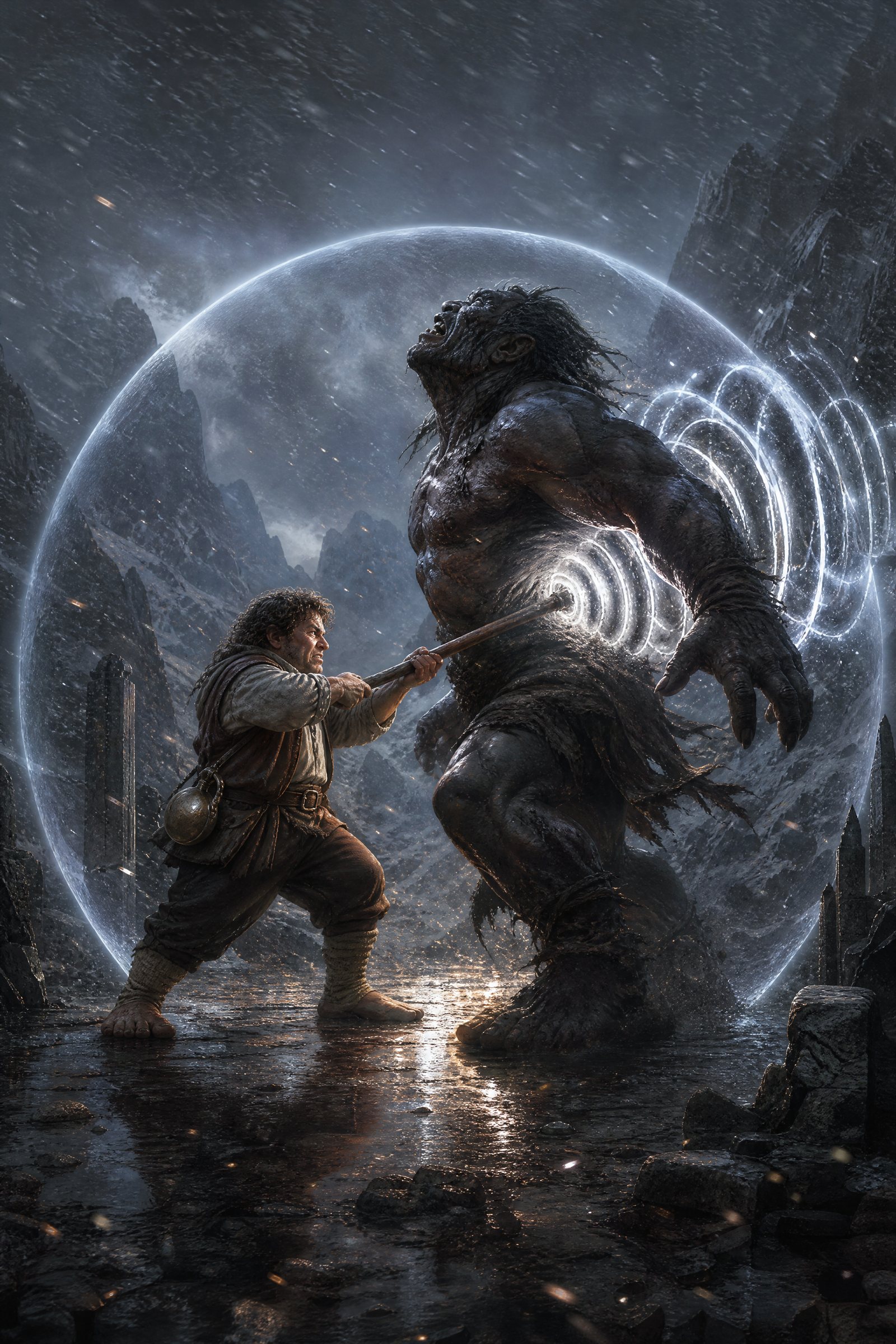
A listener who fights by tuning: the world is already holding a note, and you lean on it.
Identity
Everything is already vibrating — the stone under the road, the water in the cistern, the marrow in your own femur — and almost nobody ever hears it. You did: once, by accident, the way a bell hears a shout, or after someone spent eleven years teaching you to stop making noise long enough to notice. What you learned is the thing that makes a Harmonist: you do not push the world; you find the note it is already holding, you lean on it, and it does the rest. In a story you are the one who asks where others command — the reason the pass didn’t kill anyone and the worst blow landed at half price — and the one who must someday decide whether asking is a philosophy or an excuse.
The Harmonist is a support-controller who fights by tuning. Your baseline attack is your own body, and your signature is the Resonant Strike — a blow that you let ring, so it carries force through the target rather than merely into it. Your resource is a pool of Qi points, and it pays for everything: your spells, your terrain-work, the moment you halve a friend’s misfortune. Wisdom is your casting ability, because this art is not force of will and it is not bloodline — it is attention. You will never out-damage a Monk and you will never out-cast a Sorcerer. What you will do is make the ground obey, take the worst hit off the person who couldn’t survive it, and stand in the middle of a howling waste with your whole party walking comfortably in a bubble of unreasonable calm.
Campaign rules apply. Thirteen spells are banned and two are modified in this campaign; the campaign’s spell point rule does not apply to this class, which pays for its magic in Qi — see Campaign Rules. This document already conforms: banned spells have been removed and replaced at the same level, and modified spells are annotated where they appear.
This class belongs to the monk-caster family and is built to SPEC: Martial Arts, Unarmored Defense, the full Unarmored Movement ladder, Qi points, and Mystic Arcanum at 13/16/19. It is one of the family’s two Qi-cost casters (with the Glyphwalker): it has no spell points, and a spell costs Qi equal to its level. Its damage rider, used once on each of your turns, is Resonant Strike, deliberately smaller than the family’s Surge (see Balance Appendix, flag 1).
Class Overview
| Primary Abilities | Dexterity and Wisdom |
| Hit Point Die | d8 per Harmonist level |
| Saving Throws | Dexterity and Charisma |
| Skills | Choose 2: Acrobatics, Athletics, Insight, Medicine, Nature, Perception, or Religion |
| Weapons | Simple weapons |
| Tools | One musical instrument or one set of artisan’s tools of your choice |
| Armor | None |
| Starting Equipment | Traveling clothes of undyed cloth, a tuning implement of your tradition (a stone chime, a struck bowl, a single-string cord, a length of resonant wire — your spellcasting focus, no mechanical effect of its own), a quarterstaff or spear, your chosen instrument or artisan’s tools, a healer’s kit, a bedroll and mess kit, and 10 GP |
Spellcasting summary. You cast spells from the Harmonist spell list (drawn from the Druid and Sorcerer lists in the Abjuration, Divination, and Transmutation schools, plus a few named class additions; see Spellcasting), using Wisdom as your spellcasting ability. You do not have spell slots: you spend Qi points equal to a spell’s level to cast it, and your Qi refreshes on a Short or Long Rest (a Short Rest holds back Qi spent on a spell still in effect; see Spellcasting). Your Max Spell Level climbs to 5th and stops there; the three Mystic Arcanum spells at levels 13, 16, and 19 are the only things you ever cast above it, and they cost no Qi. No damage cantrips — the strike is your at-will offense — but you learn a few utility cantrips (see Utility Cantrips at level 2). Spell save DC = 8 + your Wisdom modifier + your Proficiency Bonus; spell attack modifier = your Wisdom modifier + your Proficiency Bonus.
Class Table
| Level | Proficiency Bonus | Martial Arts Die | Qi | Max Spell Level | Spells Known | Features |
|---|---|---|---|---|---|---|
| 1 | +2 | 1d6 | 1 | — | — | Martial Arts, Unarmored Defense, Qi Points, Resonant Strike, Aura of Equilibrium |
| 2 | +2 | 1d6 | 2 | 1st | 2 | Spellcasting, Utility Cantrips, Unarmored Movement |
| 3 | +2 | 1d6 | 3 | 1st | 3 | Resonance (subclass), Worldweave |
| 4 | +2 | 1d6 | 4 | 1st | 3 | Ability Score Improvement, Slow Fall |
| 5 | +3 | 1d8 | 5 | 2nd | 4 | Extra Attack, Redistribute Force |
| 6 | +3 | 1d8 | 6 | 2nd | 4 | Empowered Strikes, Resonance feature, Unarmored Movement (+15 ft) |
| 7 | +3 | 1d8 | 7 | 2nd | 5 | Evasion, Resonant Mind |
| 8 | +3 | 1d8 | 8 | 2nd | 5 | Ability Score Improvement |
| 9 | +4 | 1d8 | 9 | 3rd | 6 | Harmonic Glide |
| 10 | +4 | 1d8 | 10 | 3rd | 6 | Unarmored Movement (+20 ft), Self-Restoration |
| 11 | +4 | 1d10 | 11 | 3rd | 7 | Resonance feature |
| 12 | +4 | 1d10 | 12 | 3rd | 7 | Ability Score Improvement |
| 13 | +5 | 1d10 | 13 | 4th | 8 | Tongue of the World, Mystic Arcanum (6th) |
| 14 | +5 | 1d10 | 14 | 4th | 8 | Groundswell, Unarmored Movement (+25 ft) |
| 15 | +5 | 1d10 | 15 | 4th | 9 | Standing Wave, Timeless Body |
| 16 | +5 | 1d10 | 16 | 4th | 9 | Ability Score Improvement, Mystic Arcanum (7th) |
| 17 | +6 | 1d12 | 17 | 5th | 10 | Resonance feature |
| 18 | +6 | 1d12 | 18 | 5th | 10 | Unarmored Movement (+30 ft), Perfect Pitch |
| 19 | +6 | 1d12 | 19 | 5th | 11 | Epic Boon, Mystic Arcanum (8th) |
| 20 | +6 | 1d12 | 20 | 5th | 11 | Avatar of Harmony |
Cantrips Known: 1 at level 2, 2 at level 7, 3 at level 13 — utility only (see Utility Cantrips).
Unarmored Movement: +10 ft at level 2, +15 ft at level 6, +20 ft at level 10, +25 ft at level 14, +30 ft at level 18. From level 9 you can also move along vertical surfaces and across liquids on your turn without falling (see Unarmored Movement).
Mystic Arcanum: one 6th-level spell at 13, one 7th at 16, one 8th at 19 — each cast once per Long Rest without spending Qi (see Mystic Arcanum).
Class Features
Level 1: Martial Arts
Your body is a string you have learned to tension correctly. While you are unarmed or wielding a simple weapon and you aren’t wearing armor or wielding a Shield, you gain the following benefits.
- Martial Arts die. You can roll your Martial Arts die (see the class table) in place of the normal damage of your Unarmed Strikes and simple weapons.
- Dexterous strikes. You can use Dexterity instead of Strength for the attack and damage rolls of your Unarmed Strikes and simple weapons.
- Second contact. When you take the Attack action with an Unarmed Strike or a simple weapon on your turn, you can make one Unarmed Strike as a Bonus Action.
A Harmonist’s blow does not sound like a fight. It sounds like something being tuned — a short, clean, almost pleasant tone, entirely at odds with what it has just done to a rib.
Level 1: Unarmored Defense
While you aren’t wearing armor or wielding a Shield, your base Armor Class equals 10 + your Dexterity modifier + your Wisdom modifier. Half of that is knowing where the blade is going. The other half is knowing, a half-second earlier than the person swinging it, where they had decided it would go.
Level 1: Qi Points
You carry the world’s pitch as a pool of Qi points — the same breath-force a Monk counts and spends, heard as a note rather than felt as a fire. Your Qi point maximum equals your Harmonist level (see the Qi column of the class table). You regain all expended Qi points when you finish a Short or Long Rest; a few minutes of stillness is enough to re-find the pitch.
Qi is the whole budget. It pays for your spells (a spell costs Qi equal to its level), for your Resonant Strike, for Worldweave, for Redistribute Force, and for most of what your Resonance grants you. Nothing else refills it (except as the shared-pool rule allows when multiclassed). This is deliberate: a Harmonist who spends the fight casting is a Harmonist who is barely striking, and a Harmonist who strikes all day has no magic left when the door opens on something that can’t be punched. Choosing badly is the interesting part.
When you run dry, nothing about you breaks. Your strikes still land; they simply land dead, thudding, with no ring in them at all, and the world goes back to ignoring you.
Level 1: Resonant Strike
You have learned to let a blow finish its sound. Once on each of your turns, immediately after you hit a creature with an Unarmed Strike or a simple weapon, you can spend 1 Qi to sound the blow. It deals extra force damage equal to one roll of your Martial Arts die. This costs no action, Bonus Action, or Reaction, and doesn’t replace any other part of your turn.
Note three things, because they are the ceiling on your damage and they are there on purpose:
- You do not add an ability modifier to Resonant Strike damage. Ever. The note is the note.
- It fires once on each of your turns — no more strikes, no second ring. Additional attacks give you more chances to land it, never a second one.
- The Qi it costs is Qi you didn’t cast with. Your damage and your magic drink from the same cup.
This is a smaller thing than the surges other traditions in this family throw, and every Harmonist knows it. You are not here to be the biggest hit at the table. You are here so that the biggest hit at the table has somewhere to stand.
Level 1: Aura of Equilibrium
This is the headline. You can settle a volume of the world into agreement with itself. As a Bonus Action, you establish a 15-foot Emanation centered on yourself that lasts 10 minutes and moves with you. While it lasts, you and your allies inside it gain the following:
- Difficult terrain is not difficult. Moving through Difficult Terrain costs no extra movement — mud, scree, snow, rubble, tangled undergrowth, and thigh-deep water all take your weight and let it go again.
- The weather is not addressed to you. You are unaffected by extreme natural weather and environmental hazards — extreme cold, extreme heat, high altitude, driving sandstorm, blizzard, torrential rain, choking natural smoke, and the ordinary exhaustion these inflict. This covers non-magical environmental effects; a magical blizzard conjured by an enemy is still a spell, and still yours to solve some other way.
You can use this feature a number of times equal to your Wisdom modifier (minimum of once), and you regain all expended uses when you finish a Long Rest.
There is a specific look a party gets, four days into a pass that should have killed them, when they realize the Harmonist has been doing this the entire time and never mentioned it.
Level 2: Spellcasting
You have learned to pluck the world instead of pushing it. See the Spellcasting section at the end of this document for the full rules, the Qi costs, and the Harmonist spell list. In brief:
- You cast using Wisdom. Spell save DC = 8 + your Wisdom modifier + your Proficiency Bonus. Spell attack modifier = your Wisdom modifier + your Proficiency Bonus.
- You cast spells you know (you never prepare from a book), chosen from the Harmonist spell list: spells of the Druid and Sorcerer lists in the Abjuration, Divination, and Transmutation schools, plus a short list of named sympathetic strings — class additions from outside those lists or schools that ring true to the art anyway.
- You have no spell slots. Casting a spell costs Qi equal to the spell’s level: 1 Qi for a 1st-level spell, 5 Qi for a 5th-level spell. You regain all Qi on a Short or Long Rest, except Qi spent on a spell still in effect when a Short Rest ends (see Qi instead of slots).
- Your Max Spell Level is shown on the class table: 1st at level 2, 2nd at 5, 3rd at 9, 4th at 13, and 5th at 17. It never rises past 5th. The high harmonics are not for mortal ears — except three times, through Mystic Arcanum (level 13), which reaches past the ceiling and costs no Qi at all.
- No damage cantrips, but you learn utility cantrips (below).
Level 2: Utility Cantrips
Your magic refuses to trickle into damage — a note either moves something or it doesn’t — but it can be shaped to small, useful ends. You learn 1 cantrip at level 2, a 2nd at level 7, and a 3rd at level 13, chosen from the list below. These are utility cantrips only: no attack roll, no damage, no saving throw to avoid damage. You can’t learn a damaging cantrip with this feature. They use Wisdom. Whenever you gain a level in this class, you can swap one for another eligible utility cantrip.
Choose from: Guidance, Mending, Message, Druidcraft, Prestidigitation, Light, Mage Hand, and Elementalism (the 2024 cantrip that covers the small earth-and-water shaping older tables knew as Mold Earth and Shape Water, from Xanathar’s Guide to Everything; if your table still uses those, either is an equally valid pick here).
Level 2: Unarmored Movement
Unarmored Movement — what you call the Long Step. While you aren’t wearing armor or wielding a Shield, your Speed increases by 10 feet. This bonus increases when you reach certain Harmonist levels, as shown on the class table: +15 feet at level 6, +20 feet at level 10, +25 feet at level 14, and +30 feet at level 18.
In addition, starting at level 9, you can move along vertical surfaces and across liquids on your turn without falling during that move.
You are not fast the way a Monk is fast — or rather, you have arrived at the same place from the opposite direction. A Monk has removed the friction between intention and motion; you have simply stopped arguing with the ground, and the ground, being reasonable, has stopped arguing back.
Level 3: Resonance
Every Harmonist eventually finds the one frequency their whole life wants to sit on. Choose a Resonance — the Hammer, the Deep Note, the Tether, or the Hush, each described later in this document. You gain its level 3 features, and additional features at levels 6, 11, and 17.
Level 3: Worldweave
The ground and the air are not fixed things. They are held in place by agreement, and you are on speaking terms with the parties. As a Reaction or a Bonus Action, you can spend 2 Qi to produce one of the following effects.
- Earthen Pillar. When a creature you can see within 60 feet is targeted by an attack roll (or when you simply want a friend to be harder to reach), a slab of stone, ice, root, or compacted air rises beside one willing creature you can see within 60 feet. That creature has Three-Quarters Cover against one attack — the triggering attack if you used your Reaction, or the next attack against it before the start of your next turn if you used your Bonus Action. The pillar then sinks back into the world.
- Castling. Choose two willing creatures you can see within 30 feet of you (you can be one of them). They swap positions instantly. Each must be able to fit in the other’s space, and neither can be Incapacitated or unwilling. This movement doesn’t provoke Opportunity Attacks. As a Reaction, you use Castling when a creature you can see within 30 feet of you is targeted by an attack roll, and that creature must be one of the two you swap. The swap happens before the attack roll. If the original target is still within the attack’s reach or range, the attack goes ahead against it. If it isn’t, the attacker can choose a new target within reach or range (such as the creature now standing in that space); if it doesn’t, the attack is lost. As a Bonus Action, Castling needs no trigger.
Castling is the feature your party will learn to shout for. Getting the Wizard out of the ogre’s reach and the Barbarian into it, in the middle of the ogre’s own turn, is the single most Harmonist thing you can do: nobody was harmed, nothing was forced, and the fight’s whole shape just changed.
Level 4: Ability Score Improvement
You gain the Ability Score Improvement feat or another feat of your choice for which you qualify.
Level 4: Slow Fall
Slow Fall — what you call the Held Note. You can take a Reaction when you fall to reduce the falling damage you take by an amount equal to five times your Harmonist level. You do not stop falling. You simply stop arriving so abruptly.
Level 5: Extra Attack
You can attack twice, instead of once, whenever you take the Attack action on your turn.
Level 5: Redistribute Force
Force is never destroyed; it is only badly filed. When an ally you can see within 30 feet takes damage, you can take a Reaction and spend 1 Qi to catch the blow’s remainder. That ally takes half the damage (round down), and the energy you diverted has to go somewhere: the ground in a 10-foot radius centered on the creature or effect that dealt the damage buckles, ripples, softens, or grows a crust of frost, becoming Difficult Terrain for 1 minute.
If the damage came from an area effect rather than a creature, center the radius on the effect’s point of origin instead. If the source is beyond your sight or has no location you can find, you still halve the damage; the energy just goes into the sky, which is not your problem.
This is the feature that decides whether someone lives. Learn to hold the Reaction.
Level 6: Empowered Strikes
Empowered Strikes — what you call the True Tone. Your Unarmed Strikes can deal force damage instead of their normal damage type, chosen each time you hit. Nothing is proof against the world’s own pitch.
Level 6: Unarmored Movement (+15 ft)
Your Unarmored Movement bonus increases to +15 feet.
Level 7: Evasion
Evasion — what you call the Standing Note. When you make a Dexterity saving throw against an effect that deals half damage on a successful save, you instead take no damage on a success and half damage on a failure. You don’t benefit from this feature while you have the Incapacitated condition.
Level 7: Resonant Mind
A mind held at a steady pitch is difficult to retune. You have Advantage on saving throws to avoid or end the Charmed and Frightened conditions. Fear and love both work by changing what frequency you’re sitting on, and you have made that a very hard thing to do from the outside.
Level 9: Harmonic Glide
Harmonic Glide is the Harmonist’s name for the level 9 clause of Unarmored Movement, and grants no separate benefit: on your turn you can move along vertical surfaces and across liquids without falling during that move. You have stopped treating “down” as a strongly held opinion. Stone walls, sheer ice, the underside of a bridge, and the surface of a running river are all simply things vibrating at a pitch you can match for as long as you keep moving.
Stop moving, and the argument resumes. The world wins it.
Level 10: Unarmored Movement (+20 ft)
Your Unarmored Movement bonus increases to +20 feet.
Level 10: Self-Restoration
Self-Restoration — what you call the Clean String. Your body has learned to shed what doesn’t belong to it. You’re immune to the Poisoned condition and to disease, and at the end of each of your turns you can end one of the following conditions on yourself: Charmed or Frightened. In addition, you no longer need food or water; you draw sustenance from the ambient hum, which is a sentence your party will ask you to stop saying at meals.
Level 11: Resonance feature
You gain your Resonance’s level 11 feature.
Level 12: Ability Score Improvement
You gain the Ability Score Improvement feat or another feat of your choice for which you qualify.
Level 13: Tongue of the World
Speech was always just an agreed-on set of frequencies, and you no longer need the agreement. You understand all spoken languages. Furthermore, beasts and plants can understand your speech, and you can understand theirs — not their words, because most of them have none, but their meaning, which is usually more honest.
This does not make anything friendly to you. A wolf that understands you perfectly is still a wolf that is hungry, and a very old oak that understands you perfectly may simply decline to answer for eleven days.
Level 13: Mystic Arcanum
Mystic Arcanum — what you call the Struck Bell. Three times in a Harmonist’s career, the note is not yours. You find a pitch so large that sounding it is only a matter of standing in the right place and letting go, and the world does the rest of the work — once, and then it wants its quiet back.
You learn one 6th-level spell from your class’s list. You can cast it once without spending Qi, and you regain the ability to do so when you finish a Long Rest. At level 16 you learn a 7th-level spell, and at level 19 an 8th-level spell, each cast once per Long Rest in the same way. Whenever you gain a level in this class, you can replace one of these spells with another of the same level from your class’s list. These spells use your Wisdom.
Three points of order, because this feature breaks two of the class’s own rules on purpose:
- An Arcanum costs no Qi. None. Everything else you cast is priced in Qi equal to its level; these are not. You are not paying for the note, because you did not make it.
- An Arcanum ignores your Max Spell Level. Your ceiling is still 5th for every spell you cast with Qi, at every level, forever — but the Arcanum reaches one tier past it, which is the entire point of the feature. The high harmonics are not for mortal ears; you are not hearing them so much as being briefly in the way of them.
- Each Arcanum is its own use. Casting your 6th-level spell doesn’t spend the 7th or the 8th. At level 19 that is three separate soundings per Long Rest.
See the 6th–8th Level (Mystic Arcanum only) entries on the Harmonist spell list for the options.
Level 14: Unarmored Movement (+25 ft)
Your Unarmored Movement bonus increases to +25 feet.
Level 14: Groundswell
You can change a place’s mind about its own shape. As a Magic action, you spend 3 Qi and choose a 30-foot cube of ground, stone, ice, sand, or shallow water you can see within 120 feet. Choose one effect; it lasts 1 hour and requires no Concentration.
- Smooth it. The area ceases to be Difficult Terrain, and shallow water in it becomes firm enough to walk on.
- Roughen it. The entire area becomes Difficult Terrain.
- Raise it. A section of ground up to 10 feet square rises or sinks up to 15 feet, carrying anything on it. Creatures on the rising or sinking section ride it safely; a creature that would be crushed against a ceiling is instead pushed to the nearest unoccupied space.
- Wall it. A wall of stone or packed earth 10 feet high, 30 feet long, and 1 foot thick rises from the ground along a line you choose within the cube. It has AC 15 and 30 Hit Points per 10-foot section, and it is Vulnerable to thunder damage. Creatures in its path are pushed to one side of your choice.
The terrain is genuinely changed, not conjured; nothing about it is dispelled when you stop looking. If you Groundswell a road, the road is different now. Consider that before you do it inside a duke’s garden.
Level 15: Standing Wave
Your Aura of Equilibrium has settled deep enough to hold its own shape. Its radius increases to 30 feet, and while it’s active, you and your allies inside it also gain:
- Advantage on saving throws against being moved against your will or knocked Prone, and against effects that would reduce your Speed.
- Resistance to thunder and force damage — the two things that work by disagreement, met with a body that isn’t having any.
In addition, you regain one expended use of Aura of Equilibrium whenever you finish a Short Rest.
Level 15: Timeless Body
Timeless Body — what you call the Long Sustain. Your Qi sustains you so that you suffer none of the frailty of old age, and you can’t be aged magically. You still die of old age when your time comes; you simply arrive there at full pitch, which is, in the opinion of your tradition, the only respectable way to do it.
Level 17: Resonance feature
You gain your Resonance’s level 17 feature.
Level 18: Unarmored Movement (+30 ft)
Your Unarmored Movement bonus increases to +30 feet.
Level 18: Perfect Pitch
Nothing within reach is silent to you anymore. You gain Tremorsense out to 60 feet — you perceive the position of any creature in contact with the same ground, water, or structure you are, whether or not you can see it, and whether or not it is trying to be quiet.
In addition, when a creature you can see within 30 feet casts a spell of level 3 or lower, you can take a Reaction and spend 3 Qi to find its pitch and press it flat. The spell fails and has no effect, and the caster’s action or resource is spent. Once you use this second benefit, you can’t use it again until you finish a Short or Long Rest.
Level 19: Epic Boon
You gain an Epic Boon feat or another feat of your choice for which you qualify. The Boon of Fortitude and the Boon of Dimensional Travel both suit a Harmonist, but any Boon your DM allows fits someone who has spent a career being on good terms with physics.
Level 20: Avatar of Harmony
You stop being a thing that listens to the world’s note and become, for a little while, a place where that note is louder. As a Bonus Action, you become the Avatar of Harmony for 1 minute. For the duration:
- Your Aura of Equilibrium is active with a 60-foot radius regardless of your remaining uses, with all its benefits and those of Standing Wave.
- Resonant Strike costs no Qi, and its extra damage becomes two rolls of your Martial Arts die.
- Redistribute Force costs no Qi, and you can use it once per round without expending your Reaction. You still can’t use Redistribute Force more than once per round in total; your Reaction stays free for anything else, such as Worldweave.
- You and your allies in the aura add your Wisdom modifier to all saving throws.
- You have Resistance to all damage that isn’t psychic, and you can’t be Charmed, Frightened, Paralyzed, Restrained, or Stunned.
When the minute ends, you gain 1 Exhaustion level; being the loudest thing in a place costs the place’s usual occupant something. Once you use this feature, you can’t use it again until you finish a Long Rest.
Resonances (Subclasses)
Four Resonances describe the frequency your life has settled on. Each grants features at 3rd, 6th, 11th, and 17th level. A Resonance is a frequency you work through, not a power you serve; nothing in it needs a god, a people or a place to exist. Each world gives the four its own names (see In Different Worlds), and their real-world touchstones are credited under Origins and Inspiration.
Resonance of the Hammer
Every smith knows it. You do not beat the metal into shape. You ask it, on the beat, until it agrees.
Hammer Harmonists learned the art at a forge, or from someone who did. Their understanding of resonance is percussive and practical: a struck thing rings, a rung thing softens, and a softened thing can be made into whatever you needed. They keep time when they fight — a working rhythm, the two-stroke of hammer and anvil — and things come apart under it in the orderly way stock comes apart under a swage. This is the Resonance that hits hardest, and its practitioners are usually the least mystical people in the tradition, which they regard as a virtue.
Level 3: Anvil Cadence. You gain proficiency with martial weapons that have the Heavy or Versatile property (warhammers, mauls, longswords, battleaxes, and their kin; the quarterstaff is a simple weapon you already use), with smith’s tools, and such weapons count as simple weapons for the purpose of your Harmonist features — including Martial Arts and Resonant Strike.
In addition, you can ring the blow twice. When you use Resonant Strike, you can spend 1 additional Qi (2 Qi total) to have its extra force damage become two rolls of your Martial Arts die instead of one. You still add no ability modifier, and it still fires only once on each of your turns.
Level 6: Staggering Blow. A struck thing wobbles before it falls. Once on each of your turns, when a creature takes damage from your Resonant Strike, it must succeed on a Constitution saving throw against your spell save DC or be knocked off its working pitch until the start of your next turn: its Speed is reduced by 10 feet, and it has Disadvantage on the next attack roll it makes.
This is not Stunning Strike and never becomes it. You take a piece of their turn, not the whole thing.
Level 11: Rhythm of the Forge. The cadence is yours now and the metal knows it. Your Resonant Strike damage increases by your Wisdom modifier (the only ability modifier that ever touches it, and it is yours because you found the pitch, not because you swung hard).
In addition, once on each of your turns, when you score a Critical Hit with an Unarmed Strike or a weapon, or reduce a creature to 0 Hit Points, you regain 2 Qi (up to your maximum). The work pays for itself when the work is going well.
Level 17: The Hammer Falls. You have one blow left in you that finishes things. Once on each of your turns, when you would use Resonant Strike, you can instead spend 3 Qi to bring the hammer down properly:
- The extra damage becomes three rolls of your Martial Arts die + your Wisdom modifier, force damage. That Wisdom modifier is Rhythm of the Forge’s bonus, added once, not twice; Anvil Cadence’s second ring doesn’t apply; and Staggering Blow doesn’t trigger, because the blow makes its own saving throw below. The Hammer Falls is that turn’s Resonant Strike.
- The target makes a Constitution saving throw against your spell save DC. On a failure it is knocked Prone and its Speed is 0 until the end of its next turn.
- Each other creature of your choice within 5 feet of the target takes thunder damage equal to one roll of your Martial Arts die — the anvil’s answer.
In addition, your Unarmed Strikes and Heavy or Versatile weapons score a Critical Hit on a roll of 19 or 20.
Playing a Hammer Harmonist: you are the one who came to work. Where the rest of your tradition talks about listening, you talk about finish and grain and whether the piece will hold, and then you demonstrate on something’s sternum. Keep an eye on your Qi, because you will spend it twice as fast as your peers and you will notice the moment you can’t.
Resonance of the Deep Note
Under everything, there is one long low sound that has never stopped. Everything else is decoration on it.
Deep Note Harmonists went looking for the fundamental — the pitch beneath the pitch, the one the world is actually holding while all its surfaces chatter. They found enough of it to be changed. These are the ones who cast, really cast, who shape and stretch and double a working the way a Sorcerer bends a spell, because they are not reciting a formula: they are leaning on a note that was already sounding. They tend to talk slowly and stand very still, and they are often mistaken for stupid by people who then find themselves inside a sphere.
Level 3: The Fundamental. You know two additional Harmonist spells of your choice. They don’t count against your Spells Known, and they can be of any level for which you have a Max Spell Level. You can swap either of them whenever you gain a Harmonist level.
In addition, you have Advantage on Constitution saving throws to maintain Concentration. A note this deep does not stop for a punch.
Level 6: Shaping the Note. You learn to bend a working the way a singer bends a sustained tone. You gain two Metamagic options of your choice from the Sorcerer’s 2024 Metamagic list — Careful Spell, Distant Spell, Extended Spell, Seeking Spell, Subtle Spell, or Transmuted Spell — and you use them exactly as written, except that you spend Qi points in place of Sorcery Points at each option’s listed cost. You gain a third Metamagic option at level 17, and you can replace one option with another whenever you gain a Harmonist level.
Level 11: Undertone and Octave. Two gifts of the deep pitch.
- Undertone. A number of times equal to your Wisdom modifier (minimum once) per Long Rest, when you cast a Harmonist spell, you reduce its Qi cost by 2 (to a minimum of 0). You declare this before casting.
- Twinned Spell — what you call the Octave. You gain the Twinned Spell Metamagic in addition to your other options, and it does not count against the number of Metamagic options you know.
Level 17: The Fundamental Frequency. You sound the note itself, briefly, out loud, where other people can be standing in it. As a Magic action, spend 5 Qi to fill a 60-foot Emanation centered on yourself with a tone below hearing, lasting 1 minute and requiring no Concentration. While it lasts:
- Your spell save DC increases by 2 against creatures inside the Emanation.
- You and your allies inside it have Advantage on Constitution saving throws to maintain Concentration and on saving throws against being moved, Restrained, or knocked Prone.
- Enemies inside it treat the whole area as Difficult Terrain and have Disadvantage on Constitution saving throws to maintain Concentration.
Once you use this feature, you can’t use it again until you finish a Long Rest, unless you spend 5 more Qi to sound it again.
Playing a Deep Note Harmonist: you are the party’s real caster, and you will feel the arithmetic of that in your Qi pool every single fight — every spell you sound is a Resonant Strike you didn’t. The interesting play is triage: which one working, this round, is worth the whole rest of your afternoon.
Resonance of the Tether
Nobody is alone. The threads are there whether you look at them or not. I look at them.
Tether Harmonists see the connective tissue — the faint sympathetic lines running between people who have shared food, or a road, or a fight, or a bed. They can pluck those lines, and what travels along them is anything: warmth, pain, courage, the shock of a blow. This is the healer’s Resonance, though a Tether would object to the word. They do not close wounds. They spread the bill, so that four people carry something one person could not, and they nudge a body back toward the shape it remembers.
Level 3: Spirit Link. As a Bonus Action, you can tether up to a number of willing creatures equal to your Wisdom modifier (minimum of one), each of which you can see within 30 feet. You can include yourself. The tether lasts 1 hour, ends early if you use this feature again, and requires no Concentration. A tethered creature knows it is tethered and can end its own tether at any time (no action).
- Share the load. When a tethered creature you can see takes damage, you can take a Reaction and spend 1 Qi: that creature takes half the damage, and you distribute the other half, in any split you choose, among the other tethered creatures within 60 feet of it (including yourself). Damage distributed this way ignores Resistances and Immunities of the creatures receiving it, because it is not really fire or a sword anymore — it is just weight.
- Ease the string. As a Bonus Action, spend 1 Qi to have one tethered creature you can see regain Hit Points equal to one roll of your Martial Arts die + your Wisdom modifier.
Level 6: Sympathetic Vigor. Two ways the threads carry good things as readily as bad.
- When you cast a spell of level 1 or higher that targets a tethered creature, every tethered creature within 60 feet of you gains Temporary Hit Points equal to your Wisdom modifier. These don’t stack with themselves.
- When you or a tethered creature has Resistance to a damage type, you can take a Reaction and spend 1 Qi to lend it: every tethered creature within 60 feet gains that Resistance until the end of your next turn.
Level 11: The Tethers Hold. The threads are load-bearing now.
- Ease the string heals two rolls of your Martial Arts die + your Wisdom modifier, and you can target a tethered creature you can’t see, so long as it’s within 1 mile — you find it by pull, not by sight.
- Tethered creatures have Advantage on death saving throws and add your Wisdom modifier to Constitution saving throws made to maintain Concentration.
- You always know the direction, rough distance, and current condition (healthy, wounded, dying, or dead) of each tethered creature, on any plane you share with it.
Level 17: Nothing Falls Alone. You will not let a thread go slack while three others are still taut. When a tethered creature within 60 feet of you drops to 0 Hit Points, or would die outright, you can take a Reaction and catch it:
- It instead drops to Hit Points equal to your Harmonist level and has no adverse condition from the blow.
- The damage that would have felled it is distributed among the other tethered creatures within 60 feet, split however you choose, ignoring Resistance and Immunity. If you are the only other tethered creature, you take all of it — and this can drop you.
Once you use this feature, you can’t use it again until you finish a Long Rest, unless you spend 5 Qi to use it again.
Playing a Tether Harmonist: you are the reason the party’s bad rounds do not become the party’s last rounds, and your best turns look like bookkeeping from the outside. Decide early how you feel about spending your friends’ hit points to save one of them, because the game will ask you roughly every other fight, and the answer “whoever can most afford it” is a personality.
Resonance of the Hush
The music is not the notes. The music is what the silence between them is shaped like.
Hush Harmonists went the other way. Where the rest of the tradition studies the ringing, they studied the gap — the negative space where sound isn’t, which turns out to be the larger half of the art. They move unheard because they are subtracting, not sneaking. They listen at absurd distances because attention is a thing you can aim. And they can put a hand on a wall and read what the wall has been standing there absorbing for the last week, which makes them the best investigators anyone has ever hired and unsettling houseguests.
Level 3: The Silence Between Notes. You gain proficiency in Stealth (or another skill of your choice, if you already have it), and your Proficiency Bonus is doubled for any Dexterity (Stealth) check you make.
In addition, as a Bonus Action, you can spend 1 Qi to subtract yourself for 10 minutes. For the duration, you and up to a number of willing creatures equal to your Wisdom modifier within 15 feet of you make no sound at all as you move: footfalls, armor, breath, and dropped crockery are simply not there. You have Advantage on Dexterity (Stealth) checks, creatures can’t detect you by hearing, and moving at a slow pace to remain quiet no longer halves your speed. The effect on an ally ends if they move more than 15 feet from you. It does not silence deliberate noise — a shout, a spell’s Verbal component, a war horn — only the noise a body makes by existing.
Level 6: Dampening Field and the Long Ear. Two workings, both about where sound is allowed to go.
- Dampening Field. As a Bonus Action, spend 2 Qi to create a 20-foot-radius Sphere of deadened air, centered on yourself or on a point you can see within 60 feet, lasting 1 minute (no Concentration). If centered on yourself, it moves with you. No sound made inside the Sphere can be heard outside it, and creatures inside it that aren’t your allies have Disadvantage on Wisdom (Perception) checks that rely on hearing. Unlike the Silence spell, this does not prevent sound inside — you can still cast, shout, and be heard by each other. It just doesn’t leave.
- The Long Ear. As a Magic action, spend 1 Qi to hear for 1 minute as though you were standing at any point you can see within 120 feet. You hear everything a person standing there would, including whispers, through the ordinary business of walls and weather. You can end it early (no action) and reposition it as a Bonus Action while it lasts.
Level 11: What the Stone Remembers. Places hold onto things. As a Magic action, spend 2 Qi to touch a surface, object, or 10-foot square and listen backward. You receive:
- Up to three significant events that occurred in contact with that object or within 20 feet of that square in the last 7 days, as brief silent impressions — a struggle, a transaction, a confession, someone weeping, someone hiding a thing and where.
- The general emotional tenor of the place over that period: fear, grief, boredom, ritual attention, sustained cruelty.
- If a creature died there in that window, you learn its approximate appearance and the manner of its death.
You choose neither which events you get nor how much context comes with them; the place volunteers what it was loudest about. Once you use this feature, you can’t use it again on the same object or square until you finish a Long Rest.
In addition, you have Advantage on Initiative rolls, and while you are conscious, being surprised doesn’t give you Disadvantage on your Initiative roll.
Level 17: Nothing Is Unheard. The gap has become your primary sense.
- You gain Blindsight out to 60 feet, derived from hearing. You lose it while you have the Deafened condition or are inside a Silence effect (your own Dampening Field does not interfere).
- As a Magic action, spend 5 Qi to extend the Long Ear past all reason: for 10 minutes, you can perceive the sights and sounds of any location you have personally visited, or of any location within 1 mile of you, as though standing invisibly at a point of your choice there. You can move that viewpoint up to 60 feet as a Bonus Action on each of your turns. A creature with Truesight, or a place warded against divination, can detect or exclude you as it would the Scrying spell. Once you use this benefit, you can’t use it again until you finish a Long Rest.
- Once on each of your turns, when you hit a creature that can’t hear you or is unaware of you, your Resonant Strike deals an extra roll of your Martial Arts die and costs no Qi.
Playing a Hush Harmonist: you are the reason the party knows what’s behind the door, who lied in the throne room, and which of the three corridors has people breathing in it. Your combat contribution is real but modest; your pre-combat contribution routinely deletes the encounter. Get comfortable with being the one who talks least and knows most, and be careful — reading a room’s memory is an intimacy nobody consented to, and sooner or later you will hear something you should not be carrying.
Spellcasting
You do not compel the world; you find where it was already going and you ask a little louder. Your Harmonist spellcasting is governed by the rules below.
Casting ability. Wisdom. Spell save DC = 8 + your Wisdom modifier + your Proficiency Bonus. Spell attack modifier = your Wisdom modifier + your Proficiency Bonus.
Spells known. You cast spells you know, not spells prepared from a book. You know a number of Harmonist spells set by the Spells Known column of the class table, chosen from the Harmonist spell list below. Whenever you gain a Harmonist level, you can replace one spell you know with another spell from the Harmonist spell list. You can only know a spell whose level is no higher than your Max Spell Level.
Qi instead of slots. You have no spell slots. To cast a Harmonist spell of level 1 or higher, you spend Qi points equal to the level you cast it at: 1 Qi for 1st, 2 Qi for 2nd, 3 Qi for 3rd, 4 Qi for 4th, 5 Qi for 5th. You can cast a spell at a higher level than its own by spending the higher amount, exactly as if you had used a higher-level slot, up to your Max Spell Level. You regain all expended Qi points when you finish a Short or Long Rest, with one exception. If a spell you cast with Qi is still in effect when you finish a Short Rest, that rest doesn’t restore the Qi you spent on it. The first Short Rest you finish after the spell ends restores that Qi as normal, and a Long Rest restores all your Qi whether or not the spell is still in effect. Example: at level 13 you cast Death Ward (4 Qi) in the morning and take a Short Rest at noon before it has been triggered; you regain all your expended Qi except those 4. Spells lasting 1 hour or less always end before a Short Rest finishes, so the exception never touches them.
Max Spell Level. Shown on the class table: 1st at level 2, 2nd at 5, 3rd at 9, 4th at 13, and 5th at 17. It stops at 5th and never advances. The 6th harmonic and above belong to things that are not shaped like people — which is why Mystic Arcanum (level 13) is written as an exception rather than as an extension: three spells, one each at 6th, 7th, and 8th level, cast once per Long Rest without spending Qi, and never available at any Qi price. See 6th–8th Level (Mystic Arcanum only) at the end of the list.
Rituals. You can cast a spell you know as a Ritual if it has the Ritual tag. Cast that way, it takes 10 minutes longer to cast than normal and costs no Qi.
Spell list source. You choose your spells of 1st through 5th level only from the Harmonist spell list below; it is a closed list, and the DM does not add others. Its core is the Druid and Sorcerer lists, restricted to the Abjuration, Divination, and Transmutation schools — the three grammars of warding, hearing, and changing what a thing is, which is the entire art. To that core the list adds a short set of sympathetic strings: class additions from outside those two lists or those three schools that ring true to the Harmonist’s work anyway, marked as such below (Bless, Sanctuary, Alarm, Identify, Silence, Remove Curse, Otiluke’s Resilient Sphere, Death Ward, Wall of Stone, Passwall and Legend Lore). The list holds no healing spell such as Cure Wounds (the Tether is the Harmonist’s healer) and no spell whose purpose is to add damage to a strike (the old list’s Enlarge/Reduce and Absorb Elements carry small riders and stay).
Casting requires attention. Your instrument, your tuning implement, or your own open hands serve as your spellcasting focus. Verbal components are hummed or struck rather than intoned, which means a Silence effect stops them like anyone else’s.
Harmonist Spell List
This is a closed list: every spell you know of 1st through 5th level comes from it. It holds 75 spells (17 / 22 / 16 / 10 / 10 at 1st–5th level, about three-quarters of the 2024 Player’s Handbook Sorcerer list at each level), sorted alphabetically within each level. Everything below is an official spell from the 2024 Player’s Handbook, except Absorb Elements and Control Winds, which are from Xanathar’s Guide to Everything. Legend Lore works as modified in this campaign (it reveals where the knowledge is kept).
1st level (17; Max Spell Level at 2; costs 1 Qi).
- Absorb Elements (Abjuration) — you catch the energy and hand it back at the next thing you hit
- Alarm (sympathetic string) — a note left humming across a doorway, which changes key when someone crosses it
- Bless (sympathetic string) — you tune three people to the same fortunate key
- Comprehend Languages (Divination) — every language is a melody, and you hear the tune under the words
- Detect Magic (Divination) — every working has a pitch, and now you hear them
- Detect Poison and Disease (Divination) — the sour note in the cup, the off-key breath in the sickroom
- Expeditious Retreat (Transmutation) — friction takes the round off
- Feather Fall (Transmutation) — the air is asked to be thicker, briefly, for five people
- Identify (sympathetic string) — an object struck once tells you what it was made to do
- Jump (Transmutation) — you renegotiate your weight
- Longstrider (Transmutation) — the road agrees to be shorter
- Mage Armor (Abjuration) — a friend’s skin tuned a little harder, for the whole day
- Protection from Evil and Good (Abjuration) — a ward pitched against the things that don’t belong here
- Purify Food and Drink (Transmutation) — the spoiled note taken out of the meal
- Sanctuary (sympathetic string) — a note pitched so that violence keeps sliding off it
- Shield (Abjuration) — the world briefly declines to let the blade through
- Speak with Animals (Divination) — a smaller version of what you’ll have at 13th level
2nd level (22; Max Spell Level at 5; costs 2 Qi).
- Aid (Abjuration) — three bodies held a little above their own pitch, for most of a day
- Alter Self (Transmutation) — you retune the instrument you were issued
- Augury (Divination) — you strike the question and listen for whether it resolves or jars
- Barkskin (Transmutation) — skin asked to remember being bark
- Beast Sense (Divination) — you listen through an animal’s ears
- Blindness/Deafness (Transmutation) — one sense, taken out of tune
- Darkvision (Transmutation) — eyes retuned to a lower light
- Detect Thoughts (Divination) — minds are loud and mostly unaware of it
- Enhance Ability (Transmutation) — a body held at a better pitch for an hour
- Enlarge/Reduce (Transmutation) — the simplest possible disagreement about scale
- Find Traps (Divination) — a trap is a held breath, and you hear it holding
- Knock (Transmutation) — the lock’s one note, found and struck
- Lesser Restoration (Abjuration) — one sour string in a body, put right
- Levitate (Transmutation) — down, politely declined
- Locate Animals or Plants (Divination) — the meadow tells you where the herb grows
- Locate Object (Divination) — everything you have handled still answers you
- Pass without Trace (Abjuration) — the signature Hush spell, available to everyone
- Protection from Poison (Abjuration) — the body’s clean string, granted to someone else
- See Invisibility (Divination) — the hidden thing still hums
- Silence (sympathetic string) — a note so low it cancels every other
- Spider Climb (Transmutation) — Harmonic Glide, purchased early and lent out
- Spike Growth (Transmutation) — you ask the ground to become an argument
3rd level (16; Max Spell Level at 9; costs 3 Qi).
- Blink (Transmutation) — you step half out of tune with the world, and back
- Clairvoyance (Divination) — attention, aimed a mile off
- Counterspell (Abjuration) — you find the other caster’s pitch and sit on it
- Dispel Magic (Abjuration) — the same thing, done slowly and to something standing still
- Fly (Transmutation) — Harmonic Glide’s whole song, lent to a friend
- Gaseous Form (Transmutation) — a body retuned to mist
- Haste (Transmutation) — one person, given yours
- Meld into Stone (Transmutation) — you match the wall’s frequency and it makes room
- Plant Growth (Transmutation) — a field asked, firmly, to do a decade in an afternoon
- Protection from Energy (Abjuration) — the party’s answer to the dragon, prepared in advance
- Remove Curse (sympathetic string) — a wrong note pulled out of a person or a thing
- Slow (Transmutation) — half a dozen people, taken off their tempo at once
- Speak with Plants (Transmutation) — slow conversation, extremely good information
- Tongues (Divination) — a smaller Tongue of the World, given to someone else
- Water Breathing (Transmutation) — the lungs are re-tuned for a denser medium
- Water Walk (Transmutation) — the water asked to hold you like a floor
4th level (10; Max Spell Level at 13; costs 4 Qi).
- Banishment (Abjuration) — a creature pushed off this world’s pitch until it stops resisting
- Control Water (Transmutation) — a river reminded whose turn it is
- Death Ward (sympathetic string) — the string refuses, once, to be cut
- Divination (Divination) — you ask the world a question and it answers in weather
- Freedom of Movement (Abjuration) — the Aura of Equilibrium, concentrated into one person
- Locate Creature (Divination) — the pull, followed
- Otiluke’s Resilient Sphere (sympathetic string) — a single held note, closed into a shell
- Polymorph (Transmutation) — the most complete disagreement about what a thing is
- Stone Shape (Transmutation) — Groundswell’s smaller, more precise cousin
- Stoneskin (Transmutation) — a body tuned to the pitch of rock
5th level (10; Max Spell Level at 17; costs 5 Qi).
- Antilife Shell (Abjuration) — a pitch that living things cannot cross
- Awaken (Transmutation) — you give a tree the note it needed to become someone
- Commune with Nature (Divination) — you stop asking and simply listen to the whole valley at once
- Control Winds (Transmutation) — the sky, addressed directly
- Greater Restoration (Abjuration) — a badly-detuned person, put back into key
- Legend Lore (sympathetic string) — you ask where the answer is kept, and the world hums you the road there
- Passwall (sympathetic string) — the wall asked to stop being one for an hour
- Scrying (Divination) — attention, aimed across a world
- Telekinesis (Transmutation) — force, moved without a hand, which is only the art said plainly
- Wall of Stone (sympathetic string) — the capstone terrain-work, and the one your party will beg for
6th–8th Level — Mystic Arcanum only
Your Max Spell Level never passes 5th, and you can never spend Qi on the spells below — no amount of Qi buys a 6th-level working. They are reachable only through Mystic Arcanum: one 6th-level spell chosen at level 13, one 7th at 16, one 8th at 19, each cast once without spending Qi, and regained on a Long Rest. They don’t count against your Spells Known.
6th Level (Arcanum only — chosen at level 13).
- Globe of Invulnerability (Abjuration) — a held sphere of pure disagreement; nothing below 6th level is permitted inside it
- True Seeing (Divination) — every disguise is a wrong note, and for an hour you hear all of them
- Move Earth (Transmutation) — Groundswell grown up: a hillside asked to be somewhere else
- Arcane Gate (sympathetic string) — Castling without the return trip, held open for a minute
7th Level (Arcanum only — chosen at level 16).
- Reverse Gravity (Transmutation) — “down” was only ever an agreement, and you withdraw from it
- Power Word Fortify (sympathetic string) — one note struck under six people at once, and every one of them stands up
- Forcecage (sympathetic string) — force, held at one pitch until it is architecture
- Mirage Arcane (sympathetic string) — you retune a square mile until it reads as somewhere else entirely, and it holds the new note for ten days
8th Level (Arcanum only — chosen at level 19).
- Control Weather (Transmutation) — the Aura of Equilibrium, turned outward and aimed at a county
- Mind Blank (sympathetic string) — one mind tuned to a frequency nothing can find, read, or charm for a day
- Antimagic Field (sympathetic string) — total silence, in the only sense that matters
- Telepathy (sympathetic string) — a link that doesn’t care about language, walls, or planes
Two notes for the table. Antimagic Field suppresses your own magic inside it, including your Aura of Equilibrium, Worldweave, Redistribute Force, your spells, and your Resonance’s workings; it is a scalpel aimed at somebody else’s caster, and it costs you your entire kit for the duration — decide before you sound it, not after. And Globe of Invulnerability, Move Earth, Arcane Gate, Reverse Gravity, Control Weather and Antimagic Field all require Concentration, so an Arcanum competes directly with whatever 5th-level working you were already holding; the Deep Note’s Advantage on Concentration saves is worth a great deal here.
Multiclassing
To take your first level of Harmonist while multiclassing, you need Dexterity 13 and Wisdom 13. When you enter the class you gain proficiency with simple weapons and one musical instrument or set of artisan’s tools; if you don’t already have them, you gain Martial Arts and Unarmored Defense (10 + Dex + Wis). You gain Qi points, Resonant Strike, and Aura of Equilibrium, all sized to your Harmonist levels only — this class’s Qi entry equals your Harmonist level, never your total character level, and your Martial Arts die follows this class’s table. Because the Harmonist casts with Qi and has no spell points, its casting does not combine with another class’s spell points under the multiclass spellcaster rules, just as a Warlock’s short-rest spell points do not: your Max Spell Level is determined by your Harmonist levels alone, you may not spend Qi to cast another class’s spells unless that class casts with Qi, you may not spend another class’s spell points to cast Harmonist spells, and you always cast Harmonist spells using Wisdom. You reach features like Extra Attack based on your Harmonist level, and Extra Attack doesn’t stack with the same feature from another class.
Qi from more than one class. If another class in this library also gives you Qi points, or the Monk class gives you Focus Points, you have a single pool of Qi points; your Monk features spend it as Focus Points. Its maximum is the total of each class’s Qi or Focus entry for your level in that class (including any feature that raises a class’s maximum). A feature from any of those classes can spend from it. Each class’s share recovers by that class’s own rule, and a feature that reduces one class’s maximum reduces only that class’s share. Each feature keeps its own limits (once per turn, Surge dice, and so on). While your pool combines more than one class, you can use each class’s Surge no more times between one rest and the next than your level in that class. A feature that restores all of a class’s Qi or Focus Points restores no more than that class’s entry. Qi from your other classes can pay for your Harmonist spells, and the Max Spell Level still comes from your levels in this class. For this paragraph, your Resonant Strike is the Harmonist’s Surge.
In Different Worlds
Setting layer. Everything above this heading works unchanged in each of these worlds; only names, looks and stories differ. Names here are setting names, each mapped to the neutral name the rules use.
House setting — the library’s default world
Who has it. Listening-houses: small orders, often one obsessive teacher and a few students in a bell tower, that take in children who hum back at things and spend a decade teaching them to stop. The Deep Note houses are the oldest and the most jealous of their fundamentals. Hammer Harmonists mostly come out of guild forges and ignore the houses entirely.
What they call it. The class is the Harmonist, and its Qi is resonance: a full pool is “ringing”, an empty one “dead-struck”. Features keep the nicknames in the rules prose (the table below), and the Tether’s level-11 feature is The Weave Holds.
How it looks and sounds. A Resonant Strike leaves a clean tone hanging for a beat. The Aura of Equilibrium is the small, identical sigh a party gives on stepping into it.
Story hook. A place of standing on the ley-current has begun to hum a quarter-tone flat. The conductors who draw on it feel nothing wrong. The one person who can hear the fault owes the nearest listening-house an apology, and the house knows it.
Rules caveat. None. The ley-current is not the Harmonist’s source. No feature draws on it; to a Harmonist it is one more thing that hums.
| Neutral name (rules) | House-setting name |
|---|---|
| Qi points | resonance (the house nickname for the pool; in the rules “Resonance” names only the subclass category) |
| The Tethers Hold | The Weave Holds |
| Resonance (subclass category) · Hammer · Deep Note · Tether · Hush · Worldweave · every other feature | unchanged |
| Unarmored Movement · Slow Fall · Empowered Strikes · Evasion · Self-Restoration · Timeless Body · Mystic Arcanum · Twinned Spell | the Long Step · the Held Note · the True Tone · the Standing Note · the Clean String · the Long Sustain · the Struck Bell · the Octave (nicknames, kept in the rules prose) |
| “a temple” (Bonds d6, 2) · “a low, steady drone” (Quirks d6, 6) · “a Monk” (Qi Points) | “a cathedral” · “a low C” · “the monasteries” |
Mythic culture — Finnish-inspired
Who has it. The tietäjät, “those who know”: sages of the lake country who heal, bind and quarrel by singing the origin of a thing. Know where iron was born and you can tell an iron-made wound to close. A Harmonist here is a sage who fights.
What they call it. The class is a tietäjä, or plainly a singer, and Qi is breath. Resonant Strike is the birth-word; the Aura of Equilibrium is the weather-fence; Redistribute Force is singing the iron’s origin; Worldweave is singing the ground, and Castling the trade of places. The Resonances are named for great singers’ deeds:
| Resonance | Song |
|---|---|
| Hammer · Deep Note | the Sky-Smith’s Stroke · the Buried Singer’s Songs |
| Tether · Hush | the Mother’s Rake · the Kantele Hush |
How it looks and sounds. Every working is sung, a low chant of call and answer. The focus is a small five-string kantele or a smith’s tongs. A tethered friend feels the tether as a tug at the breastbone.
Story hook. Shards of a broken mill of plenty are washing up along the coast, each still humming its note: grain, salt or coin. The mistress of the north country wants them back. So does every village that has quietly begun to prosper.
Rules caveat. None. Singing is how a Verbal component sounds here, and Silence still stops it. Knowing a thing’s origin is the look of a working, not a requirement.
After the fall
Who has it. Tuners: survivors who learned to hear the towers. The lost age built singing spires that held its weather and ground in place. Most fell silent with it, and the wastes between the surviving towns have shaken and scorched ever since. A Tuner walks them inside a small pocket of the old order, and caravans pay well for one.
What they call it. The class is a Tuner, and Qi is charge. The Aura of Equilibrium is the Clear; Resonant Strike is a ringer; Redistribute Force is grounding, a hit’s charge put into the earth, which buckles; Worldweave is shifting. The Resonances are crew trades:
| Resonance | Crew |
|---|---|
| Hammer · Deep Note | Wreckers · the Tower-Choir |
| Tether · Hush | the Roped · Outriders |
How it looks and sounds. A Tuner’s focus is salvaged wire or a cracked spire-bell. A ringer sounds like a struck pipe. The Roped are named for climbers who tie on together so that one fall is carried by four.
Story hook. A dead tower has started humming again at night. The Tower-Choir says it is waking; the Wreckers say it is bait. The town in its shadow needs to know which before the storm season.
Rules caveat. Decide once, at session zero, whether the wastes’ blights are natural hazards, which the Aura of Equilibrium covers, or the remains of spells, which it doesn’t, as the feature says of magical weather. Either works; ruling case by case doesn’t. The same call settles a plane’s native heat or cold. If the gods fell with the old age, whatever replies in their place answers Divination; the spell is unchanged.
Wilds and courts of the fey
Who has it. Mortal musicians who were kept. The courts steal fiddlers for their perfect pitch. Those who come home, seven years later by their own count and one night by everyone else’s, come home hearing everything. Villages leave milk at their doors, half in thanks and half to keep them sweet.
What they call it. The class is a Hearkener, and Qi is the tune. Resonant Strike is the chime; the Aura of Equilibrium is the truce of weather; Worldweave is the reel, and Castling changing partners; Redistribute Force is the fair trade, since nothing is lost, only paid elsewhere. The Resonances bear court servants’ names:
| Resonance | Court name |
|---|---|
| Hammer · Deep Note | the Cobbler’s Tap · the Hollow Hill’s Drone |
| Tether · Hush | the Shared Cup · the Unheard Foot |
How it looks and sounds. A working sounds like a reel overheard from under a hill, too far off to place. Tethered friends find the same faint tune running in their heads, and never quite place where they heard it.
Story hook. The Summer court’s fiddler has fled, and without the tune the season will not turn. Its emissary offers the party’s Hearkener anything at all to play it right, once. Every Hearkener knows what the courts mean by “once”.
Rules caveat. None. The courts’ seasons are magic, so the Aura of Equilibrium doesn’t hold off an enchanted winter; that is already the rule. Fey are neither Beasts nor Plants, so Tongue of the World gives nothing beyond the spoken languages it already covers.
Origins and Inspiration
Inspiration, not setting. Nothing here is a rule, and nothing here is assumed by one.
The world as sound. The class rests on an old and widespread intuition: that the world is, underneath, a sound being held. In Indian thought the phrase nāda brahma (“the absolute is sound”) names one form of it, and the syllable Om (Aum) is treated in the Māṇḍūkya Upaniṣad as the whole of what was, is and will be. The Greek form is the harmony of the spheres. Tradition credits the Pythagoreans with finding that consonant intervals follow simple ratios of string length, and with imagining that the heavens sound in the same proportions. Plato’s myth of Er (Republic X) sets a Siren on each whorl of the cosmic spindle, each singing one note. Aristotle rejected the idea (De Caelo II.9), and Boethius’s musica mundana and Kepler’s Harmonices Mundi (1619) carried it on. In modern fantasy, Tolkien’s Ainulindalë makes creation a chorus and evil a discord in it.
Sympathetic resonance. A string sounds by itself when another string tuned to its pitch is played nearby. That is the physics behind the sympathetic strings of the sitar, the viola d’amore and the Hardanger fiddle. It is where the class gets its spell-list term sympathetic strings: spells from outside its schools that ring true anyway. The “struck bowl” among the starting foci recalls the standing bells of Asian Buddhist ritual. The popular name “singing bowl” is a largely modern, Western one.
Qi. The family’s shared pool takes its name from the Chinese qì (氣), breath or vital energy. The library uses it as one term for one concept, and the Harmonist hears it as a note rather than feeling it as a breath.
The Resonances and their touchstones
The mechanics don’t change; only the lineage you claim does.
| Resonance | Mythic centre | Second touchstone | Further | Alt-culture reskin |
|---|---|---|---|---|
| Hammer | Hephaestus, the lame smith | Ilmarinen, who forged the Sampo | Wayland (Völundr); the Japanese sword-forge’s aizuchi | The Bellringer |
| Deep Note | Om and nāda brahma | The harmony of the spheres | The Gyuto chant; the Ainulindalë | The Drone-Keeper |
| Tether | The Moirai and the Norns | The red thread of fate | Indra’s Net; Irish geasa | The Cord-Keeper |
| Hush | Heimdallr, who hears grass grow | The historical shinobi | Harpocrates; the Listener of folktale | The Night-Watcher |
- Hammer.
- Hephaestus, the lame smith of the Greek gods, forges Achilles’ shield in Iliad XVIII.
- Ilmarinen of the Finnish Kalevala boasts of having hammered out the vault of the sky. He forges the Sampo, the mill of plenty, which is later carried off from the north country and broken in the sea.
- Wayland (Old Norse Völundr) is hamstrung by King Níðuðr and set to work for him. He takes his revenge and escapes on wings he made himself (Völundarkviða).
- At the Japanese sword forge, the master smith’s small hammer calls the beat and the strikers’ large hammers answer it. This alternation is aizuchi, a word that now also means a listener’s small answering noises in conversation. The forge is often treated as a purified space.
- Reskin: the Bellringer. You rang a temple bell, not an anvil, and a whole valley set its day by your rhythm.
- Deep Note.
- Om and nāda brahma, and the harmony of the spheres, as above.
- The chant of the monks of Gyuto, a Tibetan tantric college, is known for a very deep “one-voice chord”: each singer sounds a low fundamental with a clear overtone above it.
- The Ainur’s Music in Tolkien’s Silmarillion.
- Reskin: the Drone-Keeper. You are sworn, in rotation, never to let one particular note stop sounding, and you have been away from the hall a while. It has real echoes in the laus perennis of some early medieval monasteries, Agaunum (Saint-Maurice) the best known, where choirs sang in shifts so that the praise never stopped. A modern one is the organ performance of John Cage’s ORGAN²/ASLSP at Halberstadt, which began in 2001 and is scheduled to end in 2640.
- Tether.
- The Greek Moirai: Clotho spins the thread of a life, Lachesis measures it and Atropos cuts it. The Norns, by contrast, lay down laws and choose lives, and in Helgakviða Hundingsbana I they twist the strands of a hero’s fate. The Fateskald draws on the same source for a different engine.
- The red thread of fate: in a Tang-dynasty tale, the Old Man under the Moon (Yuè Lǎo) ties destined spouses together by the ankle with red cord. The Japanese akai ito ties them at the little finger.
- Indra’s Net, the jewelled net in which each jewel reflects every other, is a Huayan Buddhist image developed from the Avataṃsaka Sūtra. Indra’s net appears much earlier, in the Atharvaveda, as a snare.
- The Irish geis (plural geasa), the binding prohibition on a hero. Cú Chulainn’s geis against eating dog meat is broken on the day he dies.
- Reskin: the Cord-Keeper. You kept a village’s debts and kinships in a hanging bundle of knotted cords, and one day the cords tugged back. It echoes the Andean khipu, the knotted-cord records of the Inca state, used for census and tribute and possibly for narrative.
- Hush.
- Heimdallr, who in Snorri’s Gylfaginning can hear grass growing on the earth and wool growing on sheep.
- The shinobi of the historical record rather than the legend. Their manuals, such as the Bansenshūkai (1676), give much of their space to scouting, infiltration and patient observation, listening included.
- Harpocrates, the Hellenistic god of silence, grew out of the Egyptian Horus-the-child. The child’s finger-to-mouth gesture, in Egypt a sign of childhood, was read by Greeks and Romans as a call for silence, and the image came to stand for secrecy, including (it seems) the secrecy of the Isis mysteries.
- The Listener of folktale, who lies with an ear to the ground and hears the whole world. One appears among the Grimms’ “Six Servants” (KHM 134), and another among the companions in the Russian tale of the flying ship.
- Reskin: the Night-Watcher. You were a rooftop listener, paid to notice a city’s sounds before they became its problems.
The worlds’ sources
- The Finnish-inspired example draws on Elias Lönnrot’s Kalevala (1835; expanded 1849) and on the folk figure of the tietäjä, whose healing charms worked by reciting a thing’s origin (synty). The episodes behind its names are:
- Väinämöinen singing Joukahainen into a swamp;
- the charm on the origin of iron, sung to staunch a wound;
- Antero Vipunen, the giant-sage lying long under the earth, with trees grown over him, whose belly holds all songs;
- Lemminkäinen’s mother raking her son’s pieces out of the river of Tuonela and restoring him;
- Väinämöinen’s kantele, made from a great pike’s jawbone, at whose playing every creature gathered to listen;
- the theft and breaking of the Sampo.
- The fey example draws on the ballad of Thomas the Rhymer (Child 37) and its seven years in Elfland, on the widespread motif of fairy time running differently from mortal time, on Irish traditions of fairy music, on the leprechaun as a solitary shoemaker, and on the custom of leaving milk out for household and fairy spirits.
- The after-the-fall example is invented and has no single source.
How the material was adapted
The Harmonist never had a single home culture. It was built from a shared idea, the world as a held note, and its four Resonances each borrow a different human practice of sound: the forge’s beat, the drone, the cord and the listening silence. Its rules name no god, place or people, and the real-world touchstones live here rather than in the subclass write-ups. The Tether’s level-11 feature is The Tethers Hold in the rules, because “the Weave” is another setting’s proper noun; Worldweave is an ordinary compound word. Four worlds give the same mechanics their own words. The house setting’s names, and its one Harmonist custom of calling Qi “resonance”, live in the house example above; in the rules, “Resonance” means only the subclass.
Playing a Harmonist
The core of the character is that you have chosen the least dramatic possible relationship with power, and you have to live with what that costs. Every other magical tradition in the world is about imposition — the Wizard’s formula, the Sorcerer’s blood, the Cleric’s borrowed authority, all of them saying the world will now do this because I say so. You went the other way. You decided to ask. And the trouble with asking is that it is slower, it is smaller, and it works beautifully right up until the moment when what is needed is somebody who will simply break the thing. Sooner or later, standing in front of something that is not going to be negotiated with, you will have to decide whether the discipline is a philosophy or an excuse. Most Harmonists meet that moment around the time they first watch the polite solution fail with a friend inside it.
A physical relationship with power. Give your Qi a sound at the table. A full pool is a faint clean ring under everything you do, the way a struck bowl keeps going long after you stopped listening; spending it is a note going out. Describe the difference between a Resonant Strike and a plain one — one leaves a tone hanging in the air for a beat afterward, and the other is just a hit. Your Aura of Equilibrium should be a felt thing the party comments on: the moment the wind stops mattering, the moment the scree underfoot becomes a floor, the small identical sigh everyone gives when they step inside it. And when you’re dry, say so in the fiction before you say so in the mechanics: nothing is ringing.
Where did the hearing come from? Answer this in session zero, because it sets what you owe. A training (you were given to a house, an order, or a single obsessive teacher and spent your youth learning to stop making noise — and you left, or were sent out, and they have opinions about which); an accident (you heard it once, whole, during a collapse or a drowning or a fever, and you have spent every year since trying to get back to that clarity); an inheritance (it runs in your family, unevenly and usually unhappily, and you know exactly which of your relatives it ruined); or a place (you lived somewhere that hummed — a fault line, a bell tower, an old battlefield — long enough that you started matching it, and you have never been entirely comfortable anywhere quieter).
Quirks (d6). 1: You tap objects and listen — doorframes, cups, other people’s armor — and you will do this mid-conversation, forever. 2: You cannot abide an out-of-tune instrument in the room and will fix it uninvited, at any social cost. 3: You give directions in terms of what a route sounds like and are genuinely confused when this doesn’t help. 4: You hum, continuously and unconsciously, and you have been asked to stop by every party you have ever traveled with. 5: You refuse to raise your voice, even in combat, even when it would obviously help. 6: You describe people by their pitch — “she’s a low, steady drone, he’s badly flat this week” — and your assessments are uncomfortably accurate.
Bonds and hooks (d6). 1: Your teacher is still alive and still better than you, and has told you exactly one thing you have never been able to make true. 2: There is a place that hums wrong — a valley, a vault, a temple — and you are the only person who can hear it, and it has been getting louder for a year. 3: You once used Redistribute Force and sent the energy somewhere you shouldn’t have, and something downstream of that is now looking for you. 4: A Deep Note house believes you stole their fundamental; you believe you found it independently; you are both correct in a way neither of you will enjoy. 5: You read a room’s memory and learned something about a friend that they have never told you, and you have to decide, still, whether you know it. 6: You are carrying a note — an actual sustained pitch, in your chest, that you were asked to hold — and you do not know for whom, or for how long, or what happens if you drop it.
The arc by tier. Levels 1–4: small and quietly indispensable. You punch adequately, you keep a fifteen-foot bubble where the weather isn’t allowed, and the party slowly realizes that travel has become suspiciously easy. Then Worldweave arrives and you start moving your friends around the battlefield like a very polite chess problem. Levels 5–10: Redistribute Force makes you load-bearing — the first time you halve a hit that would have killed someone, your role at the table is settled permanently — and your Resonance’s real work comes online. Levels 11–16: you stop being local. Tongue of the World, Groundswell, and a 4th-level spell list mean you can change what a place is, negotiate with things that don’t speak, and hold a 30-foot volume of reality steady while it’s being actively argued with. At 13 you sound your first Struck Bell — one note per day from above your own ceiling, free of Qi, and you will spend a week deciding which one. Levels 17–20: you sound the note yourself. The tier’s question is the one your tradition has always dodged — whether a person who can be the loudest thing in a place is still, meaningfully, someone who asks.
In the party. You are a support-controller with a functional but modest melee presence — roughly three-quarters of a Monk’s single-target damage and about seventy percent of a Sorcerer’s magic, with a Monk’s full stride, traded for a package nobody else brings. Your combat turn is usually: strike twice, ring one of them, and hold your Reaction for Redistribute Force or Worldweave. Your round-to-round value is in the two Reactions and in terrain — you decide where the fight happens, who can reach whom, and which hit lands at full price. Out of combat you are an exploration engine of the first order: the aura makes hostile environments a non-issue, Groundswell makes terrain a suggestion, and your Divination access plus (for a Hush) the ability to read a place’s memory means your party skips whole categories of problem. You pair best with a hard-hitting frontliner who benefits from you moving them into position and halving what comes back, and with a dedicated healer, because your healing is real but small. Your worst matchup is a fight in a featureless room against a single enemy with a huge single hit — no terrain to work, one target to control, and your Qi draining twice as fast as you’d like. The class’s honest weakness is that Qi is one pool doing four jobs, and a long day with no Short Rests will find you.