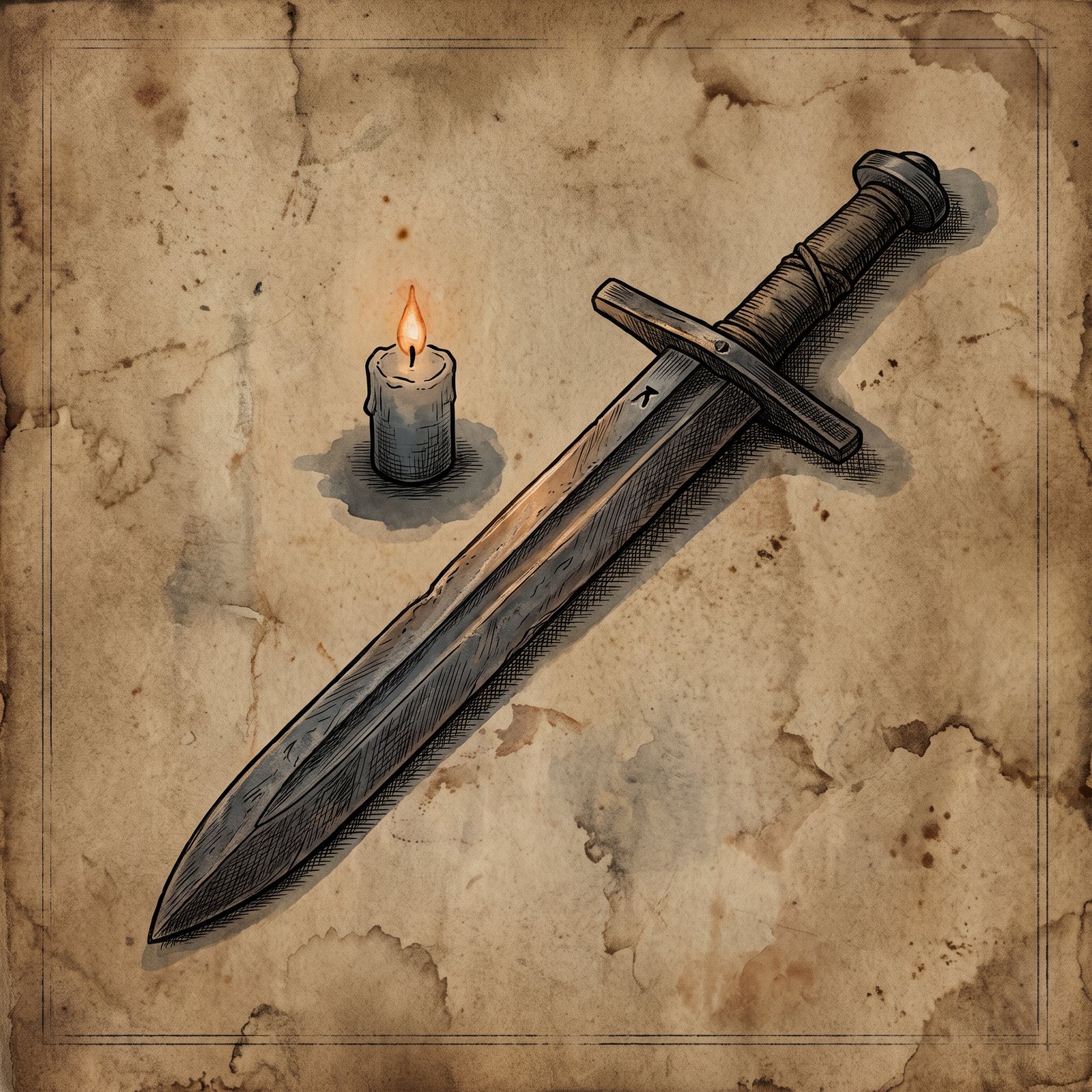
A dull, cold blade that ends things properly. Rest-iron is a working tool for places where the dead get up: the blow it lands is meant to be the last, and for a day it is. Its bearers are seldom glamorous (sextons, corpse-watchers, the soldier who stays behind after the battle), and they treat the weapon the way a gravedigger treats a shovel: with respect, and without ceremony.
Weapon (Any Simple or Martial), Uncommon
This weapon’s metal is dark, unpolished and always cold to the touch. It grants no bonus to attack or damage rolls.
Laid Down. When you reduce a creature to 0 Hit Points with an attack made with this weapon, the creature is laid down for 24 hours:
- A creature that dies. If the creature dies within that time, its remains can’t become an Undead creature, and no Undead creature can rise from them, until the 24 hours end. Its remains are its corpse, or most of what is left of it (bones or ashes count). A rising that would happen before the 24 hours end fails; it doesn’t wait. This stops all animation of the remains as an Undead creature, including animation that lasts only for a set time.
- An Undead creature. A trait or effect that would return it from 0 Hit Points or re-form it within 1 minute after it drops to 0 Hit Points (such as one that has it rise again on its next turn) fails. A trait or effect that would re-form it or return it later than that (such as Rejuvenation) can’t do so until the 24 hours end; it then does so, if it still can.
This property works only when the creature is reduced to 0 Hit Points. It doesn’t affect a trait that lets a creature drop to 1 Hit Point instead of 0, such as Undead Fortitude. It doesn’t stop a creature at 0 Hit Points from being healed or stabilized, and it doesn’t stop anything from returning a creature to life.
In Different Worlds
Ashwinter (Gritty low magic · After the fall)
- Who made it. Grave-smiths of the hearth-marches and the deep-holds, who reforge the iron that families give up from their own grave-goods once their dead are laid. Rest-iron is never bought from a stranger. It is given; or it is stolen from an unlaid grave, and then its dead come with it, and the theft answers to candle-law.
- What it is called. Rest-iron; on the fjords, lay-iron. In the hearth-marches a blade of it is “a keeper’s edge”, and Laid Down is called the second death.
- How it looks and sounds. Dark, unpolished iron with a grain like wet slate, cold in the hand even beside a hearth. It makes no ring when it strikes, only a dull knock like a shovel on frozen ground. The grave-smiths cut the giving family’s hearth-mark or rune small on the tang, so the iron’s last owners are never forgotten.
- Where one is found. Given by a family to a keeper or a host-breaker; hung by a keeper’s door.
- Story hook. The iron in the party’s blade was a family’s grave-gift. The family’s eldest wants it back for her own grave, and she is dying.
- Rules caveat. None. It keeps the half-burned and the sworn hosts down for a day; it doesn’t lay them, and their souls still linger by their remains. Under the Risen Stay Risen (Ashwinter‘s world rule), a creature killed by rest-iron can’t be made risen for a day, which buys the time to raise it or to keep its body. The world rule’s temporary-animation clause decides only whether animation makes a creature risen and doesn’t override the iron, so a Corpse-Herd can’t drive a body it has laid down.
The paladin orders of a great kingdom (Heroic high fantasy)
- Who made it. The forges of a god of endings, whose temple-smiths quench each blade in the water used to wash the dead.
- What it is called. A requiem blade; Laid Down is the final rest.
- How it looks and sounds. Black steel with a closed door engraved at the base of the blade. It rings once, like a funeral bell, when it is drawn, and never again.
- Where one is found. On the hip of a knight-errant of the order of the closed door, and in the armoury of every temple that keeps a crypt.
- Story hook. A lich’s servant has stolen the order’s requiem blades one by one. A day was all the order ever needed to find a phylactery, and now the lich is ready to die.
- Rules caveat. None.
The edge of the fey courts (Wilds and courts of the fey)
- Who made it. Village smiths who know that cold iron ends what the courts would rather prolong. A rest-iron blade is cold iron hammered on a grave-slab.
- What it is called. Cold iron of the churchyard; Laid Down is “and that’s an end of it”.
- How it looks and sounds. Black, pitted and plain as a fire-iron, with a little moss that grows back on the guard however often it is scraped off. Fey folk wrinkle their noses at it from across a room.
- Where one is found. Hung over the door of a house that lost a child to the hill, or in the hands of the midwife who walks the borders at Midsummer.
- Story hook. A fey lord’s hunt rides out with the restless dead of the barrows as its hounds, and only one smith in the valley still knows the old quench.
- Rules caveat. None. Laid Down reaches Undead only; it does nothing special against fey.
Origins and Inspiration
Northern European folklore gave iron a protective power against the uncanny: iron over a door, iron in a cradle, iron in or on a grave. In the Icelandic sagas a draugr often had to be killed a second time, and its body dealt with, before it would stay down; in Grettis saga Grettir beheads the revenant Glámr, and the body is then burned and the ashes buried where few beasts graze and few people pass. Grave-goods, the weapons and tools buried with the dead across the Germanic and Celtic north, give the iron its source. The rest-iron blade itself is invented: no tradition is known to have forged weapons from grave-goods for this purpose.