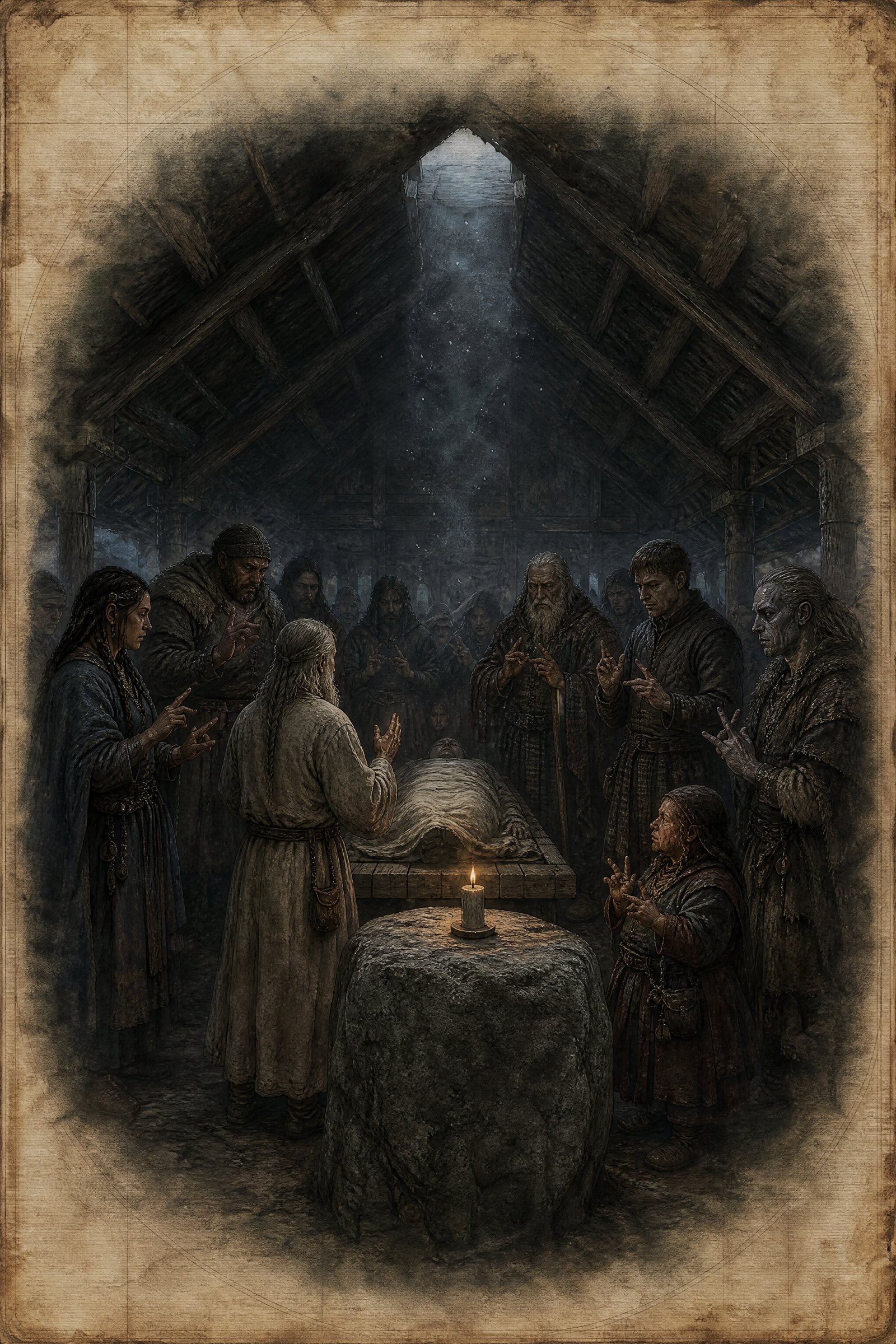
For players, before session one. Spoiler-free: everything here is something your character knows, or has heard said. The rules are the 2024 Player’s Handbook and the Campaign Rules, summed up under Make a Character and printed in full on the card at the end of Part One. Ashwinter adds one rule of its own, “The Risen Stay Risen”, under Magic below.
The Primer on One Page
The question. Who owns the dead? Their families, their faiths, the famine lords who work them in the fields, the necromancers, or the dead themselves? Every adventure in Ashwinter asks it, and your characters answer it.
The world. No soul has left the world since the First Ashfall, and this is the 440th year of ash. Sverrund, the High Jarl of the Ashen Crown, had the road’s wardens sacrificed, then walked the road while it still stood and shut it behind him, to make himself deathless, people say. The dead stay where they fall, the sky is ash, and the one law every people shares is how to put the dead to sleep.
What everyone knows.
- The road is cut. No soul has left the world since the First Ashfall (1 AA). The dead linger by their bodies, grave-goods or ashes.
- Rites give rest. The Laying of any Candle Compact faith, said on sanctuary ground, makes the dead sleep. The unrited, the unburied, those burned on old battle ground and those called by name or magic can rise.
- Sanctuaries stand on waystones. Every sanctuary needs a sworn keeper; when one dies with no successor sworn, its rest fails within days.
- The hosts are still sworn. Armies of the dead march under oaths “until the High Jarl’s death”. Whoever holds a host’s roll with the blood of the thane who mustered it commands the host.
- Every power wears many faces, one for every people, and each has a banned shadow face.
- Magic runs through the wound. Healing leaves frost scars and divination answers in a dead voice; nothing costs more or less for it.
- Nothing shortens the roads. Regions lie weeks apart, and horses are scarce.
- Rumour: the antlered judges beneath Blackwood are what is left of the wardens.
- Rumour, this spring: a live coal from the cold Gate-Pyre, the Last Ember, survived. Kindled on a waystone during a Laying, it would open that stretch of road for one season.
Three reasons to adventure.
- The dead need carrying. Keepers are dying faster than they are sworn, the roads are long, and someone has to walk the dead home and stand at the Laying.
- Bread and a grave. The famine lords pay in bread for the dead, the hosts still march for a fallen empire, and host-breakers, corpse-watches and candle-post riders make a living where the two meet.
- One season of open road. If the rumour is true, one coal could let a valley’s dead go at last, and everyone you meet wants to choose whose.
Names to say aloud.
| Name | Say it | Who or what |
|---|---|---|
| Sverrund | SVEH-rund | the High Jarl who cut the road |
| Brúvaka · Hrefnwyn · Andecarvos · Domvald | BROO-vah-kah · HREV-un-win · an-deh-KAR-vos · DOM-vald | the Warden’s faces: fjord, hearth, circle, Crown |
| Harrowmere | HARR-oh-meer | the shrine-town where you start |
| Osgyth of Sallowhearth | OZ-yith of SAL-oh-harth | Harrowmere’s keeper |
| Ollodana of the Dagovidi | ol-lo-DAH-na of the dah-go-VEE-dee | the Candle-Speaker at Seven Wicks |
| Hallbera Domsdottir | HAL-beh-ra DOMS-dot-teer | the Pyrewarden of the Order |
| Arnvald Kolung | ARN-vald KOH-lung | the Bread-Lord of Crownfast |
| Eadburh Rookhearth | AY-ad-burr ROOK-harth | the Widow of the Deadwater |
| Hrimstead · Skarvik | HRIM-sted · SKAR-veek | the Wintermarch’s hall · the fjordholds’ harbour |
This is a book for levels 1 to 5. Its four adventures take a party from 1st to 5th level; two outlines for 6th level close the Dungeon Master’s part.
Make a Character
Pick a culture. Every culture includes humans, and any 2024 background and origin feat works anywhere; these are the natural fits. Your home tongue is free flavour; Common is candle-speech.
| Culture (home) | Values | Species often found | Backgrounds · origin feats | Home tongue · languages |
|---|---|---|---|---|
| Fjordholds (Cinder Fjords, Storm Islands, north coasts) | courage before the dead; the given word; the ship and the crew | human, dwarf, orc, goliath, dragonborn, Ashborn; shifter (few), Barrowborn; aasimar, tiefling (rare) | Sailor (oarsman), Soldier (host-breaker), Entertainer (skald), Artisan (rune-carver), Guard · Tough, Savage Attacker, Tavern Brawler, Musician | Fjordtongue · Common, Dwarvish, Giant, Draconic |
| Hearth-marches (the Refugee Marches, Wintermarch, Dead Rivers, the Wain-folk’s roads) | hospitality; the tithe; feeding the dead and the stranger first | human, Hearthkin, halfling, orc, shifter (Wintermarch), Barrowborn, aasimar, tiefling | Farmer (tithe-grower), Acolyte (keeper’s novice), Guard (corpse-watch), Wayfarer (camp refugee), Merchant (Wain-folk carter) · Healer, Lucky, Alert, Magic Initiate (Cleric) | Hearth-speech · Common, Halfling, Orc |
| Circle-folk (Blackwood’s eaves, the lake-shores, the Salt Wastes’ edge, the Marches) | memory and law; courtesy with an edge | human, wood elf, drow, forest gnome, shifter, aasimar, Barrowborn | Sage (kin-list reciter), Hermit (stone-seer), Guide, Acolyte, Entertainer (reciter) · Skilled, Alert, Magic Initiate (Druid), Musician | Circle-tongue · Common, Elvish, Gnomish, Sylvan, Druidic |
| Crown-heirs (Crownfast, the deep-holds under the Ashen Crown) | writing, roads, registers; precedence; the sealed oath | human, dwarf, rock gnome, high elf, drow, tiefling, Ashborn, aasimar | Noble (a minor heir-line branch), Scribe (registrar), Acolyte (Order novice), Soldier, Merchant (grain-factor) · Skilled, Crafter, Magic Initiate (Cleric or Wizard), Alert | Crown speech and Crown script · Common, Dwarvish, Gnomish, Infernal |
| Shrine-towns (everywhere the old road ran) | where every people meets | every species | Acolyte, Guard, Merchant, Criminal (grave-robber), Charlatan (grief-draught seller), Scribe · Healer, Lucky, Skilled, Tavern Brawler | any · Common, Common Sign Language, Goblin |
| Rime-holds (Wyrm Ice margins, fjord heights) | keeping the frozen dead from wandering south | goliath, human, dragonborn | Guide, Hermit, Soldier · Tough, Alert | Fjordtongue · Common, Giant |
| Salt-lords’ country (Salt Wastes) | salt, and its price | human, dwarf, halfling, gnome, Barrowborn | Merchant (salt-trader), Guard (caravan), Criminal (smuggler) · Crafter, Skilled, Tough | Circle-tongue or Crown speech · Common, Undercommon |
Pick a species. Every 2024 species lives here, plus the shifter and three new species born of this world, printed in full in Player Species: the Ashborn, the Barrowborn and the Hearthkin. No people is evil by birth, the Barrowborn, Ashborn and tieflings included.
Pick a class. All official 2024 classes are here: clerics serve any face (some a shadow face), druids keep the Furrow’s land, and wizards and sorcerers are rare and feared. Ashwinter also knows the thirteen classes below, each under its local name. None of them is needed to play.
Where their rules are. This book prints none of these thirteen classes’ rules. Each is printed separately as its own class book (The Thresholder, The Anchorite and so on), with its subclasses and spells; ask your DM for the one you want before you build. All thirteen fight unarmoured, with a d8 Hit Point Die, and cast with spell points; most also spend Qi points, and the Fateskald and the Ley-Walker fight with a weapon they call into being.
Road-Keepers (the Thresholder; common). Keepers of the door between the living and the dead, who claim descent from the wardens’ lay brethren. Every large sanctuary keeps one, and the Order trains them at the Pyrehold. They speak to the lingering dead by name, and the dead owe them favours. A Road-Keeper’s subclass is a keeping; the Worthy keeping’s Road-Keepers are the ones sent to read a host its roll. Dexterity and Wisdom.
Candle-Sworn (the Anchorite; common). Keepers’ hermits who swear a handful of public vows on a waystone and walk the post roads healing; their grace reaches exactly as far as a hand can. A broken vow is “a guttered candle”, mended by penance at the nearest waystone. Ashwinter’s main healers. Dexterity and Wisdom.
Hearth-Wards (the Glyphwalker; uncommon). Hearth-march wardens whose promises are knots tied in soot-ink on their skin; they spend their own inner power so that the blow meant for a friend lands smaller. The commonest Knot here is the Knot of the Hearth. Dexterity and Wisdom.
Rune-Scarred (the Reddened; uncommon, the north). Fjord fighters who cut grave-runes over old scars and pay for their power in their own Hit Point maximum. They smell of tar and blood, and the runes redden under the skin. Dexterity and Constitution.
Bridge-Askers (the Fateskald; uncommon, the north). Fjord skalds who read which of the dead will rise and which oath will break, and spend a small store of corrections on other people’s dice. Their called blade is “the toll-knife”. Dexterity and Intelligence.
Ember-Bearers (the Furnace Adept; uncommon). The Order of the Unlit Pyre’s flame-carriers: a body that makes its own fire, and a lifetime’s discipline spent keeping it from burning down the room. They walk the burning ground, and ash falls warm round them. Dexterity and Constitution.
Ash-Walkers (the Harmonist; uncommon). Guides who take caravans and post-riders through ash storms by listening to the note the world is already holding; the ash parts round their “clear road”. Dexterity and Wisdom.
Muster-Drummers (the Wardancer; uncommon). They took the hosts’ war-drums for the living: performer-fighters who hear the beat under every fight, lend it to friends and steal it from enemies. Every host-breaker company wants one. Dexterity and Charisma.
Fetch-Bound (the Nagual; uncommon, the Wintermarch and Blackwood’s eaves). Fighters of the wolf-ancestor clans who share a body with an animal self, the fetch, and let pieces of it surface one strike at a time. Dexterity and Wisdom.
Ash-Tithed (the Tithed Fist; rare). Fighters who cut a channel into themselves at a waystone and draw on the current that runs along the old road’s stones: few spells, cast huge, paid for out of their own bodies. Their far leap is the Stone-Leap. Dexterity and Charisma.
Waystone-Walkers (the Ley-Walker; rare). Blade-mystics whose places of standing are the waystones and crossroads of the old road; they bow to every milestone, carry a glaive of grey light, and are owed a favour by the road itself, a road-debt. Dexterity and Charisma.
The Unmoved (the Stillmind; rare). A circle-folk seer-discipline that holds the mind so still the world begins to lean toward it, and strikes with a force no arm could throw. Dexterity and Wisdom.
Ledger-Hands (the Calligrapher; rare). The Order’s and the Crown chancery’s clerks, who fight by writing: every blow is a register-mark, and the marks stay where they were drawn. Dexterity and Intelligence.
Features keep their rules names, with a few local words: a Thresholder’s Rite is a keeping (the Rite of the Muster is the Worthy keeping) and what its rules call the far shore is the grey bank of the Grey Threshold; a Ley-Walker’s Compact is a road-debt; a Tithed Fist’s The Far Shore is the Stone-Leap; a Nagual’s animal self is the fetch.
The Campaign Rules. Every caster here uses spell points instead of spell slots, casts one spell of 1st level or higher per turn, and holds one Concentration at a time. Thirteen spells don’t exist, among them Goodberry, Create Food and Water, Leomund’s Tiny Hut, Teleport and Word of Recall, so the roads and the hunger are real. Zone of Truth and Legend Lore work differently, and the thirteen classes above don’t have Arcane Eye. The full rules are on the Campaign Rules card at the end of Part One: read it before you choose a caster.
Powers. The Warden (death as passage), the Furrow (the earth that feeds and receives), the Bearer (mercy), the Witness (oaths and law), each worn as a different face by each people, each with a banned shadow face. Every face answers its own, anywhere.
Magic. Spells work as written; only the feel changes. The Risen Stay Risen: a risen creature can’t be returned to life by magic.
Travel. On foot, 30 km a day on a Crown road, 20 across open country and 12 on rough ground; 60 by candle-post; regions lie weeks or months apart, and ash storms stop travel one day in ten.
Calendar. Years are AA, “after the Ashfall”: twelve 30-day months, then the five Mothers’ Nights.
You start in Harrowmere, a shrine-town at the Ashen Crown’s foot, on 1 Thaw, 440 AA, as the ground opens and the graves stir.
More to read
How each people tells it
| People | Their account of the cut |
|---|---|
| Fjordholds | Brúvaka drew up the bridge when the jarls broke faith, and will lower it when a jarl pays the toll in his own blood. |
| Hearth-marches | The Raven-Mother’s hand was forced shut. A hand can be opened; that is what the Mothers’ Nights are for. |
| Circle-folk | The Door was stolen, not shut. The antlered one still waits beneath the stones for someone to bring the key. |
| Crown-heirs | The Judge closed the Gate on a faithless age. The heir-lines, who kept faith, will open it. |
| The Candle Compact | All of these are one road and one warden. A man cut it, not a god, and what a man did can be undone. |
Critics call candle doctrine “the Crown’s lie in a cleaner coat”: the Crown’s temples taught “one truth, many faces” first, to bind the peoples it conquered.
The four powers and their faces
| Power | Fjordholds | Hearth-marches | Circle-folk | Crown faces |
|---|---|---|---|---|
| The Warden (the road; judgement) | Brúvaka, the Bridge-Wake | Hrefnwyn, the Mother with the Raven | Andecarvos, the Antlered Doorward | Domvald, the Judge at the Gate |
| The Furrow (harvest and burial) | Akrdis, the Field-Lady | Sedwyn, the Mother with the Sheaf | Ardumaga, the High Field | Kornbjorg, the Granary-Keeper |
| The Bearer (suffering carried) | Tholmod, the Long-Enduring | Halwyn, the Mother with the Cloth | Sucara, the Binder | Liknhild, the Mercy-Bearer |
| The Witness (oaths, fair measure) | Eidhelm, the Oath-Helm | Treowmund, the Mothers’ oath-brother | Ollovidos, the All-Seeing | Rettmal, the Even Measure |
| Shadow face (banned) | The power turned against itself | Formal name | Common bynames |
|---|---|---|---|
| The Unwaning | the Warden, refusing death; the face the High Jarl wore | Eilivald | the Mound-King, the Closed Hand, the Held Door |
| The Hollow Mouth | the Furrow, eating without filling | Gifra | the Barrow-Belly, the Field That Eats |
| The Veil | the Bearer, ending pain by forgetting | Dumnovela | the Grey Unremembering, the Cloth over the Face |
| The Iron Claim | the Witness, the oath made a chain | Jarnrad | the Oath-Chain, the Collar, the Tight Torc |
The hearth-marches’ three Mothers are three powers, the Furrow, the Bearer and the Warden, seen as sisters. A divine character picks a face, and with it a politics; no rule changes. Paladins swear before a face of the Witness or the Warden; warlocks bargain with a shadow face, the lingering dead, or something under the ice.
Quarrels. Each power is at war with its shadow face, except the Bearer, which keeps an uneasy truce with the Veil: hospices allow the Veil’s grief-draught for the dying, and its name-burners burn the names of the dead “so they can rest”. Furrow priests won’t bless a field worked by grave-thralls. Freeing a sworn host is a Witness rite; holding one is the Iron Claim’s work. The Warden and the Furrow are allies (burial is sowing), and so are the Witness and the Warden (every grave is a witness, and a grave-oath binds the dead). The Unwaning and the Iron Claim were the Crown’s twin faces; the Unwaning and the Hollow Mouth compete for the same dead. The gods answer, always, but none can open the road by itself.
The Candle Compact and the Laying
In 189 AA the keepers of seven sanctuaries from four peoples sealed the Candle Compact at Seven Wicks. Its law, candle-law, holds because it feeds people: the burial law and the food tithe are one law.
- The Laying. The officiant speaks it in the Warden’s and the Furrow’s names, whatever faces they use; the mourners keep silence and use graveside hand-speech (Common Sign Language). The laid dead sleep. They do not go: since 1 AA nothing sends a soul on.
- No rest elsewhere. A Laying in a shadow face’s name gives none. A fjord pyre, a sea-burning, a barrow-mound or a field grave honours the dead but gives no rest: the soul stays awake by its remains until they are carried to a sanctuary and laid. The pyre-burned stay by their ashes; the drowned and the sea-scattered are the sea-dead, beyond any Laying unless their remains are found.
- Sanctuaries and keepers. Every sanctuary belongs to every face. A sanctuary’s lands run a day’s walk from its waystone. Its keeper is sworn for life on the waystone and never leaves it for good. Keepers are dying faster than they are sworn.
- The shrine-town has a sanctuary, a keeper’s house, a granary, a corpse-watch and a post-house for the candle-post, the Candle Compact’s relay of fresh ponies.
- The Order of the Unlit Pyre is its burial order: the sun temple’s priests, who have kept the temple and its barges since the Ashfall and joined the Candle Compact at its sealing. It forbids pyres everywhere (the earth clause), keeps the cold Gate-Pyre at the Pyrehold, and lays the dead its barges bring in the Order’s yard, which has its own sworn keeper. Its people are named Domsson and Domsdottir, “child of the Judge”.
- Oaths sworn before any face of the Witness bind every party; one on the Iron Claim’s terms binds as hard. Every ward works on every creature exactly as written: the dead belong to no faith.
The sworn hosts
When the road shut, armies rose where they stood, and they still march under their oath. A host’s commanders are the Banner-Draugs; its dead move ten to a rank; fjord-folk call a whole host a grey crew. Whoever holds the roll with the mustering thane’s blood commands it, and releasing the oath lays the soldier down (he still needs a Laying to sleep). Host-breaker companies make a living walking into hosts with the right roll.
Who is in charge
| Who | Leader | What they want | What they can offer you |
|---|---|---|---|
| The Candle Compact (Seven Wicks) | the Candle-Speaker, Ollodana of the Dagovidi | sanctuaries kept, tithe paid, doctrine proven | the candle-post; bread and sanctuary in every shrine-town; a keeper’s token; commissions |
| The Order of the Unlit Pyre (the Pyrehold) | Pyrewarden Hallbera Domsdottir | the earth clause kept everywhere | barges on the Long Water and down the Harrow; registers; trained keepers |
| The Bread-Lord (Crownfast) | Arnvald Kolung, Lord-Steward of Crownfast | the old title Sun-Bringer and the Crown’s legitimacy | grain for a hungry town; Kolung post-houses on the Westway; a place at his table |
| The Widow of the Deadwater (Sorrowholm) | Eadburh Rookhearth, a bereaved necromancer | her dead brought home | a voice for the bereaved; the truth about a lost family member |
| The Old Burners (Skarvik) | Jarl Bersi of Skarvik | to burn their dead as their ancestors did | longships and passage on the north coast |
Great houses. The Vardungs, the Crown’s old jarls of the fjords, keep the high hall above Skarvik’s harbour under old Ingibjorg Vardung, rich in harbour-dues and ships; Bersi is no Vardung, though they take his pyre-ships’ dues. The Hrimstead hearth, the one hearth-march family named for a hall, rules the Wintermarch’s clans by the Crown’s old grant; its Hall-Mother is Godgyth of Hrimstead. The circle-folk’s old seer-kin, the Dagovidi, are led by Caradagos of the Dagovidi, who holds their kin-list; the Candle-Speaker is his sister. The salt-lords sell dearly the fact that salted dead neither rot nor rise.
Famine lords feed towns with grave-thralls, the unrited dead worked in the fields under a reeve’s tally. The Bread-Lord is the greatest of them. Bread and a grave sit on opposite sides of one ledger.
If the Last Ember is real, everyone will want it. The Order says it belongs to the Gate-Pyre or nowhere; the Bread-Lord’s people say a kindling at Crownfast would feed the western Marches; the Widow, people whisper, wants it to bring her dead home alive.
Magic and how it feels
- Healing frosts: a wound closed by magic leaves a white rime-scar that never quite warms.
- Fire on battle ground where the dead were burned unrited may wake the half-burned.
- Necromancy comes easily. Raising anyone’s dead without their family’s leave is grave-theft under candle-law.
- Divination answers in a dead voice. Speak with Dead works as written; the dead answer as the people they were.
- Arcane magic is feared. Common folk believe wizards burn the lingering dead to fuel their spells, and many towns forbid it within their walls. (Out of character: no spell spends a soul.)
- No other world is in reach. The Grey Threshold, where the unrited dead linger, is the Border Ethereal and part of this world: Etherealness and Blink work. Spells that reach other planes work as written, but where they go is story (“nothing that leaves comes back”). The banned spells (Teleport, Plane Shift and the rest) do not exist.
- The ash and its storms are ordinary weather for every rule.
The Risen Stay Risen (the world rule). A risen creature can’t be returned to life by magic.
- Risen: after death, its body rose as Undead that lasts until destroyed (Animate Dead, Create Undead, Finger of Death, a monster’s spawn), or its spirit rose as a ghost, specter or shadow, or it became Undead itself.
- Not rising: animation with a set duration that leaves a corpse behind when it ends (a Road-Keeper’s driven corpses); Speak with Dead; Summon Undead; a shape change; being Barrowborn.
- A raising is anything that returns the dead to life: Revivify, Raise Dead, Reincarnate, Resurrection, True Resurrection, Clone, Wish, or a feature or item doing the same. A new body doesn’t help.
- When one fails on a risen creature, you spend the casting time and action and nothing else (spell points, uses, charges and components are kept; Wish causes no stress); it still counts as your levelled spell that turn. You learn the creature is risen, and whether its Undead still exists. Nothing warns you before you cast.
- Once risen, always risen, even after the Undead is destroyed or laid. Gentle Repose guards the body, not the spirit. The keepers say: “Raise them before they rise.”
Travel and the ash
The continent is about 8,400 km from coast to coast (the map, with its seas, about 11,900); a region is the size of a country.
| Means | km a day |
|---|---|
| On foot: Crown road · open country · rough ground | 30 · 20 · 12 |
| Pony or cart on a Crown road (a pony costs a family’s season of food) | 35 |
| The candle-post, for riders on Candle Compact business with a keeper’s token (the Kolungs run it west of Crownfast) | 60; 45 on the thin Westway |
| Riverboat downstream by day · upstream | 60 · 25 |
| The Order’s barges, day and night, on the Long Water and down the Harrow | 90 |
| Lake or coastal sail · longship | 100 · 120 |
| Sledge on ice or snow (Longdark to Lean) | 50 |
Ash storms stop travel for the day, about one day in ten. The old Crown roads (the Crown Road, the Westway, the Sun Road) are the fastest ground in the world.
From Harrowmere: Musterdale 2 days on foot · the Pyrehold 7 days by post · Crownfast 13 by post · the Deadwater’s west shore 31 by post · Seven Wicks 32 by barge · Blackwood’s south-eastern eaves 47 by post · Sorrowholm 6–7 weeks · Saltford about 11 weeks · Skarvik 3–4 months · Hrimstead about 4 months · the Broken Circle about 3 months over the Crown’s passes (forbidden).
What history everyone learns
| When | What happened |
|---|---|
| c. 80 BA | The Ashen Crown rises under the High Jarl Sverrund; its temples forge the Crown faces. |
| c. 30 BA | The Rites begin beneath the Broken Circle: court priests and bound Dagovidi seers sacrifice captive wardens. They leave a record, the Roll of the Rites, that no one you know has seen. |
| 9 Reaping, 1 AA | The First Ashfall. Sverrund shuts the road behind him. Mounds split, armies rise where they stand, and the lowland lakes rise over the circle-folk’s towns. |
| Lean, 2 AA | An ash-slide drowns Musterdale, up the Harrow, over the Third Muster’s hall. |
| 51 AA | The Long Retreats; the Refugee Marches are settled. Thorgunn the Bridge-Holder holds Skarvik bridge against a host for nine nights. |
| c. 70–90 AA | Vindomara the Stone-Speaker carries the circle-rites into the Marches. |
| c. 150 AA | Aedwyn of Thornhearth opens the first shared sanctuary. |
| 189 AA | The Candle Compact is sealed at Seven Wicks. |
| c. 262–270 AA | The Hungry Years: grave-thralls first go to the plough. |
| 344 AA | The Blackwood Burn: the fire fails to consume the dead, and the wood walks. |
| 440 AA | Now. The rumour of the Last Ember spreads. |
Each people’s shame. The fjordholds remember the Vardung jarls who sent captives to the Rites; the hearth-marches, that the first famine lords were their own reeves; the circle-folk, the Dagovidi seers who served the Rites under compulsion and then for pay; the Crown-heirs, the empire itself. The Dagovidi say the seers who served were a cadet branch, long extinct. Many circle-folk believe it; some recite the cadet branch’s names and say the list is oddly short.
Where people live
Harrowmere stands where the Harrow leaves the Ashen Crown, the black range at the world’s centre, with Crownfast on its south flank. East lie the Refugee Marches, the braided Dead Rivers with Seven Wicks, the still Deadwater Sea with the Widow’s drowned tower Sorrowholm, and the empty Gravetide Fields, where the hosts muster. South: the Last Ember, burning ground that never cools, with the Pyrehold on its rim. North-east: the Wintermarch; offshore, the Stormreach Isles, from which no news returns. North: the Broken Circle, where no one lives (forbidden), the Volcanic Ash Zones, the Cinder Fjords with Skarvik, and the Wyrm Ice; the Storm Islands lie off the north-west. West: Blackwood, whose ash-black trees move at night and where travellers vanish at the eaves; south of it the Haunted Inland Seas, with bells under the water; then the Salt Wastes with Saltford, and the Shattered Coast. Monsters are common, and mostly dead.
Species in Ashwinter
| Species | Local names | Where |
|---|---|---|
| Human | folk | everywhere |
| Aasimar | Candle-born · Mother-touched · Bridge-lit | rare births, often on a Mothers’ Night; a faint light at the throat in grief |
| Dragonborn | Wyrm-kin · orm-born | the Storm Islands, the Wyrm Ice margins |
| Dwarf | deep-holders · berg-folk | the deep-holds; fjord smiths |
| Elf | the Long-Lived · elder-kin · rememberers | rare: wood elves at Blackwood’s eaves, high elves in the chancery, drow among stone-seers and deep-hold clerks |
| Gnome | burrow-folk (forest) · lamp-wrights (rock) | Blackwood’s eaves; the deep-holds |
| Goliath | Rime-kin | the Rime-holds and the high passes |
| Halfling | wheel-born (born on the road) | the Wain-folk caravans |
| Orc | the Wintermarch’s “first hearths” | oarsmen, host-breakers, corpse-watches |
| Tiefling | the marked: Claim-marked (Infernal) · Held-born (Chthonic) · Mouth-marked (Abyssal) | a forebear’s bargain with a shadow face, never the child’s |
| Shifter, from Monsters of the Multiverse | wolf-born | the Wintermarch, Blackwood’s eaves; ability increases come from your background |
| Ashborn | the Downwind · askfolk | born under the heaviest ash; they see through smoke, shrug off poison and bad air, and cough grit that spoils a foe’s aim |
| Barrowborn | barrow-children · haugborn | born close to the dead; alive, never Undead; dark-sight, a sense for the walking dead, and Spare the Dying, Gentle Repose and Speak with Dead |
| Hearthkin | ingle-folk (“an ingle”) · glowfolk | small, warm folk who tend the shrine-town hearths; fire-resistant; Produce Flame, Heroism and Aid; allies resting at their fire heal more; struck down, they can bank like coals |
The Ashborn, Barrowborn and Hearthkin are new species, not official ones: their full rules follow in Player Species. Ask your DM whether they are open at your table.
Backgrounds and languages
Backgrounds here. Acolyte: keeper’s or Order novice. Artisan: coffin-wright, rune-carver, lamp-wright, salt-boiler. Charlatan: false grave-blessings, grief-draughts. Criminal: grave-robber, thrall-runner, smuggler. Entertainer: skald, funeral-singer, kin-list reciter. Farmer: tithe-grower. Guard: corpse-watch. Guide: ash-guide. Hermit: waystone hermit, stone-seer. Merchant: Wain-folk carter, salt-trader, grain-factor. Noble: a minor heir-line branch, or a jarl’s kin. Sage: kin-list reciter, chancery archivist. Sailor: oarsman, Order bargeman, lake-boater. Scribe: registrar. Soldier: host-breaker. Wayfarer: camp refugee.
Languages. Common is candle-speech; home tongues are free; the literate write Crown script. Common Sign Language: graveside hand-speech · Dwarvish, Gnomish, Undercommon: the deep-holds · Elvish: the Long-Lived · Halfling: the Wain-folk · Orc: the Wintermarch’s oldest lines · Giant and Draconic: the Rime-holds, the Wyrm-kin, the runes in the ice · Sylvan: Blackwood’s walking trees · Druidic: circle seers · Celestial: the true faces’ liturgy · Infernal: debt-bonds and Kolung contracts · Abyssal: the Hollow Mouth’s cults · Primordial: the vents and storms · Thieves’ Cant: grave-robbers · Goblin: camp-cant, the refugee camps’ jargon.
Names
| Culture | Pattern | Examples |
|---|---|---|
| Fjordholds | a parent’s whole name + -son / -dottir | Hallgrim Ketilsson · Thordis Ulfarsdottir · Geirny Bjarnardottir |
| Hearth-marches | “of” a hearth-name (plant or bird + -hearth); bare once you have left your hearth | Leofwyn of Ashhearth · Godric of Elderhearth · Eadric Wrenhearth |
| Circle-folk | men -os, women -a/-ona; patronymic -cnos / -cna | Segomaros Andecnos · Cintugena Segacna · Carantos Vercnos |
| Crown-heirs | title + given name + line-name in -ung; the Order’s Domsson / Domsdottir | Sigvor Vardung · Gunnhild Domsdottir · Sigvald Domsson |
| Candle-speech | an office + a place, or a number + a thing | the Keeper of the Mere · Seven Wicks |
No god’s name as a personal name. Two hearth-march people with one hearth-name are kin. A great house’s name ties you to a ruling house: talk to your DM first.
The calendar and festivals
Deepfrost · Lean · Thaw (graves stir) · Sowing · Greening · Bright (midsummer) · Haymonth · Reaping (harvest) · Tithe · Kindling · Barrow (the great burying) · Longdark, then the five Mothers’ Nights, when the year turns.
- The Mothers’ Nights: three seats at every hearth; every people feeds its dead.
- Antlerfall (1 Lean): the circle-folk leave a seat empty for the wardens.
- Ashfall Day (9 Reaping): a fast, with every fire banked for an hour at noon.
- The Relighting (1 Tithe): each sanctuary relights its candle from a neighbour’s.
- Bridge-Wake (the last night of Kindling): empty lamp-boats on the fjords.
Words to use
the road (cut) · laid, sleep (never “sent on”) · sanctuary, waystone, shrine-town, keeper · candle-law, candle-speech · the Grey Threshold · the far country · the wardens, “the antlered” · a host, a roll, a rank · grave-thralls, the half-burned, the risen · the Marches (the land), the hearth-marches (the people). Fjord-folk call the world the Long Ash and the Laying “the earth-wake”; hearth-folk call the dead “the quiet folk” and a keeper “the candle”; circle-folk call the Broken Circle “the stones” and a lie “a short memory”; Crown-heirs call the dead “the registered”.
Tone and content
Grim, low-magic survival with dignity: expensive choices, partial victories, journeys worth their weeks. A funeral done right is the world’s commonest light. The dead are people with names. Humour is dry, and never at a graveside. No faith is the true one, and no people is evil.
Content warnings: death, funerals and grief; undead; human sacrifice (backstory only, never shown, never a player character’s act); famine; forced labour; inherited guilt; bodily scarring. No undead children appear on screen. Raise anything you want handled with care, or left out, before play.
Where the campaign starts
Harrowmere, 1 Thaw, 440 AA. The shrine-town sits on a mere where the Harrow comes out of the Ashen Crown and the Crown Road meets the valley road. Its waystone is old-road stone; its keeper’s house faces the water; its camps hold more refugees than the town holds citizens. Its keeper, Osgyth of Sallowhearth, is failing, and no successor is sworn. The thaw is opening the ground, the winter’s dead are waiting, and the rumour of the Last Ember has reached the camps.