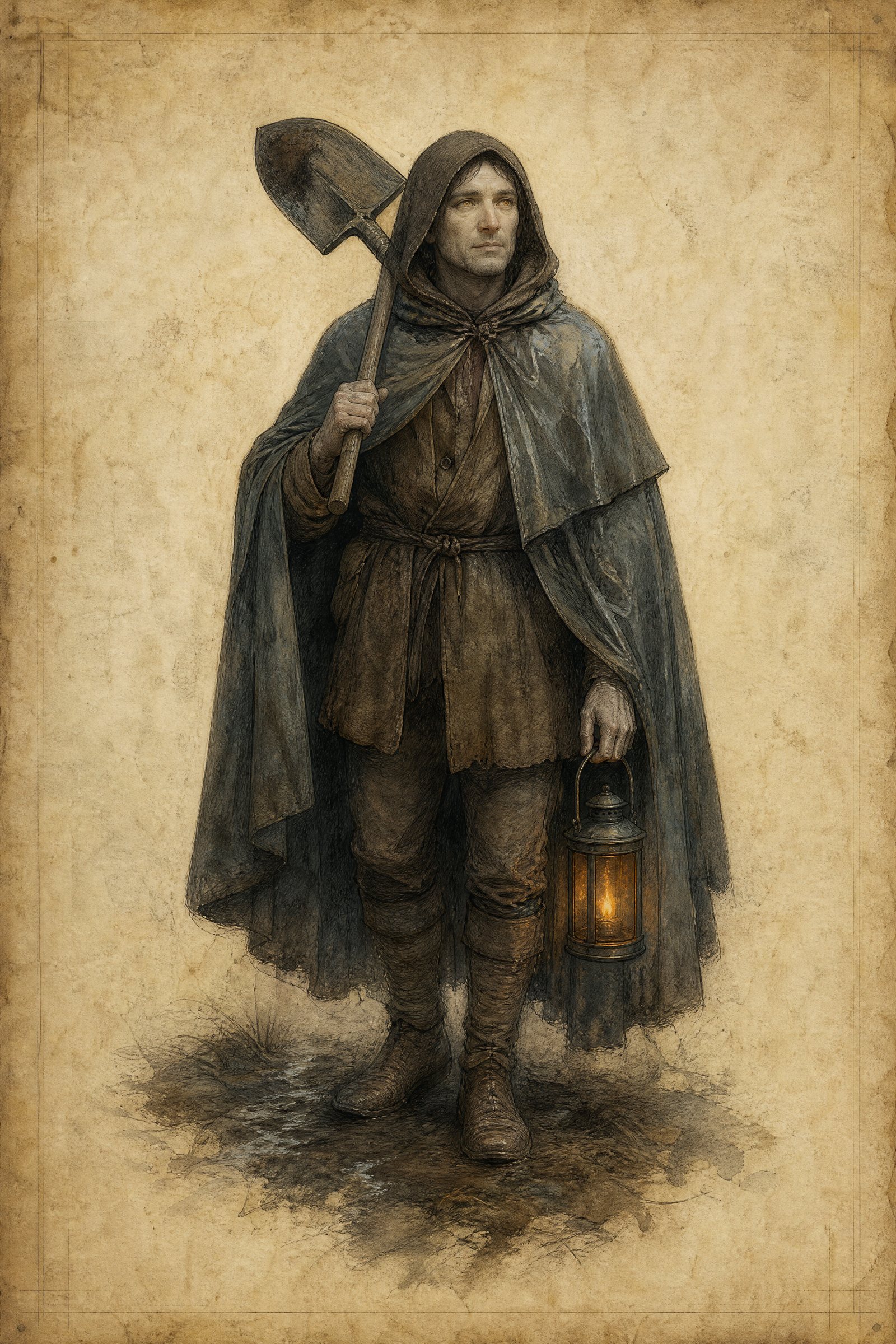
Living children of the dead-touched, cool of blood, at home in the dark, who feel the walking dead the way others feel a draught.
Barrowborn Traits
Creature Type: Humanoid. You are a living creature: you breathe, eat, drink and sleep as other Humanoids do, and you are never Undead by virtue of this species.
Size: Medium (about 4–7 feet tall) or Small (about 2–4 feet tall), chosen when you select this species
Speed: 30 feet
Barrowborn are cool to the touch and a shade paler than their kin, with eyes that catch the light like a cat’s. They live about as long as humans.
As a Barrowborn, you have these special traits.
Darkvision. You have Darkvision with a range of 120 feet.
Cold Blood. You have Resistance to Necrotic damage.
Grave Sense. As a Bonus Action, you open your awareness to the dead that walk. For the next 10 minutes, you know the location of each Undead creature within 60 feet of you that isn’t behind Total Cover; the area moves with you. You know that each one is Undead, but not what kind of creature it is. This sense doesn’t let you see the creature (an Invisible creature stays Invisible to you), and it doesn’t require Concentration.
You can use this trait a number of times equal to your Proficiency Bonus, and you regain all expended uses when you finish a Long Rest.
Barrow Lore. You know the Spare the Dying cantrip. When you reach character levels 3 and 5, you learn a higher-level spell, as shown on the table below. You always have these spells prepared. You can cast each of the levelled spells once without spending spell points, and you regain the ability to cast it in that way when you finish a Long Rest. You can also cast these levelled spells by spending spell points, as normal, if you have any. You can’t cast these spells as Rituals through this trait, even if you have a feature that lets you cast Ritual spells.
Intelligence, Wisdom, or Charisma is your spellcasting ability for the spells you cast with this trait (choose the ability when you select this species). A spell you cast with this trait is a spell for every rule, including the limit of one spell of 1st level or higher per turn and the limit of one Concentration at a time.
| Character level | Spell |
|---|---|
| 1 | Spare the Dying (cantrip) |
| 3 | Gentle Repose (2nd level) |
| 5 | Speak with Dead (3rd level) |
The setting layer
Identity
You are alive in every way that matters, but you were born close to the dead: in a tomb, after a parent’s death, or into a line that has kept company with the dead too long. Nothing in you hungers. Your blood runs cool, your eyes are at home in the dark, and you feel the walking dead the way others feel a draught under a door. Villages treat your kind as undertakers, as mediums or as bad omens, and often all three in the same week.
Sensory palette
Cool, pale and quiet: cold fingers, lamplight shining back from the eyes like a cat’s, the smell of turned earth and lime. Grave Sense is felt, never shown: a draught at the nape, a chill on the side of the face turned toward the dead. Barrow Lore‘s spells are spoken low, as at a bedside. Never a green glow, never bones on show, never hunger.
In Different Worlds
The rules above never change. Only the names, looks and stories below do.
Ashwinter (Gritty low magic · After the fall)
- Who they are there. No soul has left Ashwinter since the road was cut, and some families were born too close to what stayed behind. Most Barrowborn are born to Barrowborn parents; a few come to ordinary families, and hearth-march midwives say those come in Barrow, when the great burying is done. They are found in every culture. Sanctuary keepers foster them and take them onto the corpse-watch, because they know which graves are not quiet.
- What they are called. The hearth-marches say barrow-children at the door and worse behind it; the fjordholds say haugborn, “mound-born”. Grave Sense is the draught, Cold Blood cold hands, and Barrow Lore the keeper’s words.
- How they look and sound. Pale under the ash, with hands that are cold even by the fire and eyes that shine back at the corpse-watch’s lantern. They speak quietly from habit: in a burial field, a raised voice is an invitation. A barrow-child of the marches smells of candle-wax and wet earth from the night’s watch; a haugborn of the fjords tends the old mounds on the headlands and smells of turf smoke and brine.
- How others see them. Distrusted, and needed. The Candle Compact’s registers list more Barrowborn keepers than their numbers would suggest, and the famine lords’ thrall-masters would pay to have one. No faith of Ashwinter holds them evil, though every faith has a preacher who says otherwise.
- Story hook. Saltford’s sanctuary keeper is dying with no successor sworn, and when the keeper dies the town’s laid dead will wake within days. The Candle Compact asks a Barrowborn player character to swear the keeper’s oath on the waystone, which means never leaving Saltford for good; the only other candidate is a Kolung thrall-master’s daughter, and the town is split over which of them to accept.
- Rules caveat. The traits don’t change. Barrowborn are Humanoid and alive, so under the Risen Stay Risen (Ashwinter’s world rule) one is never treated as risen. Grave Sense finds Undead in Ashwinter far more often than in most worlds; that is the world, not the rule. Gentle Repose matters more here. While it lasts, nothing can animate the reposed remains as an Undead creature, not even for a set time (a Corpse-Herd can’t drive a reposed body); the world rule’s temporary-animation clause decides only whether animation makes a creature risen, and doesn’t override the spell. Under that rule it doesn’t stop a spirit rising. By the spell’s own text, time spent under Gentle Repose doesn’t count against the time limit of a spell that returns the target to life, so a casting made before Revivify‘s minute runs out holds that minute open for as long as the spell lasts. Ashwinter reads the spell that way.
The catacomb city (Urban intrigue)
- Who they are there. Beneath one great city lie nine centuries of catacombs, and the undertakers’ guild that keeps them is three-quarters Barrowborn. Membership passes in families. The guild buries the city’s dead, and it knows which crypts are restless and which noble houses pay to keep them so.
- What they are called. Crypt-kin in the street; Guild-born in the guild’s own charter. Grave Sense is listening at the stone, Cold Blood the guild’s chill, and Barrow Lore the last office.
- How they look and sound. Black guild coats, pale faces, the faint smell of the lime they use on the bones. They say “the quiet ones” for the dead who stay down and “tenants” for those who don’t.
- How others see them. Every noble house uses them and none invites them to dinner. Guild-born are the best-informed people in the city, because the dead are its most patient witnesses.
- Story hook. A guild undertaker has sensed something walking in a sealed family crypt, and the family insists the crypt has been empty for a century. The guild wants a quiet look before the city watch takes an interest.
- Rules caveat. None.
Children from under the hill (Wilds and courts of the fey)
- Who they are there. In a world where the fair folk live inside the hollow hills, a “barrow” is a fairy mound, and the Barrowborn are the children who came back out of one. Taken as babes and returned years later with no time lost, they grew up among folk who are not quite alive and not quite dead, and it left them cool-blooded and keen-eyed.
- What they are called. Hill-returned, or changelings by those who don’t know the difference. Grave Sense is the hill-chill, Cold Blood the mound’s touch, and Barrow Lore the hill’s courtesies: the rites the mound-folk taught them for the dead who visit.
- How they look and sound. Pale, with a faint frost of silver in the hair and eyes like a deer’s at night. They hum tunes nobody in the village knows.
- How others see them. As lucky and unlucky at once. A hill-returned child is good to have at a wake and bad to have at a wedding.
- Story hook. A Barrowborn’s hill-foster mother sends word that someone has been robbing the mound’s dead, and the trail leads to the village that raised the Barrowborn.
- Rules caveat. None for the species. Grave Sense finds only Undead, so in a world with few of them it is a quiet trait; nothing in it depends on the fair folk, and it doesn’t sense fey creatures.
Origins and Inspiration
The Barrowborn draw on three threads of real folklore. The Old Norse sagas tell of the haugbúi, the mound-dweller who lingers in his barrow, and the draugr, the restless dead who walk out of it: these are the dead the Barrowborn can feel. Folk belief in many parts of Europe held that a child born with the caul had a foot in the other world; the fullest record is the benandanti of Friuli, caul-born men and women who told sixteenth- and seventeenth-century inquisitors that they went out in spirit at night, some of them among processions of the dead (studied in Carlo Ginzburg’s The Night Battles). Some regional traditions also credited a posthumous child, born after a parent’s death, with unusual gifts. J. R. R. Tolkien’s barrow-wights are a literary echo, not a source. The dhampir of Balkan folklore, the child of a vampire, is the tradition deliberately not drawn on: the Barrowborn have no hunger, no bite and no blood-debt. The adaptation turns all of these into a living people whose gift is to sense and to ask, never to command.