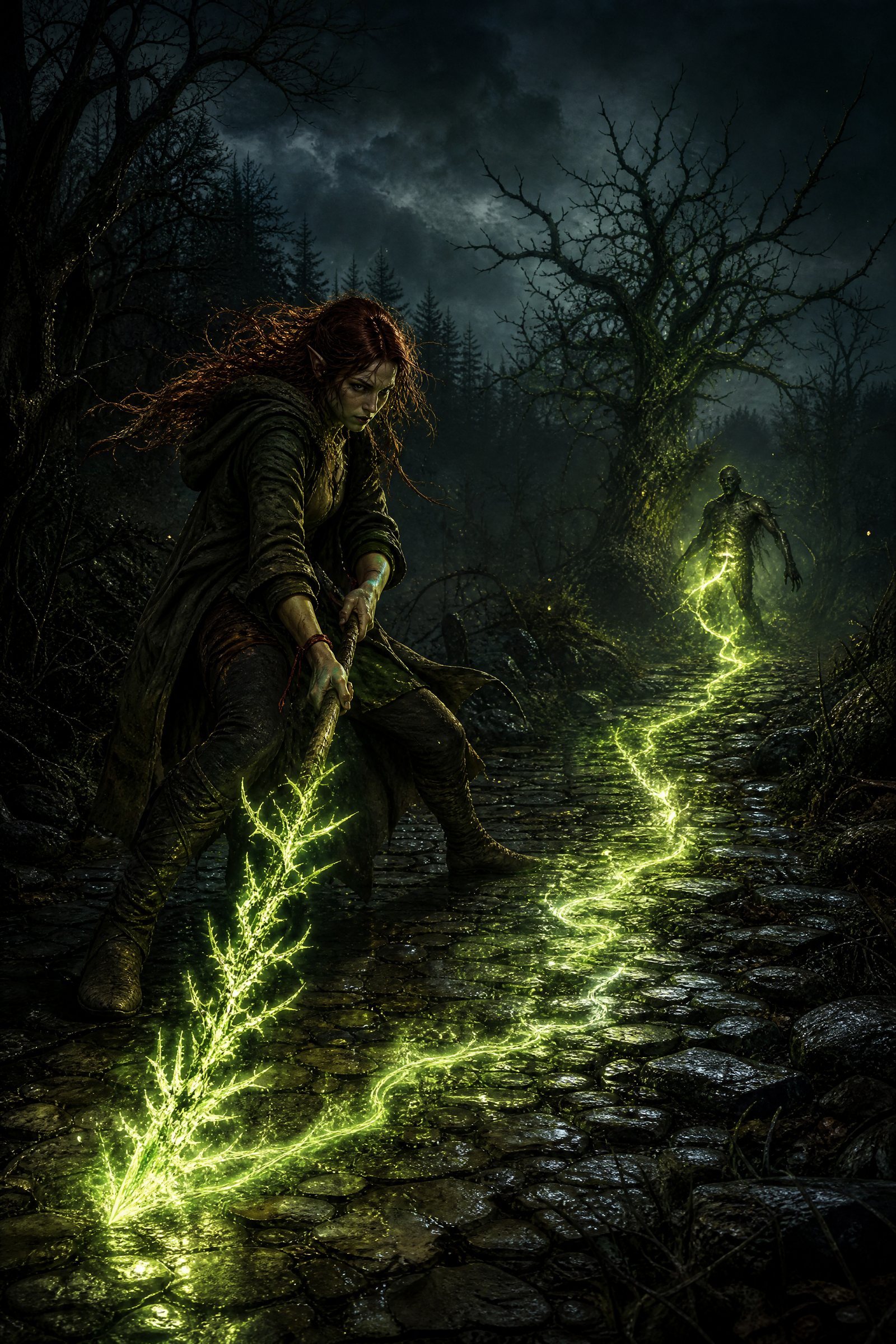
A blade-mystic who walks the old lines, moves what is standing in the wrong place, and is owed a favour by the road.
Campaign rules apply. Thirteen spells are banned, two are modified, and every spellcaster uses spell points instead of spell slots in this campaign — see Campaign Rules. This document already conforms: banned spells have been removed and replaced at the same level, modified spells are annotated where they appear, and spell slots have been converted to spell points.
Identity
The road remembers every foot that crossed it. The standing stone remembers every promise made in its shadow, and the well remembers who was lowered into it and why. Beneath all of it run the lines — old roads, root systems, rivers, fault lines, places made holy by repeated memory — and you learned the oldest and most embarrassing skill there is for dealing with them: how to ask. You do not pull the current into yourself; you find the direction a place is already leaning, put your weight beside it, and add one precise note of your own. In a story you are the guest who knows the house rules better than the hosts do: welcome almost everywhere, owed small favours in odd places, and quietly in debt to something that keeps its own accounts.
The Ley-Walker is a Charisma-based blade-mystic: a d8 unarmored duelist who manifests a reaching Glaive of Light, lashes its light along the ground, turns aside the blow that was meant to land, and cuts a Resonant Cut once a turn. Its engine is Earth-Tether — telekinetic control of where everyone is standing, including the enemy. You are not the party’s damage. You are the reason the fight happened on ground you chose.
This class belongs to the blade-mystic family, not the monk-caster family. It has no Unarmed Strike machinery, no Flurry of Blows, no Unarmored Movement ladder, no Qi points, and only a short list of utility cantrips. Its pool is Poise points, its rider is the Cut, and it is built to SPEC BLADE MYSTIC.
On the current, and the Tithed Fist. The library’s power axes reserve the impersonal, non-sentient current for the Tithed Fist, whose whole bargain is conduction: the current runs through the body and is paid for in erosion. The Ley-Walker never draws on the current inward. It walks along the lines, borrowing their direction and never their power — the way a barge borrows a river. Same substrate, opposite relationship, and the two classes should never be describable in the same sentence. See Balance Appendix, flag 1.
Class Overview
| Primary Abilities | Dexterity and Charisma |
| Hit Point Die | D8 per Ley-Walker level |
| Saving Throw Proficiencies | Dexterity and Charisma |
| Skill Proficiencies | Choose 2: Acrobatics, Animal Handling, Insight, Nature, Persuasion, Survival |
| Tool Proficiency | Herbalism Kit |
| Weapon Proficiencies | Simple weapons, and your Glaive of Light |
| Armor Training | None |
| Starting Equipment | A weathered wooden hilt (the focus for your Glaive of Light), an Herbalism Kit, a coil of red thread, an Explorer’s Pack, and 10 GP |
| Spellcasting | Half-caster, the Ley-Walker spell list (closed: Primal plus Enchantment and Illusion), Charisma, prepared, Long Rest spell points. Cantrips: 2 known at level 2, 3 at level 11, from a short utility list. |
Ley-Walker Table
| Level | Proficiency Bonus | Blade Die | Poise | Line-Marks | Invocations Known | Features | Spell Points | Max Spell Level |
|---|---|---|---|---|---|---|---|---|
| 1 | +2 | 1d8 | 1 | — | — | Unarmored Defense, Glaive of Light, Poise Points, Resonant Cut | — | — |
| 2 | +2 | 1d8 | 2 | 2 | 2 | Spellcasting, Earth-Tether, Standing, Invocations | 4 | 1st |
| 3 | +2 | 1d8 | 3 | 2 | 2 | Ley-Walker Compact, Wind Ward | 6 | 1st |
| 4 | +2 | 1d8 | 4 | 2 | 2 | Ability Score Improvement | 6 | 1st |
| 5 | +3 | 1d8 | 5 | 3 | 3 | Extra Attack | 14 | 2nd |
| 6 | +3 | 1d8 | 6 | 3 | 3 | Compact Feature, Quickened Step | 14 | 2nd |
| 7 | +3 | 1d8 | 7 | 3 | 4 | Nature’s Stride | 17 | 2nd |
| 8 | +3 | 1d8 | 8 | 3 | 4 | Ability Score Improvement | 17 | 2nd |
| 9 | +4 | 1d8 | 9 | 4 | 5 | Greater Tether | 27 | 3rd |
| 10 | +4 | 1d8 | 10 | 4 | 5 | Sylvan Resilience | 27 | 3rd |
| 11 | +4 | 1d10 | 11 | 4 | 5 | Compact Feature | 32 | 3rd |
| 12 | +4 | 1d10 | 12 | 4 | 6 | Ability Score Improvement | 32 | 3rd |
| 13 | +5 | 1d10 | 13 | 5 | 6 | Mystic Arcanum (6th level), Walk the Lines | 38 | 4th |
| 14 | +5 | 1d10 | 14 | 5 | 6 | Quickened Step (+20 ft), Unbroken Footing | 38 | 4th |
| 15 | +5 | 1d10 | 15 | 5 | 7 | Timeless Body | 44 | 4th |
| 16 | +5 | 1d10 | 16 | 5 | 7 | Ability Score Improvement | 44 | 4th |
| 17 | +6 | 1d12 | 17 | 6 | 7 | Compact Feature, Mystic Arcanum (7th level) | 57 | 5th |
| 18 | +6 | 1d12 | 18 | 6 | 8 | One Foot Elsewhere | 57 | 5th |
| 19 | +6 | 1d12 | 19 | 6 | 8 | Epic Boon | 64 | 5th |
| 20 | +6 | 1d12 | 20 | 6 | 8 | Sovereign of the Lines | 64 | 5th |
Prepared spells by level: 2 (L2), 3, 4, 5, 6, 6, 7, 8, 9, 9, 10, 10, 11, 11, 12, 12, 13, 13, 14, 14 (L20).
Cantrips known: 2 at level 2, 3 at level 11.
Class Features
Unarmored Defense
Level 1
While you aren’t wearing armor or wielding a Shield, your base Armor Class equals 10 plus your Dexterity and Charisma modifiers.
Glaive of Light
Level 1
As a Bonus Action, you manifest a long, branching weapon of moonlight, green fire, thorn-light, or condensed wind from your weathered hilt, in one free hand. It is a magical weapon with the Reach property, you are proficient with it, and it deals Blade Die damage of the Radiant or Psychic type, chosen when you manifest it. You use Dexterity or Charisma for its attack and damage rolls, chosen when you manifest it.
The glaive lasts until you dismiss it (no action required), until you manifest another, or until it has been more than 5 feet from you for 1 minute. It cannot be thrown — it is rooted to the hand that called it.
The Line-Lash. Once on each of your turns, you can take a Bonus Action to send the glaive’s light running along the ground: make one melee attack with your Glaive of Light against a creature within 15 feet of you that is standing on the ground or another solid surface. This attack reaches 15 feet whatever the glaive’s own reach, and it is a melee attack with a Melee weapon, so anything that applies to such an attack applies to it. This is the Ley-Walker’s equivalent of the family’s Long Throw, and it is the reason you have three attacks a round from level 5. Where a shared blade-mystic Invocation names the Long Throw (such as Second Manifestation), it means your Line-Lash. You can use the Line-Lash only while you aren’t wearing armor or wielding a Shield. Second Manifestation’s Bonus Action attack has the same limit: you can make it only while you aren’t wearing armor or wielding a Shield.
Poise Points
Level 1
You have a number of Poise points equal to your Ley-Walker level, as shown in the Poise column. You regain all expended Poise points when you finish a Long Rest. Until you gain Standing at level 2, you also regain all of them when you finish a Short Rest; from then on, Standing sets how many you regain on a Short Rest.
Poise Save DC. Some Ley-Walker features require a saving throw. The DC equals 8 + your Proficiency Bonus + your Charisma modifier — the same number as your spell save DC.
A Ley-Walker’s Poise is the footing under a step that hasn’t been taken yet.
Resonant Cut (the Cut)
Level 1
Once on each of your turns, immediately after you hit a creature with your Glaive of Light, you can spend Poise points to drive the weight of the old line through the blow as a free rider. This costs no action, Bonus Action, or Reaction, and doesn’t replace any other part of your turn.
Resonant Cut costs 1 Poise point at levels 1–10, 2 at levels 11–16, and 3 at levels 17–20. Roll a number of Blade Dice and add your Charisma modifier; the extra damage is Force damage or the glaive’s own type (your choice). The number of dice is 1 at levels 1–10, 2 at levels 11–16, and 3 at levels 17–20.
Form — Given Way. When you use Resonant Cut, one ally you can see within 30 feet can use its Reaction to move up to 10 feet without provoking Opportunity Attacks. In addition, you can forgo adding your Charisma modifier to the damage to instead reduce the target’s Speed by 15 feet until the start of your next turn.
Spellcasting
Level 2
You don’t compel a place. You ask it in the correct register, which is mostly a matter of knowing whose ground you are standing on.
Spells Prepared. You prepare the list of Ley-Walker spells available for you to cast, choosing from the Ley-Walker spell list. You prepare the number shown in the Prepared Spells note under the Ley-Walker table, and the spells must be of a level no higher than your Max Spell Level. Whenever you finish a Long Rest, you can replace one prepared spell with another.
Spell Points. This campaign uses spell points in place of spell slots (see Campaign Rules). Your pool is shown in the Spell Points column of the class table, and the Max Spell Level column shows the highest level of spell you can cast from it (1st at level 2, 2nd at 5, 3rd at 9, 4th at 13, 5th at 17). To cast a spell of 1st level or higher, spend spell points equal to its cost — 1st 2, 2nd 3, 3rd 5, 4th 6, 5th 7. You can cast a spell at any higher level up to your Max Spell Level by paying that level’s cost, and it takes effect as a higher-level version, exactly as the spell describes. You regain all spent spell points when you finish a Long Rest. Your spell points and your Poise points are separate pools: neither can pay for the other, and they recover on their own schedules. You can never spend spell points on a spell of 6th level or higher — those come only from Mystic Arcanum. If you also have long-rest spell points from another class, combine them as described under Multiclassing.
Spellcasting Ability. Charisma is your spellcasting ability.
- Spell save DC = 8 + your Proficiency Bonus + your Charisma modifier
- Spell attack modifier = your Proficiency Bonus + your Charisma modifier
Spellcasting Focus. Your weathered hilt.
Cantrips. At 2nd level you know two cantrips of your choice from the Ley-Walker cantrip list; at 11th level you know three. Whenever you gain a Ley-Walker level you may replace one with another from that list. They are the courtesies of the hedge and the threshold rather than workings — the small manners that keep a traveller welcome on someone else’s ground — and none of them deals damage or makes an attack roll. A Ley-Walker’s fighting magic is its glaive and its Invocations.
Standing
Level 2
Your Poise keeps the rhythm of the ground you rest on. When you finish a Short Rest, you regain Poise points equal to half your maximum (round down, minimum 1). When you finish a Long Rest, you regain all of them.
Line-Marks. Over a Short or Long Rest you can tie a Line-Mark to your location — a knot in the line, perceptible to you at any distance on the same plane. You can have the number shown in the Line-Marks column active at once; tying a new one beyond that ends your oldest. A Line-Mark lasts until you end it.
If you finish a Short Rest at a place of standing — a threshold, a crossroads, running water, a standing stone, a grave, a lit hearth, an active line of the current, or one of your own Line-Marks — you regain all expended Poise points instead of half.
Lines. A line is a path the current runs along. The DM decides where lines run in a world (by default along old roads, rivers, root systems and fault lines) and whether a line has gone quiet. A line is active unless it has gone quiet, so a running line and a disturbed line are both active. Line-Sense and Walk the Lines tell you whether a line is quiet, running or disturbed.
Earth-Tether
Level 2
As a Magic action, you can spend 1 Poise point to move a creature or an unattended object you can see within 30 feet. An object can weigh up to 100 pounds. A willing creature moves up to 10 feet in any direction.
An unwilling Large or smaller creature must succeed on a Strength saving throw against your Poise save DC or move up to 10 feet in a direction you choose. You can’t move a creature into a solid object, another creature’s space, or a space that would damage it as it enters (such as lava, a fire or a spell’s area), and you can’t move it over a drop it would fall into (such as a pit or the edge of a ledge). The one exception is upward movement: a creature you move upward falls normally when the movement ends, unless it has a way to remain aloft.
You can use Earth-Tether only once on each of your turns.
Invocations
Level 2
You have studied a handful of things until they became true rather than cast. You learn 2 Invocations of your choice from the shared blade-mystic list or the Ley-Walker list, both below, and more at levels 5, 7, 9, 12, 15 and 18, as shown in the Invocations Known column. Whenever you gain a level in this class, you can replace one Invocation you know with another for which you qualify.
Invocations and Counterspell. An Invocation is something you have made true about yourself, not something you cast, so in most cases there is no casting for anyone to interrupt. That is a description, not an immunity — no Ley-Walker power is immune to Counterspell or Dispel Magic. Where an Invocation makes you cast a spell, that spell is answered exactly like any other; where one produces a discrete magical effect as you spend a resource, so is that.
Ley-Walker Compact
Level 3
You come to an arrangement with something that keeps its own accounts. Choose Compact of the Bright Host, Compact of the Crow, Compact of the Well, Compact of the Hound, Compact of the Hollow Hill, or Compact of the Thorn. You gain features from that compact at levels 3, 6, 11, and 17.
Wind Ward (the Guard)
Level 3
When you are hit by an attack you can see, you can take a Reaction to reduce the damage by 1d10 + your Dexterity modifier + your Ley-Walker level.
Rider. If you reduce the damage to 0, the stopped force spills into the ground and everyone near you feels the line shift. You can move up to 15 feet without provoking Opportunity Attacks, and one ally you can see within 30 feet can use its Reaction to do the same. This rider costs no Poise.
Ability Score Improvement
Levels 4, 8, 12, and 16
You gain the Ability Score Improvement feat or another feat of your choice for which you qualify.
Extra Attack
Level 5
You can attack twice, instead of once, whenever you take the Attack action on your turn.
Quickened Step
Levels 6 and 14
While you aren’t wearing armor or wielding a Shield, your Speed increases by 10 feet. This increases to 20 feet at level 14.
Nature’s Stride
Level 7
Difficult terrain that isn’t magical costs you no extra movement, and you can move through nonmagical plants without being slowed and without taking damage from thorns, spines, or similar hazards. You also have Advantage on saving throws against magical plants and magically created difficult terrain.
Greater Tether
Level 9
Earth-Tether’s range increases to 60 feet, it can affect an unwilling Huge or smaller creature, and an unwilling creature that fails its save moves up to 20 feet instead of 10.
In addition, you can use Earth-Tether on two targets with a single use, choosing the direction for each separately. Doing so costs 2 Poise points instead of 1.
Sylvan Resilience
Level 10
You have Resistance to Poison damage, and Advantage on saving throws against the Poisoned condition and against disease.
Mystic Arcanum
Levels 13 and 17
Twice in a career the road offers you something well above your station — the Ley-Walker’s long invitation. At level 13, choose one 6th-level spell from the Ley-Walker spell list. You can cast it once without spending spell points, regaining that use on a Long Rest. At level 17 you learn a 7th-level spell on the same terms. Each is a separate use.
Whenever you gain a level in this class, you can replace one of these spells with another of the same level from the Ley-Walker spell list. They use Charisma as your spellcasting ability. A Ley-Walker never learns an 8th-level spell.
Walk the Lines
Level 13
You always know the direction and rough distance to every Line-Mark you have tied on your current plane.
In addition, you sense whether any line you have personally walked within 10 miles is quiet, running, or disturbed.
Walking the line. By spending 10 minutes in contact with the ground, you can travel along the lines to any of your Line-Marks within 1 mile, bringing up to five willing creatures within 10 feet of you. This is a journey, not a teleport: you and your companions travel the line at great speed and arrive ten minutes later, and anything able to intercept a traveller on that road — a ward, a watcher, a thing that lives in the line — can intercept you. Once you use this part of the feature, you can’t use it again until you finish a Long Rest.
Unbroken Footing
Level 14
When you roll Initiative and have no Poise points remaining, you regain Poise points equal to your Charisma modifier (minimum 1).
Timeless Body
Level 15
For every 10 years that pass, your body ages only 1 year, and you can’t be aged magically. You can also hold your breath for up to 1 hour.
One Foot Elsewhere
Level 18
As a Bonus Action, you become partially incorporeal until the end of your next turn. For the duration, you can move through creatures and objects as though they were Difficult Terrain, and you have Resistance to Bludgeoning, Piercing, and Slashing damage. If you end your turn inside an object, you are shunted to the nearest unoccupied space and take 1d10 Force damage per 5 feet moved.
Once you use this feature, you can’t use it again until you finish a Short or Long Rest.
Epic Boon
Level 19
You gain an Epic Boon feat or another feat of your choice for which you qualify. Boon of Dimensional Travel is thematically apt.
Sovereign of the Lines
Level 20
Your Dexterity or Charisma score increases by 2, to a maximum of 24. In addition, Earth-Tether no longer costs Poise points when you use it on a single willing creature or an unattended object, and you can tie a Line-Mark as a Bonus Action.
Once per Long Rest you can use Walk the Lines to reach any of your Line-Marks within 100 miles. That journey takes 1 hour rather than 10 minutes and can be interrupted like any other.
Shared Blade-Mystic Invocations
These Invocations belong to every blade-mystic class, and a Ley-Walker can learn them alongside the Ley-Walker list. Listed in order of prerequisite. Prerequisites are noted; you must meet them to learn the Invocation and to keep it.
Blade Recall. As a Bonus Action, you can teleport your manifested weapon into your free hand from anywhere within 60 feet, provided you can see its space.
Bladeless. You can roll your Blade Die in place of the normal damage of your Unarmed Strike, and whenever you deal damage with your Unarmed Strike, it can deal your choice of Force damage or its normal damage type. You can use your Cut on an Unarmed Strike.
Reaching Hand. You know the Mage Hand cantrip, and the hand is invisible. When you take the Attack action, you can replace one of your attacks with an Unarmed Strike made through the hand against a creature within 5 feet of it, using the Shove option; the target makes its saving throw against your Poise save DC instead of the usual DC.
Turning Step. When you use your Guard, you can move up to 10 feet without provoking Opportunity Attacks.
Unblinking. While your manifested weapon exists, being surprised doesn’t give you Disadvantage on your Initiative roll.
Steady Hand. When you roll a 1 on a Blade Die for your Cut, you can reroll it once and must use the new roll.
Second Manifestation. Prerequisite: level 5. You can manifest a second weapon in your other free hand. When you take the Attack action, you can make one attack with it as a Bonus Action; you add no ability modifier to that attack’s damage. You can’t use the Line-Lash on a turn you do this. You can make this attack only while you aren’t wearing armor or wielding a Shield.
The Held Breath. Prerequisite: level 9. When you reduce an attack’s damage to 0 with your Guard, you regain 1 Poise point. This can happen only once per round.
Deep Guard. Prerequisite: level 12. You can use your Guard against an attack you can’t see; when you do, roll the Guard’s d10 twice and use the lower roll.
Long Study. Prerequisite: level 15. Choose one 3rd-level spell from the Ley-Walker spell list. You can cast it once without spending spell points, and you regain the ability to do so when you finish a Long Rest.
Ley-Walker Invocations
Listed alphabetically. Prerequisites are noted; you must meet them to learn the Invocation and to keep it.
Bramble Step. You have Advantage on saving throws and ability checks made to end the Grappled or Restrained condition on yourself when the cause is a plant, a vine, or difficult terrain.
Called Ground. You can use Earth-Tether as a Bonus Action instead of a Magic action. Once you do, you can’t again until you finish a Short or Long Rest.
Deep-Rooted. While you are standing on natural ground, you can’t be moved against your will by an effect that doesn’t also move the ground beneath you.
Far Tether. Prerequisite: level 5. Earth-Tether’s range increases by 30 feet.
Fey Courtesy. You have Advantage on Charisma (Persuasion) checks made against Fey, and you can’t be Charmed by a Fey.
Green Tongue. You always have Speak with Animals and Speak with Plants prepared, and they don’t count against the number of spells you can prepare.
Heavy Hand. Prerequisite: level 9. Earth-Tether can move an unattended object weighing up to 500 pounds, and a creature you move with it has Disadvantage on the next attack roll it makes before the end of its next turn.
Lash the Line. Prerequisite: level 5. Your Line-Lash reaches 30 feet instead of 15.
Line-Sense. You know the direction to the nearest line within 1 mile, and whether it is quiet, running, or disturbed.
Long Reach. Your Glaive of Light’s reach increases by an additional 5 feet.
Thorn-Bound. Prerequisite: level 7. When a creature fails its saving throw against your Earth-Tether, it takes Piercing damage equal to one Blade Die.
Turning Ward. Prerequisite: level 12. When you use Wind Ward and reduce the damage to 0, you can make one attack with your Glaive of Light against a creature within your reach as part of the same Reaction. Once you do, you can’t again until you finish a Short or Long Rest.
Ley-Walker Compacts
A Compact is the Ley-Walker’s subclass: a standing arrangement with something that keeps its own accounts — brightness, dread, a well, the chase, a hollow hill, a hedge. You choose one with the Ley-Walker Compact feature, and it grants features at the levels that feature names. Who or what holds the other side of the bargain is a setting choice: a power, a place, a people or only a principle. Nothing in any Compact’s rules needs that party to exist in a particular form, to answer or to approve. Each world gives the six Compacts its own names (see In Different Worlds).
Compact of the Bright Host
“Stand where they can see you. That is most of it.”
The Bright Host leads from the middle of the field with the light held high. Your arrangement is with brightness, and brightness is legible by definition.
Shining Aura
Level 3
While you are conscious, you and allies of your choice within 10 feet of you gain a +1 bonus to saving throws. This doesn’t stack with a Paladin’s Aura of Protection or any other feature that adds an ability modifier or a flat bonus to the same saving throw; use the larger.
Commanding Strike
Level 6
Once on each of your turns when you hit a creature with your Glaive of Light, you can spend 1 Poise point to choose one ally within 30 feet who can see or hear you. That ally can use its Reaction to make one attack with a weapon it is holding against the same target.
Far Spear
Level 11
When you take the Attack action, you can replace one attack with a thrown arc of light: make one ranged attack with your Glaive of Light against a creature within 60 feet. The arc leaves the blade and the glaive stays in your hand. The attack uses the ability you chose for the glaive (Dexterity or Charisma) for its attack and damage rolls, and on a hit it deals your Blade Die plus that modifier in the glaive’s damage type. On a hit, one other creature of your choice within 10 feet of the target takes Force damage equal to one Blade Die.
Blessing of the Bright Host
Level 17
As a Bonus Action, you create a 20-foot Emanation of bright light around yourself for 1 minute. Allies of your choice in the Emanation gain Temporary Hit Points equal to your Charisma modifier at the start of each of their turns (a creature can gain these only once per turn), and the first time each turn an ally in the Emanation hits with an attack, the attack deals extra Radiant damage equal to your Proficiency Bonus.
Once you use this feature, you can’t use it again until you finish a Long Rest.
Playing a Compact of the Bright Host: you are the one who goes first, and the whole subclass is an argument that this is a tactical choice rather than a character flaw.
Compact of the Crow
“You already know how this ends. I only got here first.”
Your arrangement is with dread and foreknowledge. You break a formation before it forms.
Gaze of Doom
Level 3
Once on each of your turns when you hit a creature with your Glaive of Light, you can spend 1 Poise point to force it to make a Wisdom saving throw against your Poise save DC. On a failed save, it has the Frightened condition (of you) until the start of your next turn.
If the target is already Frightened of you when you hit it, the attack instead deals extra Necrotic damage equal to one Blade Die.
Phantom Wings
Level 6
As a Bonus Action, you can spend 2 Poise points to gain a Fly Speed equal to your Speed for 10 minutes. This requires Concentration as though you were concentrating on a spell.
Once per Long Rest you can use this feature without spending Poise points.
Sever the Thread
Level 11
When a creature you can see within 30 feet succeeds on a D20 Test, you can take a Reaction and spend 2 Poise points to force it to reroll the d20 and use the lower result.
You can use this feature a number of times equal to your Proficiency Bonus, and you regain all expended uses when you finish a Long Rest.
Battlefield of Crows
Level 17
As a Magic action, you create a 20-foot-radius Sphere of shadowy ravens centred on a point within 90 feet. It lasts 1 minute and requires Concentration. The area is Difficult Terrain for your enemies and Lightly Obscured for them only.
A creature of your choice that starts its turn in the area makes a Wisdom saving throw against your Poise save DC. On a failed save, it takes 2d10 Psychic damage and can’t take Reactions until the start of its next turn. On a successful save, it takes half as much damage only.
Once you use this feature, you can’t use it again until you finish a Long Rest.
Playing a Compact of the Crow: you are the omen, not the disaster, and the difference matters a great deal to you and not at all to anyone else.
Compact of the Well
“Bring it back to the shape it was. No further.”
Your arrangement is with wells, rivers, and roots. Its healing is restoration to a proper shape, never renewal without limit.
Flowing Water Stance
Level 3
As a Bonus Action, you can spend 1 Poise point to take the Dodge action. Until the start of your next turn, you can move through the space of any creature as though it were Difficult Terrain.
When you do, choose yourself or one willing creature within 10 feet; that creature gains Temporary Hit Points equal to your Charisma modifier.
Restorative Flow
Level 6
Once on each of your turns when you hit a creature with your Glaive of Light, you can spend 1 Poise point to restore Hit Points to one creature you can see within 30 feet equal to one Blade Die plus your Charisma modifier. A creature can benefit from this feature only once per turn.
Spring of Life
Level 11
As a Magic action, choose up to six creatures you can see within 30 feet. Each regains 2d8 Hit Points plus your Charisma modifier, and can end one effect on itself causing the Charmed, Frightened, or Poisoned condition.
Once you use this feature, you can’t use it again until you finish a Long Rest, though you can spend 3 Poise points to use it one additional time before that rest.
Eternal River
Level 17
As a Bonus Action, you create a 20-foot Emanation of flowing water around yourself for 1 minute. It requires Concentration. Allies of your choice who enter the Emanation for the first time on a turn or start their turn there gain Temporary Hit Points equal to your Charisma modifier, can stand up from Prone without spending movement, and can end the Grappled or Restrained condition on themselves by spending 5 feet of movement. The Emanation is Difficult Terrain for your enemies.
Once you use this feature, you can’t use it again until you finish a Long Rest.
Playing a Compact of the Well: you are the party’s only real healer and you will be asked to be its conscience as well, which is a different and less fair job.
Compact of the Hound
“Once the horn is blown, the chase is the only remaining fact.”
Your arrangement turns pursuit into a law of nature. You mark a quarry and the world begins to agree with you about it.
Hound’s Pace
Level 3
Your Speed increases by 10 feet.
As a Bonus Action, you can spend 1 Poise point to mark one creature you can see within 60 feet for 1 minute. The mark ends early if you mark another creature. Once on each of your turns when you hit the marked creature, it takes extra Force damage equal to your Proficiency Bonus, and you always know its direction while it is on the same plane.
Unseen Predator
Level 6
Once on each of your turns when a creature fails its saving throw against your Earth-Tether, you can teleport to an unoccupied space within 5 feet of it and make one attack with your Glaive of Light as part of the same action.
This attack can’t trigger an additional use of Resonant Cut.
Savage Deflection
Level 11
When you use Wind Ward and reduce an attack’s damage to 0, you can move up to half your Speed without provoking Opportunity Attacks (in place of the rider’s normal 15 feet). If you end this movement within reach of the attacker, you can make one attack against it with your Glaive of Light as part of the same Reaction.
Master of the Hunt
Level 17
As a Magic action, you summon a spectral hound in an unoccupied space within 30 feet for 1 minute. It uses the Dire Wolf stat block, except that it has Resistance to Bludgeoning, Piercing, and Slashing damage, Immunity to Poison damage and the Poisoned condition, and it vanishes when reduced to 0 Hit Points. Its attack bonus and save DC equal yours.
The hound acts immediately after your turn and obeys your verbal commands (no action required). It can take only the Attack action, and only one Bite attack on each of its turns.
Once you use this feature, you can’t use it again until you finish a Long Rest.
Playing a Compact of the Hound: your character’s real problem is that you are very good at not stopping, and the campaign will eventually make that a moral question.
Compact of the Hollow Hill
“Say nothing, take nothing, and be home before the music stops.”
Your arrangement is with the hollow hill and whatever keeps house inside it. It is glamour and quiet: you get in, you are not remembered, and you get out.
Fairy Step
Level 3
As a Bonus Action, you can spend 1 Poise point to have the Invisible condition until the start of your next turn or until you make an attack roll, deal damage, or force a creature to make a saving throw.
Waking Dream
Level 6
You always have Major Image and Hypnotic Pattern prepared, and they don’t count against the number of spells you can prepare. Once per Long Rest you can cast one of them without spending spell points; you can spend 3 Poise points to do so one additional time before you finish that rest.
Mind-Thief
Level 11
Once on each of your turns when you hit a creature with your Glaive of Light, you can spend 2 Poise points to force it to make a Wisdom saving throw against your Poise save DC. On a failed save, it can’t take Reactions until the start of your next turn and you learn its surface thoughts for the same duration.
This feature doesn’t erase or alter memories.
The Wild Court
Level 17
As a Magic action, choose one creature you can see within 60 feet. It makes a Charisma saving throw against your Poise save DC. On a failed save, it is transported to a harmless demiplane until the end of your next turn; when it returns to the space it left (or the nearest unoccupied space), it takes 4d10 Psychic damage and has the Frightened condition (of you) until the end of its next turn. On a successful save, it takes half as much damage and is neither transported nor Frightened.
Once you use this feature, you can’t use it again until you finish a Long Rest.
Playing a Compact of the Hollow Hill: you are on good terms with something the rest of the party would not sleep in the same building as, and you have promised not to explain.
Compact of the Thorn
“A hedge is not a wall. It is an opinion about where you should be.”
Your arrangement is with boundaries: the briar, the ditch, the line you do not cross without asking. You are the party’s terrain.
Hedgecraft
Level 3
As a Bonus Action, you can spend 1 Poise point to raise a briar along a line up to 15 feet long within 30 feet of you. The area is Difficult Terrain and lasts 1 minute. The first time a creature enters it on a turn, it takes Piercing damage equal to one Blade Die.
You can have only one briar at a time, and it ends if you raise another.
Thorn-Warded
Level 6
While you are within 5 feet of your briar or one of your Line-Marks, you have Half Cover.
In addition, when a creature within 5 feet of you hits you with a Melee attack, you can take a Reaction to force it to make a Strength saving throw against your Poise save DC. On a failed save, it is pushed 10 feet away from you and its Speed is reduced by 10 feet until the end of its next turn.
The Long Hedge
Level 11
Your briar can be up to 30 feet long, you can have two active at once, and you can shape a briar as a closed ring around a point instead of a line.
Once on each of your turns when a creature takes your briar’s damage, you can spend 1 Poise point to give it the Restrained condition until the end of its next turn.
The Unasked Threshold
Level 17
As a Magic action, you set a boundary in a 30-foot Emanation around a point within 60 feet. It lasts 1 minute and requires Concentration. A creature of your choice that attempts to cross the boundary in either direction must succeed on a Charisma saving throw against your Poise save DC or be unable to cross until the start of its next turn; its movement for that turn is wasted.
A creature that fails this save twice during the same use of the feature takes 4d8 Psychic damage and has the Restrained condition until the end of its next turn.
Once you use this feature, you can’t use it again until you finish a Long Rest.
Playing a Compact of the Thorn: you are the least aggressive member of the party and you have decided exactly where the fight is going to happen.
Ley-Walker Spell List
You prepare your spells only from this list. It is a closed list: every spell you prepare of 1st through 5th level comes from it, and the DM does not add others. It holds 75 spells (17 / 22 / 16 / 10 / 10 at 1st–5th level, about three-quarters of the 2024 Player’s Handbook Sorcerer list at each level), sorted alphabetically within each level. They are drawn from the Primal list (the 2024 Druid and Ranger lists) and extended with Enchantment and Illusion spells from any list, plus one class addition outside both: Misty Step. A Ley-Walker’s magic moves, hides, entangles, restores and negotiates; it does not incinerate. The 6th- and 7th-level entries are Mystic Arcanum options only — they are never prepared and can’t be cast with spell points.
Sources. Every spell on this list is from the 2024 Player’s Handbook except Absorb Elements (1st level), Wrath of Nature (5th level) and Whirlwind (7th level), which are from Xanathar’s Guide to Everything. Absorb Elements and Whirlwind are this campaign’s replacements for banned spells (see Campaign Rules). The Enchantment and Illusion spells from outside the Primal list are Disguise Self, Silent Image, Sleep and Tasha’s Hideous Laughter (1st); Calm Emotions, Invisibility, Mirror Image, Suggestion and Zone of Truth (2nd); Fear and Phantom Steed (3rd); Greater Invisibility (4th); and Dream, Mislead and Seeming (5th).
Cantrips. Dancing Lights, Druidcraft, Elementalism, Friends, Mending, Message, Minor Illusion, Resistance.
The cantrip list sits outside the school restriction that governs the levelled list, as the Fateskald‘s does: courtesies, not workings. None deals damage or makes an attack roll; Friends calls for a saving throw against being Charmed, never against harm.
1st level (17). Absorb Elements, Alarm, Animal Friendship, Charm Person, Cure Wounds, Detect Magic, Disguise Self, Entangle, Faerie Fire, Fog Cloud, Jump, Longstrider, Protection from Evil and Good, Silent Image, Sleep, Speak with Animals, Tasha’s Hideous Laughter.
2nd level (22). Aid, Animal Messenger, Augury, Barkskin, Beast Sense, Calm Emotions, Enhance Ability, Enlarge/Reduce, Gust of Wind, Hold Person, Invisibility, Lesser Restoration, Locate Animals or Plants, Locate Object, Mirror Image, Misty Step, Pass without Trace, Silence, Spike Growth, Suggestion, Summon Beast, Zone of Truth (campaign-modified: Advantage on Wisdom (Insight) checks; it compels nothing).
3rd level (16). Conjure Animals, Daylight, Dispel Magic, Fear, Meld into Stone, Nondetection, Phantom Steed, Plant Growth, Protection from Energy, Revivify, Sleet Storm, Speak with Plants, Summon Fey, Water Breathing, Water Walk, Wind Wall.
4th level (10). Charm Monster, Confusion, Dominate Beast, Freedom of Movement, Grasping Vine, Greater Invisibility, Hallucinatory Terrain, Locate Creature, Polymorph, Stoneskin.
5th level (10). Awaken, Commune with Nature, Dream, Greater Restoration, Mass Cure Wounds, Mislead, Scrying, Seeming, Tree Stride, Wrath of Nature.
Mystic Arcanum options.
- 6th level: Conjure Fey, Heal, Move Earth, Wall of Thorns
- 7th level: Mirage Arcane, Regenerate, Reverse Gravity, Whirlwind
Flagged for the DM: with Find the Path and Plane Shift both banned, this class no longer shortens a travel plot with a spell — only with Walk the Lines, which is now an interruptible ten-minute journey to a mark it has personally tied. The exploration fantasy survives; the shortcut does not.
Multiclassing
Prerequisite: Dexterity 13 and Charisma 13.
What you gain: proficiency with simple weapons; Unarmored Defense if you don’t already have it; the Glaive of Light and the Line-Lash; and Poise points, Line-Marks and Invocations sized to your Ley-Walker levels only. Your Blade Die and Resonant Cut dice are set by your Ley-Walker level, not your character level. You can use the Line-Lash only while you aren’t wearing armor or wielding a Shield, so a character in armor or with a Shield keeps the glaive and the Resonant Cut but not the Line-Lash or Second Manifestation’s Bonus Action attack.
Poise points and Qi points are separate pools and never merge. A Ley-Walker/Tithed Fist multiclass — a tempting build, and a thematically loaded one — tracks both independently and gains nothing from holding two pools beyond holding two pools. See the Balance Appendix on why that character is a good story and a mediocre optimisation.
Ley-Walker spell points combine with other long-rest spell point pools under the standard multiclass spellcaster rules (see the multiclass spell point table in Campaign Rules); your Mystic Arcanum uses do not.
In Different Worlds
Setting layer. Everything above this heading works unchanged in each of these worlds; only names, looks and stories differ. Names here are setting names, each mapped to the neutral name the rules use.
Mythic culture — the house setting, Celtic-inspired (the class’s origin)
Who has it. In the house setting the ley-current runs beneath the land along ley lines: old roads, holy wells, the fairy paths between the raths. Ley-Walkers are hedge-wanderers who learned the roads’ courtesies from an older walker, usually for a debt they are still paying. They regard the Tithed Fist, who conducts the same current through the body, as something close to a thief.
What they call it. The class is the Ley-Walker; the current is the ley-current. The glaive is drawn from a hilt of bog-oak. The Line-Lash is the Ley-Lash and Line-Marks are Ley-Marks. The Compacts bear the old stories’ names: the Tuatha, the Morrigan, Danu, the Wild Hunt, the Sidhe, and the Thorn.
How it looks and sounds. The glaive comes out as moonlight, green fire or thorn-light. Tying a Ley-Mark is a hand flat on a stone; the scrap of red thread left on the nearest thorn is manners, and the mark holds without it. Walking a ley line smells of turned earth and wet peat.
Story hook. A surveyor’s new road runs straight through a lone hawthorn on a ley line. The crew won’t cut it and the landlord won’t reroute, and a Ley-Walker of the Sidhe has been told, politely and at night, what it will cost the parish if the tree comes down.
Rules caveat. None. The Tuatha, the Morrígan and the people of the mounds are the Compacts’ images, not their patrons; no feature needs them to exist, answer or approve.
| Neutral name (rules) | House-setting name |
|---|---|
| the current · lines · an active line of the current | the ley-current · ley lines · an active ley line |
| a weathered wooden hilt · your weathered hilt | a weathered hilt of bog-oak · your bog-oak hilt |
| The Line-Lash · Line-Marks (and the Line-Marks column) | The Ley-Lash · Ley-Marks (and the Ley-Marks column) |
| Unbroken Footing · One Foot Elsewhere · Sovereign of the Lines | Unbroken Ley · Spirit of the Sidhe · Sovereign of the Sidhe |
| Line-Sense · Fey Courtesy (Invocations) | Ley-Sense · Sidhe-Fair |
| Compact of the Bright Host · Crow · Well · Hound · Hollow Hill · Thorn | Compact of the Tuatha · the Morrigan · Danu · the Wild Hunt · the Sidhe · the Thorn |
| Far Spear (Bright Host) · Restorative Flow (Well) | Spear of Lugh · Restorative Current |
| Compact introductions: “The Bright Host leads…” · “the hollow hill and whatever keeps house inside it” · “restoration to a proper shape” (Well) | “The Tuatha Dé Danann lead…” · “the people under the hill” · “restoration to a proper pattern” |
| Banner and flag 1: “On the current, and the Tithed Fist” · “the library’s power axes” | “On the ley-current, and the Tithed Fist” · “the lore ledger” |
| “plus Enchantment and Illusion” · “a harmless demiplane” (The Wild Court) | “plus fey Enchantment and Illusion” · “a harmless fey demiplane” |
Arcane-industrial
Who has it. Surveyors of the Trunk Line Survey, licensed to walk ahead of the railway and find the grades the land will tolerate. Every good railway follows an older line, and surveyors are paid to ask before the navvies dig. The licence is a brass chain-link worn at the collar.
What they call it. The class is a surveyor; the current is the grade, and lines are survey lines. The glaive is the lamp-pike, drawn from a brass-capped hilt. Earth-Tether is shunting, Line-Marks are benchmarks, and Walk the Lines is riding the grade. Compacts are Survey departments:
| Compact | Department |
|---|---|
| Bright Host · Crow · Well | Signals · Accident Inquiry · Waterworks |
| Hound · Hollow Hill · Thorn | Line Police · Tunnelling · Boundaries and Fencing |
How it looks and sounds. The lamp-pike is banded red, green and white like a signal lamp and hums like telegraph wire. Shunting sounds like points changing under the floor. A benchmark carries a broad arrow cut into a doorstep, which anyone can see and nobody but the surveyor reads; chiselling the arrow off doesn’t end the benchmark.
Story hook. The new trunk line is pegged to run through a market town’s only well. The Waterworks surveyors refuse to sign it off, and the last one who rode the grade to argue in person was intercepted halfway and has not been seen since.
Rules caveat. None, if the places of standing are reskinned one for one rather than added to: a level crossing is a crossroads, a survey pillar a standing stone, a signal-box stove a lit hearth. No feature needs a railway.
After the fall
Who has it. The old empire’s roads still run straight through forests that have forgotten it, and the milestone-folk know which of them still hold. They travel between survivor settlements as guides, pedlars and arbiters of boundary disputes, paid in salt and the right to sleep nearest the fire.
What they call it. The class is a milestoner; the current is the hold, and lines are the old roads. The glaive is the lantern-reed, drawn from a hilt cut from a road-sign post. Earth-Tether is the road’s shove, Line-Marks are cairns, and Walk the Lines is running the old road. Compacts are the trades that survive along the roads:
| Compact | Trade |
|---|---|
| Bright Host · Crow · Well | the Lamplighters · the Gleaners · the Cisternkeepers |
| Hound · Hollow Hill · Thorn | the Outriders · the Vault-Sleepers · the Hedgewardens |
How it looks and sounds. The lantern-reed burns the pale green of old glass and flickers like a failing streetlamp. A cairn is three stones on the verge, and kicking it over ends nothing. Running the old road leaves grey dust on the boots, the colour of paving nobody has laid in centuries.
Story hook. Scavengers are prising up the old milestones to build a town wall. Each stone taken quiets a stretch of road, and the settlement’s only safe route to the salt flats is going quiet a mile at a time.
Rules caveat. If this world has no Fey creatures, Fey Courtesy has nothing to apply to: let the player swap it for another Invocation, and describe the spirit of Conjure Fey as a spirit of the place. With no other planes, The Wild Court’s demiplane is a pocket of nowhere. Otherwise none.
Planar crossroads
Who has it. In a spindle-city where a dozen planes meet, the streets themselves are lines, worn by so many travellers that the city has started to agree with them. The seamwalkers’ Lodges guide strangers through districts that drift with the tides of other planes, and settle disputes over whose customs apply at which door.
What they call it. The class is a seamwalker; the current is the drift, and lines are seams. The glaive is the guide’s lamp, a long pole of light with an edge on it. Earth-Tether is the nudge, Line-Marks are door-chalk, and Walk the Lines is taking the seam. Compacts are Lodges:
| Compact | Lodge |
|---|---|
| Bright Host · Crow · Well | the Lamp · Black Feathers · the Cistern |
| Hound · Hollow Hill · Thorn | the Leash · the Back Door · the Toll-Gate |
How it looks and sounds. The guide’s lamp takes its colour from whichever sun is nearest and smells faintly of somebody else’s weather. Door-chalk is a tick on a doorpost that only its maker reads; scrubbing it off ends nothing, because the mark is in the seam. Taking the seam sounds like a crowd heard through a wall.
Story hook. A seamwalker of the Back Door chalked a door in the Lantern Ward last week. This morning the ward drifted onto another plane and the chalk went quiet. The client who has paid to be walked there on the next tide is a known assassin.
Rules caveat. Line-Marks, Walk the Lines and Hound’s Pace stop at the edge of the plane, and here that edge moves. The DM decides where it lies; a mark in a district that has drifted elsewhere goes quiet until it drifts back. Nothing else changes.
Origins and Inspiration
Inspiration, not setting. Nothing here is a rule, and nothing here is assumed by one.
Leys. The word comes from Alfred Watkins, a Herefordshire businessman and photographer who proposed in 1921 that Britain’s old sites — barrows, standing stones, hill-forts, churches on ancient ground — fall into straight alignments, which he took to be the remains of old trackways (Early British Trackways, 1922; The Old Straight Track, 1925). He made no claim about energy. Leys as lines of earth-power are glimpsed in Dion Fortune’s novel The Goat-Foot God (1936) but belong to the 1960s, above all to John Michell’s The View Over Atlantis (1969), which drew on the “dragon currents” of Chinese feng shui. Archaeologists generally put the alignments down to chance. The class takes the later, mystical reading as its image and keeps Watkins’s older one underneath it: a ley is, first, a road.
Roads that remember. Irish folklore holds that the sí travel fixed paths between their forts, and that a house built across one will have no luck; the lone hawthorn left standing in a ploughed field is the best-known survival of the wider fairy belief behind it. British custom kept corpse roads, the routes along which the dead were carried to burial, and gathered stories about what else walked them. These, more than the energy reading, are the Ley-Walker’s courtesy: the road belongs to someone, so you ask.
The people under the hill. In medieval Irish tradition the Tuatha Dé Danann, whose arrival is told in the Lebor Gabála Érenn (the Book of Invasions), withdraw into the síde, the mounds, after their defeat by the sons of Míl, and become in later belief the aos sí. Bargains with them, the danger of eating their food, time that runs differently under the hill, and the changeling are the class’s oldest stock.
The light-blade. The Glaive of Light and Earth-Tether owe something to the mystic of space fantasy, with a blade of light in one hand and an unseen push in the other. Here the light grows from a wooden hilt, and the push comes from the ground.
The Compacts and their touchstones
| Compact (neutral) | House-setting name | Mythic centre | Second touchstone | Alt-culture reskin |
|---|---|---|---|---|
| Bright Host | Tuatha | Lugh arriving at Tara | Nuada’s silver arm | Vedic deva host |
| Crow | Morrigan | The Morrígan and the Washer at the Ford | The raven banner | Balkan vila |
| Well | Danu | Danu, mother of the gods (inferred) | Brigid’s wells | Japanese mizu no kami |
| Hound | Wild Hunt | The Cŵn Annwn | Gwyn ap Nudd | Germanic Wilde Jagd |
| Hollow Hill | Sidhe | The aos sí under the hill | Oisín in Tír na nÓg | Persian peri |
| Thorn | Thorn | The uncut hawthorn | The hægtesse | Baltic žaltys |
- Bright Host. Lugh Lámhfhada, “of the long arm”, admitted to Tara in Cath Maige Tuired because he alone holds every skill; Nuada, who loses his arm and with it the kingship (a blemished king could not rule), is given an arm of silver by Dian Cécht and, in Cath Maige Tuired, one of flesh by Dian Cécht’s son Miach before he rules again; the Dagda’s club, which kills with one end and revives with the other. The Far Spear borrows Lugh’s long reach; the spear itself, counted among the four treasures the Tuatha Dé Danann brought to Ireland, is a separate thread of the tradition. Reskin: in a Vedic frame, the deva host behind Indra — brightness as a formation, not a mood.
- Crow. The Morrígan, whose name is read as “great queen” or “phantom queen” (the etymology is disputed), who meets the Dagda at a river before the second battle of Mag Tuired and comes to Cú Chulainn in several shapes, a bird among them; Badb, “crow”, called Badb Catha, “battle crow”; and the Washer at the Ford, the woman seen washing the clothes or armour of those about to die, who is identified with the Badb or the Morrígan in some tales and survives in Scottish folklore as the bean nighe. The raven banner is a Norse crossover rather than an Irish image: Njáls saga has Sigurd of Orkney carry one at Clontarf in 1014. Reskin: in a Balkan frame, the South Slavic vila of epic song, who can befriend or wound a hero and is met at the edges of fields and mountains.
- Well. Danu is known mostly by inference: from one reading of the uncertain genitive in the name Tuatha Dé Danann, and from Anu, whom Sanas Cormaic (Cormac’s Glossary) calls mother of the Irish gods, remembered in the Paps of Anu in Kerry. Tying her to the Danube, the Don and the Vedic Dānu through a shared root for “river” is a popular comparison, not a settled one. Brigid’s holy wells and the rag trees beside them are well attested; Nechtan’s well, which only he and his cupbearers could safely approach, rose against Boand when she walked round it in defiance, and became the River Boyne. Reskin: in a Japanese frame, the mizu no kami or suijin, the water kami honoured at a village spring — generous, particular about how it is treated, and not to be neglected.
- Hound. The hounds of Arawn, king of Annwn, shining white with red ears, which Pwyll finds at a stag’s kill and drives off in the First Branch of the Mabinogi, and which later Welsh folklore calls the Cŵn Annwn; Gwyn ap Nudd, a ruler of Annwn, whose castle on the summit of Glastonbury Tor vanishes under the saint’s holy water in the Welsh Life of St Collen, and who leads the hunt in later Welsh folklore; the sluagh of Scottish and Irish lore, the host of the restless dead; and Herne the Hunter, who is English, not Celtic, and first appears in Shakespeare’s The Merry Wives of Windsor, haunting an oak in Windsor Forest. Reskin: in a Germanic frame, the Wilde Jagd, led in different regions by Wodan, Frau Holle and others, which in some accounts sweeps up anyone who watches it pass.
- Hollow Hill. The aos sí, the people of the mounds, and the rule, widespread in Irish and Scottish fairy lore, against eating their food; Oisín in Tír na nÓg, whose three years there are three hundred outside in Mícheál Coimín’s eighteenth-century telling; the changeling left in the cradle. Reskin: in a Persian frame, the peri, in later Persian legend a beautiful spirit kept out of paradise until a penance is served (the older Avestan pairikā is a plainly hostile figure) — beautiful, obligated, and operating on a calendar nobody mortal was shown.
- Thorn. The lone hawthorn in an Irish field that nobody will cut; in 1999 the line of a new road in County Clare was reportedly shifted to spare one, after a campaign by the storyteller Eddie Lenihan. The Old English hægtesse, “witch” or “fury”, whose German cousin hagazussa is often, though not certainly, read as “hedge-rider”, the one who sits on the boundary between village and wild. The Welsh Cad Goddeu, the Battle of the Trees, a poem in the Book of Taliesin, and the later tradition that Gwydion raised the trees to fight. Reskin: in a Baltic frame, the Lithuanian žaltys, the household grass snake kept for luck in the house, often by the hearth. Keeping the luck in by keeping a line unbroken is the class’s own gloss, not the folklore’s.
How the material was adapted
The class began as a Celtic road-walker in a world with one ley-current under it, and it keeps that root, but no god, place or people appears in its rules. The Tuatha, the Morrígan, Danu, the Hunt and the people of the mounds became images rather than counterparties. A Compact borrows the shape of a bargain — the bright company that goes first, the omen that arrives before the fight, the well that heals only to the old shape, the chase that does not stop, the hill you leave before the music ends — and anyone in any world can make it with whatever keeps the other side’s accounts. The ley-current became “the current” and its lines simply “lines”: in the house setting they are ley lines, but elsewhere they are survey grades, the roads of a fallen empire or the seams of a planar city, and the rules work the same on all of them. The setting names now live in the house-setting example above, and the touchstones stay here as credit for where the shapes came from.
Playing a Ley-Walker
The core dramatic question: what do you owe the places that helped you? Everything you do is a transaction with something that does not speak, keeps records anyway, and will collect. A Ley-Walker who takes without asking doesn’t lose their powers dramatically — the road simply stops being convenient, and the campaign gets harder in ways that are difficult to prove.
The physicality of the power. Tying a Line-Mark looks like nothing: a hand flat on a stone, a heel scuffed through dirt, and the place agrees. Earth-Tether is not a gesture of force but of leverage — you are not pushing the guard, you are asking the floor to slide, and the guard is on the floor. Walking the lines always leaves you slightly out of breath, as though you had run the distance, because in some accounting you did.
Origin prompts. Which line taught you first, and is it still running? What did you promise to something you can’t name? Where is your weathered hilt from — and who buried it? Which road do you refuse to walk?
Quirks (d6)
| d6 | Quirk |
|---|---|
| 1 | You greet thresholds aloud before crossing them, even in a hurry. |
| 2 | You will not take the last of anything: water, bread, firewood. |
| 3 | You tie a scrap of red thread at every place you mean to return to, whether or not you tie a Line-Mark. |
| 4 | You give directions by landmark and refuse to use distances. |
| 5 | You ask permission of doors, and wait a beat. |
| 6 | You never sleep with your back to running water. |
Bonds & Hooks (d6)
| d6 | Bond or hook |
|---|---|
| 1 | A line you marked years ago has started calling, and something else has been using the mark. |
| 2 | You owe a favour to something under a hill and it has finally named the price. |
| 3 | A road you rely on is being paved over by people who don’t know what it is. |
| 4 | Someone is tying Line-Marks in your style, on your lines, and you did not teach them. |
| 5 | You are the only person who remembers where a village used to be. |
| 6 | A Tithed Fist has been drawing on a line you walk, and it is going quiet behind them. |
The Arc
- Levels 1–4. A reach duelist who can move one thing thirty feet a turn. Most of the tier is discovering that moving the right creature five feet is worth more than hitting it.
- Levels 5–10. Extra Attack, a Compact, and Wind Ward. Standing means you can run a hard day if you rest in the right places, which begins to shape how your party travels.
- Levels 11–16. Greater Tether moves two creatures at sixty feet; Walk the Lines makes a mile a short walk. You become the party’s logistics as well as its terrain.
- Levels 17–20. At 20, moving willing creatures and objects costs you nothing at all, and any mark on the plane is a morning’s work away.
Party role. A control and terrain duelist with real team value. Your damage sits at the bottom of the blade-mystic band; what you sell is that nobody in your party is ever standing in the wrong place, and the enemy usually is.