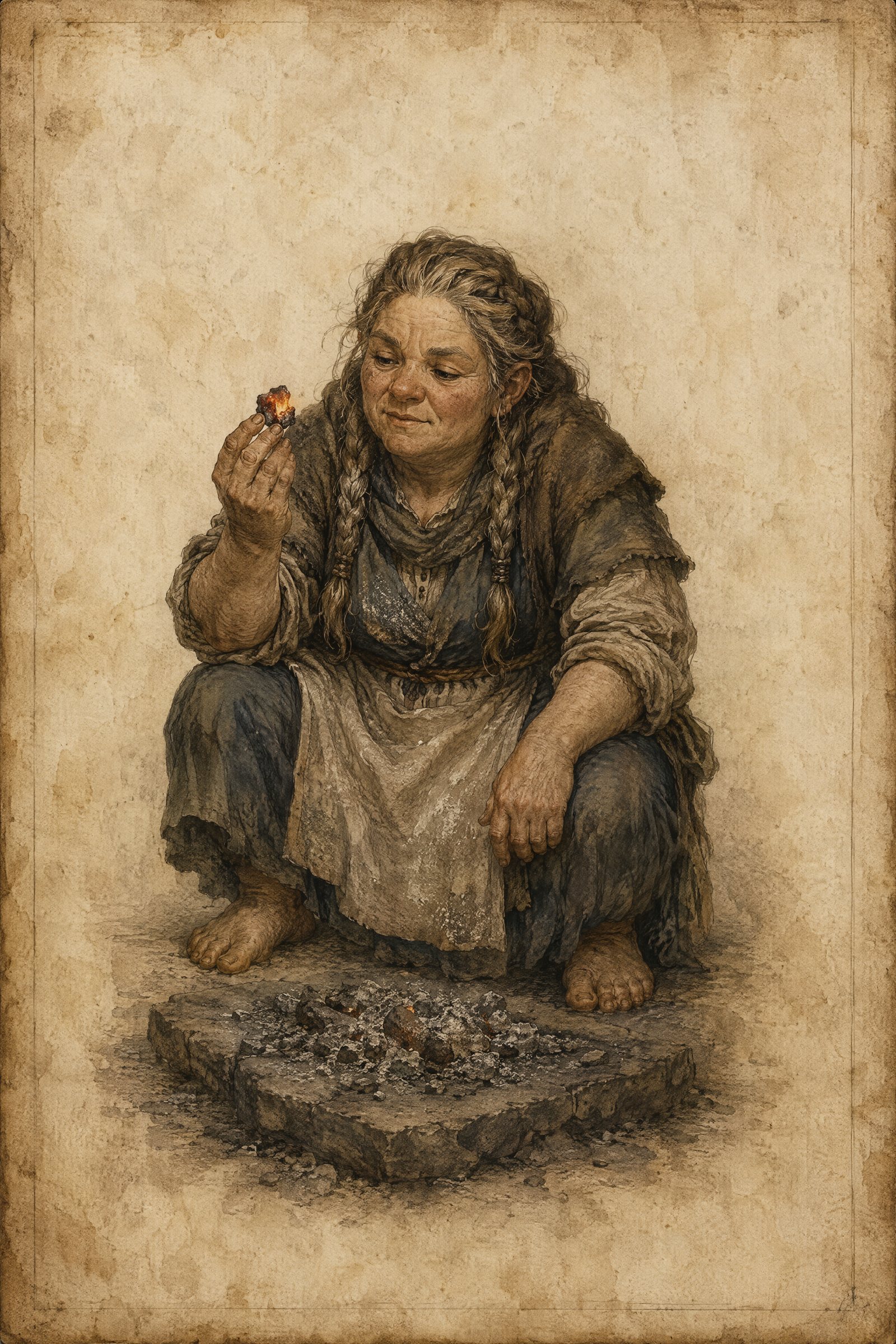
Small, long-lived folk bound to warmth, who coax flame from a dead hearth, send the people who rest at their fire away stronger, and bank down like coals when the cold or a hard blow gets into them.
Hearthkin Traits
Creature Type: Humanoid
Size: Small (about 2–3 feet tall)
Speed: 30 feet
Hearthkin are small and solid, warm to the touch, with ruddy skin and hair in the colours of a fire’s edge, from straw to soot. They live for several centuries.
As a Hearthkin, you have these special traits.
Warm Blood. You have Resistance to Fire damage.
Fireside. When you finish a Short Rest, each creature that meets both of these conditions regains extra Hit Points equal to your Proficiency Bonus, on top of what its Hit Point Dice restored:
- it is you, or an ally who spent the whole rest within 30 feet of you; and
- it spent at least one Hit Point Die as part of that rest (this applies to you too). Hit Point Dice spent during the rest by other means, such as through a salve, aren’t spent as part of the rest.
A creature can benefit from this trait only once per Short Rest, however many Hearthkin rested with it.
Ember-Coaxing. You know the Produce Flame cantrip. When you reach character levels 3 and 5, you learn a higher-level spell, as shown on the table below. You always have these spells prepared. You can cast each of the levelled spells once without spending spell points, and you regain the ability to cast it in that way when you finish a Long Rest. You can also cast these levelled spells by spending spell points, as normal, if you have any.
When you select this species, choose Intelligence, Wisdom, or Charisma as your spellcasting ability for the spells you cast with this trait. Each such spell is a spell for every rule, including the limit of one spell of 1st level or higher per turn and the limit of one Concentration at a time.
| Character level | Spell |
|---|---|
| 1 | Produce Flame (cantrip) |
| 3 | Heroism (1st level) |
| 5 | Aid (2nd level) |
Banked Ember. When you are reduced to 0 Hit Points but not killed outright, you can sink into a torpor. This costs no action, Bonus Action or Reaction, even on someone else’s turn. You become Stable at once (you still have the Unconscious condition, as any creature at 0 Hit Points does). If you are still Stable and at 0 Hit Points when 1 minute has passed, you regain 1 Hit Point. The torpor ends early if you regain any Hit Points or stop being Stable (for example, by taking damage), and you don’t regain the Hit Point. The torpor has no other effect: in particular, it doesn’t reduce your need for food, water, air or rest.
Once you use this trait, you can’t use it again until you finish a Long Rest.
The setting layer
Identity
You are of a small people bound to warmth. You can coax a flame out of a dead hearth, the people who rest at your fire rise stronger from it, and when the cold or a hard blow gets into you, you bank down into a torpor, like coals under ash, and wake later. A household that keeps your kind at its fireside rarely lets them go, and a Hearthkin who leaves home is either very brave or carrying very bad news. What makes your people a people is the fire, not luck or cleverness.
Sensory palette
Ruddy and warm: skin like a hand held to the grate, hair in a fire’s edge-colours from straw to soot, and the smell of whatever their hearth burns. Produce Flame is a coal-red light cupped in a palm; Heroism and Aid are a warmth that spreads from the hands into the chest. Fireside has no light at all: a kettle, a shared pot, a story told twice. Banked Ember is a slow fade to the dull red-grey of a banked fire, breath slowing, skin still warm to the touch. Never white fire, never thrown sparks, never a flame that burns the person it helps.
In Different Worlds
The rules above never change. Only the names, looks and stories below do.
Ashwinter (Gritty low magic · After the fall)
- Who they are there. The Hearthkin of Ashwinter live among the hearth-marches, from the Wintermarch halls to the shrine-towns of the Marches, and tend the hearths that every sanctuary and every Mothers’ Night depends on. A shrine-town counts its Hearthkin at dawn after the worst nights, because in hard cold they bank down where they sit and some do not wake on their own.
- What they are called. In the hearth-marches, ingle-folk; one is an ingle. The fjordholds call them glowfolk, not unkindly. Ember-Coaxing is the coaxing, Banked Ember banking down, Warm Blood coal-hands, and Fireside the stranger’s share, after the hearth-march custom of feeding the stranger before yourself.
- How they look and sound. Ruddy faces, peat-smoke and bread-smoke in their clothes, hands that can lift a coal from the grate. They take hearth-names like everyone in the marches (Leofwyn of Ashhearth, Eadric Wrenhearth). In the Wintermarch halls they smell of resin and wet wool; the few glowfolk of the fjords sit nearest the seal-oil lamp in the turf longhouse through the dark months. On Ashfall Day, when every fire is banked for an hour at noon, the ingle-folk bank with them and sit very still.
- How others see them. As the luck of a house, whether they like it or not. At the Mothers’ Nights an ingle is given the seat nearest the fire, beside the three seats kept for the Mothers.
- Story hook. In a shrine-town down the Crown Road from Harrowmere, the sanctuary’s ingle banked down in a hard storm and woke three days later to find the keeper dead and no successor sworn. A keeperless sanctuary’s rest fails within days. She saw who came to the keeper’s door the night before she slept, and she is the only one who did.
- Rules caveat. None. That hard cold sends the ingle-folk into torpor is story, with no rules effect.
The kingdoms’ kitchens (Heroic high fantasy)
- Who they are there. Behind every great kitchen, inn fire and temple brazier in the kingdoms there is likely to be a Hearthkin family that has kept it for two hundred years. Their guilds are kitchens, their lineages are recipes, and their quarrels are about who has the better oven.
- What they are called. Cooks’ kin in the common tongue, or oven-folk. Ember-Coaxing is lighting the house, Banked Ember a long nap, Warm Blood oven-hands, and Fireside second helpings.
- How they look and sound. Flour on the sleeves, aprons scorched at the hem, a habit of talking to the fire as if it were a slow apprentice.
- How others see them. As trusted and invisible: everyone eats what they make and nobody remembers their names. Some of them have noticed.
- Story hook. A king’s Hearthkin cook has walked out of the palace kitchens, and no fire in the palace will light. The court wants her back before the feast; she wants to be asked why she left.
- Rules caveat. None.
The boiler-tenders (Arcane-industrial)
- Who they are there. When the first engine-houses went up, the owners found that Hearthkin could tend a firebox for twelve hours and handle a hot grate bare-handed. Three generations later the boiler rooms of every engine-house, rail-yard and steamship are Hearthkin territory, and their union is the strongest in the city.
- What they are called. Stokers, firekin, or on the shop floor the little union. Ember-Coaxing is lighting up, Banked Ember damping down, Warm Blood firebrick hands, which the bosses take literally, and Fireside a brew-up: the shift’s kettle on the firebox door, and nobody back to work until the pot is empty.
- How they look and sound. Overalls, goggles pushed up on the forehead, voices pitched to carry over a boiler. They know every valve by its sound.
- How others see them. Prized and exploited: the engine-houses run on Hearthkin labour and pay Hearthkin wages. When the stokers bank the fires, the city stops.
- Story hook. The stokers’ union has called a strike for midwinter, the one week the city can’t do without heat. The engine-house owners have hired someone to make sure the union’s leader doesn’t wake from her next torpor.
- Rules caveat. None. A firebox’s heat is ordinary fire; Warm Blood‘s Resistance applies to Fire damage from it as from any source.
Origins and Inspiration
The Hearthkin are drawn from the household spirits of the hearth found across Europe: the Slavic domovoi, who lives behind or under the stove, and who in many regional customs was invited to a new house by carrying embers from the old stove; the Scandinavian tomte or nisse of the farmstead, and its Finnish counterpart the tonttu, a household form of the haltija, the guardian spirit of a place; the English and Scottish brownie and hob, who work by the fire at night for a bowl of cream or porridge; and the Roman Lares, household gods honoured at the family hearth, with Vesta, goddess of the hearth-fire itself. The torpor borrows from animals that hibernate, the dormouse and the hedgehog. The adaptation turns a spirit into a mortal people, and a household’s luck into a body’s warmth.