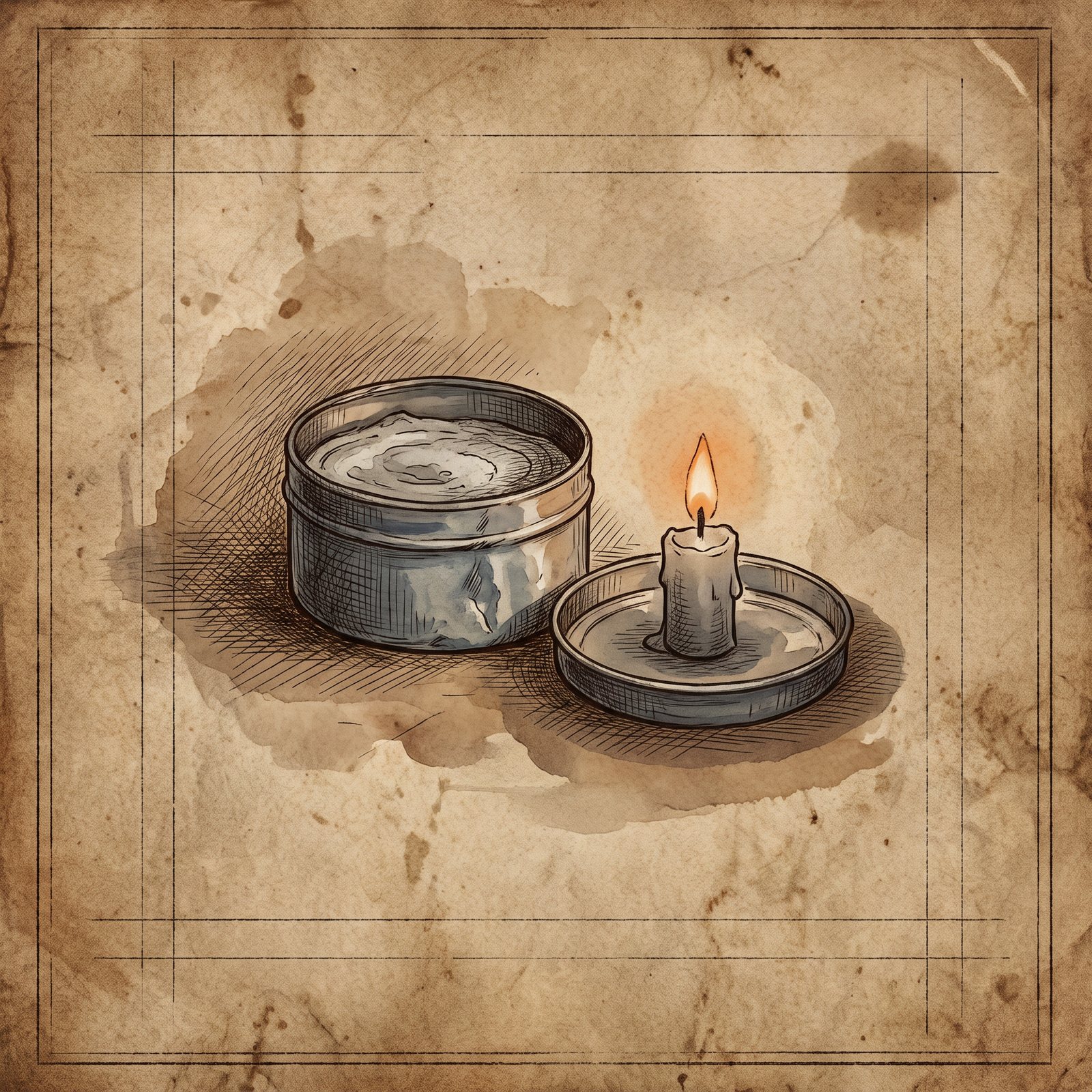
A healer’s ointment that lets the body mend itself on the road. It is the medicine of people who can’t stop: soldiers on a forced march, couriers, refugees, anyone for whom an hour’s halt is an hour too long. It works no miracle; it asks the body for strength it already has, and gets it a little sooner.
Wondrous Item, Common
A small tin of this pale, cold-smelling ointment holds one application.
Mend on the Move. You can spend 1 minute rubbing the salve into the wounds of yourself or a willing creature that has at least 1 Hit Point. At the end of the minute, the creature can spend up to two of its Hit Point Dice. For each die spent, it rolls the die, adds its Constitution modifier, and regains that many Hit Points (minimum 1). For example, a creature with a Constitution modifier of +2 that spends two d10s regains 2d10 + 4 Hit Points. The application is then used up.
This isn’t a Short Rest. It doesn’t count toward one or interrupt one, and nothing that happens when a creature finishes a Short Rest happens. Hit Point Dice spent through the salve aren’t spent as part of any rest, even if the salve is used while one is under way. It restores no Hit Point Dice. An effect that improves Hit Point Dice spent as part of a Short Rest doesn’t apply; an effect that improves every Hit Point Die the creature rolls to regain Hit Points does.
In Different Worlds
Ashwinter (Gritty low magic · After the fall)
- Who made it. The Candle Compact’s hospices, from goose fat, birch tar and the waystone-moss that grows only on the old road’s stones.
- What it is called. Frost-salve, for its cold smell and the cold it leaves in the skin; the hospices’ own word for it is the honest mend.
- How it looks and sounds. A dented tin with a candle pressed into its lid. The salve is grey-white, smells of birch tar and snow, and stings like a cold wind on a cut. Where it has worked, the skin closes pink and plain, without the white tracery of a frost-scar.
- Where one is found. On every hospice shelf, in a keeper’s house, and in any candle-post rider’s kit.
- Story hook. A grain-factor has bought every tin of frost-salve in three shrine-towns and sells them back at a week’s field-work each. The hospices want the price broken; the factor says the towns’ tithe came up short, and someone has to make it good.
- Rules caveat. None. In Ashwinter magical healing leaves a frost-scar; frost-salve heals by the body’s own strength and leaves none, which is why soldiers prize it. That is story; the salve’s rules don’t change.
A free company’s surgeons (Gritty low magic)
- Who made it. The barber-surgeons who march with mercenary companies, from a recipe each guards jealously and none admits to being magic.
- What it is called. Field grease; the surgeons’ own word is “the second wind in a tin”.
- How it looks and sounds. A yellow, rank-smelling paste in a horn box, slapped on by the handful between one march and the next. Men groan when it goes on and swear by it afterwards.
- Where one is found. In the surgeon’s chest of every company that pays its surgeon well, and stolen from those that don’t.
- Story hook. A surgeon is selling his company’s recipe to its enemies. The company’s captain wants him back alive, because no one else can make it.
- Rules caveat. None.
The pilgrims’ infirmaries (Heroic high fantasy)
- Who made it. Lay brothers and sisters of a healing order, for pilgrims who can’t pay a priest for a prayer and can’t afford to stop walking.
- What it is called. Pilgrim’s balm; applying it is “walking it off”.
- How it looks and sounds. A clay pot sealed with blue wax and stamped with an open hand. It smells of lavender and lard, and the brothers hum a walking-song while they rub it in, one verse to the minute.
- Where one is found. In the infirmary at every hostel on the pilgrim road, and in the pack of anyone who has walked that road twice.
- Story hook. The order’s balm has started failing on one stretch of the road, and the pilgrims who walk it are arriving half-dead. Someone has been watering the pots, or something on that road is drinking the virtue out of them.
- Rules caveat. None.
Origins and Inspiration
Healing salves are among the oldest recorded medicines. The Old English Bald’s Leechbook (10th century) gives an eye-salve of garlic, onion or leek, wine and ox gall; in 2015 a team at the University of Nottingham reported that a reconstruction killed MRSA bacteria in laboratory tests. Goose fat and birch tar both appear in northern European folk remedies for the skin. The salve’s game idea, spending one’s own reserves of recovery away from a rest, is invented.