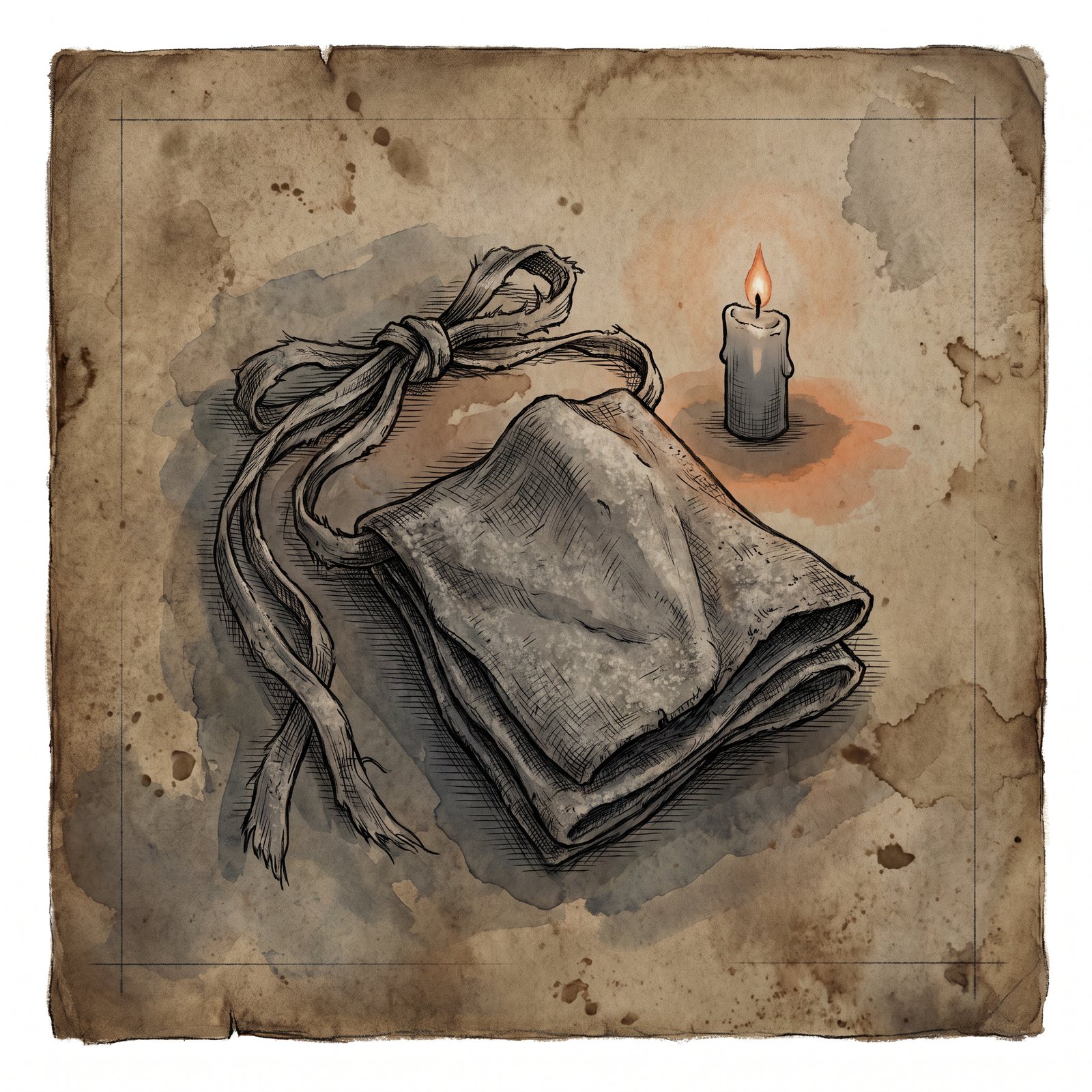
A breathing veil for people who work in smoke. Stokers, pyre-tenders, miners and firefighters wear it: people whose trade is breathing what others run from. It is humble cloth with a small magic in its weave, and it does one thing, keeping the smoke out of the chest, so that the wearer can stay and finish the work.
Wondrous Item, Common
This veil of fine, layered cloth ties over the nose and mouth. While you wear it that way, you gain these benefits:
- Clean Breath. Breathing smoke, ash, dust or volcanic fumes doesn’t make you choke or suffocate and can’t give you a level of Exhaustion, unless a spell, a magic item, another magical effect or a class feature created them. This doesn’t protect you from a poison carried in the air, such as an inhaled poison or a trap’s gas.
- Filtered Air. You have Advantage on saving throws against inhaled poisons and against gases, smoke and dust that you breathe in. This doesn’t apply to any of them, inhaled poisons included, that a spell, a magic item, another magical effect or a class feature created.
The veil doesn’t let you breathe where there is no air or underwater, and it doesn’t change what you can see or smell. It doesn’t stop you speaking, coughing or using a breath weapon. It does nothing about smoke, ash, dust, gas or poison that a spell, a magic item, another magical effect or a class feature created. Nor does it do anything against what a creature breathes out or gives off through a breath weapon or another of its own actions or traits, such as a dragon’s poison breath or a gorgon’s petrifying breath; a poison or other item that a creature merely uses is covered as normal. An effect is magical if a spell or a magic item created it or a rule calls it magical. What a class feature created is excluded whether or not it is magical. Smoke from an ordinary fire (even one that a spell or a class feature lit), a forge or a nonmagical alchemical item is neither, so it is covered. Blowing sand counts as dust.
In Different Worlds
Ashwinter (Gritty low magic · After the fall)
- Who made it. Pyre-tenders and the Order of the Unlit Pyre’s barge crews, who soak layered linen in a salt-and-ash wash and have a keeper bless it over a sanctuary’s candle.
- What it is called. Smoke-linen, in candle-speech and the hearth-marches; on the fjords, a pyre-cloth.
- How it looks and sounds. Three layers of grey linen, stiff with salt from the wash, tied behind the head with a pyre-tender’s knot. It smells of brine and old smoke. A voice through it comes out flat and close, so the Order’s barge crews fall back on graveside hand-speech when the smoke is thick; a fjord pyre-cloth is tarred at the edges and smells of the shingle.
- Where one is found. Hanging by the door of every fjord hold that still sends out pyre-ships, and issued to anyone who rides the Order’s barges down the burning reach of the Long Water.
- Story hook. The burning reach’s smoke carries the keening of the Ash Mourners. Smoke-linen keeps the smoke out of your lungs, and nothing keeps the names out of your ears.
- Rules caveat. None. Ashwinter‘s ash, its pyre-smoke and its ash storms are nonmagical. Smoke-linen gives no sight through smoke; that remains the Ashborn‘s own trait.
A smog-choked foundry city (Arcane-industrial)
- Who made it. The Stokers’ Union’s own seamstresses, after the owners refused to pay for masks.
- What it is called. A union veil; foremen call it “the red rag”, after the union’s colour.
- How it looks and sounds. Red flannel over waxed gauze, the union’s number stitched at the corner. Behind it a stoker’s voice is a muffled growl, which suits the foremen’s opinion of stokers perfectly.
- Where one is found. On the face of every stoker on the night shift, and in the evidence room after every strike.
- Story hook. The owners have hired a hedge-mage to make a smoke the veils don’t stop. The union wants to know what is in it before the next shift goes down.
- Rules caveat. None. Factory smoke is nonmagical; a smoke that a spell, a magic item, another magical effect or a class feature created isn’t covered.
Origins and Inspiration
People have tied cloth over their mouths against smoke and dust for as long as there have been fires and mines. Pliny the Elder records that workers preparing red lead (minium) covered their faces with loose bladders so as not to breathe the dust (Natural History, book 33). The beaked masks of 17th-century plague doctors, often credited to the French physician Charles de Lorme, packed the beak with herbs against “bad air” (both the attribution and how widely they were worn are debated). The veil is a modest fantasy of the oldest protection there is.