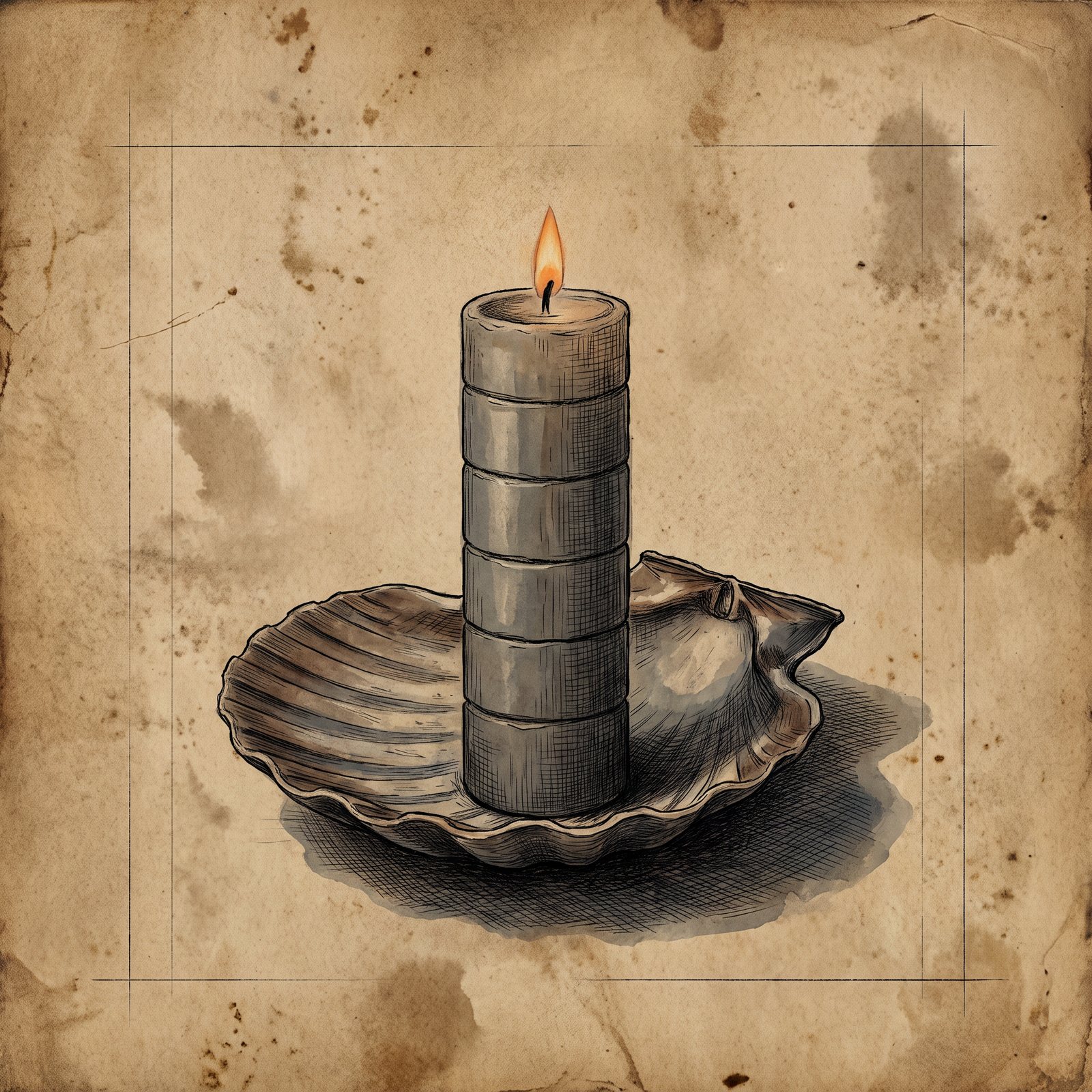
A candle burned beside the dead so that they stay dead. It belongs to whoever sits up with a body far from proper burial: a rider on a long road, a family snowed in with their grief, a watch kept in a field after a battle. It lays no one to rest and promises nothing about souls; it buys time, an hour of grey wax at a time, so that the dead can be carried home as themselves.
Wondrous Item, Common
This candle of plain grey wax burns for 1 hour in total. You light it or put it out as you would an ordinary candle, and it keeps whatever burning time it has left between uses. While lit, it sheds Bright Light in a 5-foot radius and Dim Light for an additional 5 feet.
Warning Flame. While the candle is lit, its flame burns blue whenever an Undead creature is within 60 feet of it, or whenever remains are within 60 feet of it that will become an Undead creature, or from which an Undead creature will rise, within the next 24 hours. The flame reacts to Undead that are hidden or Invisible, but not to creatures on another plane of existence. It shows only that something of the kind is near, not where it is, what it is or how many there are.
Graveside Rite. You can burn the candle down for one dead creature. You can begin the rite only if the candle has at least 10 minutes of burning time left. Light it within 5 feet of the creature’s remains and tend it for 10 minutes, keeping within 5 feet of the remains. For those 10 minutes you must maintain Concentration, as if you were concentrating on a spell: beginning the rite ends any other Concentration you have, and beginning anything else that needs Concentration ends the rite. If your Concentration ends, if the candle goes out (a strong wind can put it out, as it can any candle), or if you and the remains are ever more than 5 feet apart, the rite fails and the candle loses 10 minutes of its burning time. If you keep your Concentration for the full 10 minutes, the rite succeeds, and the candle burns out whatever burning time it had left and is used up.
When the rite succeeds, the creature’s remains can no longer become an Undead creature, and no Undead creature can rise from them. The remains are the creature’s corpse, or most of what is left of it (bones or ashes count). The protection is permanent, and it goes with the remains wherever they are taken. This stops all animation of the remains as an Undead creature, including animation that lasts only for a set time.
- It has no effect on remains that are already an Undead creature, or on an Undead creature that has already risen from them.
- It doesn’t preserve the remains from decay, and it doesn’t hinder Speak with Dead, or any spell or effect that returns the creature to life.
- Dispel Magic or a similar effect can end it, treating it as a spell of 2nd level.
The rite is not a spell, uses no spell points, and is not the turn’s spell of 1st level or higher.
In Different Worlds
Ashwinter (Gritty low magic · After the fall)
- Who makes it. Sanctuary keepers pour it from the drippings of the sanctuary’s own candle, the one relit at every Relighting. A keeper gives them to candle-post riders, to corpse-watches and to families with a death too far from any waystone, who must sit with their dead on the road home.
- What it is called. A sitting-candle; on the fjords, a wake-stub. The rite is sitting the candle, and the blue flame is the grey turning.
- How it looks and sounds. Plain grey wax, thumb-thick, scored by the keeper’s knife into six rings, one for each turn of the watch. It smells of cold stone and the sanctuary’s bread-oven, and it is lit in silence, as the mourners keep silence at the Laying. When it turns, the flame goes the pale blue of a frost-scar and stands very still, even in a draught. A fjord wake-stub is the same wax, burned in a shell on the shingle beside the drawn-up dead.
- Where one is found. In a keeper’s chest, or in a candle-post rider’s saddlebag.
- Story hook. A shrine-town’s keeper has died with no successor sworn, leaving three sitting-candles and forty winter dead waiting unrited in its cold-house, and the thaw has come. Until a new keeper is sworn, the corpse-watch must choose whose bodies the candles sit by, and every family already knows the names.
- Rules caveat. None. The candle keeps a body from rising; only a Laying on sanctuary ground lets the soul sleep. Sitting the candle is not a Laying and gives no rest: the soul stays awake by its remains until it is carried home, and the candle buys the time to carry it. Under the Risen Stay Risen (Ashwinter‘s world rule), a body kept from rising stays able to be raised, which is why the keepers’ saying “raise them before they rise” sells candles. The world rule’s temporary-animation clause decides only whether animation makes a creature risen and doesn’t override the candle, so a Corpse-Herd can’t drive a candled body.
A city of foundries and licensed trades (Arcane-industrial)
- Who makes it. The Chandlers’ and Coffin-Makers’ Company, under a licence from the city’s Board of Health, after the cholera years filled the municipal pits with dead that would not stay down.
- What it is called. A certified wake-light, stamped with the Board’s seal. Sitting with it is the night shift; the blue flame is a showing.
- How it looks and sounds. A squat stearin candle in a tin collar stamped with a number and the Board’s seal. A showing is a hard gas-blue flame that hisses faintly, and every undertaker’s apprentice learns to hear it before they see it.
- Where one is found. On the shelf of every licensed undertaker, and in the pocket of every inspector who walks the pauper pits after dark.
- Story hook. A batch of counterfeit wake-lights has gone out to the poor quarter. Three nights later the first of those graves opens.
- Rules caveat. None.
Origins and Inspiration
The candle draws on the European wake: the watch kept over the dead between death and burial, with lights burning by the body, a custom recorded across Ireland, Scotland and much of the continent. Its warning flame echoes the Welsh canwyll corff, the “corpse candle”, a moving light said to foretell a death or to mark the way a funeral would go (folklore recorded from the 17th to the 19th centuries; the details vary by teller). The idea that a body must be properly watched and buried or it may walk again runs through the medieval revenant tales of northern Europe, the Icelandic draugr stories among them. Nothing here reproduces a real rite as practised.