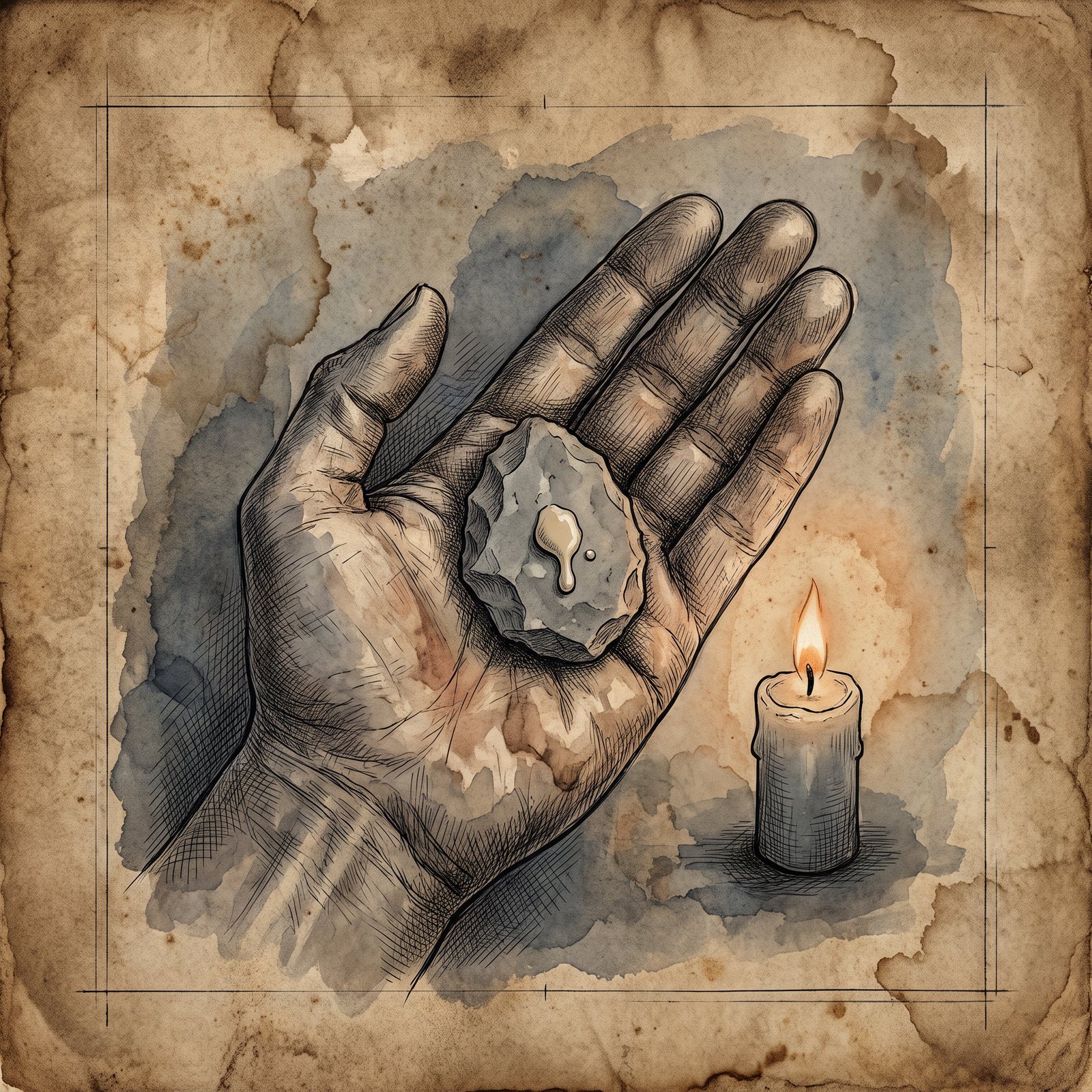
A flake of holy stone that keeps the dead quiet for one night and wakes you if anything dead comes near. It is a traveller’s charm for roads where the dead don’t stay buried, carried by pilgrims, carters and soldiers who must camp near graves or battlefields. It is not a wall: it keeps the bodies at your feet lying still and tells you when something already risen is coming, and the rest is up to you.
Wondrous Item, Uncommon
This flake of worked stone is a little larger than a coin and always faintly cool.
Set the Chip. As a Magic action, you set the chip on the ground or on another surface and wake it. It stays awake for 8 hours and then crumbles to dust. If the chip is moved while it is awake, it crumbles at once and its effects end.
While the chip is awake:
- Still Ground. No creature’s remains within 30 feet of the chip can become an Undead creature, and no Undead creature can rise from them. A creature’s remains are its corpse, or most of what is left of it (bones or ashes count). Remains carried out of that range lose this protection. This stops all animation of the remains as an Undead creature, including animation that lasts only for a set time. It affects only remains that aren’t yet Undead: an Undead creature can enter, stay and fight within the range as normal, and an Undead creature destroyed there can still return by its own traits.
- Cold Warning. Whenever an Undead creature comes within 60 feet of the chip, including one that is hidden or Invisible, the chip turns cold. If you, the creature that set the chip, are within 60 feet of it, you feel the cold, and if you are asleep, it wakes you. You don’t learn where the Undead is or what it is. An Undead creature already within 60 feet when you set the chip warns you at once. The chip doesn’t react to creatures on another plane of existence.
The chip creates no barrier, cover or concealment. It keeps no creature out, hides nothing and no one, and doesn’t change how a rest works.
In Different Worlds
Ashwinter (Gritty low magic · After the fall)
- Who made it. Sworn keepers, who take the flakes from a waystone’s foot at the Relighting and wake them with the sanctuary’s oath. A keeper gives a few each year to the candle-post and to host-breakers.
- What it is called. A Relighting-flake; host-breakers call one a night’s peace. Still Ground is keeping the ground, and the Cold Warning is the stone’s breath.
- How it looks and sounds. A coin-sized flake of waystone-grey, often with a drop of the Relighting’s candle-wax still on one face. Set on the ground it looks like nothing at all. When the stone breathes, the cold comes up through a bedroll like frost through a floor, and the one who set it wakes with the taste of cold stone in their mouth.
- Where one is found. In a keeper’s chest, in a host-breaker company’s kit, or traded at a shrine-town’s gate for a week’s bread.
- Story hook. Someone at a Long Water ferry-house has been chipping the town’s waystone by night to sell the flakes, and the town’s laid dead are beginning to stir.
- Rules caveat. None. A Relighting-flake is not a sanctuary: it gives no rest and no Laying, and Ashwinter has no shelter-rest rule for it to change. Under the Risen Stay Risen (Ashwinter’s world rule), a body kept from rising overnight stays able to be raised. The world rule’s temporary-animation clause decides only whether animation makes a creature risen and doesn’t override the flake, so a Corpse-Herd can’t drive a body lying within its 30 feet.
A realm of cathedrals and pilgrim roads (Heroic high fantasy)
- Who made it. Cathedral masons, from the offcuts of a consecrated foundation stone, blessed one by one at the high altar.
- What it is called. A foundation chip; pilgrims call it “a bit of the house”.
- How it looks and sounds. Pale limestone with a fleck of gilt from the altar’s blessing, smelling faintly of incense. Its warning is a chill and, some pilgrims swear, a single distant note of the cathedral’s bell.
- Where one is found. Sold at the cathedral door to pilgrims bound for the haunted passes, and carried in every pilgrim-guide’s pouch.
- Story hook. The cathedral’s foundation stone has been chipped so often that its own crypt has begun to stir.
- Rules caveat. None.
A city of railways and foundries (Arcane-industrial)
- Who made it. The Permanent Way Company, from ballast quarried at the old abbey, laid under the sleepers of the line that runs past the plague-pits.
- What it is called. Ward ballast; railwaymen call a chip “a sleeper’s sleeper”.
- How it looks and sounds. A lump of oil-blackened abbey granite that could have come off any trackbed. When it warns, it goes cold enough to frost a linesman’s glove.
- Where one is found. In a linesman’s lamp-box, or picked from the trackbed by children who sell them to night-shift workers.
- Story hook. The company has stopped laying ward ballast to save money. The night mail is late on the stretch past the pits, and it has started arriving with passengers it didn’t leave with.
- Rules caveat. None.
Origins and Inspiration
Consecrated ground keeping the dead at rest is a widespread European belief: burial in hallowed churchyard ground was sought for the dead and refused to some (suicides, the excommunicated, executed criminals), who were sometimes buried at crossroads or outside the wall instead, in part for fear that they would walk. Fragments of holy places carried away as protection, from relics to pilgrims’ souvenirs of shrine stone, are attested across medieval Christendom. Boundary stones and wayside stones marking the edge of the safe and the known are older still. The waking chip is invented.