For players, before session one. Spoiler-free: everything here is something your character knows or has heard.
Caerwyn on one page
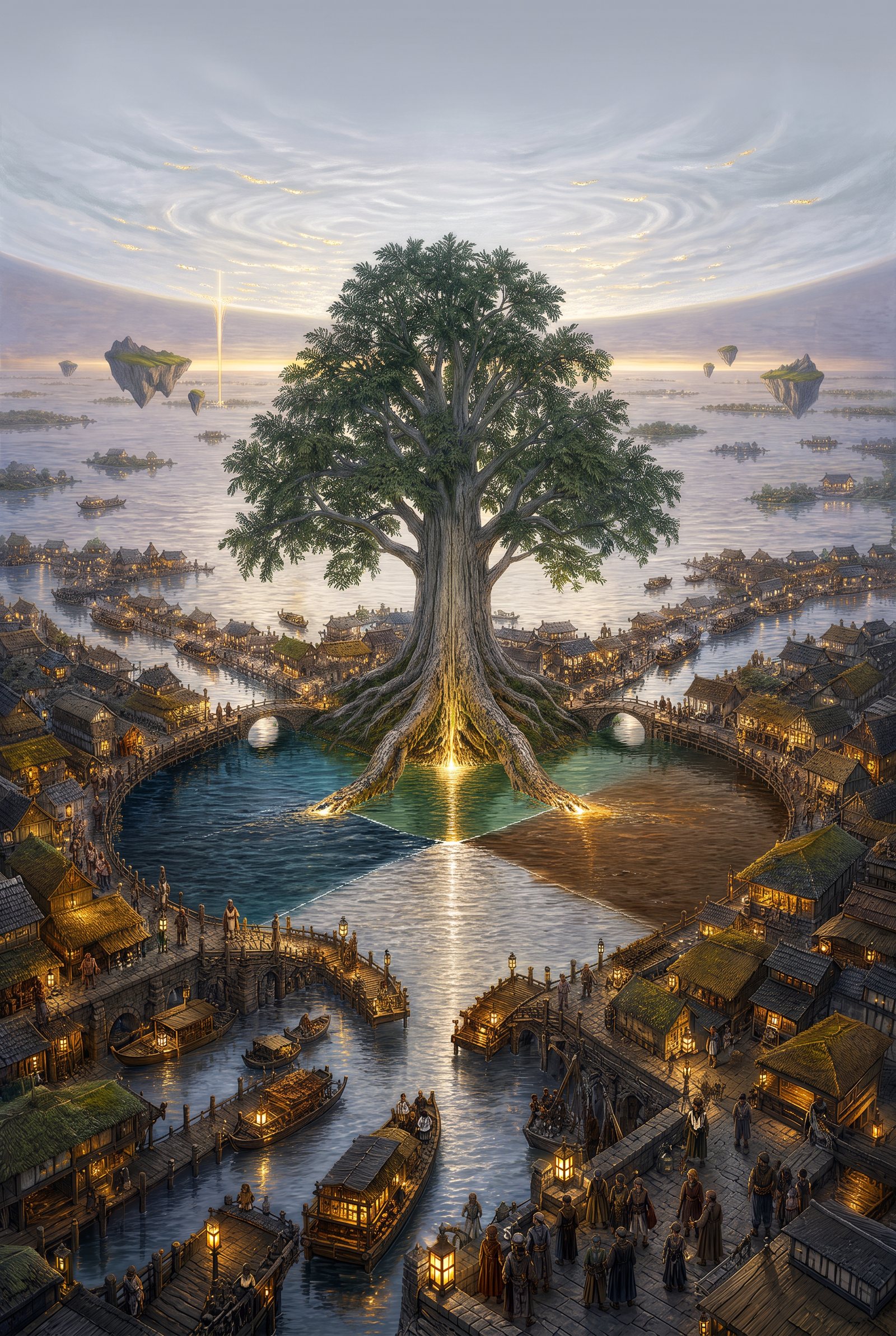
The world. Four sacred rivers, the Thunder, Elk, Salmon and Wolf, meet at the Confluence, where the roots of the World Ash come down from its vast root-mound to the great pool. Above the world hangs a second, inhabited realm, the Mirror Sky, where elven star-houses sail between drifting islands; the only way up is the Moon Road, a chain of moon gates crossed by star-vessel. It is 551 AS: the Road has been failing for seventy years, the sky hangs lower every summer, and pilgrims dream of a fifth river under the Ash.
The question your table answers: what is owed between the ground and the sky, and who will pay it?
What everyone knows.
- The twofold world: there is the Ground and the Mirror Sky, and the Moon Road is the only crossing.
- Borrowing: magic leaves a debt. Pay it with offerings, rest, repair and service, or the ground sours.
- The rivers: the current runs in the rivers; springs, fords, stone circles and moon wells are places of standing.
- The World Ash: its four great roots are the Four Springs, and their waters meet at the Confluence.
- Oaths: an oath sworn on holy ground binds, and the Oath Moot at the Confluence keeps the Accords.
- The powers: every power is real, mighty, partial and bargainable; none is the only true one.
- The far shore: the rites spoken over the dead choose their harbour.
- The animal nations: animals are nations, with elders and treaties.
- Poor time: the Road sets travellers down in the wrong place or year; hundreds of Misarrived live out of their own time.
Three reasons to adventure.
- Debts are falling due everywhere, and the people who ran them up are rarely the ones who pay. Someone fair is needed: a stranger with no stake.
- The Moot pays outsiders. A writ, a fee from the common purse and a witnessed name open doors that birth never will.
- The sky is coming down, or so the watchers of the Narrow Sky say, and pilgrims dream of a fifth river under the Ash. No one agrees what it is, and the Moot pays strangers to go and look.
Names to pronounce. Caerwyn KIRE-win · Selûne seh-LOON · Sehanine SEH-ha-neen · Corellon KOR-eh-lon · Lunastra loo-NASS-tra · Carn Gwyll karn GWITHL · Meinir MAY-neer · Bleddyn BLETH-in · Gunnvör GOON-vur · Hrafnsson HRAHFN-son · Han Jingyu hahn jing-YOO · Mo Qingyan maw ching-YEN · Ilvane IL-vain · Suuva SOO-vah · Thaelis Ysmaere THAY-lis iss-MAIR · nagual nah-WAHL · repa RAY-pah.
This book’s adventures are for characters of 1st to 3rd level: The Tallyman of Wickering Bridge, then The Hail-Rune of Brackenholm.
The campaign rules. Caerwyn plays the 2024 Player’s Handbook with this campaign’s rules: every caster spends spell points instead of spell slots; you cast one spell of 1st level or higher on a turn (a cantrip as well is fine); thirteen spells that would skip the road, the supplies or the risk of resting don’t exist here; and every kind of Concentration, whatever a class calls it, shares one slot. The Campaign Rules card at the end of this part has the point table, the list and the details. Caerwyn adds one rule of its own, No shortcuts between worlds, under Magic below.
Make a character
What everyone knows, in full. Since 481 AS the Road has been failing (the Waning). (1) The world is twofold, Ground and Mirror Sky; the Moon Road is the only crossing. (2) Every taking is a borrowing: magic leaves a debt, paid by offerings, rest, repair and service; unpaid, it sours the ground (story, never a rules cost). (3) The current runs in the rivers; springs, fords, stone circles, moon wells and crossroads are places of standing; nothing in the current listens. (4) The World Ash stands on its vast root-mound north of the Confluence; its four great roots are the Four Springs, whose waters run down to meet at the Confluence, and they glow at the solstices; everyone claims it, no one owns it. (5) Rumour: the Road and the Springs, both opened in 1 AS, were one bargain never paid for, and the Waning is the bill; others call that slander. (6) Rumour: the sky is drawing closer (the Narrow Sky) and a fifth river stirs beneath the Ash; no one agrees what it is. (7) Oaths sworn on holy ground bind, and an oath sworn there for a household, town or people binds that body for as long as it lasts; the Oath Moot at the Confluence keeps the Confluence Accords. (8) Every power is real, mighty, partial and bargainable; none is the true one. (9) One far shore, many harbours: the rites spoken over you choose yours. (10) Animals are nations, with elders and treaties. (11) The Road keeps poor time: hundreds of Misarrived live out of their own year.
Pick a culture. Any 2024 background and origin feat works anywhere; these are the natural fits. Common is the river trade-speech; your home tongue is free flavour.
| Culture (home) | Gives you | Species often found | Backgrounds · origin feats | Languages |
|---|---|---|---|---|
| Hill clans (Highlands) | courtesy with teeth; guest-right; a hill-bargain in the family | human, wood elf, halfling, dwarf, gnome, tiefling | Farmer, Guide, Hermit, Wayfarer, Acolyte · Musician, Healer, Lucky, Magic Initiate (Druid) | Common, Sylvan |
| Fjord jarldoms (Raven Fjords) | courage, plain speech, arm-rings | human, dwarf, orc, goliath, shifter | Sailor, Soldier, Entertainer (skald), Artisan (rune-carver), Guard · Tough, Savage Attacker, Tavern Brawler, Musician | Common, Dwarvish, Giant |
| Jade Cloud (monasteries) | patience, repair; a debt audited is half paid | human, dwarf, gnome, halfling; a few high elves | Scribe, Sage, Acolyte, Hermit, Artisan · Skilled, Crafter, Magic Initiate (Wizard), Healer | Common, Draconic |
| Moonspine hermits | power refused is power kept | human, goliath, dwarf, aasimar | Hermit, Acolyte, Guide, Merchant · Alert, Tough, Healer | Common, Giant, Dwarvish |
| Day-sign cities (the Sunward) | the count, foresight, an animal self born on your day | human, dragonborn, halfling, tiefling, orc | Sage, Scribe, Acolyte, Noble, Artisan · Alert, Lucky, Magic Initiate (Cleric or Druid) | Common, Draconic, Primordial |
| Grassland treaty-nations | statecraft across species; an envoy’s word | human, orc, halfling, shifter, goliath | Guide, Farmer, Wayfarer, Noble (envoy), Soldier · Alert, Tough, Musician, Magic Initiate (Druid) | Common, Orc, Halfling |
| Moon-elf courts (Silverwood) | grace, divination, the Moon’s dignity | high elf, wood elf, drow, shifter, human | Noble, Sage, Acolyte, Entertainer · Magic Initiate (Cleric or Wizard), Alert, Musician | Elvish, Common, Sylvan, Celestial |
| Astral houses (Mirror Sky) | daring, navigation, a house’s name | astral elf, star-island humans | Sailor (star-pilot), Sage, Noble, Artisan · Alert, Crafter, Skilled, Magic Initiate (Wizard) | Elvish, Common, Celestial |
| River-folk (Moot city) | trade, a fair toll, everyone’s neighbour | any | Merchant, Guard, Criminal, Charlatan, Scribe, Sailor · Skilled, Lucky, Tavern Brawler | Common, Common Sign Language |
| Storm Isles | weather-sense; a tower kept lit | human, dragonborn, astral elf | Sailor, Guide, Soldier · Tough, Alert | Common, Draconic, Primordial |
| Cedar Marches | a fresh start | human, halfling, gnome, orc, goblin, tiefling | Farmer, Artisan, Soldier, Criminal, Guide · Tough, Crafter, Savage Attacker | Common, Goblin, Gnomish |
| Misarrived (any sky culture) | another year’s news and debts | astral elf, high elf, any sky-born | any | Elvish, Celestial |
Pick a species. Any species in the 2024 Player’s Handbook (its rules are there). Moon elves are high elves; drow are the courts’ “new-moon born” seers, with no evil name; a tiefling’s forebear’s bargain is not their own debt. Two more peoples are at home here:
- Astral elf (“sky-born”). The elves of the astral houses, the Misarrived and the Storm Isles’ old mooring-families: starlight in the eyes, a trance like listening to distant music. Full rules: Spelljammer: Adventures in Space (2022); as with every species under the 2024 rules, your ability increases come from your background.
- Shifter (“wolf-blooded”, “elk-blooded” and so on, for the animal nation your line claims). Found among the grassland nations, Silverwood’s rangers and the fjords: the animal rising in the face and hands. Not the same as a nagual‘s animal self. Full rules: Mordenkainen Presents: Monsters of the Multiverse (2022), read the same way.
Pick a class. All official 2024 classes are here: clerics serve any power, Old or High; druids keep the Old Powers; paladins swear on holy ground; warlocks bargain with the courts under the hill, with old debts or with the torn sky; bards are skalds, harpers and treaty-singers. The house’s own thirteen classes are here too, each a way of paying. Each paragraph says who has it in Caerwyn and how it plays; its full rules are in its own class book, named at the end of each entry, and it changes nothing in Caerwyn.
- Anchorite. Walk-outs from the High Powers’ great temples, living in cells along the river roads; the Moot accepts their vows as witnessed oaths. An ascetic who keeps a handful of public promises, and whose grace runs exactly as far as a hand can reach: a support tank and healer. Full rules: The Anchorite.
- Calligrapher (Jade brush-masters). Scholar-scribes who write and seal the Moot’s oath-scrolls and gate law. A scholar who fights by writing: every blow is a character, and the characters stay where they were drawn. Full rules: The Calligrapher.
- Fateskald. Raven Fjord hall-skalds, paid in arm-rings, who read where a lord’s memory is going; their Bifrost Blade is the rules’ Fateblade. A blade-mystic who reads the moment before the moment and spends a small bank of corrections on other people’s dice. Full rules: The Fateskald.
- Furnace Adept (the Moonspine’s repa, “cotton-clad”). Snow hermits of the Seven Caves, who call their inner fire tapas (the rules’ Inner Furnace). A body that makes its own fire, and a lifetime’s discipline spent keeping it from burning down the room. Full rules: The Furnace Adept.
- Glyphwalker. Rune-marked oath-keepers of the fjord halls, whose inked promises the Moot accepts as witnessed oaths. A marked warden who keeps every promise in ink and spends their own inner power so that a blow lands smaller. Full rules: The Glyphwalker.
- Harmonist. The bell-keepers of the river towns’ listening-houses, who heard the Road go flat in 481 AS; their resonance is the rules’ Qi points. A listener who fights by tuning: the world is already holding a note, and you lean on it. Full rules: The Harmonist.
- Ley-Walker. Highland hedge-wanderers on the lesser lines, with compacts made under the hill. A blade-mystic who walks the old lines, moves what stands in the wrong place, and is owed a favour by the road. Full rules: The Ley-Walker.
- Nagual. Common in the Sunward’s day-sign cities, where every child is born with a tonal, an animal self. A martial artist who lets pieces of that animal self surface, strike by strike. Full rules: The Nagual.
- Reddened. Fjord rune-carvers who cut their own skin after the Hanged God, in ættir (the rules’ Rows). An attrition fighter who writes power into their skin and pays for it in Hit Point maximum. Full rules: The Reddened.
- Stillmind. Forest ascetics below the Moonspine and the pilgrim towns that feed them; their siddhis are the rules’ Mind Spells. A contemplative whose still mind makes the world lean toward it: a ranged controller. Full rules: The Stillmind.
- Thresholder. The six funerary orders: the Scales, the Ferryman, the Chooser, the Corpse-Herd, the Ancestor and the Hungry Door (the Chooser’s rite is the rules’ Rite of the Muster). A keeper of the door between the living and the dead, owed favours by those who pass through it. Full rules: The Thresholder.
- Tithed Fist. Initiates who cut a channel into themselves at the Confluence. A martial artist wired into the current: few spells, cast huge, the biggest paid for out of your own body. Full rules: The Tithed Fist.
- Wardancer. The dance-hall at the Starfall Gate, founded by six troupes from six sky ports. A performer-combatant who hears the beat under every fight, lends it to friends and steals it from enemies. Full rules: The Wardancer.
Powers. The Old Powers are the ground’s: the river elders (the Salmon Mother, the Wolf, the Elk, the Thunder), the animal nations, the courts under the hill, the Sunward’s Day-Keepers, the jarls’ Hammer-Jarl and Hanged God, the ancestors. The High Powers came down the Road: Selûne (the Moon, named alike by both skies), Sehanine Moonbow, Corellon, Tyr, Silvanus, Chauntea, Tempus. City shrines keep a double altar. No one owns magic.
Magic. Spells work as written (with the campaign rules above); only the footprint changes (a brackish well, a hearth that won’t draw). No shortcuts between worlds (the world rule called One Crossing): nothing moves, projects or opens a way to the Mirror Sky except the Moon Road; such a use simply fails and costs nothing. Swap Gate or Astral Projection for another spell of its level.
Travel. 35 km a day on foot; a barge makes 60 km a day downriver and 25 up; neighbouring regions lie one to three months apart. The Moon Road crosses the continent in three to eight days, gate to gate (working gates: Starfall, Sunward, Tower), and any crossing may misarrive.
Calendar. Years are AS, “after the Springs”. Springs’ Day (midsummer) opens the year, then thirteen 28-day moons (Hay, Thunder, Salmon, Reaping, Elk, Frost, Wolf, Snow, Hunger, Thaw, Sower’s, Bloom, Veiled). Springs’ Day has opened the year since the count began; the moons came from the elves at the Eclipse Settlement (408 AS), so an older date names Springs’ Day or a season, never a moon. Play begins on Springs’ Day, 551 AS.
More to read
How each people tells it
Each of these is believed somewhere, and they disagree. Your character grew up with one of them.
| People | Their account of the two skies |
|---|---|
| Hill clans | The Ash drank so deep that four springs broke from its roots, and the sky leaned down to drink after it. The sky still owes for the water. |
| Fjord jarls | The Ash is the pillar of the world-hall and the sky its roof. The elves built a bridge to the roof-beam without asking whose hall it was. |
| Jade Cloud | Earth and sky are one body. The Concord pulled a vein of the earth’s current up into the sky without closing the wound, and the fifth river is the wound trying to close. |
| Grassland nations | The animal elders went up long ago to watch over the herds as stars. The Road is a trail the elves cut across their pasture. |
| Moon-elf courts | The Moon laid the Road as a gift. The Springs were the Ash weeping for joy at the joining. |
| Astral houses | The Star-Wright sang the Road. The ground is “the Low Shore”, and is owed nothing: the sky lent it light for five centuries. |
| Day-sign cities | Our calendars counted the joining before it happened. Every 52nd year the sky comes a little closer, and this cycle is the last. |
| Moonspine hermits | It does not matter who is right. Something was taken, and someone will pay. |
About the Waning, people say: the Moon is grieving (courts); the ground is pulling the sky down (houses); bad engineering (Moot clerks); the count says so (Sunward); something was taken (hermits). About the fifth river: a prophecy, a catastrophe, a new river elder being born, or a trick of the Survey.
The powers and their quarrels
- High and Old keep an uneasy truce under the Accords. Rural households pay at two altars; a High Power’s priest at a river shrine is a guest and leaves an offering.
- Selûne and the Salmon Mother are allies: the moon calls the salmon run, and the Salmon Festival is shared.
- Selûne and Sehanine: the courts say the Veiled One is the Moon’s dark face, the astral houses say she is a sister. Which you say marks your side of the old Starfall Schism.
- Corellon and the Wolf are at war. The Wolf’s constellation was cut from the sky in the Star-Wright’s name during the Schism; the Wolf’s people and Corellon’s clergy do not share a fire.
- Selûne and the Wolf circle each other, hunter and moon; shifters and moon-hunters are caught between.
- The Thunder and the Hammer-Jarl: the jarls say they are one; the grassland nations say the Thunder is a nation, not a jarl’s god.
- Chauntea and the Salmon Mother are rivals (granaries against nets), and so are Silvanus and Chauntea (forest against field). Silvanus and the Elk share one altar in Silverwood.
- Tempus and Tyr keep a truce: trial by combat at the Moot, Tempus’s champions on Tyr’s field.
- The Day-Keepers gave each High Power a day in the Sunward count. A Sunward shrine opens only on its power’s day; the High Powers’ clergy do not like being scheduled.
- The courts under the hill never come to the Moot. A bargain made under the hill is not an Accord oath, and the Moot cannot unmake it.
- Divine magic answers anywhere, on the Ground and in the Mirror Sky. On another power’s holy ground its keepers can feel you there. Since the Waning a High Power’s answer feels farther away; nothing changes in the rules.
Oaths, the dead and holy ground
- Oaths bind under the law of the holy ground they are sworn on. An oath sworn at the Moot, before every tradition’s witnesses, is the strongest in the world. An oath sworn on no holy ground binds each swearer only by their own tradition.
- Oaths for a body. An oath sworn on holy ground for a household, town or people binds that body for as long as it lasts. Each swearer’s own share goes with them to their harbour when they die; the body’s share falls on whoever is of it now.
- The dead keep their debts and attitudes. Rites decide the harbour; with no rites, the soul’s own faith decides; with two, it lingers at the threshold until the families, a Thresholder or the Moot settle it. The dead travel the water road (downriver and south over the sea) or the Moon Road (up). Since the Waning some sky-bound souls are stranded. Speak with Dead works, and the dead answer as the people they were.
- Coming back from death works as the rules say, but a life called back is borrowed back from its harbour, and that harbour’s keepers may one day come to collect.
- Holy ground can belong to two powers at once if both are honoured. The Confluence is holy to everyone and governed by the Accords.
- Wards work on every creature exactly as their rules say, whoever claims the creature.
The Moot and the people in charge
The Oath Moot at the Confluence keeps the peace of the watershed. Four Spring Seats belong to the peoples who keep the Ash’s four springs (hill clans: the Salmon; jarls: the Thunder; Jade Cloud: the Elk; grassland nations: the Wolf). The sky houses sit on the Gate Bench since the Eclipse Settlement of 408 AS. The Speaker always comes from a people with no seat. A Moot writ grants safe passage, and the right to go down into the root caverns under the Confluence. When the Moot says “at the Ash”, it means at its roots by the Confluence; the trunk itself is a month’s climb north.
| Who | Leader | What they want | What they can offer you |
|---|---|---|---|
| the Oath Moot | Speaker Halde Ferrow | the peace kept and the Accords whole | writs, witnessed oaths, pay from the common purse |
| the Raven Fjord jarls | Jarl Ketil Hrafnsson | open harbours, a seat as high as anyone’s | ships, war-bands, skalds, arm-ring gold |
| the hill clans | Meinir of Carn Gwyll | the old roads and hills kept | hospitality, guides, introductions under the hill |
| the grassland treaty-nations | Treaty-Speaker Ilvane, Long Ford | treaties kept; the Wolf’s sky restored; their stranded dead home | envoy status with the animal nations, mounts, star-lore |
| the Jade Cloud monasteries | Auditor-Abbess Mo Qingyan, the Ninth Terrace | balance repaired; the Reforms everywhere | training, scholarship, sealed records |
| the moon-elf courts | Thaelis Ysmaere, Warden of the Wells | the Road preserved; the wells bright | divination, moon wells, court patronage |
| the astral houses | Iskaren Vohl, Speaker of the Astral Reach | survival under the Narrow Sky | passage on star-vessels, star-metal, prophecy |
| the Survey | Chief Measurer Odo Brannick, Cedarweir | spirits measured; covenants replaced by contracts | pay, instruments, maps of anywhere |
| the six funerary orders | convened by Orla Dunmere of the Scales | the dead sent right | rites, favours owed by the dead |
| the Sunward calendar-keepers | Thirteen Reed, Nine Springs | the count kept true; the cycle survived | the right day for anything |
What history everyone learns
| Year | Event |
|---|---|
| 1 AS | The Concord of Silver Wells opens the Moon Road; the Four Springs open beneath the Ash. |
| 141 AS | The First Oath Moot swears the Confluence Accords to stop a war over river access. |
| 191 AS | The Starfall Schism splits the moon-elf courts from the astral houses; the Wolf’s stars go dark. |
| 219 AS | The Cedar Fleet Raids take the lower river forts. |
| 281 AS | The Winter of Broken Nets: field-dams break spawning law, the salmon fail, famine. |
| 343 AS | The Broken Constellation falls on the Great Grasslands, making the Starstrewn. |
| 397 AS | The Jade Pilgrim Reforms set out how to repay magic’s debt. |
| 408 AS | The Eclipse Settlement gives the ground a voice in gate law; the Moot takes the thirteen-moon calendar. |
| 481 AS | The Waning begins; the Road’s note goes a quarter-tone flat. |
| 490 AS | The Flood of Seven Oaths drowns three courts on the Thunder River. |
| 532 AS | The Year of Misarrivals; the Silverwood gate falls silent. |
| 551 AS | Now. |
Where people live
The Confluence and its Moot city sit at the centre, at the southern foot of the Ash’s root-mound: a green upland of roots some 2,000 km wide, with the trunk about 1,100 km north, a month’s climb, and its crown a cloud on the northern sky. North: the Raven Fjords, and beyond them the Frozen North, where the sky’s lower edge shows thin on clear nights. North-west: the Stone-Circle Highlands. North and north-east: the Moonspine’s glaciers and hermit forests. North-east: the Jade Cloud Peaks. East: Silverwood, its moon wells and its silent gate. South: the Great Grasslands, the Starstrewn crater field to the south-east, and Starfall Harbor on the Shattered Coast, where sea, river and sky trade meet. West: the Sunward’s day-sign cities, the Storm Isles offshore. South-west: the Cedar Marches. Monsters are common only in the wilds: the Frozen North, the Cedar Marches, the Starstrewn, the Under-Hill.
Down the Salmon. Four days’ walk south of the Moot city, on the Salmon’s west bank, the river-folk toll town of Wickering Bridge (“Wickering”, for its wicker fish-weirs) keeps an old stone bridge of five piers, a toll-house and boom, a bell tower that is one of the listening-houses, and a granary-temple whose double altar has an empty niche beside Chauntea’s sheaves. Under the bridge’s first pier sits the ford-stone, a place of standing and the Salmon Mother’s holy ground; a morning’s walk upriver lies the Broken Weir, a field-dam ruin from the famine. People you may know there: Nell Tolliver, the reeve; Wat Fordham, her warden-captain; Mags Wharton, a net-mender; Ansel Shoalby, Chauntea’s granary-priest; Bram Weirley, the bell-keeper, a Harmonist; and Shen Zhiheng, the Jade auditor posted there.
Down the Thunder. The Thunder runs west from the Confluence along the southern foot of the root-mound, then turns north up its western side toward the fjords, so the Moot city is upstream of everything on it; river-folk call its left bank the west bank all the way down. About twelve days down by barge, on that bank, the river town of Bellhythe keeps one of the listening-houses and a Jade auditor’s seat. About fourteen days down by barge (some 850 km; twenty-four days’ walk), just past the turn, on the west bank, lies Brackenholm, a barley hamlet of river-folk and fjord-born households: a green, barns, a fjord-built longhouse with a turf roof, and a standing stone on the knoll above the green, which the hamlet calls the brow. Across the river, the long green skyline is what river-folk call the Ash’s hill. West of the hamlet runs the heather moor Wethermoor (“the moor”), with Hollin Beck and its old ford; the river-folk valley of Garthdale lies south-west of the moor, and the shepherds’ steading of Crookbank stands on the moor’s western edge. Beyond Crookbank rises Strikestone Hill, where the Thunder Moon storms break every year on a lightning-split stone: the Thunder’s holy ground, its watch kept by the Rillings of Crookbank. People you may know there: Tobin Mallard, Brackenholm’s reeve; Gunnvör Eyvindsdóttir, a fjord-born carver there; Han Jingyu, the Jade auditor who rides circuit down the west bank from Bellhythe; Abel Fallowford, Garthdale’s reeve; and Maud Rilling (“Old Maud”) of Crookbank.
Visiting a treaty-town. Bring a guest-gift and give the treaty greeting: who you are and for whom you speak. A guest who keeps the courtesy is given a guest-reed, a reed whistle burned with the town’s treaty-mark, known at any treaty-town’s landing. Coming up armed, refusing the greeting or offering coin for a treaty-song is a slight.
Festivals
Springs’ Day (the roots glow; the Moot sits; oaths renewed at the Ash’s roots by the Confluence) · the Salmon Festival (14 Salmon Moon; nets blessed by moon-priests and river-keepers together) · the Return of Lights (Frost Moon, first aurora; the fjords feast the ancestors) · Long Night (14 Wolf Moon; the roots glow; every people feeds its dead; the grassland nations keep silence for the Wolf’s empty sky) · Treaty-Renewal (Elk Moon, Long Ford) · Sower’s Blessing (Sower’s Moon) · Veiled Night (14 Veiled Moon; the Eclipse Settlement’s anniversary). River towns keep every festival; at Wickering’s Springs’ Day fair the year’s first toll is rung in at sunrise and its penny kept apart in the reeve’s dish, crews race to weave a fish-trap in the wicker race, everyone eats the bitter famine loaf standing up, and a visiting moon-priest blesses the weirs, with river-keepers beside the priest by custom. The Sunward counts 52-year cycles; this one closes at the end of 572 AS.
Words to use
the current (lower-case; never the water itself, which is the stream, the river or the flow), lines, places of standing · the Moon Road, moon gates · the Mirror Sky, the Ground (sky folk say “the Low Shore”) · the threshold, the far shore, its harbours · the World Ash · the Misarrived · the Accords · the High Powers and the Old Powers · star-vessel, star-pilot, star-metal · the debt, soured ground. Grassland leaders are Treaty-Speakers, envoys and herd-lords; a grassland keeper of the leave holds a people’s leave from the salmon nation, and river-keepers keep the river elders’ rites in any people. Caerwyn is the Moot’s name for the world; sky folk call the whole of ground and sky Lunastra.
Content
The world carries famine, drowning and floods, death and funeral rites, displacement and refugees, and bodily cost. Raise anything you want handled with care before play.